Daily Cocoa Market Report (2 Dec 2025): Cocoa Prices Drop as Ivory Coast Tightens Transport Permits


- Price Action:
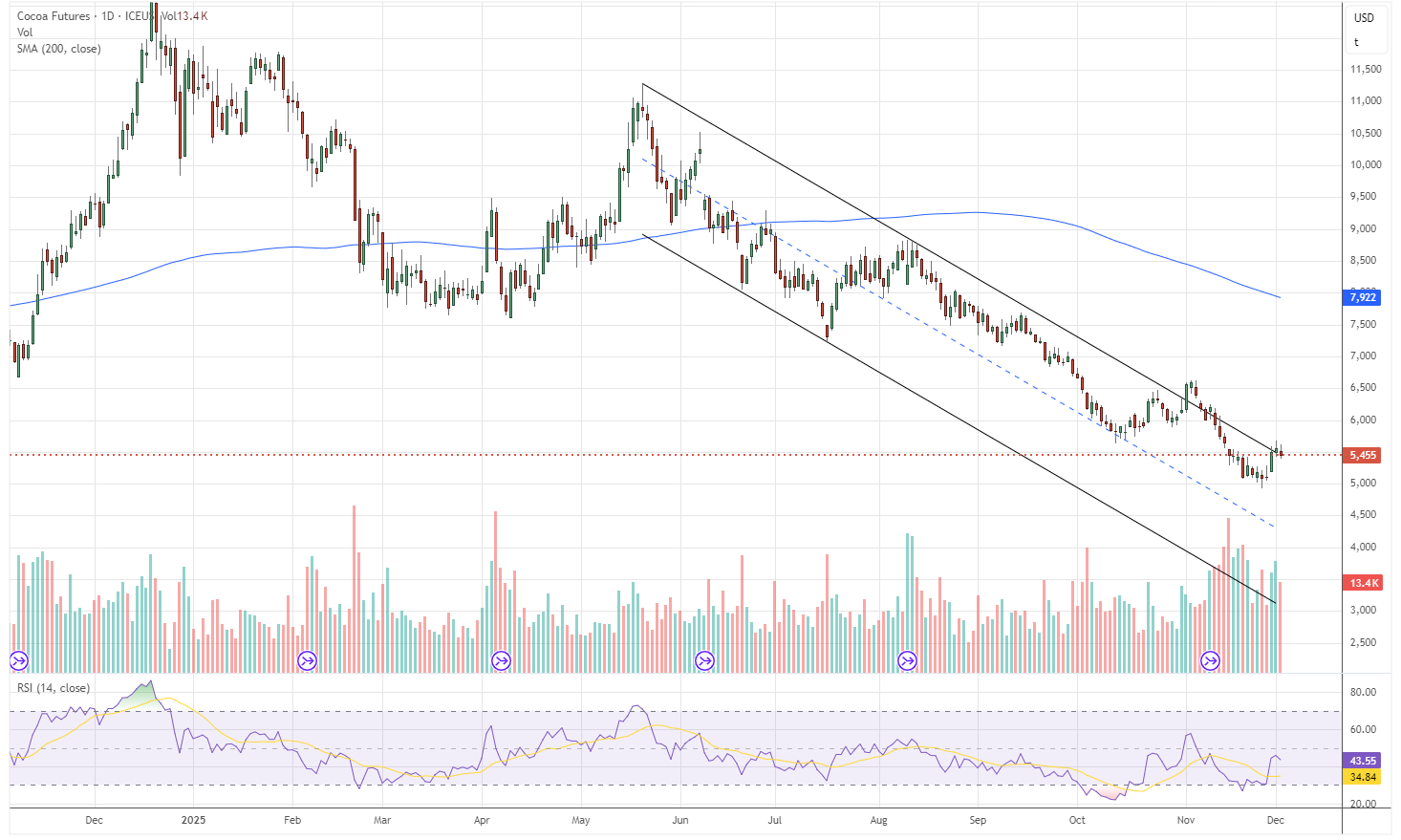
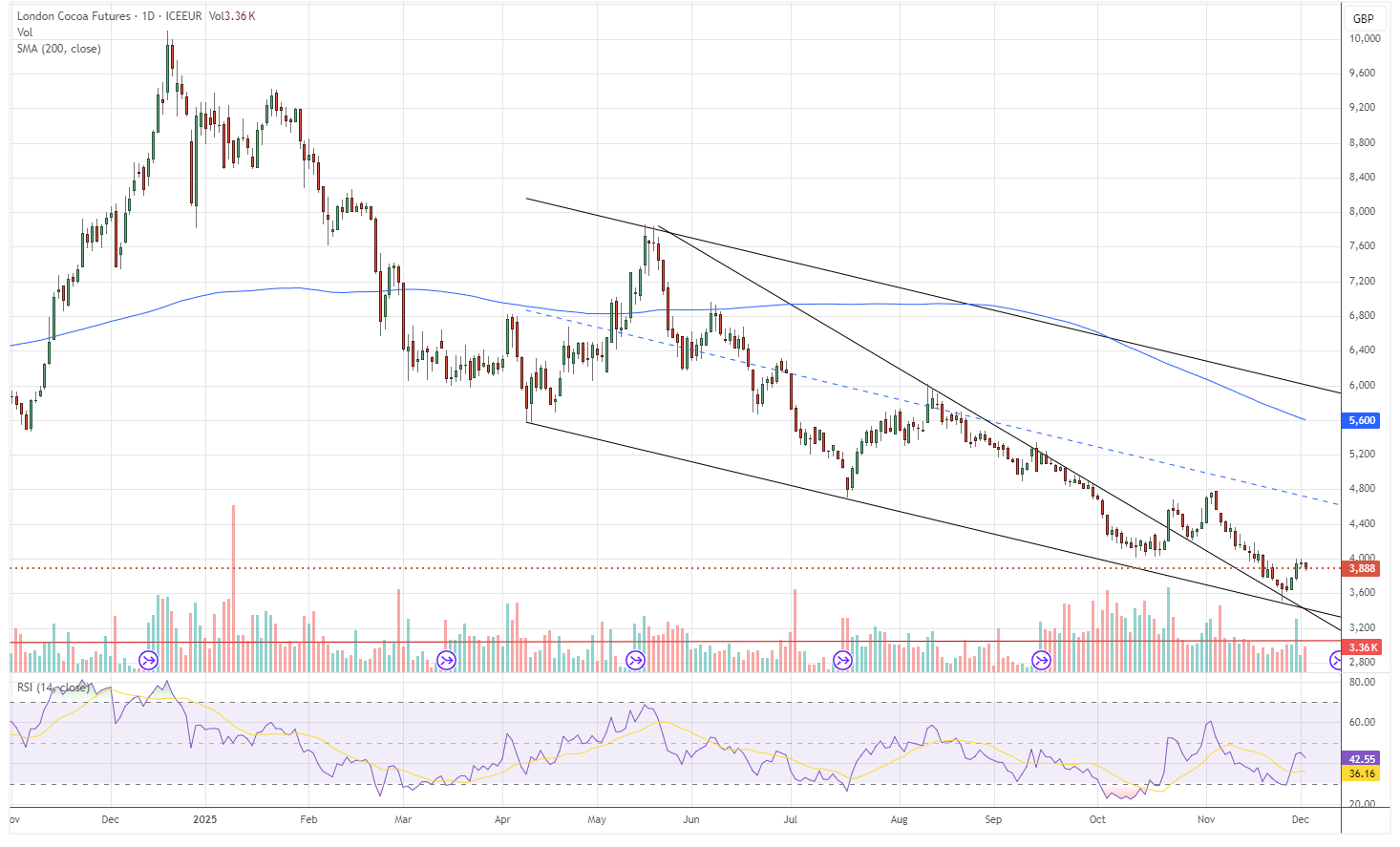
US March cocoa futures fell from 5,527 to 5,458, a decline of -1.25%, while UK March cocoa futures dropped from 4,082 to 4,024, down -1.42% on the day. Open interest has shown only minimal change in recent sessions, indicating that the move was driven more by price pressure than by any significant position reshuffling. - Weather:
Rainfall remains above average across several key cocoa-producing regions in Ivory Coast, supporting tree health, pod development, and moisture retention. - Regulatory Intervention:
Ivory Coast’s cocoa regulator has begun restricting transport permits to match each factory’s real unloading capacity. - Fundamental Tightness Highlighted:
Commerzbank emphasized that the ICCO’s latest estimate indicates supply tightness persists despite recent price declines. According to the bank, the sharp price drop in recent months may have been exaggerated relative to underlying fundamentals.
Market Commentary
Dealers are closely watching whether global grindings will continue to weaken into the 2025/26 season, after European cocoa processing already fell by 5.3% in 2024/25. Softer grindings would signal ongoing demand pressure at a time when supply expectations are gradually stabilizing. Meanwhile, Commerzbank highlighted that the ICCO’s latest estimate — showing only a 49,000-ton surplus for 2024/25 — suggests the supply tightness seen after last year’s 489,000-ton deficit has not eased as much as markets had assumed. According to the bank, the sharp drop in cocoa prices in recent months may have been exaggerated, given that fundamentals have not deteriorated nearly as significantly as price action implied.
The most consequential development comes from Ivory Coast’s cocoa regulator, which has begun restricting transport permits for moving beans to the ports of Abidjan and San Pedro. This measure directly targets the severe port congestion and the artificial perception of oversupply that built up earlier in the season, when factories accelerated deliveries far ahead of their real processing capacity. By limiting each factory’s transport authorization strictly to its daily unloading capability, the regulator has effectively choked back the excessive flows that had previously depressed farmgate prices and overwhelmed exporters’ logistics. Early feedback indicates the policy is already having an impact: port congestion has eased, market efficiency has improved, and price pressure on farmers has stabilized. Importantly, this intervention arrives as the peak production window begins, meaning it will shape the entire December–January flow dynamic. But the deeper signal is more structural — the ICC sees no near-term path to recovery given the heavy investment needed to restore yields. This reinforces that Ivory Coast’s supply constraint is fundamental, not temporary, and that logistics tightening will amplify the underlying physical tightness through the 2025/26 season.
Supply Outlook
The fundamental backdrop remains mixed. Ivory Coast cocoa arrivals for 2025/26 remain slightly below last season on a cumulative basis but improved week-on-week. However, the CCC’s updated assessment reinforces concerns over declining national output, with current-harvest production estimated at 1.3 million tons, down from 1.7 million tons last year.
The latest ICCO update shows a 49,000-ton global surplus for 2024/25, far smaller than the 98,000-ton surplus traders surveyed by Reuters had expected back in September. CRA has taken an even more aggressive stance, slashing its outlook by 33,000 tons and now projecting an 8,000-ton deficit for the same season. It also cut its 2025/26 surplus forecast by 20,000 tons, leaving a still-large but less comfortable 265,000-ton surplus.
Longer term, significant investment is still required to reverse agronomic decline, meaning the structural deficit narrative remains intact despite short-term arrival improvements and favourable rainfall.
Weather Conditions
Rainfall remains above average across several key cocoa-producing regions, offering continued support for tree health and pod development heading into the February–March peak. Farmers report strong moisture retention and healthy ripening of main-crop pods. Sunshine levels have also been supportive, reducing disease pressure and encouraging steady bean formation.
The key risk remains the harmattan, but so far, winds have been relatively mild for early December. Traders are monitoring whether conditions tighten later in the month, though current forecasts suggest moderate strength. Overall, weather remains a near-term positive for yield potential.
Certified Stocks
- US certified stocks: 1,693,561 tons (down from 1,698,135)
- UK certified stocks: 646,563 tons (up from 619,844)
US stocks continue their steady decline as grinders draw down certified inventory faster than it can be replenished. In contrast, EU stocks continue to rise sharply, reflecting weaker European demand for certified beans and increased deliveries into the system—further softening London relative to New York.
Futures Performance
London (ICE Europe)
Comparing Tue 2 Dec vs Mon 1 Dec
| Contract | CLOSE# 2 Dec | CLOSE# 1 Dec | Change | Volume (Tue) |
|---|---|---|---|---|
| Dec-25 | 3,881 | 3,966 | -85 | 3,363 |
| Mar-26 | 4,024 | 4,093 | -69 | 9,352 |
| May-26 | 4,032 | 4,096 | -64 | 6,304 |
| Jul-26 | 4,034 | 4,113 | -79 | 3,806 |
| Sep-26 | 4,026 | 4,108 | -82 | 1,860 |
London closed sharply lower across all listed expiries, with declines of -64 to -85 points, confirming a full retracement of Monday’s bounce. Volume 27,341 was stable, but OI still hasn’t increased — meaning sellers remain dominant and buyers continue to avoid building fresh length.
New York (ICE US)
Comparing Tue 2 Dec vs Mon 1 Dec
| Contract | CLOSE# 2 Dec | CLOSE# 1 Dec | Change | Volume (Tue) |
|---|---|---|---|---|
| Dec-25 | 5,401 | 5,456 | -55 | 0 |
| Mar-26 | 5,458 | 5,556 | -98 | 14,693 |
| May-26 | 5,479 | 5,586 | -107 | 8,607 |
| Jul-26 | 5,509 | 5,592 | -83 | 2,625 |
| Sep-26 | 5,498 | 5,580 | -82 | 1,714 |
NY cocoa also turned decisively lower, with losses of -82 to -107 points after Monday’s strong close. Heavy volume (28,321) confirms active selling, not a low-liquidity pullback.
Converting the UK price into USD at the current GBP/USD rate of 1.321, London’s equivalent value is roughly $5,316. This leaves a US premium of about $142 per ton, maintaining the recent pattern where New York trades meaningfully above London.
Volume & Open Interest
London (ICE Europe)
- Volume (Tue): 27,341
- OI: Not yet posted (last confirmed 173,469)
London continues to show no commitment from new speculative longs, and price declines are being amplified by rising certified stocks.
New York (ICE US)
- Volume (Tue): 28,321
- OI: Not yet posted (last confirmed 120,188)
US cocoa futures saw consistently rising open interest through late November, climbing steadily from 115,855 on 18 November to a peak of 120,883 on 28 November, indicating strong position-building into the end of the month. However, open interest slipped on 1 December to 120,188, implying that part of the post-Thanksgiving rally was driven by short-covering or position adjustments rather than sustained new buying. Volume showed healthy engagement throughout the period, with notable spikes on 19 November (40,472) and again on 1 December (32,569), confirming active participation and increased trading momentum as the market reacted to weather developments and new supply data. OI for 2 December is not yet released, which is standard—open interest is always reported one business day later.
What to expect today
Today’s price action is most likely to be range-bound and choppy, with cocoa trading between 5430 and 5520. All timeframes — 5-minute, 1-hour, daily, and weekly — are showing neutral momentum, meaning neither buyers nor sellers are in control right now. The 5-minute chart has stabilized with no trend, the 1-hour chart shows a rejection from the 200 MA but no follow-through, and yesterday’s daily candle was an indecision bar sitting right under resistance. The weekly chart also shows cocoa mid-range after a bounce, not yet strong enough to start a new trend. Together, this suggests today will likely be a low-volatility consolidation day, with quick rejections at both ends of the range and no strong directional move unless price breaks above 5550 (bullish) or below 5430 (bearish).
 Cocoa Intel
If you notice any discrepancies in these figures or have extra information, please email hello@cocoaintel.com or leave a comment – corrections and additional insights are always welcome.