Cocoa Buying Restarts in Ivory Coast After Regulator Adjusts Pricing Policy


Cocoa buying activity has resumed in Ivory Coast after the country’s regulator adjusted its pricing approach, bringing export offers back in line with international market levels. The move follows months of tension between exporters and authorities that had resulted in significant volumes of beans remaining unsold.
The national regulator, Le Conseil du Café-Cacao, has reportedly authorized forward sales from the upcoming mid-crop harvest without applying the additional premiums that had previously pushed Ivorian cocoa prices above global benchmarks. The mid-crop, which begins in April and typically accounts for roughly a quarter of annual output, is expected to total around 400,000 to 450,000 tons this season.
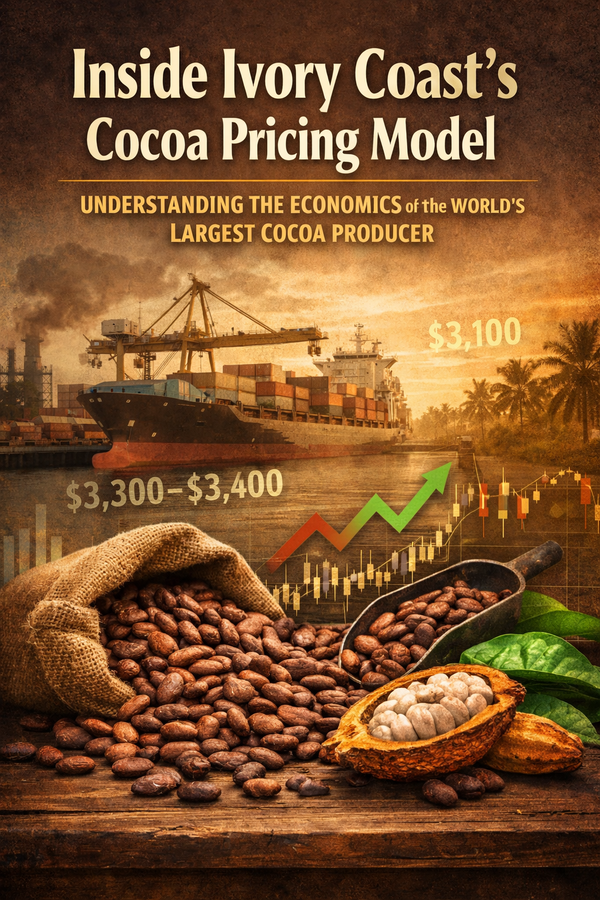
In recent months, exporters had largely stepped back from purchases because Ivorian cocoa was being offered at prices significantly above international futures markets. Premiums, including quality-related country differentials and the $400 per ton Living Income Differential introduced in 2020 by Ivory Coast and Ghana, added between $250 and $470 per ton above global reference prices. As the international market corrected sharply from record highs, these fixed premiums became increasingly difficult for traders to justify or absorb.
The pricing mismatch contributed to a buildup of cocoa stocks on farms and in warehouses, compressing exporter margins and creating cash flow pressures throughout the supply chain. The policy adjustment signals recognition from authorities that market conditions have shifted dramatically compared to the environment in which the premium structure was originally implemented.
Cocoa futures in New York surged to nearly $13,000 per ton in late 2024 amid severe supply shortages and weather-related disruptions. Since then, prices have fallen by roughly 75 percent from that peak, with New York futures recently trading near $3,100 per ton, levels last seen in 2023. London contracts have experienced a similar downturn. The sharp correction has led to softer demand and forced producing nations to reconsider pricing mechanisms that were designed during a period of extreme tightness.
Despite the current easing on forward sales, government officials have maintained that the Living Income Differential itself will not be formally rolled back, emphasizing the importance of securing minimum income levels for farmers. However, past seasons have shown that country premiums can be negotiated downward in practice when market conditions require flexibility.
The adjustment in Ivory Coast comes as Ghana, the world’s second largest cocoa producer, has also taken steps to align domestic pricing more closely with global market conditions, including reducing its farmgate price and reviewing its price setting system. With international prices now substantially lower than their 2024 highs, West African producers face the challenge of balancing farmer income protection with the need to remain competitive in a more price sensitive global market.