Daily Cocoa Market Report (11 Dec 2025): Cocoa futures consolidated


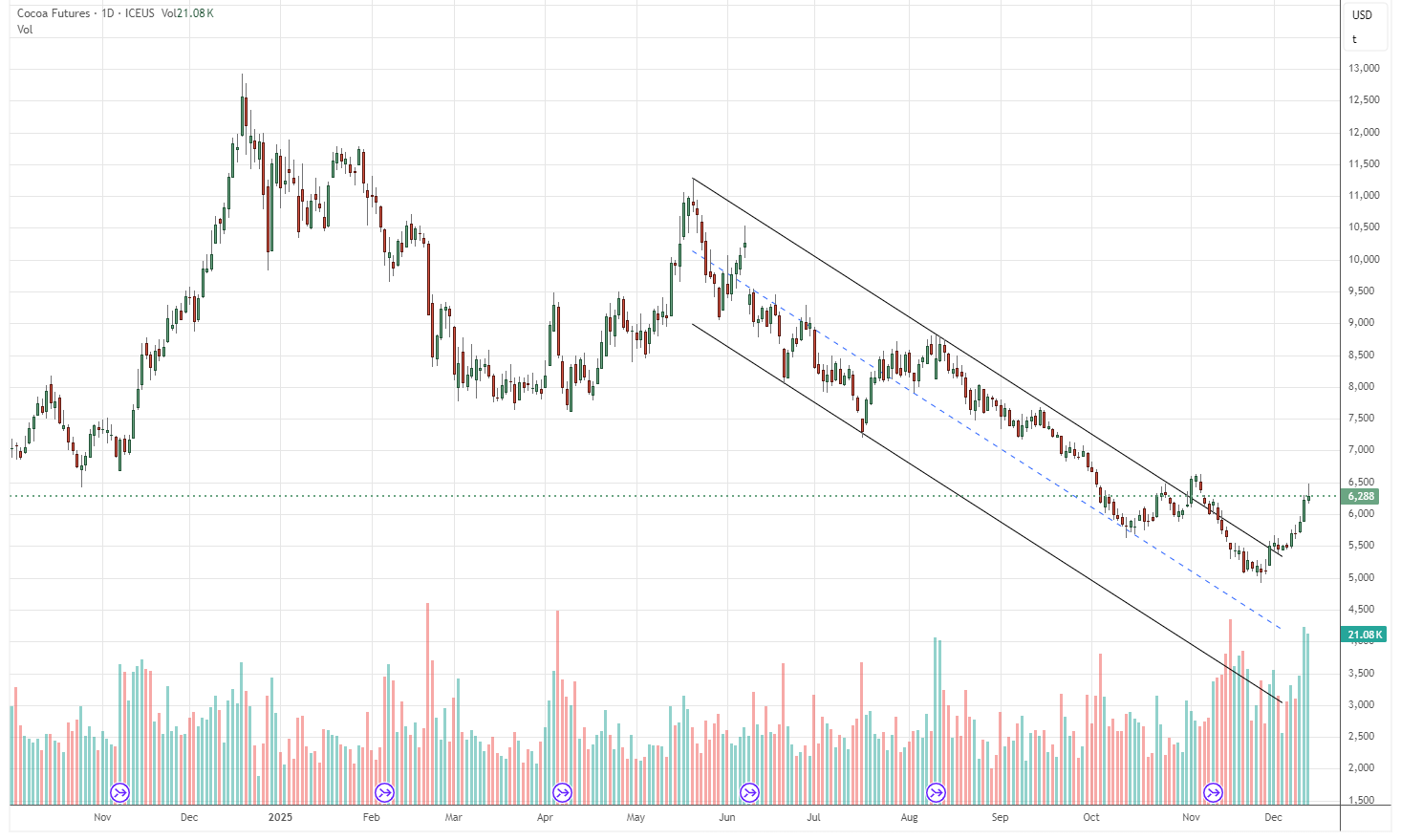
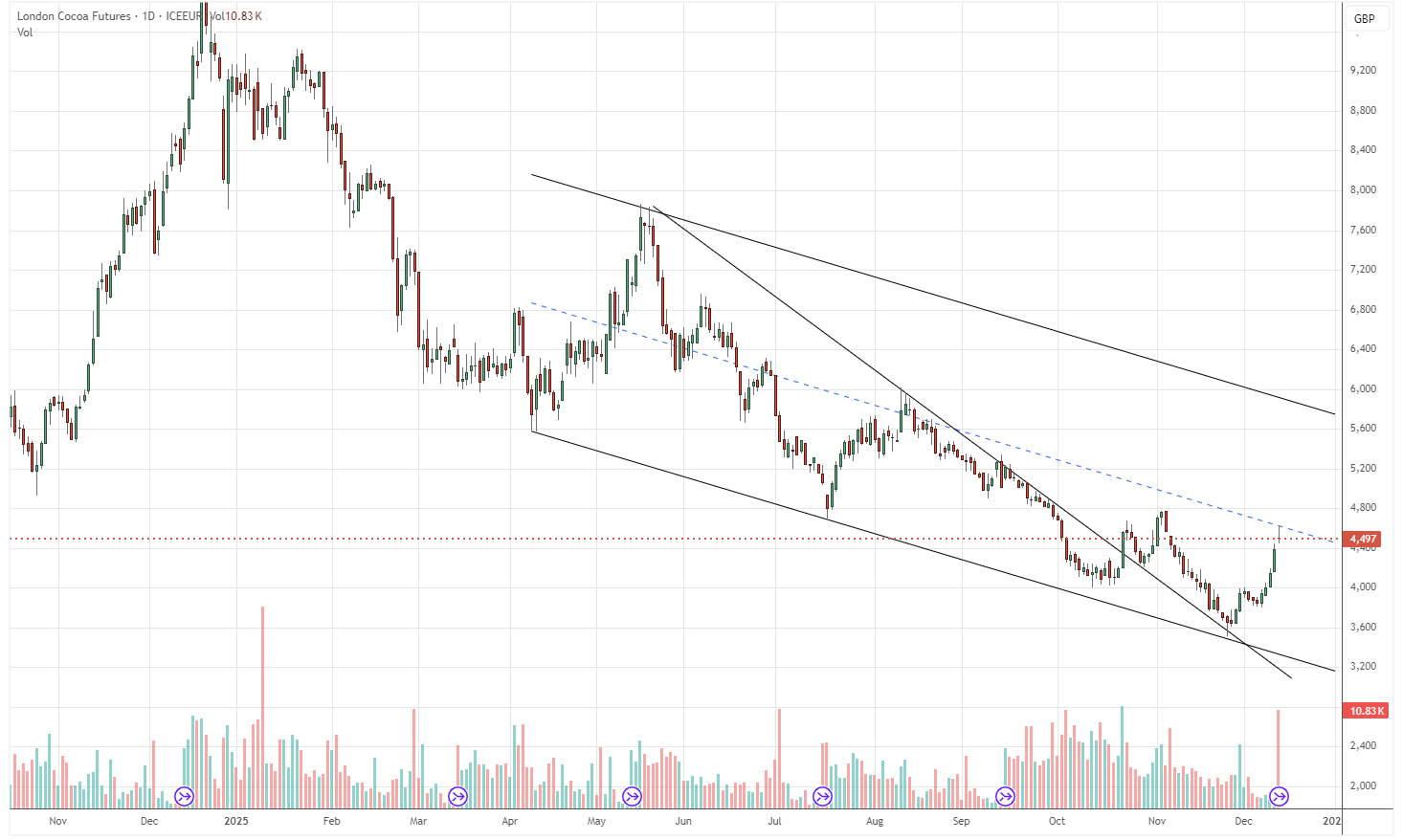
- Cocoa futures consolidated on Thursday after two sessions of sharp gains, with both New York and London posting modest follow-through on elevated volumes.
- The European Union has warned Ghana and Côte d’Ivoire that failure to reform their cocoa sectors could result in loss of global market share.
- Ghana has announced a ban on mining in forest reserves.
- ESG scrutiny and regulatory pressure are intensifying, adding longer-term uncertainty to compliant cocoa supply, particularly into Europe.
- In the UK, certain Nestlé chocolate bars have reportedly lost their legal classification as “chocolate” due to recipe changes.
Cocoa futures consolidated on Thursday following two sessions of sharp gains, with New York and London both posting modest follow-through while volumes remained elevated. The market paused after aggressively repricing West African supply risk earlier in the week, as traders assessed whether fresh macro, regulatory, and sustainability developments could materially alter medium-term supply dynamics.
Despite the consolidation, the broader structure remains firm, underpinned by tightening certified stocks, high participation levels, and a growing list of policy-driven risks affecting production in Ivory Coast and Ghana.
Supply & Origin Developments
Physical market sentiment remains cautious. Traders continue to question the durability of recent Ivorian arrivals following last week’s drop below 100,000 tons, while labour shortages and weak farm maintenance persist across both Côte d’Ivoire and Ghana.
On the policy front, pressure on West African producers is intensifying. The European Union has warned Ghana and Côte d’Ivoire that failure to reform their cocoa sectors could result in loss of global market share, highlighting governance, traceability, and sustainability shortcomings. While the warning does not immediately restrict exports, it reinforces long-term uncertainty around compliant supply flows, particularly into Europe.
At the same time, Ghana has announced a ban on mining in forest reserves, a move aimed at curbing environmental damage from illegal and small-scale mining. While supportive for long-term forest preservation, the decision could further constrain rural labour availability, as mining has already drawn workers away from cocoa farming.
New sustainability analysis has added another layer of complexity to the cocoa narrative. A report from Mighty Earth highlighted potential forest loss linked to cocoa supply chains servicing major multinationals, including Mondelez. The findings reinforce growing scrutiny of corporate sourcing practices and strengthen the case for stricter enforcement of deforestation rules under EU regulations.
On the consumer side, brand perception risks are also emerging. In the UK, certain Nestlé chocolate bars have reportedly lost their legal classification as “chocolate” due to recipe changes, underscoring how cost pressures and reformulation are altering downstream demand dynamics. While not directly bearish for cocoa in the short term, these trends signal longer-term tension between high raw-material prices and consumer affordability.
Weather Conditions
Isolated showers continued across key cocoa belts, providing limited soil-moisture support but also creating uneven drying conditions. As the region enters the most intense phase of the Harmattan, weather risk remains elevated, with any strengthening likely to reduce bean size, trigger pod shriveling, and increase defective-bean incidence. Overall, weather remains a net bullish factor for the market until strong and sustained rains return—an outcome not expected in the near term.
Futures Performance
New York Cocoa (ICE US)
| Contract | 10-Dec | 11-Dec | Change (USD) |
|---|---|---|---|
| Dec-25 | 6,168 | 6,235 | +67 |
| Mar-26 | 6,223 | 6,326 | +103 |
| May-26 | 6,242 | 6,354 | +112 |
| Jul-26 | 6,241 | 6,365 | +124 |
New York continued to firm, but the move was more controlled than Wednesday. The key point is structure: deferred contracts (May/Jul) outperformed March, which is consistent with a market still pricing forward supply tightness rather than a pure nearby squeeze.
London Cocoa
| Contract | 10-Dec | 11-Dec | Change (GBP) |
|---|---|---|---|
| Mar-26 | 4,504 | 4,492 | -12 |
| May-26 | 4,487 | 4,487 | 0 |
| Jul-26 | 4,463 | 4,479 | +16 |
| Sep-26 | 4,437 | 4,467 | +30 |
London traded defensively. March softened by 12 GBP, while deferred contracts were mixed to modestly higher, indicating consolidation rather than renewed buying. Relative underperformance versus New York continues to reflect thinner liquidity and reduced speculative participation in London.
Contango/Backwardation
The cocoa futures curve shows a fragmented structure rather than a uniform contango or backwardation. From Mar-26 through Jul-26, prices rise progressively, indicating contango in the front-to-mid curve and reflecting carry costs and expectations of some seasonal normalization. However, beyond July the curve turns lower, with Sep-26 and Dec-26 trading below Jul-26, creating backwardation in the back end, which signals that the market remains unconvinced about longer-term supply relief. In London, the curve slopes consistently downward from Mar-26 through Dec-26, placing the market in clear backwardation. This structure highlights stronger concern over nearby physical availability and compliance-constrained supply into Europe, while New York’s mixed curve suggests an ongoing debate between near-term tightness and medium-term normalization rather than outright panic.
US–UK Spread (Close-to-Close)
$6,326−(4,492£×1.338$/£)=$316
The widening spread reflects stronger speculative engagement in New York versus a more constrained London market.
Volume and Open Interest
New York Cocoa (ICE US)
| DATE | VOLUME | OPEN INTEREST |
|---|---|---|
| Dec 11, 2025 | 40,485 | — |
| Dec 10, 2025 | 43,617 | 124,830 |
| Dec 9, 2025 | 29,715 | 123,407 |
| Dec 8, 2025 | 25,154 | 122,328 |
London Cocoa (ICE Europe)
| DATE | VOLUME | OPEN INTEREST |
|---|---|---|
| Dec 11, 2025 | 23,265 | — |
| Dec 10, 2025 | 30,203 | 159,767 |
| Dec 9, 2025 | 20,383 | 159,602 |
| Dec 8, 2025 | 22,942 | 160,871 |
Volumes remain well above recent averages, particularly in New York, confirming that participation remains strong even as prices consolidate. Open interest data from earlier sessions show steady accumulation, indicating that recent gains were driven by new long positioning rather than pure short covering.
Certified Stocks
- US certified stocks: 1,659,791 (down from 1,664,563)
- UK certified stocks: 757,656 (up from 757656)
The continued drawdown in US stocks reinforces tight deliverable supply. The increase in UK stocks provides some cushion but does not materially alter the global balance.
Short-Term Outlook
The US cocoa futures market is transitioning out of a prolonged bearish phase into a base-building recovery, with downside risk materially reduced after the successful defense of the 200-week moving average near the 5,800–5,900 zone. Across timeframes, selling pressure has clearly exhausted, volume is supporting the recent rebound, and higher lows are forming, indicating that bears have lost control, though bulls have not yet fully reasserted dominance. The current advance should be viewed as a corrective rally within a broader recovery structure rather than the start of a new parabolic bull trend, as price remains capped below key medium-term moving averages clustered between 6,800 and 7,200. Short-term momentum is stretched, suggesting consolidation or a controlled pullback toward the 6,050–6,150 area would be technically healthy and constructive, while a decisive break above 6,350–6,400 would signal continuation. Overall, the market is moving from fear toward balance, with accumulation favored on pullbacks rather than chasing strength at resistance.
If you notice any discrepancies in these figures or have extra information, please email hello@cocoaintel.com or leave a comment – corrections and additional insights are always welcome.
 Cocoa Intel