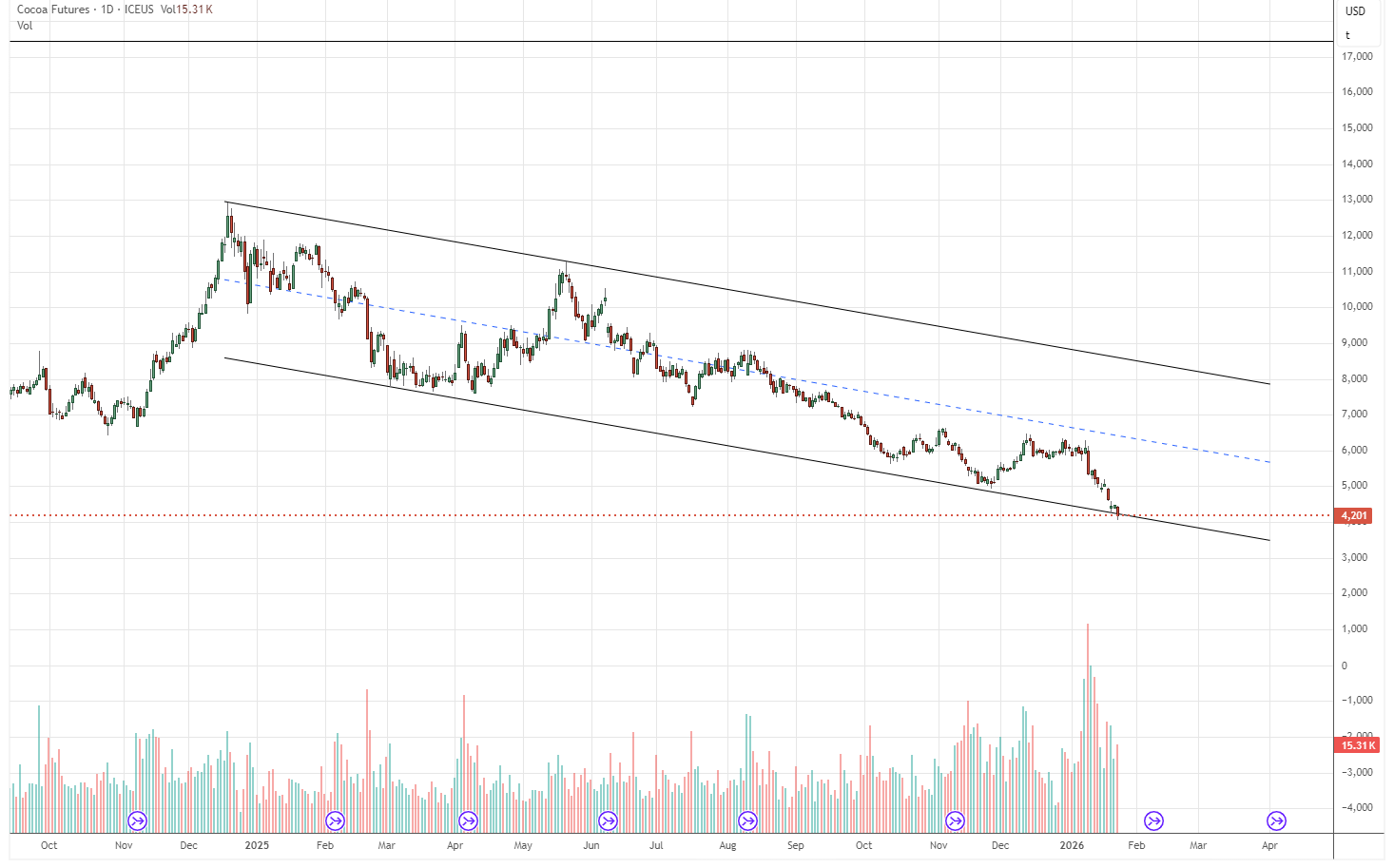
Daily Cocoa Market Report (23 Jan 2026): Cocoa Futures Enter Liquidation Phase as Prices Collapse Across the Curve


Dealers reported that cocoa stocks are building across key origins and consumer markets due to weakening demand, particularly in Ivory Coast and Europe. European cocoa grinders confirmed that demand from end-users has softened noticeably, with buyers increasingly delaying purchases. The sustained rise in cocoa prices during 2023–2024 has forced chocolate manufacturers to reduce cocoa content in products and reformulate recipes, as consumers push back against higher retail prices, translating into visible demand destruction and growing physical inventories.
This structural oversupply is now becoming explicit at origin. According to estimates by Ivory Coast’s Agriculture Ministry, the government will need to spend approximately 280 billion CFA francs to absorb and clear remaining unsold cocoa stockpiles held by producers. Around 123,000 tonnes of cocoa are currently stored within the country, with the most severe accumulation located in the Duekoué region in western Ivory Coast, now considered a major cocoa logistics hub. The scale of these stockpiles confirms that physical offtake has collapsed even at farm-gate level, forcing the state to intervene directly to prevent systemic payment stress.
At the global level, the International Cocoa Organization (ICCO) estimates that world cocoa stocks will reach between 1.1 and 1.32 million tonnes by the end of the 2024/25 season, still above last year’s levels despite modest downward revisions. This indicates that the global balance sheet is no longer tightening and is instead stabilizing with excess inventory.
Financially, the International Finance Corporation (IFC) has already provided $100 million in funding to Ghana’s cocoa sector, with an additional $200 million increase pledged, aimed at stabilizing payments to Licensed Buying Companies and farmers. This reduces the risk of forced supply disruptions but also reinforces the reality that production is running ahead of demand.
Politically, the cocoa downturn is now producing consequences in Ivory Coast. The former Minister of Agriculture and Sustainable Development, René Kouassi Adjoumani, was excluded from the new government, widely interpreted locally as a response to dissatisfaction with cocoa sector management. He was replaced by Bruno Koné, formerly Minister of Housing. This reshuffle occurred alongside President Alassane Ouattara’s broader cabinet reorganisation, including the appointment of his brother as Vice Prime Minister, underscoring the strategic importance of economic control during a period of commodity stress.
Futures Performance
ICE US Cocoa Futures (CC)
| Contract | Close 22-Jan | Close 23-Jan | Daily Change |
|---|---|---|---|
| Mar-26 | 4,450 | 4,211 | -239 |
| May-26 | 4,507 | 4,274 | -233 |
| Jul-26 | 4,573 | 4,336 | -237 |
| Sep-26 | 4,634 | 4,410 | -224 |
| Dec-26 | 4,654 | 4,460 | -194 |
ICE London Cocoa Futures (C)
| Contract | Close 22-Jan | Close 23-Jan | Daily Change |
|---|---|---|---|
| Mar-26 | 3,208 | 3,002 | -206 |
| May-26 | 3,230 | 3,008 | -222 |
| Jul-26 | 3,260 | 3,050 | -210 |
| Sep-26 | 3,307 | 3,095 | -212 |
| Dec-26 | 3,333 | 3,136 | -197 |
Contango / Backwardation
Across the full cocoa futures curve, both ICE US and ICE London markets remained firmly in contango before and after Friday’s sell-off, with no segment of the curve exhibiting backwardation. In the ICE US market, the 22-Jan structure showed a progressive increase from 4,450 in Mar-26 to 4,654 in Dec-26 (+204 points), which widened further on 23-Jan as the curve shifted to 4,211 in Mar-26 and 4,460 in Dec-26 (+249 points), indicating that the front months absorbed a disproportionate share of the liquidation. A similar pattern was observed in ICE London, where the curve rose from 3,208 in Mar-26 to 3,333 in Dec-26 on 22-Jan (+125 points), and from 3,002 to 3,136 on 23-Jan (+134 points), again confirming a structurally rising forward curve. Importantly, this contango extended consistently across all listed maturities, including 2027 contracts, with each successive contract priced above the previous one, demonstrating that the market is pricing in ample carry and storage rather than scarcity. The uniform upward slope across the entire term structure implies that the recent price collapse was driven by speculative position unwinding and risk-off flows, not by any tightening in physical supply, as genuine supply stress would have manifested through curve flattening or outright backwardation in the front months.
US–UK Spread
4,054 − (3,002 x 1.364$/£) = 116USD
Volume & Open Interest
ICE US Cocoa (CC)
| Date | Total Volume | Total Open Interest |
|---|---|---|
| Jan 19, 2026 | 0 | 141,208 |
| Jan 20, 2026 | 57,192 | 145,503 |
| Jan 21, 2026 | 48,651 | 145,000 |
| Jan 22, 2026 | 39,061 | 145,113 |
| Jan 23, 2026 | 43,472 | Not published yet |
From 19 to 22 January, ICE US cocoa recorded consistently high turnover, with volumes ranging from 39,061 to 57,192 contracts, while open interest rose sharply from 141,208 to 145,503 on 20 January and then stabilized around 145,000 into 22 January. This pattern indicates that the initial phase of the sell-off was accompanied by active position reconfiguration rather than immediate mass liquidation, as new positions were still being opened even as prices were falling. However, the subsequent flattening of open interest despite continued heavy volume suggests that by 21–22 January the market had entered a churn and distribution phase, where exits and entries were largely offset, a classic transition stage before broader liquidation.
ICE London Cocoa (C)
| Date | Total Volume | Total Open Interest |
|---|---|---|
| Jan 19, 2026 | 27,011 | 164,507 |
| Jan 20, 2026 | 54,604 | 163,806 |
| Jan 21, 2026 | 40,854 | 162,054 |
| Jan 22, 2026 | 19,992 | 163,354 |
| Jan 23, 2026 | 32,344 | Not published yet |
In London, the signal is structurally weaker and more bearish. Open interest declined from 164,507 on 19 January to 162,054 on 21 January while volume remained elevated above 40,000 contracts on both 20 and 21 January. This is the textbook signature of long liquidation, with significant turnover but shrinking aggregate exposure. The partial rebound in open interest on 22 January (to 163,354) occurred on much lower volume (19,992 contracts), implying technical repositioning and roll activity rather than genuine speculative re-entry.
COT Analysis - US
Current positioning and price structure jointly indicate that cocoa is in a late-stage bear market characterized by extreme speculative short crowding and structural trend exhaustion. Exchange data shows non-commercial traders heavily net short while larger, more informed participants are increasingly positioned on the opposite side, even as a growing share of total market risk has migrated into OTC and swap-based instruments, implying that the true positioning imbalance is likely more severe than publicly visible. The surge in open interest during the recent breakdown reflects late-cycle short chasing rather than healthy trend continuation, while the 60%+ drawdown from the highs, deeply oversold momentum indicators, decelerating downside volume, and flattening volatility profile all point to forced liquidation dynamics. Taken together, these conditions suggest that current price weakness is driven by positioning stress and financial crowd behavior rather than deteriorating physical fundamentals, placing the market in a base-building phase where the risk-reward profile increasingly favors medium-term upside rather than further sustained decline.
Certified Inventory Stocks
| Market | 22-Jan-2026 | 23-Jan-2026 | Daily Change |
|---|---|---|---|
| ICE US | 1,752,451 | 1,755,877 | +3,426 |
| ICE UK | 561,406 | 561,406 | 0 |
If you notice any discrepancies in these figures or have extra information, please email hello@cocoaintel.com or leave a comment – corrections and additional insights are always welcome.