Daily Cocoa Market Report (8 Dec 2025): Panic among buyers and intermediaries in Ivory Coast


- Ports in Ivory Coast reached 803,000 metric tons by December 7. That is a 2 % decline compared to last year.
- Light rains plus warm conditions have improved prospects for pods maturing in February–March, but many warn that a strong Harmattan wind.
- Bloomberg notes that falling terminal prices have created panic among buyers and intermediaries in Ivory Coast.
- Mars has secured unconditional EU approval for its $36 billion acquisition of Kellanova
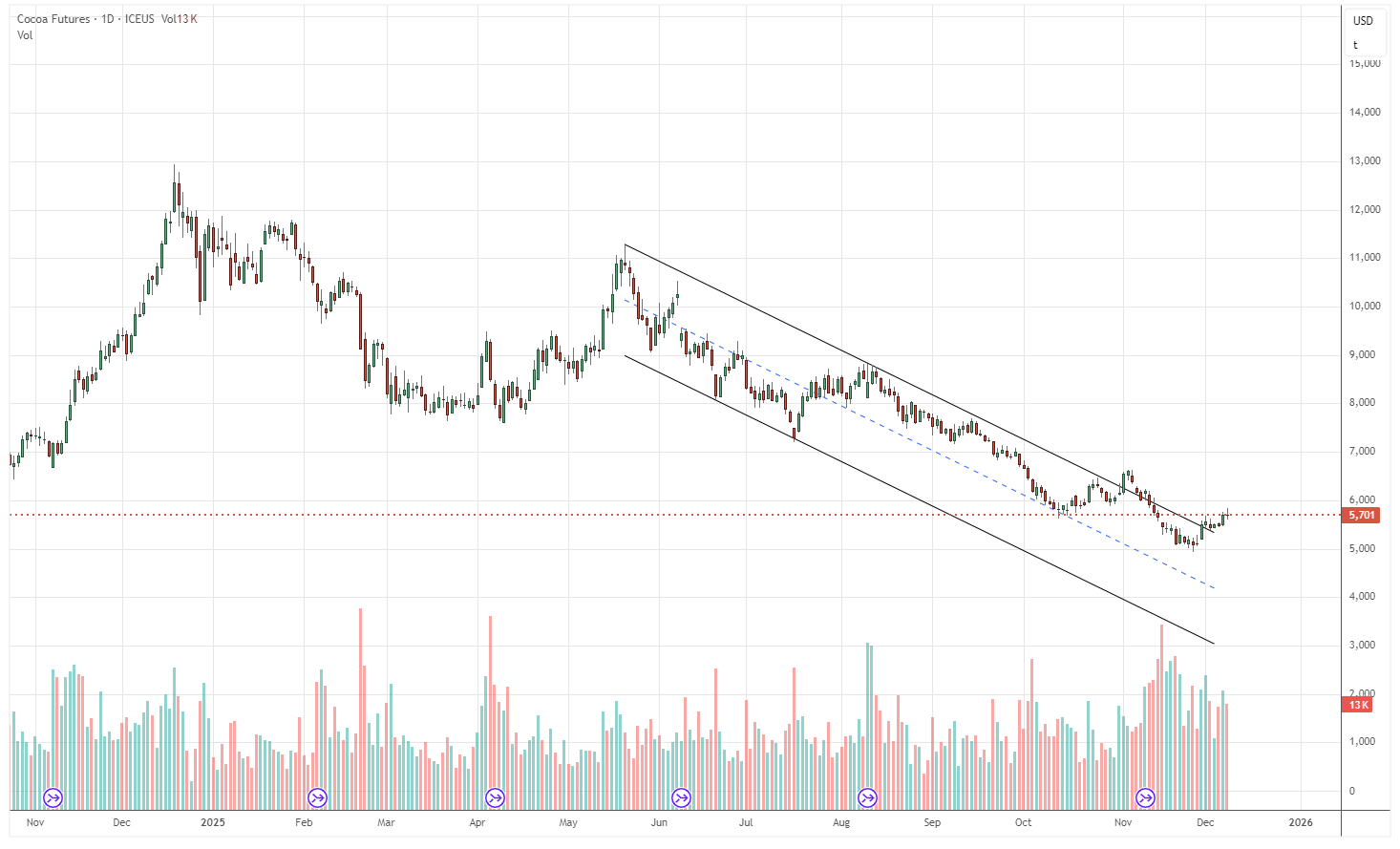
A fairly muted session for cocoa to start the week. The March New York contract traded within a narrow intraday band and settled almost unchanged at 5,708, reflecting the market’s hesitancy after last week’s rebound. Prices remain positioned between the 20-day and 50-day moving averages. The market is still digesting Friday’s increase in open interest, which signaled new long participation, but Monday’s quieter tone suggests that traders are waiting for clearer supply signals before extending positions.
Cocoa beans have been piling up at Ivory Coast ports as exporters face a sharp liquidity shortage, leaving many unable to finance purchases, transport or loading costs. This has triggered a surge of beans arriving at Abidjan and San Pedro, not because production is unusually strong, but because farmers and middlemen are rushing to off-load stocks before prices fall further. The spike in arrivals therefore exaggerates the true strength of early-season supply and risks creating a false impression of surplus. With buyers short on cash and banks reluctant to extend credit, export flows are slowing even as port inventories grow. If liquidity does not return soon, shipments could decline and real supply could tighten later in the season despite today’s swollen port volumes, setting up the possibility of a misleading soft supply signal now followed by a genuine shortage later.
 Cocoa Intel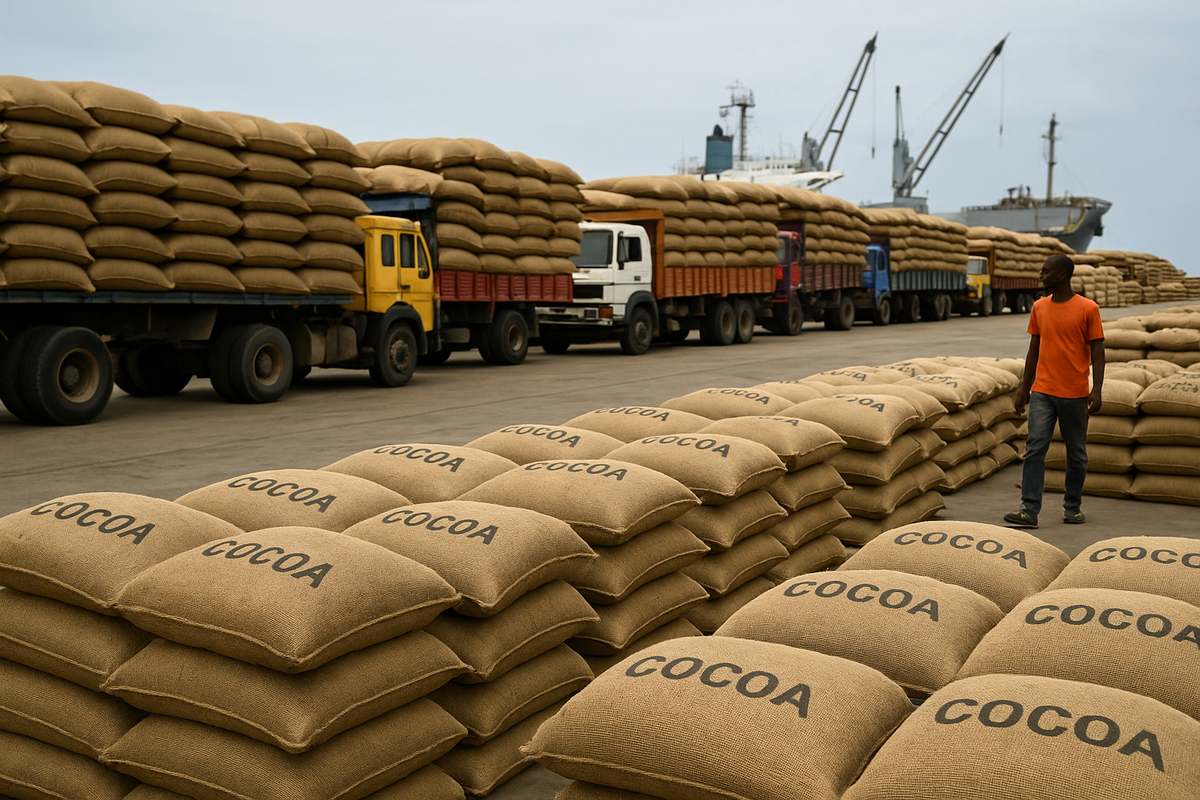
Mars has secured unconditional EU approval for its $36 billion acquisition of Kellanova, reversing earlier regulatory concerns that the deal would give Mars excessive bargaining power over European retailers. After an in-depth review, the European Commission said it found no evidence that the merger would enable Mars to force higher prices or distort competition. The transaction, already cleared in the US, will combine Mars’ major confectionery and pet-food brands such as M&M’s, Snickers and Whiskas with Kellanova’s leading snack and cereal lines including Pringles, Pop-Tarts and Kellogg’s cereals. European retailers had previously warned that Mars’ expanded portfolio could strengthen its leverage in negotiations, prompting the EU investigation in June. The deal also supports Mars’ strategic shift to diversify away from cocoa-dependent products at a time of historically high cocoa prices. Kellanova, meanwhile, has posted strong financial performance since separating from WK Kellogg Co., making it an attractive target for Mars’ recent acquisition push.
A COCOBOD cocoa health officer in the Suaman District has warned that cocoa smuggling is rising sharply in the area, with more beans being moved illegally across the border. The increase is hurting local farmers and reducing national revenue, and COCOBOD has cautioned that continued smuggling could lead to the suspension of farm support and rehabilitation programs for the district if the issue is not brought under control.
Weather Conditions
Light rains in most cocoa regions last week were below average, but the combination of these showers and hot weather helped support the development of pods that will be harvested from February onward. Ivory Coast is now in its dry season, which runs from mid November to March, so any rainfall during this period is important for pod survival.
Farmers across the country said they expect no disruption to supply in February and March as long as some moisture continues in December. Many reported that plenty of beans were still leaving the bush as harvesting picked up, with December output expected to surpass October and November because more pods are now reaching maturity.
Conditions varied by region.
In the centre western region around Daloa, and in the central regions of Bongouanou and Yamoussoukro, rains were weaker, but pod loads were still good. Farmers noted that a strong Harmattan wind could quickly damage pods if it arrives early.
In the western regions of Soubre, Agboville and Divo, rains were above average. Farmers there expect healthy harvest levels until mid January before output naturally begins to decline. Farmers in the eastern region of Abengourou, where rainfall was weaker, said pod conditions remained stable.
The key weather risk now is the Harmattan. This dry wind from the Sahara usually appears between December and March. When it strengthens, humidity drops sharply and small pods can die. Mature pods may also shrink or ripen poorly. One farmer near Daloa said that if the Harmattan intensifies now, it will cause significant damage because temperatures have been very hot.
Rainfall last week ranged from 3.6 millimetres in the Daloa area, which is below the five year average, to 13.5 millimetres near Soubre, which is above average. Weekly temperatures were high at 27.4 to 30.7 degrees Celsius, increasing evaporation stress.
The overall signal is that weather has been mildly supportive for the early part of the next crop, but the Harmattan window has opened and remains the main threat to pod survival and quality for the coming months.
Ivory Coast Port Deliveries
Cocoa arrivals at ports in top grower Ivory Coast reached 803,000 metric tons by December 7 for the 2025/26 season, which began on October 1. This is 2% lower than the same point last season 820,000 metric tons, exporters said on Monday.
Between December 1 and 7, exporters delivered an estimated 85,000 tons of beans (41,000 tons to Abidjan and 44,000 tons to San Pedro) — virtually unchanged from the 85,000 tons delivered during the same week last season.
Futures Performance
New York Cocoa (ICE US)
| Contract | Close 5 Dec | Close 8 Dec | Change |
|---|---|---|---|
| Dec 25 | 5,643 | 5,676 | +33 |
| Mar 26 | 5,694 | 5,708 | +14 |
| May 26 | 5,712 | 5,716 | +4 |
| Jul 26 | 5,717 | 5,727 | +10 |
New York advanced modestly. Gains were smaller than in London because near term contracts were already elevated after last week’s rebound. The curve remains backwardated and reflects continuing tightness in certified stocks.
London Cocoa (ICE Europe)
| Contract | Close 5 Dec | Close 8 Dec | Change |
|---|---|---|---|
| Dec 25 | 3,944 | 4,000 | +56 |
| Mar 26 | 4,067 | 4,116 | +49 |
| May 26 | 4,064 | 4,113 | +49 |
| Jul 26 | 4,068 | 4,119 | +51 |
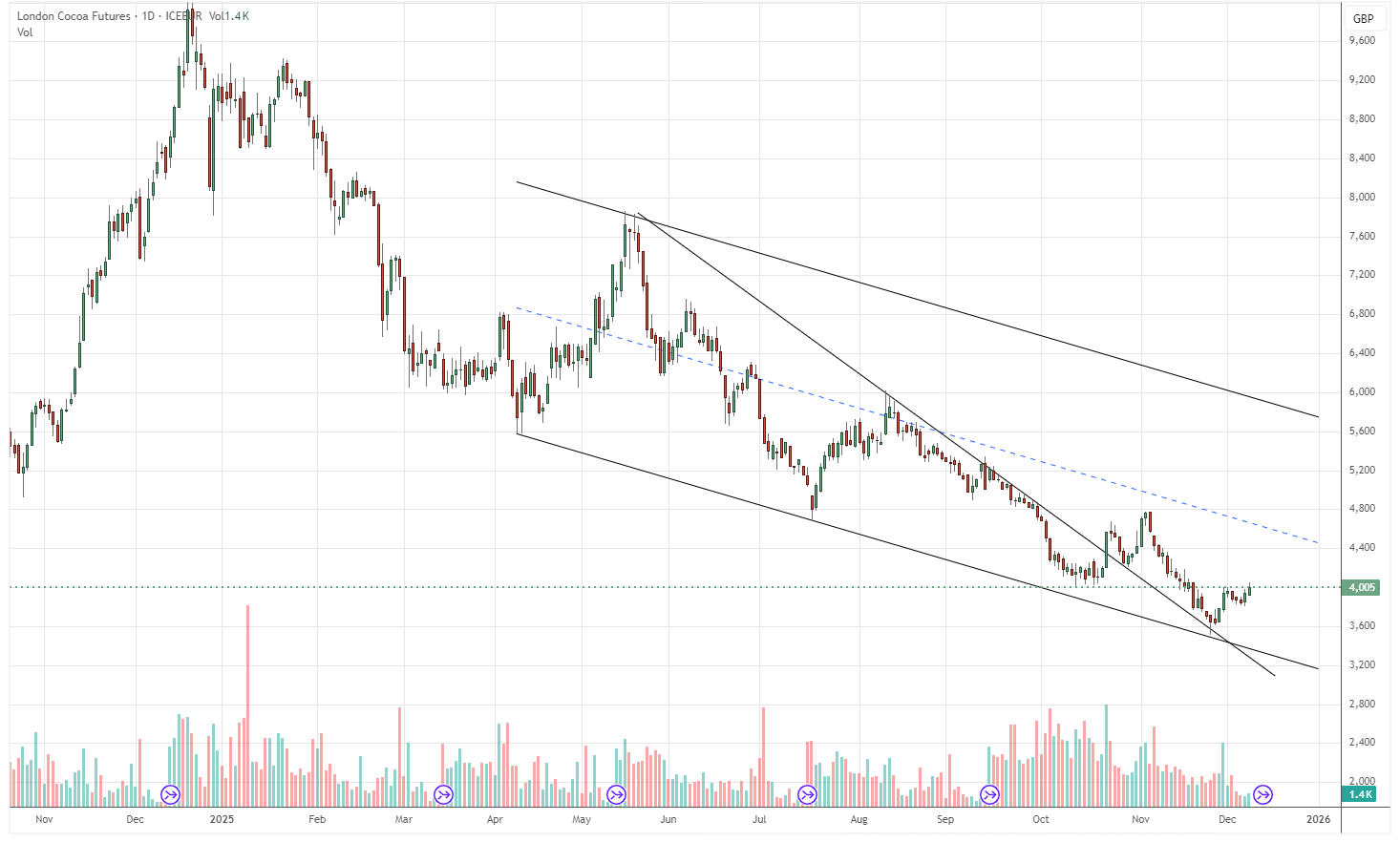
London posted broad but moderate gains. Buying interest returned across the curve, although volumes were limited. The move looks like position adjustment rather than strong directional conviction.
Contango & Backwardation
London cocoa remains in a very shallow contango, with prices edging slightly higher from Dec 25 to Mar 26 and staying almost flat through May and Jul 26, showing stable forward structure and no sign of backwardation. New York cocoa also sits in mild contango, with small step-ups from Dec 25 through Jul 26, indicating that traders expect near term tightness to persist without worsening. Both curves signal steady but not escalating supply constraints, and neither market is currently pricing in aggressive mid curve stress.
US–UK Spread
$5,708−(4,116£×1.332$/£)=$222
The US premium over London stands at 222 dollars. This is lower than the 277 dollars in the template example, indicating a modest narrowing of the transatlantic differential.
Volume and Open Interest
New York Cocoa (ICE US)
| Date | Volume | Open Interest |
|---|---|---|
| Dec 8, 2025 | 25,154 | — |
| Dec 5, 2025 | 26,906 | 121,774 |
| Dec 4, 2025 | 23,397 | 120,724 |
| Dec 3, 2025 | 16,536 | 119,200 |
London Cocoa (ICE Europe)
| Date | Volume | Open Interest |
|---|---|---|
| Dec 8, 2025 | 22,942 | — |
| Dec 5, 2025 | 23,428 | 161,380 |
| Dec 4, 2025 | 21,792 | 160,335 |
| Dec 3, 2025 | 19,668 | 159,447 |
Cocoa volumes slipped on December 8 across both New York and London, with activity falling back toward the lower end of the recent range. The decline highlights a market that remains cautious despite rising concerns over weakening Ivory Coast arrivals. Open interest data for December 8 has not yet been published for either exchange, but the preceding days showed steady positioning in both markets. New York held within the 119k to 122k corridor, while London maintained its gradual upward trend toward the 161k region. The pattern suggests that recent price gains were driven more by light repositioning than by strong new buying. Overall, the soft volume backdrop reinforces the view that traders are waiting for confirmation of ongoing supply tightening before adding significant exposure.
Certified Stocks
- US certified stocks slipped to 1,675,801 tons (from 1,681,896 ).
- UK stocks fell to 732,188 tons (from 739,688).
Intraday / Short-Term Outlook
Cocoa is in a bear-market rally, not a confirmed trend reversal. The bounce from 5,200 is real, but momentum is already fading on the 1-hour and intraday charts, while the daily chart still sits below major moving averages and the weekly trend remains firmly bearish. Resistance at 5,800–6,200 is the critical ceiling; until price breaks decisively above it with strong volume, this move is just a temporary rebound inside a larger downtrend. If 5,600 fails, the market likely retests 5,300–5,200.
If you notice any discrepancies in these figures or have extra information, please email hello@cocoaintel.com or leave a comment – corrections and additional insights are always welcome.
 Cocoa Intel