
EU Deforestation Rule Delay: What It Really Means for Cocoa
The EU has delayed its deforestation regulation—but what does this mean for cocoa farmers, exporters, and global supply chains? Here’s the reality behind the headlines.

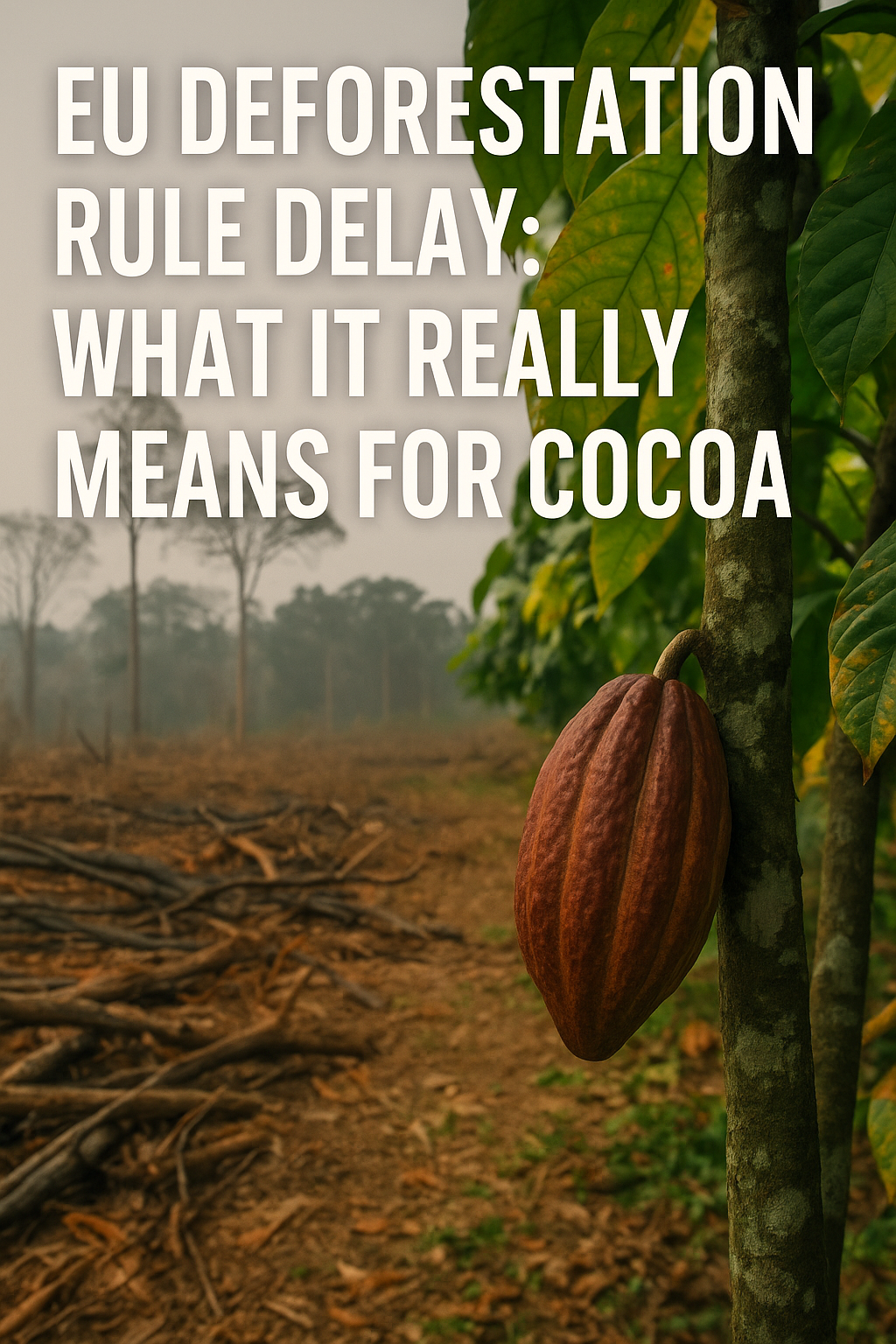
The European Parliament’s decision to postpone enforcement of the EU Deforestation Regulation from 2025 to late 2026 for large operators, and mid 2027 for smaller firms, changes the regulatory and pricing timeline for the cocoa sector. The public rationale emphasizes technical readiness and the need to stabilize the electronic due diligence reporting system. The political and commercial reality is more complex, and the investment implications are significant.
The delay temporarily removes the risk of immediate supply contraction into the European market. Without the extension, a meaningful portion of West African cocoa would have become non compliant due to incomplete farm mapping, unresolved land tenure claims, informal purchasing networks, and ongoing cultivation near protected forests. The enforcement shift therefore reduces the probability of near term physical shortages and supports refining margins in Europe throughout 2026. However, the structural supply challenge has not disappeared. It has only been postponed.
Roughly 72 percent of global production still originates from West Africa. The EU accounts for about 60 percent of global cocoa import demand. Approximately 35 to 45 percent of global cocoa lacks full traceability, and 15 to 20 percent of Ivorian output may originate from areas considered environmentally sensitive or protected. Current mapping coverage in Ghana and Côte d’Ivoire is estimated at 55 to 65 percent. These figures indicate that compliance remains far from guaranteed.
The enforcement timeline now unfolds as follows. Operational testing of the digital due diligence platform is expected through early 2025. Broader satellite verification and supply chain integration should accelerate during late 2025. Compliance becomes mandatory for large traders and processors on 30 December 2026, and for small and micro operators on 30 June 2027. The first full cycle of compliance audits and potential penalties will likely occur in 2028. Markets should begin pricing regulatory scarcity risk between mid and late 2026 rather than in 2025.
The most under discussed consequence relates to capital allocation. Several global processors, cooperatives, traders, and sustainability technology firms invested heavily to meet a 2025 compliance horizon. Industry estimates suggest between 800 million and 1.2 billion US dollars has already been committed to mapping, geolocation technology, satellite surveillance, cooperative training, and origin level traceability architecture. These expenditures are not wasted, but the financial return on these investments has been deferred by at least one year, and potentially longer. Competitors who delayed spending have now preserved liquidity without strategic penalty, creating a temporary disadvantage for early movers and potentially encouraging budget reductions in sustainability departments.
The risk that a two tier cocoa market emerges is rising. If enforcement proceeds as planned in 2027, the EU may begin trading compliant cocoa at a premium, while non compliant cocoa finds a pricing floor in unregulated markets including China, Indonesia, and the Middle East. The expected spread between compliant and non compliant cocoa ranges from 300 to 1,000 dollars per ton. This would alter trade flows, incentivize regulatory arbitrage, and reshape future pricing models.
Risk modeling for hedge funds and commodity investors must now focus on several variables. These include the rate of progress in farm mapping and land registry systems, satellite based deforestation alerts in Ghana and Côte d’Ivoire, political stability during producer price negotiations, the possibility of another enforcement delay, the scale of Asian import substitution, and speculative net long exposure across commodity funds. A meaningful shift in any of these indicators could accelerate price repricing ahead of enforcement.
The regulation also creates a new strategic incentive for producing countries. If the EU continues postponing implementation or appears politically uncertain, governments in West Africa may redirect export flows toward less regulated destinations. Such a realignment would reduce the EU’s leverage over sustainability standards and weaken the regulation’s long term impact. Markets should monitor export diversification policies beginning in late 2025.
Current supply chain fragility extends beyond compliance. Soil degradation, tree age, disease prevalence, labor shortages, high fertilizer costs, and climate volatility continue to pressure yield potential. The regulatory delay does not address these realities. It merely removes the immediate regulatory amplification of existing constraints. Over the medium term, the structural supply deficit remains intact.
The market should interpret this postponement not as a reduction in regulatory risk, but as a temporal shift. If enforcement is credible and preparation remains insufficient, volatility and price appreciation will be more severe in 2027 than originally projected.
In summary, the delay temporarily protects supply flows, corporate margins, and European refining capacity, but it increases long term disruption risk and introduces new pricing, political, and sourcing uncertainties. For hedge funds and institutional commodity investors, the extension is not a resolution. It is a repricing opportunity followed by a larger regulatory event.