Inside Ivory Coast’s Cocoa Pricing Formula: What the CCC Documents Reveal About Global Cocoa Prices

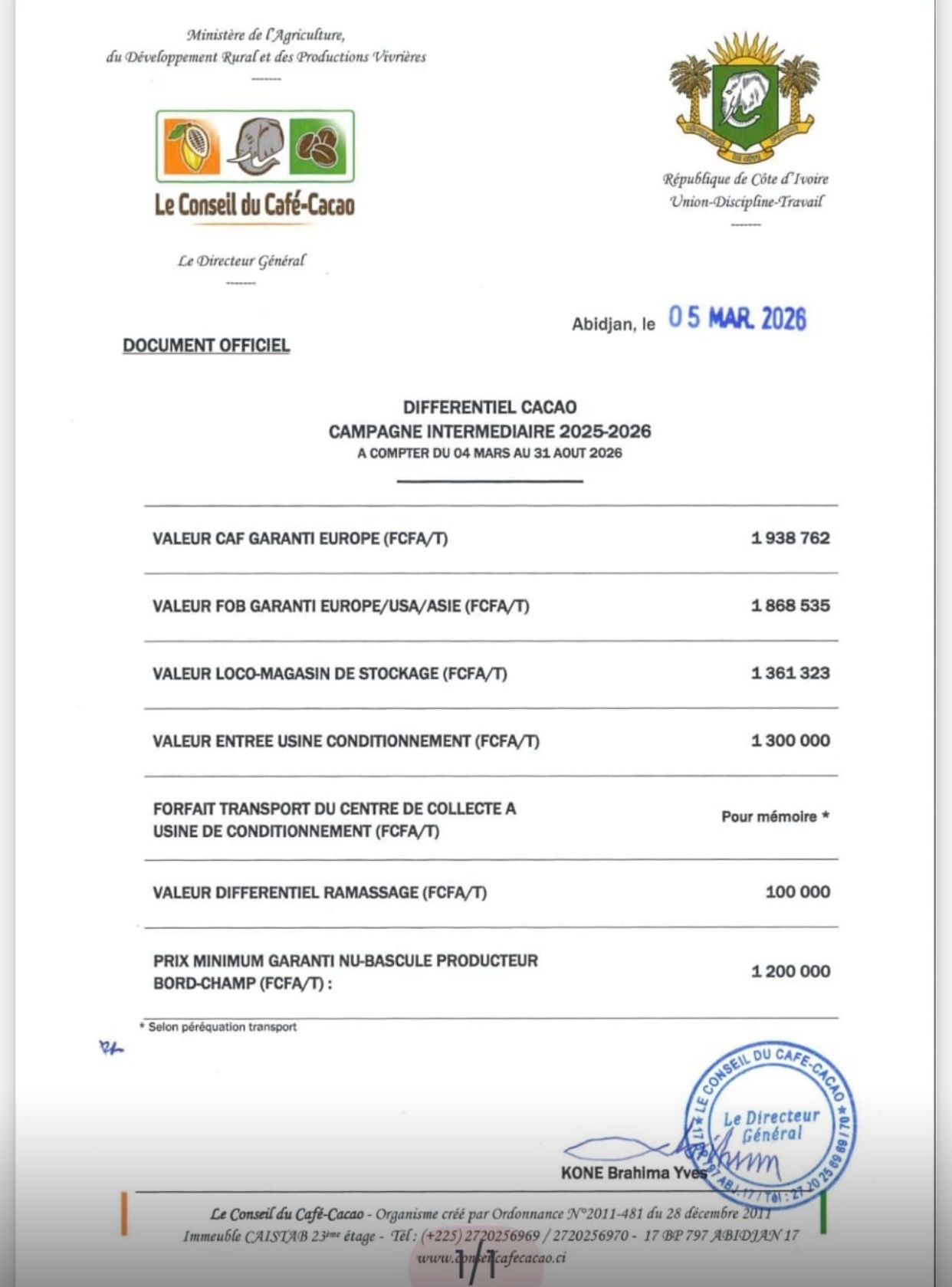
In March 2026, Le Conseil du Café-Cacao (CCC), the cocoa regulator of Côte d’Ivoire, published the official pricing framework for the 2025–2026 mid-crop cocoa campaign. The announcement confirmed that the minimum farmgate price remains fixed at 1,200 FCFA per kilogram, equivalent to 1,200,000 FCFA per ton.
At first glance this appears to be a routine regulatory update. However, the detailed calculation sheet released alongside the decision provides something far more valuable. It reveals the full economic structure of the cocoa export system and makes it possible to estimate the true economic thresholds of Ivory Coast’s cocoa sector.
Because Ivory Coast produces roughly 40 percent of the world’s cocoa, these thresholds effectively act as structural reference points for global cocoa prices.
With international cocoa futures currently trading near $3,100 per ton, the CCC documents suggest the market is now operating very close to the economic foundation of the world’s largest cocoa supply system.
The CCC Pricing Framework
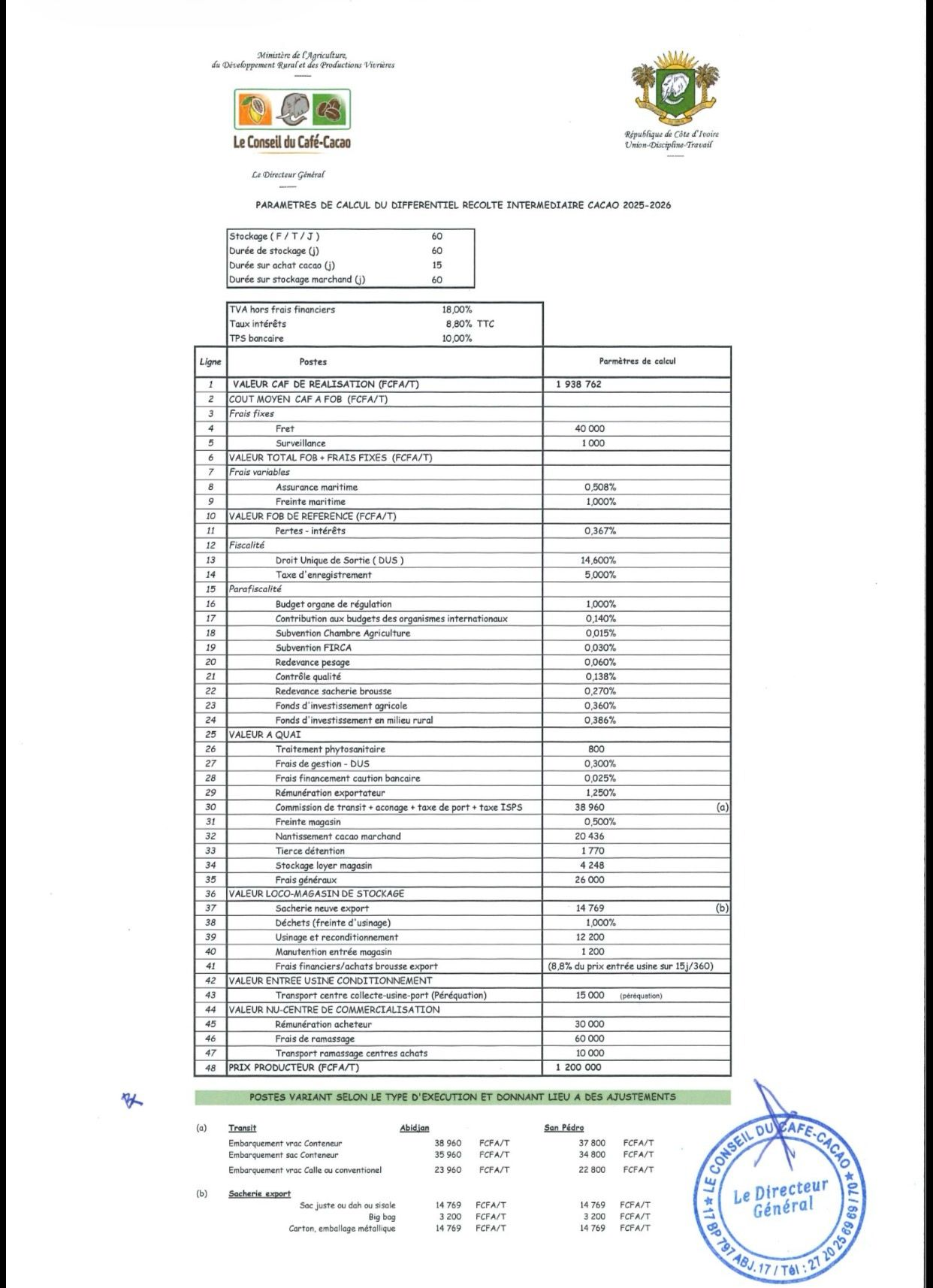
The CCC pricing formula begins with the CAF realization price, which represents the expected export value of cocoa delivered to international markets.
This value acts as the anchor for the entire pricing system and determines how revenue is distributed between farmers, exporters and government institutions.
| Pricing Metric | Value |
|---|---|
| CAF realization price | 1,938,762 FCFA per ton |
| FOB export reference price | 1,868,535 FCFA per ton |
| Minimum farmgate price | 1,200,000 FCFA per ton |
The CAF price represents the expected value of cocoa exports before domestic costs and sector levies are deducted.
Converting the CAF Price into Global Market Terms
To understand the implications for global markets, the CAF price can be converted into international currency terms.
| Conversion Step | Calculation | Result |
|---|---|---|
| FCFA to EUR | 1,938,762 ÷ 655.957 | 2,956 EUR |
| EUR to USD | 2,956 × 1.07 | ≈ $3,160 per ton |
This calculation shows that the CCC pricing system assumes an export value of roughly $3,100–$3,200 per ton for Ivorian cocoa shipments.
The Role of the Living Income Differential
Another structural component influencing West African cocoa pricing is the Living Income Differential (LID) introduced jointly by Côte d’Ivoire and Ghana in 2019.
The policy adds a nominal $400 per ton premium to cocoa exports in order to improve farmer incomes and support rural livelihoods.
In theory the LID functions as a fixed surcharge paid by buyers on top of the international cocoa price. In practice, however, market conditions determine how much of this premium is effectively realized. During periods of strong demand and tight supply, buyers typically pay the full premium. During weaker market conditions, part of the differential may be offset through discounts applied to origin premiums or contract structures.
Even when such adjustments occur, the LID framework still shapes the economic structure of the cocoa trade. Export contracts, price negotiations and regulatory models all incorporate the expectation that West African cocoa will trade at a structural premium relative to benchmark futures prices.
As a result, the effective price required to sustain the cocoa export system may be higher than the futures market alone suggests.
Taxes and Sector Levies
From the export value, the CCC deducts a series of taxes and sector contributions that finance agricultural programs, rural infrastructure and sector administration.
| Tax Category | Rate |
|---|---|
| Export duty (DUS) | 14.5 percent |
| Registration tax | 5.0 percent |
| Sector development levies | about 3 percent |
Together these charges remove roughly 22–23 percent of the export value before operational costs are even considered.
These fiscal revenues form a major component of government income and play a key role in maintaining the institutional structure of the cocoa sector.
Logistics and Operational Costs
Exporters must then cover a range of operational costs as cocoa beans move from farms through the domestic supply chain to export terminals.
| Cost Category | Approximate Cost (FCFA per ton) |
|---|---|
| Port handling and transit | 38,960 |
| Export sacks | 14,769 |
| Reconditioning | 12,200 |
| Warehouse storage | ~4,248 |
| Collection costs | ~60,000 |
| Transport to port | ~15,000 |
Exporters are also limited to a regulated margin of roughly 1.25 percent, reflecting the tightly controlled structure of the Ivorian cocoa sector.
The True Cost of Cocoa for Exporters
Using the values provided in the CCC document, it is possible to estimate the total cost of cocoa once exporters acquire beans from the domestic supply chain.
| Component | FCFA per ton |
|---|---|
| Farmgate price | 1,200,000 |
| Collection differential | 100,000 |
| Transport and internal logistics | ~60,000 |
| Warehouse and conditioning | ~100,000 |
These figures imply that exporters acquire cocoa beans at a cost of roughly 1,460,000–1,500,000 FCFA per ton before taxes and export expenses are applied.
Estimating the Export Break-Even Level
After including fiscal deductions and operational costs, exporters require an export price close to the CCC reference level.
| Metric | Value |
|---|---|
| FOB reference price | 1,868,535 FCFA |
| FOB price in EUR | 2,849 EUR |
| FOB price in USD | ≈ $3,050 |
This calculation indicates that exporter margins begin tightening significantly when export prices fall toward roughly $3,000 per ton.
However, this figure represents the physical export price, not the underlying futures market level.
The Hidden Differential Assumption
Ivory Coast cocoa typically trades at a premium over exchange futures contracts due to origin quality, logistics advantages and contractual pricing structures.
When origin differentials and the Living Income Differential are considered, the CCC pricing model implies a higher equilibrium value for the cocoa market.
Reversing the calculation illustrates the relationship.
| Component | Approximate Value |
|---|---|
| Physical export price (FOB) | ~$3,050 |
| Origin differential | −$100 to −$200 |
| Effective LID component | −$200 to −$250 |
| Implied equilibrium futures price | ≈ $3,300–$3,400 equivalent physical value |
In other words, while $3,000 represents the zone where exporter margins begin to compress, the broader economic framework suggests the cocoa sector operates more comfortably when physical export prices approach $3,300–$3,400 per ton.
Storage Assumptions and Market Signals
The CCC calculation sheet also includes operational assumptions that provide insight into expected market conditions.
One parameter assumes that cocoa stocks will remain in storage for approximately 60 days before export.
This storage duration corresponds to the typical logistics cycle of cocoa moving through the supply chain:
farm collection → cooperative aggregation → transport → port storage → export shipment.
However, it also determines the financing costs exporters must carry while assembling shipments.
Financing Costs and Inventory Levels
The CCC model assumes a commercial interest rate of roughly 8 percent for financing cocoa inventories.
Applied to the FOB value of approximately 1.87 million FCFA per ton, a 60-day holding period implies financing costs of roughly:
≈ 24,000–25,000 FCFA per ton
This financing structure corresponds to exporters holding approximately two months of export inventory.
Based on Ivory Coast’s typical export pace of roughly 150,000 tons per month, a 60-day storage window implies working inventories in the range of 250,000–350,000 tons.
This detail provides an indirect signal about expected mid-crop supply flows. Rather than anticipating an immediate surge of beans flooding the export system, the pricing framework suggests regulators expect a gradual flow of cocoa through the supply chain, requiring exporters to finance meaningful inventories during the mid-crop season.
Conclusion
The CCC mid-crop pricing framework provides a rare window into the internal economics of the world’s largest cocoa producer. What initially appears to be a simple announcement about the farmgate price actually reveals the deeper financial architecture of the Ivorian cocoa sector, including export pricing assumptions, tax structures, logistics costs, financing conditions and inventory expectations. Because Côte d’Ivoire produces roughly 40 percent of global cocoa, the economic thresholds embedded in this model offer valuable insight into the structural forces shaping the global cocoa market.