Ivory Coast and Ghana After the Cocoa Crash: Who Takes the Hit Now?

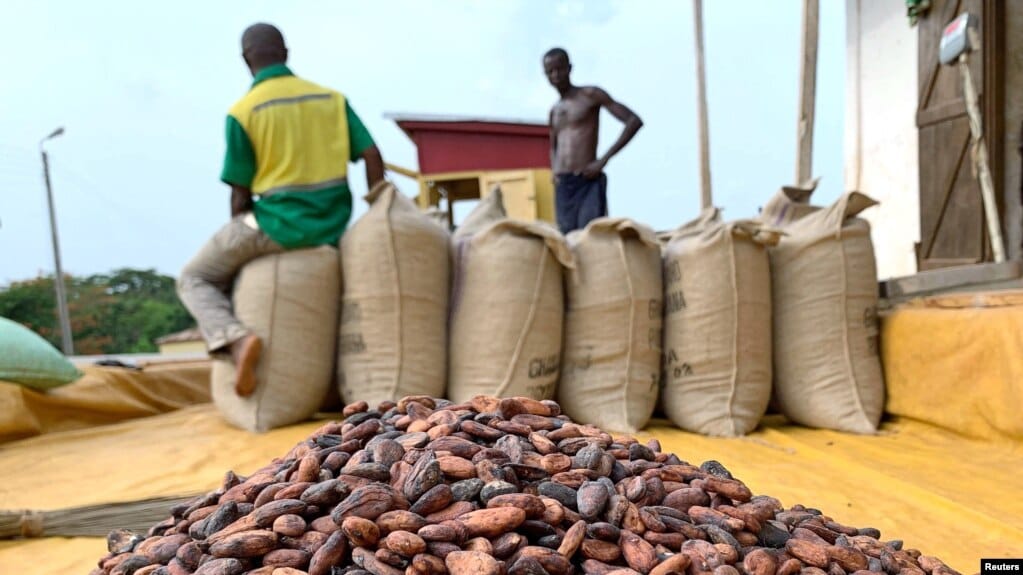
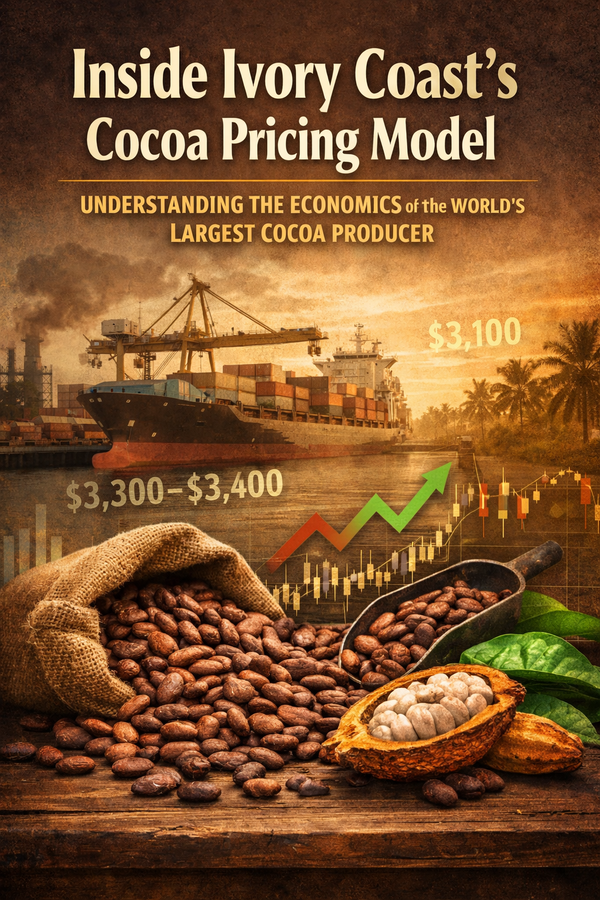
Cocoa has crashed. The spectacular surge above $10,000–$11,000 per tonne during the 2024–25 supply panic is long gone, replaced by prices near $5,200–$5,500. Traders call it a correction, chocolate companies call it stabilization, but for Ivory Coast and Ghana — which together produce roughly 60 percent of the world’s cocoa — the collapse marks the beginning of a deeper structural crisis. The price crash arrived at the exact moment when their production systems, marketing structures, fiscal positions, and political environments were at their most fragile. The world sees lower futures prices and assumes the danger has passed. In reality, the danger has only begun.
To understand the scale of the threat, start with Ivory Coast. The country is more diversified and fiscally stronger than Ghana, but cocoa remains absolutely central to its macroeconomic architecture. Cocoa and cocoa products make up roughly 30 percent of its exports by value and are a leading source of foreign exchange. Around one million producers and about five million people — roughly a fifth of the population — depend on cocoa income directly or indirectly. When prices collapse, it’s not just a rural income story; it is a core macroeconomic shock. And the current combination of lower volumes and lower realized prices means less FX, full stop. CCC has already cut forward sales from 1.7 million tonnes to around 1.2 million tonnes for 2025/26 because production has fallen. Meanwhile, the collapse in world prices means that more of the crop will be sold at sharply lower levels. Ivory Coast’s total exports stand around $20–21 billion; cocoa’s ~30 percent share translates into billions of dollars of FX now at risk. That weakens the current account, pressures external reserves of the entire WAEMU zone, and restricts the state's ability to finance imports and investment without more borrowing.
The growth impact in Ivory Coast is subtle but relentless: weaker rural consumption, less farm investment, and second-order effects rippling into transport, trade, and local finance. It doesn’t produce a headline GDP crash in year one; instead, it erodes potential growth year after year. Fiscal conditions are tightening as well. Cocoa is a major tax base. Export levies and CCC transfers support the budget and help service debt. When volumes and prices fall, fiscal space shrinks: the government must either cut spending, borrow more, or push quasi-taxes through the cocoa chain — often by keeping the politically sensitive farmgate price artificially high or squeezing exporters in ways that quietly transfer the burden to banks. And because Ivory Coast is in a monetary union with a fixed CFA–euro peg, it cannot devalue. Unlike Ghana, it must absorb the adjustment through internal austerity: slower wage growth, reduced public investment, and tighter budgets.
The Ivorian banking system feels the strain as well. CCC’s forward sales are used as collateral for syndicated loans and local bank financing. When export revenue underperforms, quality issues widen origin differentials, and the government insists on maintaining a politically elevated farmgate price (2,800 CFA/kg), the risk profile of cocoa-linked loans deteriorates. Banks tighten lending, which slows payments to farmers and reduces liquidity for rural buyers. Co-ops face higher financing costs, more traders collapse, and credit conditions contract through the sector. It’s not a system-wide banking crisis, but it’s a meaningful increase in systemic risk and a constraint on rural financial stability.
Poverty and inequality widen. Cocoa households are already among the poorest in Ivory Coast. As margins collapse, they reduce spending on food, schooling, and healthcare, delay replanting, and allow trees to degrade. Youth exit toward cities, rubber plantations, or illegal mining. Rural–urban inequality grows, creating social tensions that the government tries to manage with high farmgate prices. But the political tension doesn’t disappear; it is deferred. Lower real farmgate prices, reduced subsidies, or stricter enforcement against smuggling would trigger rural backlash. Ivory Coast faces a grinding structural burden rather than an immediate sovereign crisis: a decade of underinvestment and slow rot in the cocoa belt if nothing changes.
Ghana, on the other hand, is already in the danger zone. Cocoa is smaller relative to its exports than in Ivory Coast, but still macro-critical for employment, FX earnings (over $2 billion a year), and rural livelihoods for roughly 800,000 farm families across 10 of 16 regions. The problem is that Ghana enters this cocoa shock with a sovereign already under extreme strain: a 2022 default on most external debt, a $3 billion IMF program since 2023, ongoing restructuring of $13+ billion in debt, and a $2.8 billion relief package from official creditors. COCOBOD itself is heavily indebted — about $2 billion in liabilities under review — and a recent $800 million syndicated loan partially defaulted when Ghana could not deliver contracted beans. Roughly 370,000 tonnes of obligations had to be rolled over from the disastrous 2023/24 season, where production collapsed below 550,000 tonnes. The reputational damage was devastating: Ghana broke the unwritten rule of global cocoa marketing — that producer countries deliver what they sell. Since then, every buyer views forward commitments from West Africa through a lens of distrust.
Ghana’s cocoa collapse feeds directly into FX weakness, cedi depreciation, inflation, IMF constraints, and fiscal fragility. Smuggling remains rampant — hundreds of thousands of tonnes in recent years — and forward sales priced around $2,600 severely limited Ghana’s ability to benefit from the 2024 price spike. Less FX inflow intensifies pressure on the already fragile cedi. A weaker cedi inflames domestic inflation, raises import prices for fuel and fertilizers, forces higher interest rates, and deepens household hardship. Meanwhile, COCOBOD’s debt is in effect quasi-sovereign. Its inability to service loans spills straight onto the state’s balance sheet. Rolling losses forward means future cocoa revenues must pay for past mistakes, effectively taxing farmers via lower-than-expected farmgate prices. Ghana failed to enjoy the benefits of record-high cocoa prices but is fully exposed to the downside as prices fall.
The rural economy is unraveling. Weak cocoa production reduces consumption, discourages investment, and accelerates migration into illegal gold mining (galamsey). Galamsey is an economic dead end: it destroys farmland and water sources, permanently eliminating cocoa potential and diverting FX into informal channels that bypass government revenue entirely. Every hectare lost to illegal mining is a permanent structural hit to Ghana’s agricultural base.
Political tensions intensify. Farmers are furious over the 51,660-cedi farmgate price, accusing the government of breaking its promise to deliver 70 percent of the FOB price. Hundreds of thousands have threatened resistance: blocking COCOBOD agents, smuggling beans to Ivory Coast or Togo, or shifting entirely into mining. But Ghana cannot raise farmgate prices without breaching IMF conditionality, nor can it lower them without igniting rural unrest. It is trapped — economically, politically, and institutionally.
Meanwhile, a deeper regional crisis is unfolding beneath both countries. The collapse in cocoa prices has created a new financial reality. Both Ivory Coast and Ghana managed to pre-sell part of their upcoming crop at high earlier prices, which temporarily cushions revenues. But as the season advances, a growing share of beans must be sold at current much lower market prices. As average realized export prices decline, the assumptions underlying farmgate prices, budget projections, and syndicated loan collateral weaken. Regulators cannot delay sales; they must sell continuously to keep the system functioning. Cocoa is not discretionary revenue — it is the financial lifeblood of both economies.
The political distortion is clearest in farmgate pricing. Ivory Coast raised its farmgate price to 2,800 CFA, the highest ever. But with global prices now far below that level, exporters cannot cover costs. The result is system friction: slower payments, stricter quality rejections, limited pre-financing, and delayed purchases. Ivory Coast cannot cut its farmgate price mid-season, so the strain shifts onto exporters, co-ops, and eventually banks. Ghana’s farmgate unrest is even worse: raising prices breaks the IMF program; cutting prices triggers rural upheaval. There is no painless path.
Liquidity is quietly deteriorating across the region. Syndicated loans are collateralized by forward sales; when export prices drop, financing gaps open, lenders become cautious, and credit tightens. Exporters reduce purchasing; intermediaries struggle for liquidity; payment delays cascade through the supply chain. This creeping erosion is one of the most dangerous aspects of the crisis — invisible until it becomes catastrophic.
Smuggling distorts everything. Ghana loses huge volumes to cross-border flows; Ivory Coast’s official numbers are artificially boosted by that leakage. Lower world prices will not curb smuggling; if anything, smaller margins make even small price differences between countries more meaningful and encourage more informal trade. This undermines tax revenue, cripples export planning, and further destabilizes the sector.
Quality is deteriorating as well. Years of stress have produced smaller beans, and financial pressure pushes farmers to cut corners in fermentation and drying. Mold, smokiness, off-flavors, and acidity issues are increasingly common. Exporters face more rejections and heavier penalties, widening negative origin differentials on West African cocoa. Poor quality reduces realized prices, worsening liquidity problems and deepening financial strain.
Demand-side shifts are accelerating structural decline. Chocolate manufacturers adjusted aggressively to the price spike: reduced cocoa content, increased alternative vegetable fats, shrank package sizes, and diversified sourcing toward Latin America. Ecuador and Brazil are receiving sustained investment as processors seek more stable, higher-yield origins. Ecuador’s rise is strategically threatening. With disease-resistant clones, higher-yielding varieties, lower labor costs, and efficient supply chains, Ecuador could reach 500,000–600,000 tonnes. If that happens, global procurement strategies will permanently shift, eroding West Africa’s dominance.
Regulatory pressures add another layer of risk. The EU’s deforestation regulation (EUDR) requires precise farm-level mapping and legality verification. Ivory Coast and Ghana are not ready. Thousands of farms risk exclusion. Europe accounts for roughly 60 percent of Ivory Coast’s cocoa exports; any compliance failure would be a severe blow to demand, export earnings, and rural incomes.
Above all this looms the Harmattan — a risk consistently underestimated by analysts and traders. These dry Saharan winds, hitting December to February, can destroy pods, abort flowers, and weaken trees under normal conditions. After two consecutive weak seasons, trees are already exhausted. A strong Harmattan could devastate the early 2025/26 pod set, shrink developing pods, escalate disease vulnerability, and extend the structural supply deficit for years. Nearly every bearish market projection assumes a mild Harmattan. That assumption is reckless. A strong Harmattan could drive prices back toward $7,000–$9,000 overnight.
Financial markets add yet another destabilizing force. The melt-up above $10,000 was amplified by hedge funds and algorithmic trading; the crash was accelerated by ICE margin hikes that triggered forced liquidations. Price discovery is now driven more by financial flows in New York and London than by fundamentals in Abidjan or Accra. Producer countries are powerless price takers in a financialized market they cannot influence.
Two decades of sustainability and certification programs achieved almost nothing meaningful for farmer incomes, resilience, soil fertility, or replanting. They improved corporate PR more than they improved economic or agronomic fundamentals. When the real crisis emerged, sustainability proved irrelevant.
Zooming out, the structural consequences for both economies are severe. Rural poverty becomes entrenched as incomes stagnate and climate risk grows. Human capital investment slows. Medium-term growth potential declines as farms are abandoned, trees age, and land degrades. Financial sector vulnerability rises because CCC and COCOBOD are systemically important borrowers whose distress affects banks, exporters, and cooperatives. Bargaining power in global cocoa trade erodes as buyers shift toward Ecuador, Brazil, and other origins. Internal inequality rises as rural regions stagnate while urban elites benefit from gold, oil, services, and trade. This divergence is a classic driver of long-term political instability.
The path forward — if Ivory Coast and Ghana want to avoid a hard landing — demands realism and structural reform, not PR slogans. They must stop pretending they can deliver 1.7 million tonnes (Ivory Coast) or 800–900k tonnes (Ghana) anytime soon. Forward sales must be shorter, smaller, and more cautious. Farmgate pricing needs a rule-based, transparent, adjustable mechanism tied to moving averages of realized export prices. Liquidity must be prioritized over cosmetics; farmers and domestic buyers must be paid on time even if it requires cutting political projects or administrative fat. Both countries must take the EUDR seriously — mapping farms and establishing credible traceability systems is no longer optional.
Over the medium term, massive replanting and disease control are required. Old and diseased trees must be replaced with higher-yielding, climate-resilient varieties, with subsidies targeted at real farmers and linked to sound agronomic practices. Ghana must confront illegal mining decisively, or it will simply not have a cocoa future. COCOBOD and CCC must be rationalized — focused on pricing, quality, traceability, and risk management rather than bloated portfolios of social projects and opaque financial flows. Value addition should expand, but realistically — semi-finished products like butter and liquor, not fantasies of becoming Africa’s Switzerland. And both countries must work jointly to renegotiate value-sharing with global buyers under a platform that emphasizes reliability, sustainability, and replanting.
Long-term diversification is unavoidable. Even a perfectly reformed cocoa sector will not be enough to sustain either economy. Ivory Coast must continue expanding non-cocoa agriculture, manufacturing, logistics, digital services, and energy. Ghana must manage gold and oil more competently, build non-extractive exports, and use any future boom to create real shock absorbers rather than pro-cyclical consumption.
The brutal conclusion is simple: this cocoa crash is not a commodity story — it is a macro story. It exposes deep structural weaknesses in both economies, threatens FX stability, tightens budgets, increases banking risk, entrenches rural poverty, amplifies political fragility, and accelerates a global shift away from West African cocoa. Ivory Coast may muddle through with slower growth and chronic underinvestment. Ghana faces a real risk of policy failure if it mismanages the intersection of cocoa collapse, sovereign distress, IMF conditionality, and rural anger.
Unless both countries fundamentally reshape how they forecast production, manage forward sales, set farmgate prices, finance the supply chain, replant trees, enforce land and mining rules, and comply with global regulations, this decade will be remembered as the moment when the world’s largest cocoa origin began a long, slow, and possibly irreversible decline.
If they fail to confront the crisis with honesty and structural reform, the decline won’t be cyclical. It will be permanent. The world will move on, Ecuador will take the crown, and West Africa’s cocoa belt will become a monument to political denial and economic decay.
If you notice any discrepancies or have additional insights, please feel free to contact me at cocoatradeblog@gmail.com or leave a comment. Cocoa markets move fast, and your feedback helps ensure the accuracy of these reports.