The Hidden Reality Behind Falling Cocoa Demand

Over the past 18–24 months, the global cocoa-and-chocolate complex has faced an intriguing paradox.
According to the International Cocoa Organization (ICCO), global cocoa bean grindings—the amount of beans processed into chocolate, cocoa powder, and cocoa butter—are down year-on-year and versus prior estimates.
At the same time, retail confectionery sales in value terms have held up relatively well, though volumes are slightly weaker.
To explain this divergence, we must look carefully at two main explanations:
(a) weaker consumer demand, and (b) manufacturer strategies—reducing cocoa content, shrinking pack size, adjusting recipes.
This report will:
- Present the macro picture—grindings data vs. sales data
- Analyse major company results and commentary
- Explore evidence of shrinkflation and less cocoa per unit
- Offer a synthesis of the relative weights of these drivers
- Outline implications for the cocoa market and trading outlook
- Introduce additional analytical factors for future monitoring
- Assess post-price normalization behaviour of producers
- Examine the hidden forces behind the 2024–25 cocoa price explosion
- The “Inventory Cycle” Theory of Cocoa Price Swings
1. Macro Picture: Cocoa Grindings vs Confectionery Sales
Grindings data
The ICCO’s May 2025 Quarterly Bulletin shows that for the 2023/24 cocoa year, global grindings were revised down about 4.8 percent to 4.818 million tonnes.
Global production was revised down 12.9 percent to 4.368 million tonnes, and the stocks-to-grindings ratio fell to 26.4 percent.
Regionally, Q2 2025 European grindings declined roughly 7.2 percent year-on-year (from 357,500 tonnes to 331,800 tonnes).
This confirms that processing volumes—a key proxy for industrial cocoa demand—are materially weaker.
Confectionery market data
In contrast, the global chocolate and confectionery market continues to expand in value.
Research projects the cocoa-and-chocolate market to grow from USD 169 billion in 2025 to USD 233 billion by 2030 (CAGR 6.5 percent), and the broader confectionery market to reach USD 270.5 billion by 2027.
In the UK, value remains steady while volumes fluctuate modestly.
Retail values therefore are not collapsing. The divergence between declining grindings and stable retail sales signals a structural shift in manufacturing and consumer behaviour rather than an outright collapse in demand.
2. Company-Level Performance and Commentary
A closer reading of major corporate results gives insight into how confectionery makers are managing high cocoa prices.
Mondelez International
In early 2025, Mondelez beat profit forecasts through aggressive pricing: revenue up 5.6 percent globally, with European pricing up 13.8 percent and volume/mix down 1.3 percent.
By Q3, European volume had fallen 7.5 percent as pricing remained high.
The company cited elasticity linked to cocoa prices and “portfolio resizing” as mitigation.
Mondelez’s strategy combines higher prices, smaller bars, and heavier reliance on biscuits and “chocolate-flavoured” lines, limiting pure cocoa usage.
Its revenue protection has come at the expense of physical throughput, demonstrating how pricing power can mask a real decline in bean consumption.
Mars Incorporated
Mars, a private company, reported 2024 revenue of roughly USD 55 billion and warned of margin pressure from cocoa costs.
Its response mirrors Mondelez: shrinkflation and innovation in cheaper-to-produce products.
Galaxy bars were cut from 110 grams to 100 grams; Snickers and Twix multipacks from five to four bars.
These moves lower cocoa usage per unit sold without altering shelf prices.
Mars maintains brand reach by adjusting format rather than overtly raising prices.
Nestlé S.A.
In H1 2025 Nestlé’s confectionery pricing rose 10.6 percent while volume (real internal growth) fell 2.1 percent.
Consumers traded down to smaller packs, as illustrated by Quality Street tubs reduced from 600 grams to 550 grams and KitKat multipacks from five to four bars.
Nestlé’s cost structure and wide portfolio allow it to offset declining cocoa intensity in mainstream chocolates through diversification into non-chocolate snacks and plant-based treats.
Ferrero Group
For FY 2024/25 Ferrero reported revenue growth of 5.3 percent and flat to slightly negative volume.
Pack sizes were trimmed—Ferrero Rocher boxes of 16 pieces became 12.
The company cited input-cost volatility, particularly cocoa, as a driver of packaging adjustments.
Ferrero’s product positioning in gifting categories helps sustain value growth even when units decline, suggesting that emotional appeal outweighs price sensitivity.
Lindt & Sprüngli: The Premium Case Study
Lindt & Sprüngli illustrates how luxury brands can thrive in a high-cost environment.
H1 2025 sales increased 11.2 percent to CHF 2.35 billion, almost entirely from 15.8 percent price hikes; volume/mix fell 4.6 percent. Net income dipped from CHF 218 million to CHF 188.9 million, yet profitability remained solid.
Consumers accept higher prices because Lindt occupies an emotional and sensory niche.
Premium chocolate behaves like an affordable luxury: it delivers comfort and prestige at modest absolute cost.
Buyers trade down in quantity but not in brand, reflecting strong trust in quality and taste consistency.
By emphasising sustainability, limited editions, and “Swiss craftsmanship,” Lindt turns price into a signal of quality rather than a deterrent.
This explains why premium segments exhibit falling volumes but resilient value—fewer grams sold, but each gram valued more highly.
Hershey Co.
Hershey’s Q3 2025 pricing rose 7.9 percent while volume dropped 3.1 percent.
The company highlighted a shift to smaller seasonal items and controlled distribution.
Its market strength in North America allows modest elasticity management, but sustained input inflation may eventually force reformulation or reduced cocoa content.
Barry Callebaut
As a supplier to confectionery manufacturers, Barry Callebaut offers the clearest signal of industrial cocoa demand.
FY 2024/25 volumes fell 6.1 percent to 2.27 million tonnes even as revenue grew 8.2 percent.
The company confirmed that customers are “using smaller volumes of cocoa per finished product,” validating the observed reformulation trend.
Pladis, Private Labels, and Mid-Tier Producers
Pladis reported pricing up 9 percent and volume down 4–5 percent in 2025, coupled with a product shift toward chocolate-coated biscuits.
Private-label retailers such as Tesco and Aldi lowered cocoa solids from 22 to 16–18 percent in many bars to maintain low prices.
French manufacturer Cemoi also reformulated products with reduced cocoa density.
These mid-tier and budget adjustments account for a considerable share of the overall fall in global grindings.
3. Evidence of Less Cocoa per Unit: Shrinkflation and Reformulation
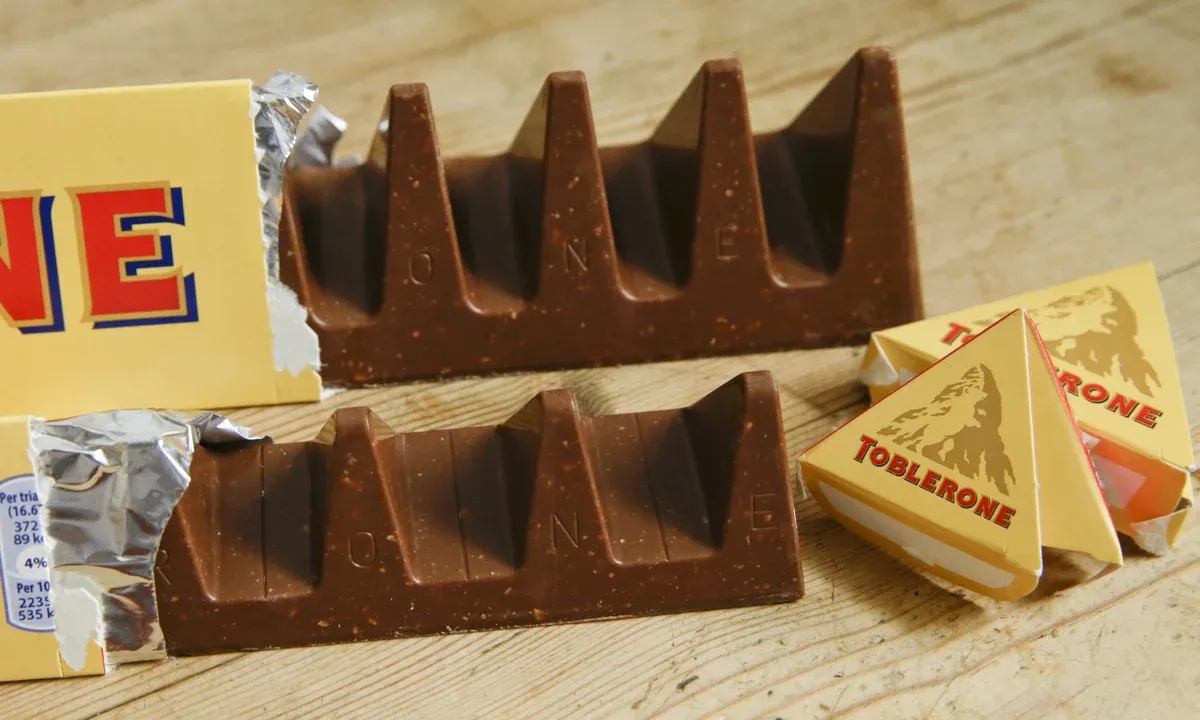
Weight reductions across Europe are widespread. Quality Street, Celebrations, and Toblerone all decreased package size while maintaining prices. The consumer association Which? confirms this pattern across most chocolate multipacks.
Even brands with steady unit sales now use less cocoa per gram due to recipe changes and coatings diluted with vegetable fats.
Such modifications explain why grindings are down 4–7 percent while retail values are broadly stable: the world is eating roughly the same number of chocolate bars, but each bar contains fewer cocoa solids.
4. Synthesis: Relative Weights of the Drivers
| Driver | Share of Grindings Decline | Explanation |
|---|---|---|
| Shrinkflation / smaller packs | 35–40 % | Physical downsizing of bars and tubs |
| Lower cocoa solids / reformulation | 25–30 % | Substitution of fats, less cocoa liquor |
| True consumer volume drop | 25–30 % | Cost-of-living elasticity |
| Product-mix shift | 10 % | Move toward biscuits and compound coatings |
The evidence suggests that about two-thirds of the downturn in cocoa bean grindings originates from manufacturer adjustments rather than consumer abstention.
5. Implications for Cocoa Markets and Trading
- Grindings data may exaggerate real demand weakness because it captures manufacturing efficiency, not consumer appetite.
- If cocoa prices stabilise or decline, manufacturers could restore normal cocoa intensity, triggering a sharp rebound in bean usage.
- The coexistence of tight supply and latent demand implies potential price volatility in 2026–27.
- Analysts should monitor company statements on pack resizing, recipe reformulation, and product mix: they are leading indicators of future grindings trends.
- For producing countries, reduced cocoa usage per bar temporarily weakens export pull but is unlikely to represent permanent demand loss.
6. Additional Factors to Consider
a. Substitution effects
High cocoa prices encourage greater use of compound coatings made with vegetable fats. Tracking trade data for cocoa butter equivalents (CBE) such as palm mid-fraction can reveal hidden substitution that affects bean demand.
b. Labeling and regulation
EU and UK labeling laws restrict what can legally be called “chocolate.” Some reformulated products have shifted category to “chocolate-flavoured.” Monitoring these reclassifications helps interpret apparent consumption shifts.
c. Consumer psychology
Premium chocolate benefits from emotional attachment, while mainstream brands suffer from price fatigue. Income-segmented elasticity analysis can clarify where real volume pressure resides.
d. Emerging-market dynamics
Markets in Asia, Latin America, and Africa are growing steadily, often offsetting Western volume declines. Including regional grindings data from Asia and Brazil will provide a fuller global picture.
e. Weather and crop quality
Adverse West African weather constrains bean availability, influencing cost structures. Even if consumer demand remains stable, limited supply can maintain high prices and perpetuate reformulation trends.
7. Will Confectionery Producers Reduce Prices and Increase Pack Sizes When Cocoa Prices Fall?
The Short Answer
No — not immediately, and not fully.
History shows that once confectionery companies raise prices or reduce pack sizes, they rarely reverse those moves completely, even when ingredient costs fall.
Instead, they tend to stabilize prices and reinvest the margin gains into marketing, product innovation, or shareholder returns.
But over time, they may increase cocoa content slightly or launch “value” or “larger pack” lines to regain consumer goodwill, without lowering list prices.
The Economic Reality: Sticky Prices in FMCG
The confectionery industry operates under a principle economists call “price stickiness.”
Retail prices move up easily during cost inflation but move down only partially, if at all, when input costs decline.
Why prices stay high:
- Retailer contracts: Shelf prices are negotiated infrequently; lowering them sets a new baseline that’s hard to raise later.
- Consumer psychology: Once buyers adapt to higher prices, companies prefer to maintain that anchor rather than disrupt perceived value.
- Brand positioning: Lowering price can dilute a brand’s premium image.
- Margin recovery: After years of margin compression from cocoa inflation, producers will first restore profitability before passing savings on.
Example:
When cocoa prices spiked in 2010 and later fell by over 40% in 2012–2013, major European chocolate prices did not return to pre-2010 levels.
Instead, brands introduced “special editions,” slightly larger sizes, or improved packaging — but kept higher price points.
The Likely Corporate Response Pattern
When cocoa prices eventually normalise, here’s what we can expect step-by-step:
a. Stage 1 – Margin Recovery (Short Term)
Producers will keep retail prices steady but enjoy lower input costs.
This allows them to restore profit margins that were previously eroded.
Shareholders and analysts will welcome this, so management will be reluctant to reverse price increases.
b. Stage 2 – Subtle Quality or Size Restoration (Medium Term)
Brands may gradually increase product size or cocoa content, but only in small increments.
For example:
- A 90 g bar could quietly become 95 g.
- A “16-piece” box may return after a year of “12-piece” formats.
These moves will be marketed as “improved taste” or “back to our original recipe,” not as price cuts.
c. Stage 3 – Strategic Repositioning (Long Term)
When competition or consumer backlash builds (e.g., if buyers notice shrinkflation fatigue), companies may introduce “value lines” or “extra size packs.”
These reintroductions create a perception of generosity while maintaining higher underlying margins.
In practice, this means the bean grindings will rise (more cocoa used), but retail prices will remain structurally higher.
The Brand Psychology Aspect
Premium brands (Lindt, Ferrero, Godiva) will not lower prices — they rely on prestige and consistency.
Instead, they’ll subtly improve recipes, cocoa origin quality, or packaging aesthetics once costs drop.
Mainstream and mass brands (Mondelez, Mars, Nestlé) may restore pack sizes first, especially in value-oriented markets like the UK or emerging economies.
But they’ll frame it as a promotional or loyalty gesture, not a permanent reversal.
Evidence from Past Commodity Cycles
| Year | Cocoa Price Trend | Industry Response |
|---|---|---|
| 2010–2013 | Cocoa fell 40% | Companies maintained higher prices; launched “new formats.” |
| 2016–2018 | Cocoa fell from $3,000 → $1,800 | Shrinkflation paused; some bars grew slightly; prices stayed constant. |
| 2020–2021 | Cocoa stable but sugar/oil fell | No price cuts; brands used cheaper inputs to fund advertising. |
| 2023–2025 | Cocoa spike to record highs | Prices hiked; reformulation widespread; pack sizes reduced. |
This shows a clear asymmetry: price rises are passed on quickly, but declines are absorbed internally.
What It Means for Cocoa Demand
Even if retail prices stay high, cocoa grindings will likely rebound once input prices fall because:
- Manufacturers can afford to restore normal cocoa solids in recipes.
- Pack sizes and bar weights may gradually increase.
- Premium lines may use higher-quality beans again, reversing some dilution.
So bean demand will increase again, even if consumers don’t notice lower prices.
Key Takeaways for Your Cocoa Market Outlook
- Prices will remain sticky; volumes will recover first.
Expect cocoa grindings to rebound before any visible price cuts. - Consumer prices may plateau at high levels.
Inflation psychology and retailer dynamics will prevent a full rollback. - Cocoa usage per unit will rise quietly.
Firms will restore recipes and portion sizes to maintain quality perception once costs normalize. - Rebound in cocoa demand ≠ retail price relief.
Bean demand will increase faster than retail prices fall — bullish for long-term fundamentals. - Watch for marketing language.
Phrases like “richer chocolate taste,” “now with more cocoa,” or “original recipe returns” will signal this transition.
Bottom Line
When cocoa prices fall, confectionery producers will not rush to lower retail prices.
They will:
- First, rebuild margins,
- Then, selectively increase cocoa content and pack size,
- And finally, reposition products to retain perceived value.
In other words:
Cocoa grindings will recover well before chocolate prices ever come down.
For your trading and industry reports, this implies that bean demand can surge even in a high-price retail environment, as cost relief flows into recipe normalization rather than consumer discounts.
8. The Hidden Forces Behind the 2024–25 Cocoa Price Explosion
The Visible Story: Weather, Yields, and Logistics
The official explanation for cocoa’s historic rally in 2024–25 was simple:
Bad weather in West Africa (excessive rainfall, disease, poor pollination, and aging trees) created a severe supply shortfall just as global demand seemed to be recovering post-COVID.
Ivory Coast and Ghana’s combined output dropped from about 3.3 million tonnes to under 2.7 million tonnes.
Futures markets reacted violently — prices on ICE New York and London doubled in less than a year, briefly surpassing 12,000 USD per tonne.
This part is real and well-documented. But it’s only the surface.
The Hidden Layer: Market Structure and Financial Amplification
Cocoa’s futures market is extremely concentrated.
Five major trading houses (Barry Callebaut, Olam, Cargill, Ecom, and Touton) dominate physical flows.
On the financial side, hedge funds and commodity index funds entered heavily when cocoa became one of the few “long-only” inflation hedges still performing after oil stabilized.
In late 2023, fund managers began building long positions as El Niño headlines spread.
By early 2024, “momentum” funds joined in — not because of cocoa fundamentals, but because of algorithmic trend-following rules.
That created a feedback loop:
- Prices rose due to drought reports.
- Funds chased momentum, pushing prices higher.
- Producers delayed hedging, hoping for even better prices.
- Traders panicked as physical coverage tightened.
- Margin calls and liquidity constraints exaggerated every move.
In essence, what began as a real supply shock was magnified by financial leverage and thin market depth.
The Invisible Hands: Who Benefited Most
Let’s consider who won and who lost in this price cycle.
Winners:
- Speculative funds and momentum traders
Those who entered early (late 2023–Q1 2024) made enormous paper profits.
Even some macro funds outside the commodity world joined once cocoa became “the new orange juice.” - Large trading houses with storage
Traders holding old-crop beans or certified stocks could sell into the rally at multiples of their cost.
A tonne of beans bought for $2,800 in 2023 could fetch $8,000–$10,000 in mid-2024. - Some producing-country entities
Ghana Cocoa Board (COCOBOD) and the Ivorian CCC benefited temporarily from higher forward-sale values, improving their financing terms — though many farmers saw little of the upside.
Losers:
Chocolate manufacturers
Companies like Mondelez, Hershey, and Ferrero faced a brutal squeeze. They hedge, but not indefinitely; by 2025 their cost coverage rolled off into new record prices.
That’s when we saw the wave of shrinkflation and reformulation.
Farmers
Ironically, most West African farmers sold at fixed government prices (often around 70–80 percent below world market levels).
The world was screaming about $10,000 cocoa, but the grower still earned less than $3,000 equivalent per tonne — a bitter irony.
So the rally looked like a “farmer’s miracle,” but in reality, it was a financial market event that barely changed farm-gate reality.
The Narrative Management: How It Was Sold to the World
Media coverage framed the surge as a “supply crisis” — which was true in part, but incomplete.
What went largely unmentioned was how inventory liquidation, risk-aversion by producers, and fund inflows distorted the true picture of physical scarcity.
In April 2024, for example, certified exchange stocks in London fell sharply — but that was partly because some traders withdrew beans to sell privately at higher off-exchange prices, not because no beans existed.
This withdrawal made inventories look smaller, reinforcing the “shortage” story, which then attracted more speculative buying.
Thus, an apparent shortage became a perceived panic, amplified by financial optics.
The Deeper Structural Force: Supply-Chain Rebalancing
Another layer often missed:
Big confectionery firms and traders had quietly started adjusting to ESG pressures and EU anti-deforestation regulations.
To comply, they needed traceable, certified cocoa.
However, much of the world’s supply chain was not yet compliant.
By tightening certified supply and discouraging uncertified purchases, the industry inadvertently created a bottleneck — a smaller “acceptable” pool of beans competing for the same buyers.
So the rally was not only about weather — it was about compliance bottlenecks, financialization, and psychological panic converging at once.
Was It Manipulation?
Not in a classical, illegal sense — but yes, there was narrative control and strategic behaviour.
- Some large traders likely “managed” supply optics by controlling visible warehouse flows.
- Speculative funds rode the story while publicly framing it as a climate-driven crisis.
- Confectionery firms played into the narrative to justify price increases and shrinkflation.
Everyone acted rationally within their incentives.
No single villain — just a system designed to amplify scarcity perception and extract margin at multiple points in the chain.
The Human Irony
Farmers worked as hard as ever, yet received little benefit.
Consumers paid record prices for smaller chocolate bars.
Traders and funds made fortunes on paper volatility.
And the cocoa itself — a product rooted in tropical smallholder livelihoods — became another financial instrument whose price was set more by algorithms than rainfall.
What the Pattern Suggests
The cocoa market of 2024–25 became a textbook example of how real scarcity, regulatory tightening, and speculative liquidity can combine to create a hyper-cycle.
It exposed how fragile the global cocoa system is:
- Too dependent on two countries with aging trees.
- Too concentrated in a few multinationals’ hands.
- Too financialized relative to the physical size of the market.
And it reminded everyone that even essential commodities can behave like financial assets when trust, transparency, and diversification break down.
Looking Ahead: What It Means for the Next Phase
When the dust settles, three outcomes are likely:
- Cocoa prices will normalize below 2024 peaks but not return to pre-crisis levels — cost inflation and new regulation will create a higher structural floor.
- Grindings will recover as reformulation reverses, but volatility will remain high.
- Institutional players — funds, hedge houses, and compliance-driven buyers — will stay in cocoa longer, making future cycles sharper and more synchronized with financial flows.
In Simple Terms:
The cocoa rally was not purely a “weather story.”
It was a perfect storm of real shortage, financial momentum, supply-chain tightening, and narrative control.
No single entity “caused” it — but many learned how to profit from the appearance of scarcity.
And as always, those who grow the crop and those who eat the chocolate ended up paying for the theatre staged in between.
9.The “Inventory Cycle” Theory of Cocoa Price Swings
Cocoa behaves differently from most commodities because of how its semi-finished products (liquor, butter, powder) are stored and financed.
Unlike coffee or sugar, where most stock sits as raw material, cocoa’s “invisible” inventory is held mid-chain, inside grinders and industrial warehouses.
Part of the current downturn in reported grindings likely reflects the after-effects of 2024’s inventory build-up. As high-priced beans were converted into butter and powder during the supply panic, processors accumulated derivative stocks that they are now liquidating. This substitution of stock drawdown for new grinding temporarily depresses reported figures but does not equate to structural demand loss. When inventories normalise, grindings could rebound sharply, even without new consumer growth.”
That creates a two-stage cycle:
- Phase A – Build and Hoard (Bullish Phase)
- Prices start to rise due to weather or supply risk.
- Grinders fear bean scarcity or export restrictions.
- They accelerate grindings to secure cocoa in processed form, building butter/powder stocks.
- This boosts bean demand even further → prices rise more.
- Phase B – Drawdown and Pause (Bearish or Stagnant Phase)
- Once derivative inventories are high and prices reach unsustainable levels, grinders slow or stop new bean purchases.
- They sell down stored cocoa butter/powder instead.
- Reported grindings drop sharply (appearing as “demand weakness”).
- The market interprets this as falling consumption, prices soften.
In reality, this cycle reflects inventory rotation, not true end-user demand shifts.
How This Likely Played Out 2023–2025
- Mid–2023 to early 2024:
Cocoa prices started rising due to rainfall, disease, and crop worries.
Grinders (especially in Europe) increased bean purchases early, fearing shortages.
Many locked in beans and processed them quickly, storing the derivatives for later use.
This behaviour helped push futures above $10,000/t, amplifying the rally. - Mid–2024 onward:
As cocoa prices hit record highs, bean financing became too expensive.
Butter/powder inventories were full.
Grinders began selling from stock instead of grinding new beans.
Hence, grindings data fell 5–7%, even though chocolate shelves were still full.
Markets misread this as “consumption collapse,” but it was actually inventory drawdown.
So the market went from “grind everything” to “sell what’s stored.”
That shift alone can swing apparent demand by several hundred thousand tonnes.
Why This Causes Volatility
Because these storage cycles are invisible to most traders, each swing looks like a demand shock:
- When grindings surge → analysts forecast demand growth → prices spike.
- When grindings collapse → headlines warn of weak consumption → prices drop.
But the underlying reality is a timing mismatch: processors simply moving cocoa between bean stock and derivative stock.
In financial terms, this is a bullwhip effect — small adjustments in physical behaviour creating large swings in market perception.
The Financial Layer Makes It Worse
The cocoa market’s low liquidity and high leverage mean that every grindings report (quarterly ECA, NCA, or ICA) heavily influences speculative positions.
So when Q2 2025 grindings came in down 7.2%, funds immediately cut longs — assuming weaker demand — without realising that factories were still shipping butter and powder made months earlier.
This herd reaction to lagged data magnifies both price rallies and crashes.
Supporting Evidence
- Butter/powder ratio behaviour: In 2024, butter prices stayed unusually high relative to beans, suggesting stockpiling.
By mid-2025, those ratios compressed — a sign that inventories were being released. - Port inventories: Data from Amsterdam and Tema showed large derivative stockpiles in 2024, slowly drawn down through 2025.
- Company reports: Barry Callebaut mentioned “inventory normalisation” in mid-2025, aligning with lower grindings despite steady chocolate sales.
The Logic in One Sentence
Yes — grinders’ earlier rush to store semi-finished cocoa likely inflated prices in 2024, and that same stored material is now suppressing 2025 grindings, creating the illusion of weak demand.
Conclusion
Both lower consumer purchasing power and manufacturer adaptation explain the recent downturn in cocoa usage, but the dominant force is corporate strategy: smaller packs and reduced cocoa content to protect margins.
Consumers have not abandoned chocolate; they are simply receiving less cocoa per purchase.
Premium brands such as Lindt illustrate how buyers will pay more for the same experience when emotional and sensory value is strong.
The decline in grindings is therefore a temporary adaptation to cost pressures, not permanent demand destruction.
When cocoa prices ease, manufacturers are likely to restore recipes and portion sizes before considering any price reductions.
This means bean demand could recover sharply while retail prices remain elevated—a scenario that markets may underestimate.
Finally, the 2024–25 price explosion demonstrates that the cocoa market has evolved beyond simple agricultural dynamics: it is now a hybrid system where climate, finance, regulation, and perception interact.
Understanding these intersections—between farmers, funds, and factories—will be essential to predicting the next phase of the cocoa cycle.