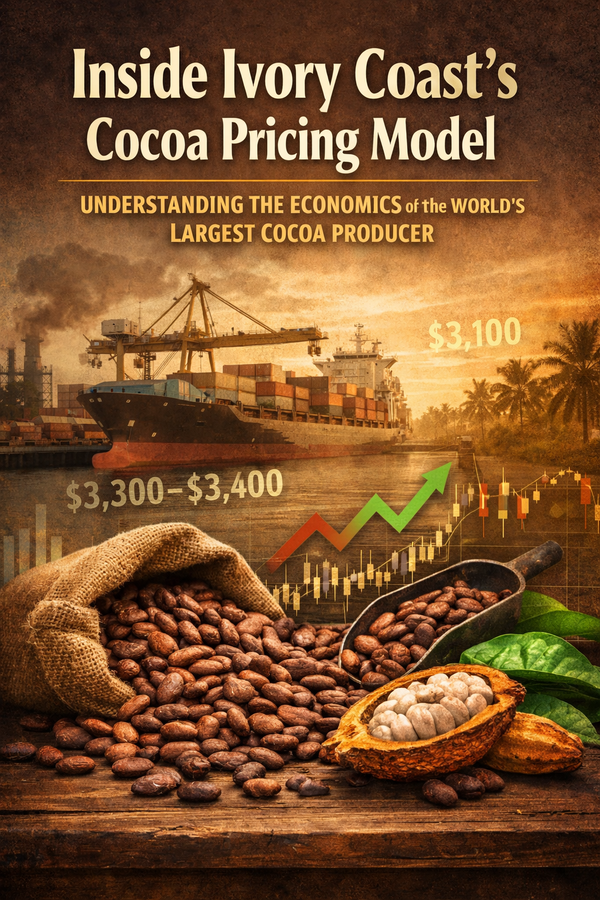
The Next Cocoa Boom: Supply Surge, Climate Crossroads, and Structural Inequality

Analysis of Geographic Redistribution and Supply Rebalancing
Executive Summary
Cocoa prices collapsed 53% from their December 2024 peak of $12,900/t to $5,300–5,500/t (December 2025), yet the market remains structurally tight. The 2024/25 surplus was only 49 kt, against forecasts of 100+ kt. This indicates that supply rebalancing will extend 2–3 years longer than previously anticipated.
Three critical forces now reshape the cocoa outlook. First, EUDR (EU Deforestation Regulation) enforcement will reduce effective West African supply by 3–8% through 2027/28, as smallholder farms lack resources for compliance. Second, Indonesia is contracting, not growing. Production is declining at 1.6% annually through 2030, eliminating a crucial 50–100 kt supply buffer. Third, Ecuador and Brazil must execute flawlessly to avoid extending the supply deficit to 2029/30. The geographic power shift away from West Africa is real and structural, but the transition will be drawn out over four years (2025–2029) rather than 2–3 years. Tail risks remain asymmetric. Disease resurgence, EUDR enforcement tightening, or weak demand recovery could extend supply constraints to 2030 and beyond.
Price Collapse and Underlying Supply Tightness
The December 2024 Peak
Cocoa reached an all-time high of $12,900/t in December 2024, driven by panic buying in response to severe supply constraints. Stocks-to-grindings fell to 27.0%, absolute inventory to 1.30 Mt (just 3.2 months of global coverage), and West African production was still recovering from 2023/24's historic 13.1% production collapse (down to 4.37 Mt, the lowest in eight years).
The November 2025 Policy Shock
On November 13–14, 2025, the Trump administration made two major policy announcements affecting cocoa markets:
November 13: The administration removed 10% reciprocal tariffs on cocoa for all origins, exempting agricultural products not grown in sufficient quantities in the US. This applied to Ecuador, Ghana, Côte d'Ivoire, Cameroon, and most major cocoa origins.
November 20: Trump signed an executive order eliminating the 40% national-security tariff on Brazilian cocoa (along with coffee, beef, and fruits) that had been imposed in August 2025 as retaliation for Brazil's prosecution of former President Jair Bolsonaro.
These twin exemptions triggered a rapid price collapse. Cocoa fell from approximately $6,200/t (pre-November 13) to $5,050/t by early December, a 19% decline in two weeks. As of mid-December 2025, cocoa trades at $5,300–5,500/t, a 58% decline from the December 2024 peak.
The collapse was swift but did not reflect abundance. It reflected policy shock and demand front-running. Chocolate manufacturers rushed to rebuild inventory at lower prices. Exporters reduced hedges. Speculators closed long positions.
What Prices Don't Tell
Current spot prices of $6,200/t obscure a fundamental reality. The market remains structurally tight. The ICCO's November 2025 quarterly bulletin, released November 28, 2025, revised the 2024/25 supply balance to a 49 kt surplus. This is down 66% from the 142 kt forecast released in February 2025.
Stocks-to-grindings ratio stands at 28.8%, still below the 30% threshold for market stability. Absolute inventory levels remain precarious. The price collapse is temporary relief from policy exemptions, not resolution of supply constraints.
If West African weather deteriorates in Q1 2026, or if disease escalates in Ghana or Cameroon, prices could spike back to $7,000–8,500/t within weeks. Low spot prices are masking unresolved supply tightness.
Global Supply Rebalancing
The Indonesia Contraction
Indonesia and other Asian origins currently supply approximately 470 kt cumulatively. Recent production data reveals an important correction: Indonesia is declining, not growing. Production is forecast to fall from 555.6 kt in 2024 to 519.8 kt by 2028, a compounded annual decline of 1.6%.
This structural decline eliminates a critical assumption in supply projections. If Indonesia were growing modestly, West Africa's yield stress could be partially offset. Instead, supply growth must come entirely from Ecuador and Brazil. This leaves zero margin for error. The path to rebalancing narrows significantly.
Global Supply by Origin (2030 Forecast)
| Origin | 2024/25 Actual/Estimate | 2030 Forecast | Key Driver |
|---|---|---|---|
| West Africa | 3.1–3.2 Mt | 3.0–3.3 Mt | Climate stress plus EUDR compliance drag |
| Ecuador | 0.57 Mt | 0.65–0.75 Mt | Yield advantage; EUDR compliance advantage |
| Brazil | 0.25 Mt | 0.35–0.45 Mt | Investment recovery; tariff relief now removes constraint |
| Indonesia & Asia | 0.47 Mt | 0.51–0.53 Mt | Structural decline despite optimization efforts |
| Rest of World | 0.05 Mt | 0.08–0.12 Mt | Minor contribution |
| GLOBAL TOTAL | 4.69 Mt | 5.0–5.5 Mt | Modest growth masks geographic concentration |
Global cocoa production reached 4.69 Mt in 2024/25, up 7.6% from 2023/24 (which closed at a 489 kt deficit). However, this improvement masks dramatic geographic shifts. West Africa's share contracts from the historical 74% to 60–65% by 2030. Ecuador and Brazil combined rise from 17% to 23–25%. This is not marginal shift. It is fundamental realignment of supply geography.
West Africa – From Dominance to Structural Decline
Côte d'Ivoire: Climate Stress and Logistics Bottlenecks
Côte d'Ivoire remains the world's largest cocoa producer. However, actual 2024/25 production is running approximately 1.8–2.0 Mt, below the earlier government projections of 2.2 Mt. Port data through December 7, 2025 shows Côte d'Ivoire shipped 804,288 mt of cocoa from October 1 onward. This is down 1.8% year-on-year, signaling weaker-than-expected production.
Côte d'Ivoire faces converging headwinds that will compress output by 2030.
Structural constraints:
- Aging tree populations (average age 25+ years, well past peak productivity)
- Declining soil fertility across the main cocoa belt
- Increasing pest and disease pressure
- Climate deterioration: temperatures now include 26 additional days above 32°C annually versus historical baseline
Climate modeling shows yields declining from approximately 400 kg/ha to 350–380 kg/ha by 2030. Replanting efforts in response to high prices in 2024–2025 will provide modest offset, but cannot reverse the structural yield decline. Field observations in June 2025 showed flower and pod mortality rates 15–20% higher than May forecasts.
2030 Forecast: 1.8–2.0 Mt, representing a 0–10% volume decline from current levels. This reflects continued yield stress despite high prices encouraging some replanting. Côte d'Ivoire will remain the world's largest producer, but its dominance will erode.
Ghana: Production Collapse and Compliance Risk
Ghana's actual 2024/25 production is approximately 0.65–0.70 Mt, down from the government's initial optimistic forecast of 0.88 Mt. The USDA projects 0.70 Mt. Ghana's COCOBOD (Cocoa Board) revised down from earlier targets to 0.65 Mt, acknowledging structural challenges.
Ghana's 2023/24 season was the worst in 15 years at 0.531 Mt. The 2024/25 recovery reflects improved yields during the early main crop harvest (October–March), but the mid-crop outlook is weak. Processors are anticipating poor mid-crop harvests, suggesting the recovery will be limited.
Ghana faces dual headwinds: climate vulnerability and EUDR compliance gaps.
Climate pressure:
- Older tree stock, land degradation, erratic rainfall patterns
- Yield vulnerability of 15–20% by 2030 if adaptation efforts falter
- Water stress increasingly severe during main crop season (October–March)
EUDR compliance challenge:
Ghana's Cocoa Traceability System (GCTS) is functional but behind implementation schedule. Current estimates suggest only 60–70% of Ghana's cocoa will meet full EU deforestation-free and traceability standards by December 2025. An estimated 10–15% of production will fail EU import inspection, forcing diversion to Asia or informal channels.
Compliance costs of €50–100/ha setup and €20–35/ha annual are prohibitive for smallholders earning $1,500–2,000/year. Without government subsidy (not guaranteed), 5–10% of farms will remain non-compliant.
2030 Forecast: 0.65–0.75 Mt. This reflects continued climate stress and EUDR compliance drag. The mid-crop remains weak; full recovery to 0.80+ Mt is unlikely. Ghana will slip from the world's second-largest producer to third place (behind Ecuador), losing strategic leverage in global cocoa supply.
Nigeria and Cameroon: Divergent Trajectories
Nigeria faces accelerating decline.
Nigeria's Cocoa Association projects 2025/26 production at 305,000 mt, down 11% year-on-year from 344,000 mt in 2024/25. EUDR compliance infrastructure is nascent. Only 40–50% of Nigerian cocoa is expected to achieve traceability standards by 2026. An estimated 20–30% of production will be excluded from EU markets.
Swollen shoot disease and aging tree stock limit replanting momentum. 2030 Forecast: 0.25–0.30 Mt, flat to declining.
Cameroon is positioned for market share gains.
Over 90% of cocoa-growing areas are georeferenced. Approximately 80% of 2024 cocoa output meets EUDR standards. Government coordination through the CICC (Cocoa and Coffee Interprofessional Council) ensures farmer training and compliance. 2030 Forecast: 0.30–0.35 Mt, with potential upside to 0.40 Mt as EU buyers redirect sourcing away from non-compliant regions.
West Africa Aggregate: Reality Check
The combined 2024/25 actual production from West Africa is approximately 3.1–3.2 Mt:
- Côte d'Ivoire: 1.8–2.0 Mt
- Ghana: 0.65–0.70 Mt
- Cameroon: ~0.30 Mt
- Nigeria: ~0.30 Mt
This is significantly lower than the historical 3.7 Mt baseline and reflects structural decline already underway.
2030 Forecast: 3.0–3.3 Mt, down from 3.1–3.2 Mt today. Market share contracts from 66% (current 3.1–3.2 Mt of 4.69 Mt global) to 58–62% by 2030. This is not a reversal of the geographic shift. It is confirmation that the shift is already occurring.
Ecuador – The New Powerhouse
Production Trajectory
Ecuador has emerged as the world's second-largest cocoa producer and is tracking to overtake Ghana within 1–2 years. Current production sits at approximately 570 kt, with yields of 750–850 kg/ha. This is more than double West Africa's 350–450 kg/ha.
Yield advantage drivers:
- Superior clonal genetics (improved disease resistance, productivity)
- Better pest and disease management systems
- Optimal climate regime (25–30°C, 2,000–3,000 mm rainfall annually)
- Modern agroforestry systems replacing older shade systems
Production growth:
Ecuador added approximately 100 kt of production in the past three years alone. Industry consensus points to Ecuador reaching 650–750 kt by 2027–2028. Some scenarios project 800 kt by 2030.
Constraints and EUDR Implications
Land availability: Total cocoa-suitable area in Ecuador is estimated at 500–600 kt capacity. Further expansion is technically constrained.
Deforestation risk: Ecuador's expansion into Amazon margins faces stringent EUDR scrutiny. Producers expanding into high-conservation-value forests will trigger automatic EUDR non-compliance. This requires deforestation risk assessment and independent verification. It effectively caps expansion at 750–800 kt.
Disease risk: Frosty pod rot is endemic in Ecuador but managed through phytosanitary controls and replanting. If controls weaken, rapid disease spread could reduce yields by 10–20%.
2030 Forecast: 650–750 kt, with a conservative mid-range of 700 kt. This assumes continued investment in disease management, moderate EUDR enforcement allowing expansion to approximately 750 kt, and no major frosty pod rot escalation.
If EUDR enforcement restricts Amazon-margin expansion or frosty pod rot escalates significantly, production could fall to 600–650 kt.
Strategic Position
Ecuador becomes the marginal supplier by 2027–2028. When supply tightens, Ecuador supplies the gap. When supply loosens, Ecuador cuts production. This position gives Ecuador disproportionate influence over global pricing, despite supplying only 14–15% of cocoa.
Brazil – Tariff Relief Removes Structural Handicap
Rehabilitation and Scale-Up
Brazil represents a critical supply expansion opportunity. After witches' broom disease devastated production in the 1990s–2000s (falling from 400+ kt to 130 kt), the country has invested heavily in replanting and new agroforestry systems.
Current production stands at approximately 250 kt, with substantial government support and private investment directed toward rehabilitation.
2030 ambition: The Brazilian cocoa industry targets 400+ kt by 2030. This requires:
- Successful disease-resistant variety deployment across 50,000+ hectares
- Sustained capital investment despite commodity price volatility
- Supply chain integration with international grinders
- Climate adaptation (shade management, irrigation) offsetting warming and drying in Bahia region
Tariff Relief Opens the Door for Investment
On November 20, 2025, Trump signed an executive order eliminating the 40% national-security tariff on Brazilian cocoa (along with coffee and beef). This removes a major constraint on Brazil's investment prospects.
Before tariff removal:
- Brazil cocoa: $5,300/t spot price faced a 40% tariff, resulting in $7,420/t effective cost to US importers
- Ecuador/West African cocoa: $5,300/t faced no tariff
- Result: Brazilian cocoa was uncompetitive; investment incentives collapsed
After tariff removal (November 20, 2025):
- Brazil cocoa: $5,300/t spot price equals $5,300/t effective cost to US importers (now subject only to 10% baseline reciprocal tariff, with agricultural exemptions being applied)
- Result: Brazilian cocoa returns to competitive pricing; investment incentives restored
The tariff elimination is a game-changer for Brazil's 2030 production targets. Without the 40% penalty, capital investment in replanting and disease management becomes economically viable again.
2030 Forecast: 350–450 kt (upside from earlier revised estimate of 300–400 kt). This assumes:
- Tariff removal stays in place (or is renewed)
- Continued government investment despite commodity price volatility
- Successful witches' broom management (15–20% yield vulnerability remains manageable)
- Bahia climate adaptation offsetting warming and drying pressures
The tariff removal eliminates a major downside scenario and increases the probability of Brazil reaching 400 kt by 2030.
EUDR Compliance – A Material Supply Constraint
Regulation and Timeline
The EU Deforestation Regulation (EUDR) mandates that all cocoa imported to EU markets be:
- Deforestation-free (no land conversion after December 31, 2020)
- Legally produced (compliant with country legislation)
- Fully traced (farm-level geolocation, transaction records)
- Due-diligence verified (risk assessment documentation)
Implementation timeline:
- December 30, 2024: Original application date (delayed)
- December 30, 2025: Revised application date (now in effect)
- December 30, 2026: Proposed further one-year delay (pending EU Commission approval)
Compliance Costs and Burden Distribution
EUDR imposes significant compliance costs that fall disproportionately on smallholder producers.
| Region | One-Time Setup (€/ha) | Annual Compliance (€/ha) | Estimated Non-Compliance Rate |
|---|---|---|---|
| Côte d'Ivoire | €60–120 | €25–40 | 5–10% |
| Ghana | €50–100 | €20–35 | 10–15% |
| Cameroon | €40–70 | €15–25 | Less than 2% |
| Nigeria | €80–150 | €30–50 | 20–30% |
| Ecuador | €30–60 | €15–25 | Less than 3% |
| Brazil | €35–75 | €20–35 | 5–8% |
West African cocoa is 80% smallholder-produced. For a 2-hectare farm earning $1,500–2,000/year, compliance costs of €200–300 represent a 10–15% income reduction. Without donor or government support, smallholders face a stark choice: comply and accept lower net income, or sell into informal channels at depressed prices.
An estimated 3–8% of West African cocoa diverts to non-EU markets or fails to reach market altogether.
Regional Compliance Reality
Cameroon stands out as the compliance leader. Over 90% of cocoa-growing areas are georeferenced, and 80% of 2024 production already meets EUDR standards. Government coordination ensures high compliance by June 2026. This positions Cameroon to gain EU market share as non-compliant origins face import restrictions.
Ghana faces infrastructure gaps. Only 60–70% of Ghanaian cocoa will achieve full EUDR compliance by December 2025. The Ghana Cocoa Traceability System is behind schedule. An estimated 10–15% of production will fail EU inspection, forcing diversion to Asia or informal channels.
Côte d'Ivoire has functional systems but faces smallholder burden. Approximately 20% of production remains non-compliant. An estimated 5–10% diverts to non-EU markets.
Nigeria is worst-positioned. Only 40–50% of Nigerian cocoa is expected to meet traceability standards. An estimated 20–30% will be excluded from EU markets.
Impact on Supply Forecast
EUDR reduces effective West African cocoa supply by 3–8% through 2027/28, independent of climate or disease factors. This amplifies West Africa's market share contraction beyond climate-driven yield declines alone.
Scenario Analysis – When Will Rebalancing Occur?
Base Case: Moderate Execution and EUDR Compliance Takes Effect
| Cocoa Year | Production (Mt) | Grindings (Mt) | Balance (kt) | Stocks/Grindings | Cocoa Price ($/t) |
|---|---|---|---|---|---|
| 2024/25 | 4.69 | 4.64 | +49 | 28.8% | 5,300–5,500 |
| 2025/26 | 4.80 | 4.82 | –20 | 27.5–28.5% | 5,800–6,500 |
| 2026/27 | 4.95 | 4.90 | +50 | 28.0–29.0% | 6,000–7,000 |
| 2027/28 | 5.10 | 4.98 | +120 | 29.5–31.0% | 6,500–7,000 |
| 2028/29 | 5.28 | 5.08 | +200 | 31.0–33.0% | 6,000–6,500 |
| 2029/30 | 5.40 | 5.18 | +220 | 32.0–35.0% | 5,500–6,500 |
Key assumptions:
- West Africa stabilizes at 3.0–3.3 Mt (reflecting both climate stress and EUDR compliance drag)
- Ecuador reaches 700–750 kt by 2028
- Brazil reaches 350–400 kt by 2029 (tariff removal now supports this growth)
- Indonesia continues declining to 520 kt
- Demand grows to 5.1–5.2 Mt by 2029/30 as prices normalize
- EUDR enforcement is moderate
- Tariff exemptions remain in place
The critical inflection point occurs in 2027/28–2028/29. This is when Ecuador and Brazil's expanded volumes finally saturate global demand and force a permanent price reset downward.
Upside Scenario: Perfect Execution and Strong Demand Recovery
| Year | Production | Demand | Surplus | Price Range |
|---|---|---|---|---|
| 2025/26 | 4.85 | 4.95 | –100 kt | 6,500–7,500 |
| 2027/28 | 5.15 | 5.08 | +70 kt | 7,000–7,500 |
| 2028/29 | 5.40 | 5.15 | +250 kt | 6,000–6,500 |
Drivers:
- Ecuador and Brazil execute flawlessly, with combined 2030 output of 1.1–1.2 Mt (Brazil now more likely to hit 400 kt due to tariff relief)
- Demand elasticity stronger than base case; grindings recover rapidly to 5.15–5.25 Mt by 2027
- EUDR enforcement lenient; West African production loss limited to 2–3%
- Brazil investment accelerates due to tariff certainty
Probability: 35–40% (increased from 25–30% due to tariff removal)
Downside Scenario: Supply Shock and Enforcement Tightening
| Year | Production | Demand | Deficit | Price Range |
|---|---|---|---|---|
| 2025/26 | 4.65 | 4.80 | –150 kt | 7,000–8,000 |
| 2026/27 | 4.75 | 4.95 | –200 kt | 8,000–9,500 |
| 2027/28 | 4.85 | 5.05 | –200 kt | 8,500–10,000 |
Drivers:
- Swollen shoot disease escalates in Ghana and Cameroon in late 2025/early 2026, reducing production by 150–200 kt
- Strict EUDR enforcement excludes 10–15% of West African cocoa from EU markets
- Ecuador expansion slows: frosty pod rot escalates
- Brazil investment falters (unlikely now, given tariff relief)
- Indonesia's decline accelerates
- Deficit extends 2–3 years; prices remain supported above $7,500/t through 2029/30
Probability: 25–30% (decreased from 30–35% due to tariff removal reducing Brazil downside)
Investment Implications
The Rebalancing Timeline: 2027–2029, Not 2026–2027
The supply rebalancing will occur. The timing is later and the path is narrower than traditional forecasts suggested. The critical inflection point will occur in 2027/28–2028/29, when Ecuador and Brazil's expanded volumes finally saturate demand.
Ecuador Emerges as the Swing Supplier
Ecuador will become the marginal supplier by 2027–2028. It will supply the gap when demand exceeds base supply, and cut production when demand softens. This position gives Ecuador disproportionate influence over global pricing despite supplying only 14–15% of cocoa.
A structural supply chain premium of $500–1,000/t for Ecuador cocoa through 2028/29 is justified, reflecting its reliability, compliance advantages, and strategic position.
Cameroon Gains EU Market Share
Cameroon's early EUDR compliance positions it as a premium West African origin for EU-focused manufacturers. Chocolate makers who secure multi-year Cameroon supplies at 3–5% premiums are buying insurance against both climate risk and regulatory risk.
West Africa Becomes a Price-Taker, Not a Price-Setter
West Africa will remain the largest cocoa region through 2030, supplying 58–62% of global cocoa. However, it will lose control over global supply dynamics. When demand is strong, Ecuador sets the price. When demand is weak, West Africa competes on cost.
This represents the fundamental shift: from monopoly power today to commodity price-taker status by 2030.
Brazil Tariff Removal Accelerates Supply Growth
The November 20, 2025 removal of the 40% tariff on Brazilian cocoa is transformative. Brazil's path to 400+ kt by 2030 is now economically viable. Private investment, previously handicapped by the tariff penalty, can now proceed based on cocoa fundamentals rather than punitive trade policy.
This shift increases the probability of rebalancing occurring by 2028/29 (vs. extended to 2029/30 if tariffs had persisted). It also reduces the downside scenario probability, as Brazil is now more likely to execute on its production targets.
Risk Management Recommendations
Immediate Actions (Q4 2025 to Q1 2026)
- Map EUDR compliance readiness for all tier-1 and tier-2 suppliers by end of Q1 2026. Identify supply concentration risk in non-compliant origins (Ghana, Nigeria).
- Secure 50–60% of 2026/27 cocoa contracts with compliance guarantees from Cameroon, Ecuador, and Brazil. Accept 3–5% premium over spot for compliance assurance (lower than when tariff uncertainty existed).
- Stress-test pricing models for $5,800–7,500/t cocoa through 2027/28. Current $5,300/t may represent a durable floor given tariff certainty and policy tailwinds.
Medium-Term Positioning (2026–2027)
- Front-load Ecuador and Brazil supply agreements through 2029. Tariff removal significantly improves Brazil's execution probability. Brazil is now a more reliable growth source.
- Reduce Ghana exposure in favor of Cameroon and Brazil. Compliance risk in Ghana remains elevated; Brazil's improved tariff outlook makes it more attractive.
- Monitor swollen shoot disease signals in Cameroon and Ghana closely. If resurgence indicators emerge in Q1 2026, extend cocoa hedges forward 12 months.
Hedging Strategy (Through 2027/28)
- Lock in forward cocoa prices at $5,800–6,500/t for 2025/26–2026/27 contracts. Tariff certainty and favorable policy backdrop support moderate pricing. Upside to $7,000+ if supply shocks occur.
- Use options strategies to cap downside below $5,300/t while preserving upside above $7,500/t through 2027. Volatility has moderated with tariff certainty.
Conclusion
The cocoa market's 53% price collapse in two months masked persistent supply constraints. The 2024/25 surplus was only 49 kt, indicating that supply rebalancing will extend 2–3 years beyond earlier expectations.
West Africa will lose its dominant position in global cocoa supply by 2030. Côte d'Ivoire production is already running at 1.8–2.0 Mt, not the 2.2 Mt government projections. Ghana will decline from 0.88 Mt to 0.65–0.75 Mt due to climate stress and EUDR compliance gaps. Ecuador will emerge as the swing supplier, gaining disproportionate pricing influence. Cameroon will gain EU market share at Ghana's expense. Brazil, now freed from the 40% tariff constraint, will become a reliable growth contributor, likely reaching 350–400 kt by 2030. Indonesia's contraction eliminates supply buffers, narrowing the path to rebalancing.
The geographic shift is structural and irreversible. Climate degradation, regulatory compliance requirements, and structural supply dynamics all point toward West Africa's market share compression from 66% (current) to 58–62% by 2030. This rebalancing will unfold over four years (2025–2029), not 2–3 years, creating a prolonged period of supply tightness and elevated pricing.
Policy tailwinds (tariff removal, reciprocal trade agreements with Ecuador, Guatemala, El Salvador, and Argentina) now support cocoa supply growth from new origins. However, West African EUDR compliance drag remains a headwind that will reduce sellable volumes 3–8% through 2027/28.
Investors and supply chain managers who position for 2027/28 rebalancing will outperform those who assume rapid rebalancing. Secure supplies from compliant origins. Hedge strategically around $5,800–6,500/t pricing. Monitor disease, compliance, and demand recovery signals closely. The window for strategic positioning extends through Q4 2027.