
Cocoa at $3,000: What Happens to West African Farmers and the Billions Invested in New Plantations?

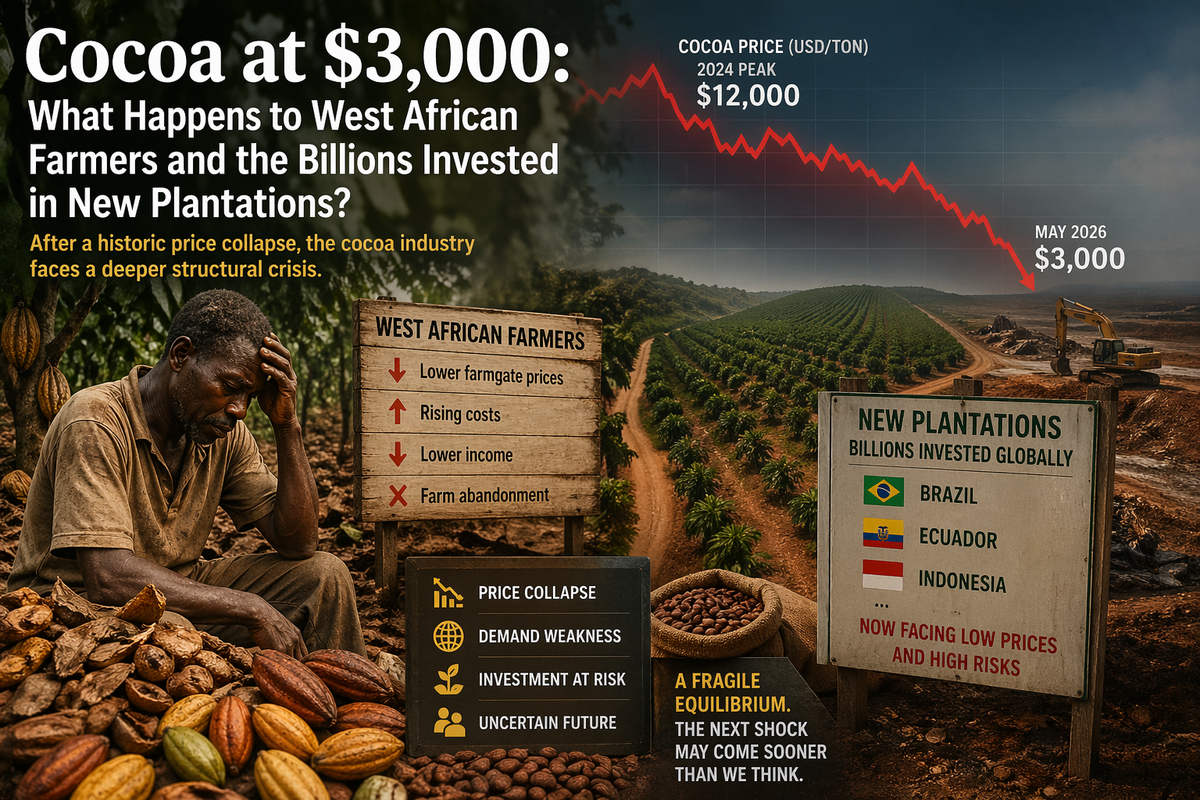
After a historic price collapse, the cocoa industry is entering a deeper structural crisis that goes far beyond the headlines.
When cocoa prices surged to nearly $12,000 per ton in 2024, the global industry reacted exactly as expected. Farmers expanded production, investors committed capital to new plantations, and governments reinforced cocoa as a strategic export.
Two years later, prices have fallen back toward $3,000. The consequences are now starting to materialize across the entire value chain.
At first glance, lower cocoa prices should be positive. Chocolate should become cheaper, demand should recover, and the market should stabilize. That is not what is happening. Instead, the cocoa sector is moving into a more complex and potentially destabilizing phase.
West Africa produces roughly 70 percent of the world’s cocoa. Millions of smallholder farmers depend on it as their primary income source, often operating on very thin margins. When prices fall, the impact is immediate. Farmgate prices are typically reduced, which directly affects farmer income regardless of global price stabilization.
The result is a predictable contraction in farm-level investment. Maintenance declines, use of fertilizers and pest control drops, and yields begin to weaken in subsequent seasons. In more severe cases, farmers shift to alternative crops or abandon cocoa entirely in favor of activities that offer faster or more stable returns.
This creates a structural vulnerability at the origin level. Reduced investment today translates into weaker supply tomorrow.
At the same time, a different problem is developing globally. During the price spike, high cocoa prices triggered aggressive expansion outside traditional producing regions. New plantations were developed in Latin America and parts of Asia, often based on expectations of sustained high prices.
Those expectations are now under pressure. Cocoa plantations require long-term capital commitment. Trees take years to reach maturity, and investment returns depend on stable price environments. With prices falling, financial models deteriorate. Payback periods extend, margins compress, and some projects become economically unviable.
A key question for these large-scale investments is simple: at what price do they actually work? During the boom, many projects assumed a sustained high-price environment. However, real-world data from Brazil suggests a much narrower margin of safety. Moises Schmidt, one of the leading investors behind industrial-scale cocoa farming, stated that his operation would remain profitable at around $4,000 per ton, while prices above $6,000 make cocoa “super profitable” and more attractive than crops like soy or corn. The implication is critical. At current levels near $3,000, a large portion of new projects falls below their economic threshold. This is already visible in the market. Industry estimates indicate that up to half of the planned industrial cocoa projects in Brazil are being delayed, scaled down, or canceled because current prices do not cover the high upfront costs of irrigation, inputs, and infrastructure. In practical terms, this means the expansion narrative that drove global investment is now reversing. Only the most efficient, high-yield operations are likely to continue as planned, while the rest enter a phase of reassessment or quiet withdrawal.
This means that part of the anticipated increase in global cocoa supply may not materialize as expected.
The market is now moving through a classic but intensified commodity cycle. A shortage phase drove prices sharply upward. This triggered expansion and investment. The current phase reflects a correction, where demand has weakened and supply has expanded, leading to a price decline.
The next phase is already forming. Farmers reduce investment or exit the sector, while new investments slow down. This sets the conditions for future supply instability.
Demand dynamics are also shifting. Chocolate manufacturers are responding to cost pressures by adjusting product formulations. This includes reducing cocoa content, modifying recipes, and introducing alternatives.
These changes do not reverse immediately when prices fall. Product reformulation, supply contracts, and pricing strategies introduce a lag. As a result, lower cocoa prices do not automatically translate into higher cocoa consumption. In some cases, the industry uses less cocoa per unit of finished product.
From a processing perspective, these shifts are already visible. Grinding volumes, which serve as a direct indicator of demand, have shown signs of decline in key regions. This reflects real changes in consumption rather than temporary price effects.
Periods of farmer stress also tend to affect raw material quality. Reduced investment at farm level leads to greater variability in bean characteristics, including size, composition, and defect rates. For processors, this translates into lower efficiency, higher energy requirements per ton, and less predictable output in cocoa liquor.
Even as raw material prices decrease, processing does not necessarily become more efficient.
The broader implication is that the cocoa market is not stabilizing in a conventional sense. Pressure is being redistributed across the system. Farmers absorb income losses, investors face declining returns, processors deal with operational inefficiencies, and manufacturers adjust formulations to manage costs.
The result is a more fragile equilibrium.
If farmer exits accelerate, future supply could tighten unexpectedly. If investment slows too sharply, expansion capacity weakens. If demand continues to shift structurally, the traditional relationship between price and consumption becomes less reliable.
The return of cocoa prices to around $3,000 per ton does not mark the end of volatility. It marks the beginning of a new phase in which the underlying structure of the cocoa market is being tested.
The full consequences of this transition may only become clear in the next supply cycle.