
Cameroon Cocoa Output Falls 20% as Ghana Faces Heavy Rain Risk (6 August 2026)


New York cocoa remained under heavy selling pressure on 6 August, with the September 2026 contract settling at $5,776 per tonne, down 1.80% from the previous session. Price action was highly volatile: the contract initially traded as high as $5,830, before selling accelerated and pushed prices to an intraday low of $5,534, representing a 5.1% decline from the session high. Buyers subsequently emerged at the lower levels, allowing the market to recover approximately 4.4% from the intraday low and settle back at $5,776. The strong late-session recovery therefore reduced what had been a much larger intraday decline, although the contract still recorded a second consecutive substantial daily loss.
West Africa — production and supply
Cameroon delivered one of the more important supply-side developments. Marketed cocoa production for the 2025/26 season fell to 247,914 tonnes, down 19.9% from 309,518 tonnes a year earlier and marking the weakest marketed volume in five seasons. Exports fell even more sharply, declining 34.7% to 125,469 tonnes, while domestic processing dropped to 95,946 tonnes from 110,388 tonnes. Europe remained the dominant destination, accounting for around 84.6% of exports. End-of-season stocks, however, increased substantially to 40,447 tonnes from 13,947 tonnes, providing some offset to the otherwise clearly negative production picture. Cameroonian officials also warned that adverse West African weather could contribute to another decline in supply during 2026/27.
Ghana and Côte d’Ivoire — weather remains the main crop risk
Weather remains particularly important in Ghana ahead of the weekend. Ghana Meteorological Agency's weekly outlook calls for the country's middle belt to become mostly cloudy with rain and occasional thunderstorms during the weekend, while the transition zone is expected to see scattered thunderstorms and rain. Forecasts for major cocoa areas including Kumasi, Sunyani and Sefwi Wiawso also show rain or showers through Saturday and Sunday, with the strongest signal around Sunyani, where periods of rain are expected on Sunday.
The rainfall requires close monitoring because Ghana's crop has already been affected by excessive rain, disease and weak pod development. COCOBOD currently expects 2026/27 production to fall by at least 16%, with Western and Western North particularly affected by low cherelle counts, disease and previous heavy rainfall. Additional moderate rain would still support soil moisture, but a prolonged period of heavy precipitation and persistent cloud cover would increase concerns over black pod disease, flower and cherelle loss, spraying difficulties and reduced sunlight. This would be supportive for cocoa prices.
Conditions in Côte d’Ivoire remain related but slightly different. Farmers have recently said the developing main crop now needs more sunshine, following cooler and relatively cloudy conditions. Consequently, another spell of widespread cloudiness or excessive rainfall across the West African cocoa belt would reinforce concerns that the crop is receiving moisture but insufficient sunlight for optimal pod development and ripening.
El Niño
The broader climate backdrop has also become more important. NOAA currently has an El Niño Advisory in place and expects El Niño to strengthen through the remainder of 2026, with a 97% probability that it persists into early spring 2027 and an 81% probability of a very strong event during October–December. The Financial Times has highlighted cocoa among the agricultural markets particularly exposed to an intensifying El Niño because of the potential for disruptive rainfall and temperature patterns in West Africa. This does not automatically imply lower cocoa production, but it increases the probability of weather volatility during an already vulnerable stage of the Ghanaian and Ivorian crop cycle.
Nigeria — export quality and value addition
Nigeria continues to focus on improving the quality, traceability and competitiveness of its cocoa exports. Authorities are stepping up efforts to reduce export rejections by strengthening certification, grading and quality-control standards, while the National Cocoa Management Committee continues to identify traceability and improved bean quality as important factors in increasing the competitiveness and value of Nigerian cocoa in international markets.
At the same time, Nigeria is accelerating its strategy of processing more cocoa domestically rather than relying primarily on raw-bean exports. One important clarification is that the Nigerian government subsequently stated that it is encouraging local processing rather than imposing a blanket ban on raw cocoa exports, despite earlier reports suggesting otherwise. This remains more important for the medium- and long-term structure of trade flows than for immediate global cocoa availability.
Asia — Indonesia seeks to rebuild cocoa production
Indonesia is attempting to reverse a long decline in domestic cocoa production. The country has introduced an export levy intended to finance replanting, improved seedlings and productivity programmes after years of ageing trees, pests and underinvestment. Indonesia's 11 cocoa processors have capacity exceeding 750,000 tonnes annually, but are operating at only around 60% because domestic bean production has declined and processors have become increasingly reliant on imports. The programme could eventually add meaningful global supply, but the effect will be gradual because newly planted cocoa trees require years before reaching significant yields. The development is therefore potentially bearish for the longer-term cocoa balance, but has little immediate effect on 2026/27 availability.
Chocolate industry and demand
Mondelēz International announced an expanded 2026 Christmas confectionery range, including new Cadbury Dairy Milk Biscoff products, Smash Baubles and returning seasonal lines across Cadbury and Oreo. The company is positioning retailers for an early seasonal sales period beginning in September, followed by the major gifting period in December. The breadth of new launches is a modestly constructive signal for chocolate merchandising and seasonal demand, but it should not be interpreted on its own as evidence of stronger cocoa grindings.
The broader Mondelēz demand picture remains mixed. In Q2 2026, company-wide volume/mix increased 0.7%, with stronger performance in emerging markets and North America, while European volume/mix declined 2.1%. The festive programme therefore appears partly designed to support consumer engagement and volume recovery in an environment where European chocolate demand remains comparatively weak.
Other relevant development — protection of Ghanaian cocoa farms
Ghana's parliament has also approved legislation designed to make it significantly harder to convert cocoa farms to other uses, particularly illegal gold mining. The measure is intended to protect productive cocoa acreage from continued losses to galamsey, which has become an important structural constraint on Ghanaian production. The effect on near-term output is limited, but if effectively enforced it could help slow the continued erosion of Ghana's productive cocoa area over the medium term.
Futures performance
New York cocoa
New York cocoa extended the previous session’s decline on 6 August, although the losses were considerably smaller than the sharp sell-off recorded on 5 August. September 2026 recorded a last trade of $5,723 per tonne, falling $125, or 2.14%, from 5 August. May 2027 registered the largest percentage decline among the five nearest contracts, losing $156, or 2.57%.
| CONTRACT | 5 AUG | 6 AUG | CHANGE | CHANGE % |
|---|---|---|---|---|
| Sep-26 | $5,848 | $5,723 | -$125 | -2.14% |
| Dec-26 | $5,969 | $5,829 | -$140 | -2.35% |
| Mar-27 | $6,055 | $5,911 | -$144 | -2.38% |
| May-27 | $6,067 | $5,911 | -$156 | -2.57% |
| Jul-27 | $6,045 | $5,940 | -$105 | -1.74% |
Unlike the previous session, however, the final recorded trades were positioned well above the daily lows. The five nearest contracts finished approximately 60%–77% of the way through their respective daily ranges. They were only $55–$107 below their session highs, while remaining $160–$189 above the reported lows.
This indicates that although selling pressure remained substantial and prices recorded another broad-based decline, the market recovered significantly from its intraday lows before the final recorded trades. The session therefore differed from 5 August, when prices finished much closer to the bottom of their ranges.
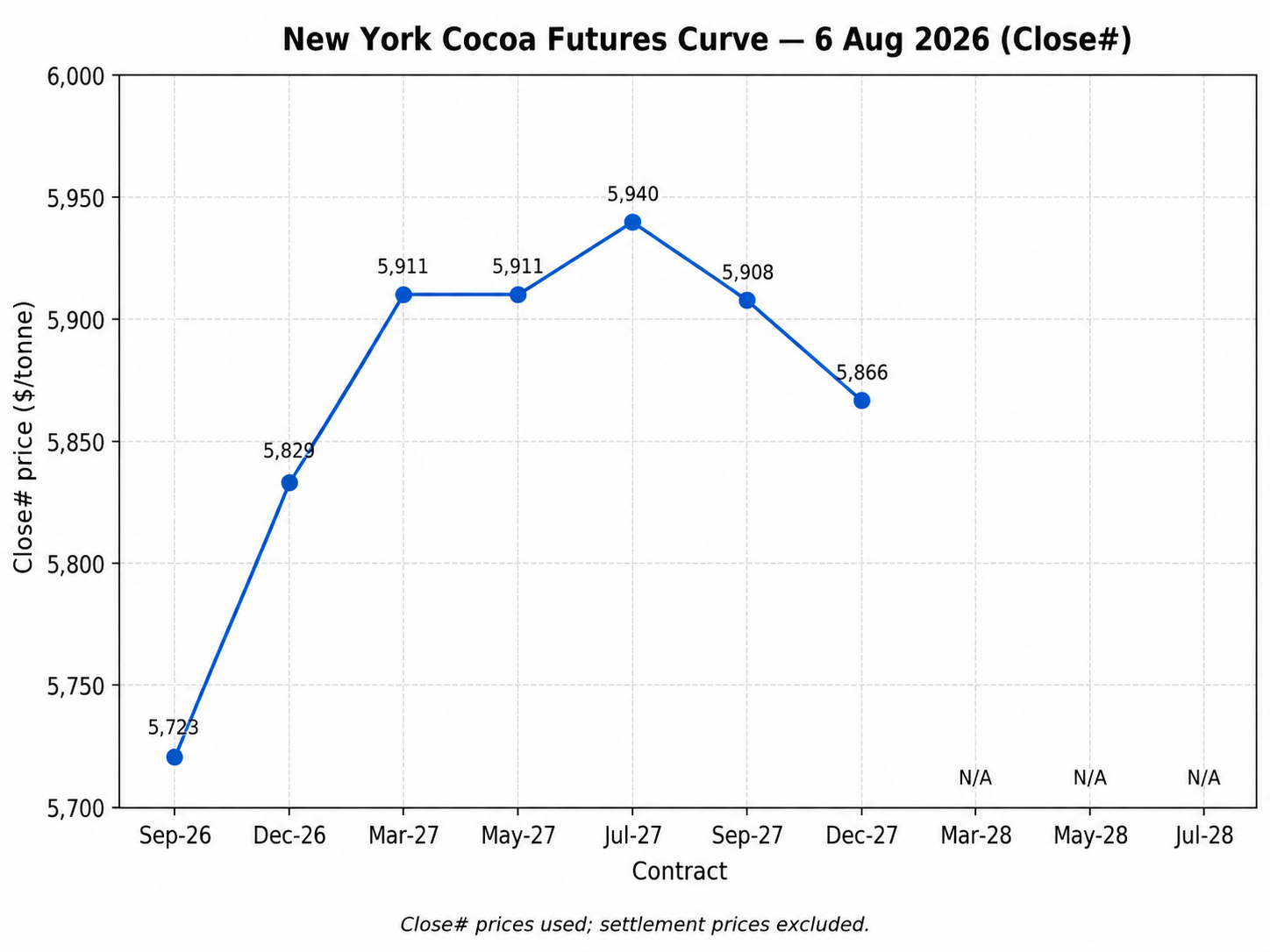
July 2027 became the highest-priced nearby contract at $5,940 per tonne. The curve rose from $5,723 in September to $5,829 in December and $5,911 in March. May remained unchanged from March at $5,911 before the curve increased modestly to $5,940 in July. It then moved into backwardation, declining to $5,908 in September and $5,866 in December 2027.
The September-to-May premium narrowed from $219 to $188 per tonne. The September-to-December contango also contracted further, from $121 to $106 per tonne.
A notable change occurred between May and July. On 5 August, July traded at a $22 discount to May. On 6 August, July instead finished $29 above May, shifting the highest point of the nearby curve from May into July. The July-to-September backwardation remained at $32 per tonne, while December traded $74 below July.
Despite another outright decline, the front of the New York curve therefore remained in contango. At the same time, the reduction in the September-to-May premium indicates continued flattening of the nearby structure. The subsequent backwardation beyond July remains considerably less pronounced than would normally be associated with an acute near-term shortage.
London cocoa
London cocoa also recorded a broad decline on 6 August, with losses much larger than those seen during the previous session. September 2026 registered a last trade of £4,248 per tonne, falling £104, or 2.39%, from 5 August.
September recorded the largest percentage decline among the five nearest contracts. March and May experienced the largest declines in absolute terms, each losing £105 per tonne.
| CONTRACT | 5 AUG | 6 AUG | CHANGE | CHANGE % |
|---|---|---|---|---|
| Sep-26 | £4,352 | £4,248 | -£104 | -2.39% |
| Dec-26 | £4,383 | £4,280 | -£103 | -2.35% |
| Mar-27 | £4,478 | £4,373 | -£105 | -2.34% |
| May-27 | £4,477 | £4,372 | -£105 | -2.35% |
| Jul-27 | £4,464 | £4,376 | -£88 | -1.97% |
As in New York, the last recorded London trades recovered substantially from the lows reached during the session. The five nearest contracts finished approximately 62%–72% of the way through their respective daily ranges. They remained only £59–£100 below the reported highs while finishing £151–£163 above the session lows.
This suggests that the decline was accompanied by significant intraday volatility. Selling pressure pushed prices sharply lower during the session, but a meaningful recovery subsequently developed before the final trades were recorded.
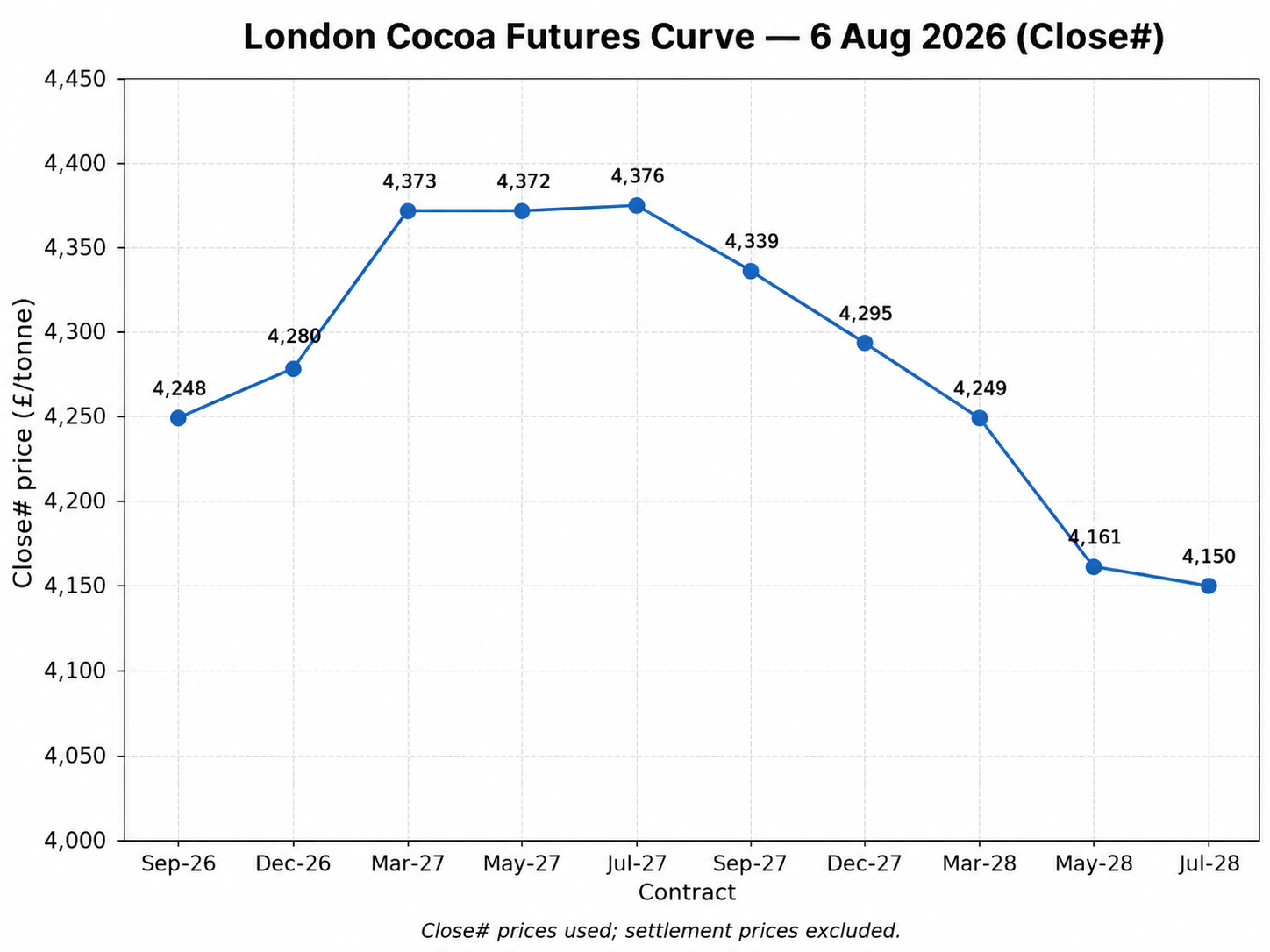
The front of the London curve continued to show contango. September closed at £4,248, December at £4,280 and March at £4,373. The curve then became almost completely flat through the middle of 2027, with May at £4,372 and July marginally higher at £4,376.
From July onward, however, the structure moved progressively into backwardation. September 2027 closed at £4,339, December at £4,295, March 2028 at £4,249, May at £4,161 and July 2028 at £4,150.
The September-to-May premium remained almost unchanged, narrowing only £1 from £125 to £124 per tonne. The September-to-December contango increased marginally from £31 to £32.
Further along the curve, however, the backwardation became noticeably less pronounced. The May-to-September premium narrowed from £50 to £33 per tonne, while the May-to-December premium contracted from £116 to £77.
The London curve therefore displayed relatively little change in its front structure despite the substantial outright price decline. Contango remained present across the nearby contracts, followed by a relatively flat March-to-July section and progressively lower deferred prices thereafter.
Overall, the sharp divergence between New York and London seen on 5 August largely disappeared on 6 August. Percentage losses were broadly comparable across the two markets: the September contract declined 2.14% in New York and 2.39% in London. Both markets also recovered materially from their intraday lows before the final recorded trades, indicating that the session represented another significant downward repricing, but not the same type of close-at-the-lows liquidation seen one day earlier.
US–UK Spread
(Sep Contract)
$5,723 − (£4,248 x 1.345$/£) =$9ton (up from $-9 ton )
Volume and Open Interest
New York cocoa
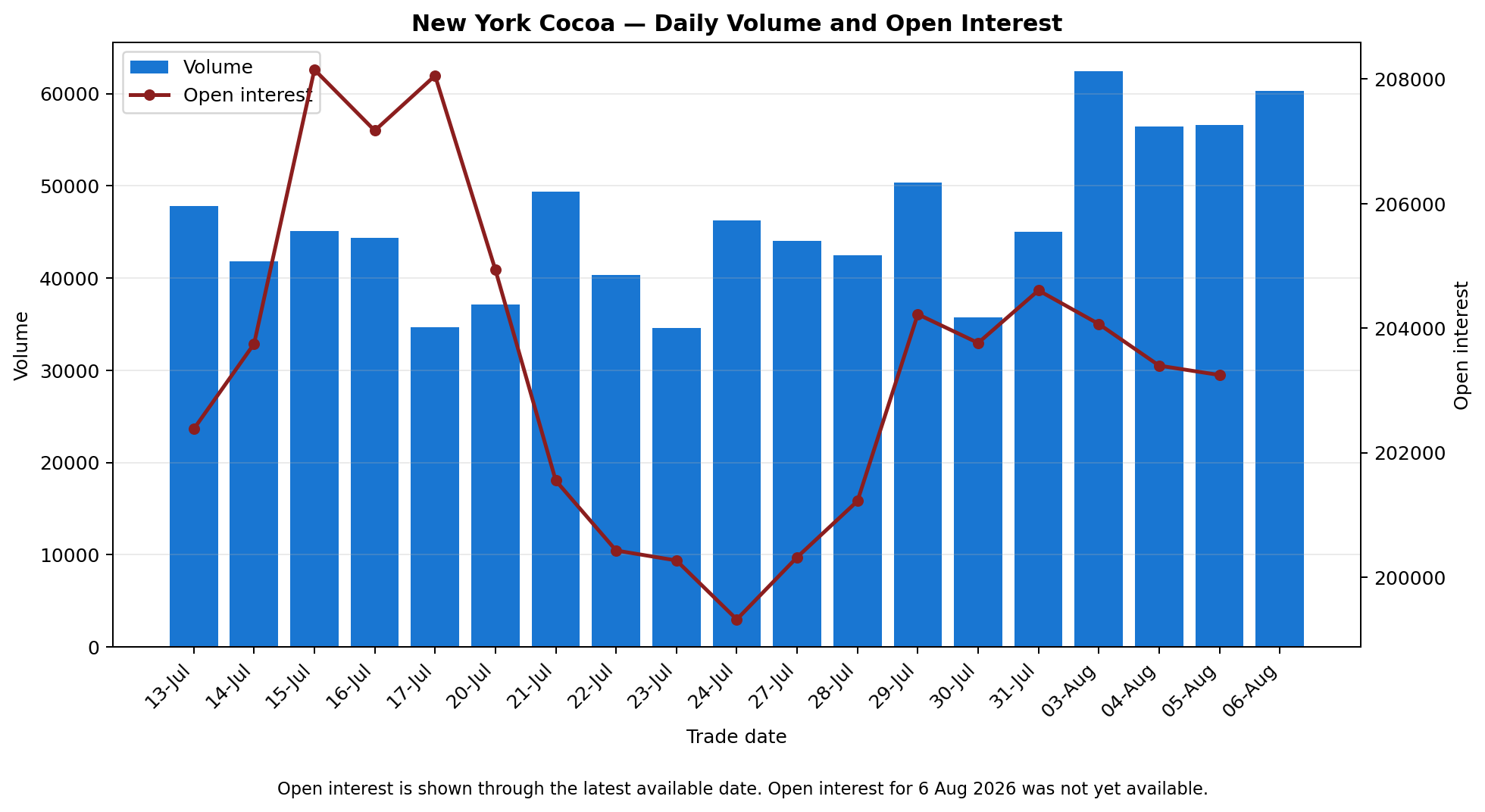
New York cocoa volume increased further on 6 August, confirming that the second consecutive sharp decline in prices took place on very active trade rather than on thin market participation. Daily volume reached 60,286 contracts, up 3,701 contracts, or 6.5%, from 56,585 on 5 August.
This was also one of the strongest trading sessions. Volume did not exceed the recent peak of 62,458 contracts recorded on 3 August, but it was the second-highest reading in the sample. It also stood approximately 33.0% above the average of the preceding 15 sessions, indicating that market participation remained exceptionally strong even as prices extended their decline.
This suggests that the additional weakness seen on 6 August was accompanied by substantial market engagement. In other words, the market was not simply drifting lower on reduced liquidity; rather, the move reflected another session of heavy trading activity, with participants continuing to reposition aggressively after the volatility seen earlier in the week.
The latest available observation was 203,247 contracts on 5 August, compared with 203,398 contracts on 4 August. This represents a modest decline of 151 contracts.
London cocoa
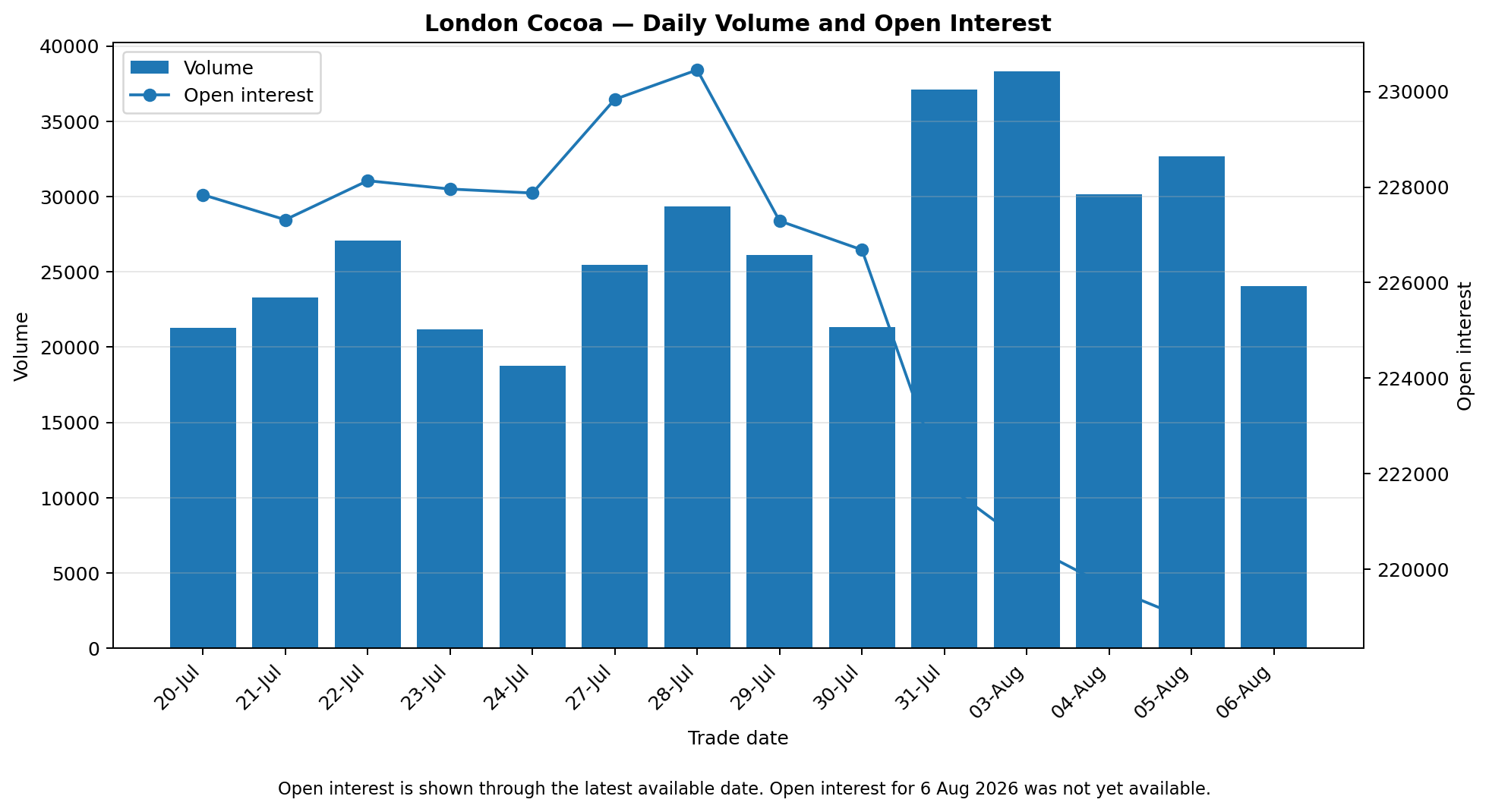
London cocoa volume moved lower on 6 August, indicating a much less aggressive trading session than in New York despite the continued weakness in prices. Daily volume reached 24,030 contracts, down 8,666 contracts, or 26.5%, from 32,696 on 5 August.
Although the session remained active in absolute terms, turnover was clearly softer than on the previous several trading days. Based on the available sample, volume was approximately 11.3% below the average of the prior 13 sessions, suggesting that trading participation moderated noticeably as the market moved lower.
This suggests that the London decline on 6 August occurred on a less forceful participation profile than the corresponding move in New York. Whereas New York registered another very high-volume session, London volume eased back significantly, implying that the price decline may have reflected a less aggressive round of trade, with lighter participation from market actors.
The latest available figure was 218,919 contracts on 5 August, compared with 219,621 contracts on 4 August. This represents a decline of 702 contracts.
The broader pattern in London open interest has been notably softer. Open interest rose to 230,455 contracts on 28 July, then declined to 227,292 on 29 July, 226,686 on 30 July, 221,793 on 31 July, 220,518 on 3 August, 219,621 on 4 August, and 218,919 on 5 August. In other words, open interest has been falling steadily and the latest available reading stands 11,536 contracts below the late-July peak, making it the lowest level in the period shown.
This may indicate that the recent activity in London has been characterised more by liquidation or position reduction than by fresh build-up in outright exposure. However, as with New York, it is still too early to draw a firm conclusion about 6 August itself until the official open-interest figure becomes available. For now, the combination of lower volume on the day and falling open interest through 5 August points to a market where participation has been softening rather than intensifying.
Exchange Trading Volume
| Exchange | 5 Aug 2026 | 6 Aug 2026 | Change | % Change |
|---|---|---|---|---|
| ICE U.S. Cocoa | 3,384,956 | 3,365,988 | -18,968 | -0.56% |
| ICE Europe Cocoa | 1,149,063 | 1,145,938 | -3,125 | -0.27% |
| Combined | 4,534,019 | 4,511,926 | -22,093 | -0.49% |
Readers can explore detailed cocoa market datasets, futures statistics, and historical indicators in the CocoaIntel Data Hub:
 Cocoa Intel
Tomorrow's Outlook
My expectation for the next session is for New York cocoa to attempt a moderate rebound from the 6 August close of 5,776, although some early weakness or consolidation around 5,700–5,750 remains possible. After two heavy sell-offs, short-term momentum appears increasingly exhausted while the market has shown an ability to recover from intraday lows, making a move back toward 5,850–5,950 more likely than another immediate sharp decline. Overall, I would expect a volatile but firmer session, with the September contract most likely closing moderately higher than 5,776, provided the 5,650–5,700 area holds.
If you notice any discrepancies in these figures or have extra information, please email hello@cocoaintel.com or leave a comment – corrections and additional insights are always welcome.