
Cocoa Consolidates at Key Support as Rebound Fades (30 September 2026)


New York December cocoa surrendered an early recovery on Wednesday, 30 September, after reaching $5,505/t, up 2.82% from Tuesday’s last-traded close. Selling subsequently pushed the contract to $5,292, testing support around $5,300, while a later recovery towards $5,400 also faded. The last-traded close was $5,338/t, down $16 (−0.30%), leaving December just $46 above its low, in the bottom 22% of its $213 daily range. The official settlement fell $41 (−0.76%) to $5,367/t. Despite the modest decline in the last-traded close, the failed rebound and weak finish showed persistent selling into rallies, leaving the ascending-channel support area under pressure.
Côte d’Ivoire’s producer dispute expands to residual-stock collection
SYNAP-CI raised fresh objections on 30 September to arrangements for collecting residual cocoa stocks. President Moussa Koné said a circular received by the union specified neither the quantities concerned nor the purchase price and lacked the Conseil du Café-Cacao director-general’s signature. These remain the union’s allegations. The dispute adds uncertainty over the terms and timing of stock clearance, while Koné’s claims of disruption to port arrivals remain unconfirmed by operators or the authorities. The new development concerns collection arrangements within the existing strike, which began on 16 September.
Ghana’s regulator reportedly reaches compromise with local traders
Africa Intelligence reported on 30 September that COCOBOD had reached a compromise with local traders during a meeting on 28 September, against outstanding bills of nearly €300 million from the 2025/26 season. This provides a new development in the purchasing-liquidity dispute, although the publication’s publicly available summary does not disclose the agreement’s terms or confirm that payments have been made. Its practical significance will depend on implementation: an agreement could help restore purchasing capacity if it releases working capital, but the report does not establish that financing constraints have been resolved.
Indonesia’s cocoa council highlights uneven benefits for growers
In comments published by Bisnis on 30 September, Indonesian Cocoa Council chairman Soetanto Abdullah said international price gains had been only partly reflected in growers’ returns. He cited prices of approximately Rp70,000–80,000/kg in Lampung and called for improved farm management, input support, market information and transport infrastructure. The comments highlight constraints on farmers’ ability to reinvest and improve productivity. The quoted range is an industry assessment for a producing region, rather than a national price benchmark or a new production forecast.
Brazil’s Cacau Show increases Christmas production
Cacau Show has increased panettone production by approximately 20% for Christmas 2026, from 10 million units last year to more than 12 million, Veja reported on 30 September. Initial seasonal sales have already begun across its retail network. The expansion provides a positive company-level signal for seasonal output, although it cannot be translated directly into additional cocoa demand: the assortment includes both fruit and chocolate products, and neither cocoa usage nor consumer sales volumes was disclosed.
Weather concerns continue to compete with weak demand
Dealers cited by Reuters said more rain was needed for the main crops in Côte d’Ivoire and Ghana, while weak demand and a large global surplus from 2025/26 continued to weigh on the market. Their assessment highlights the distinction between risks to the developing crop and the availability of cocoa already produced. Weather concerns could support prices, but the commentary provides no new quantified crop loss or evidence that the existing surplus has been absorbed.
Futures Performance
New York cocoa
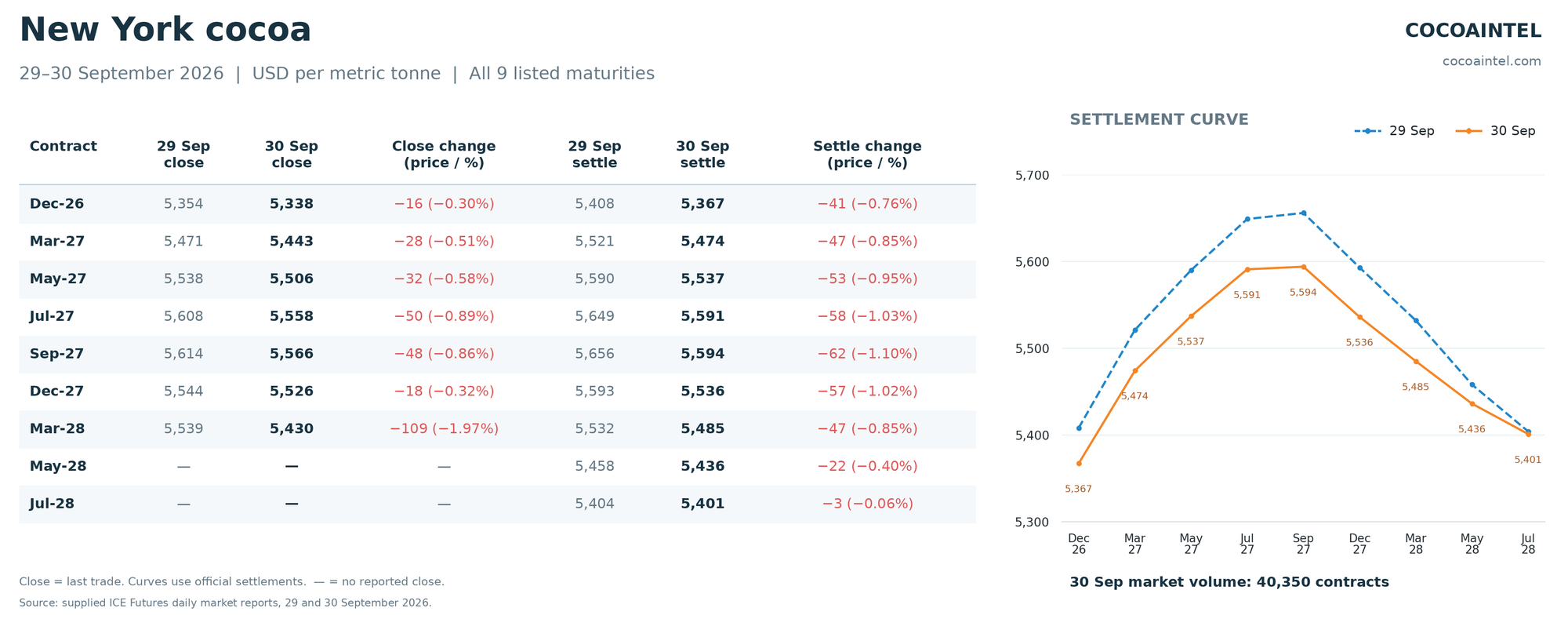
New York weakened across all seven available last-traded closes on Wednesday. December closed at $5,338/t, down $16 (−0.30%), while July and September 2027 lost 0.89% and 0.86%, respectively. March 2028 recorded the largest decline at 1.97%, although turnover of only 170 contracts limits the strength of that signal. December’s failed recovery to $5,505 and finish in the bottom 22% of its daily range showed that buyers remained unable to sustain higher prices.
The settlement curve declined across all nine maturities, with December settling at $5,367, down 0.76%. Nearby cocoa nevertheless strengthened relative to the main 2027 contracts: Dec/Mar contango narrowed from $113 to $107/t and Dec/Jul from $241 to $224/t. The curve retained its September 2027 peak at $5,594. The narrower nearby discounts indicate relative resilience in December during a broader decline. However, the curve remains in contango into September 2027, and spread tightening alone does not establish an outright price reversal.
London cocoa
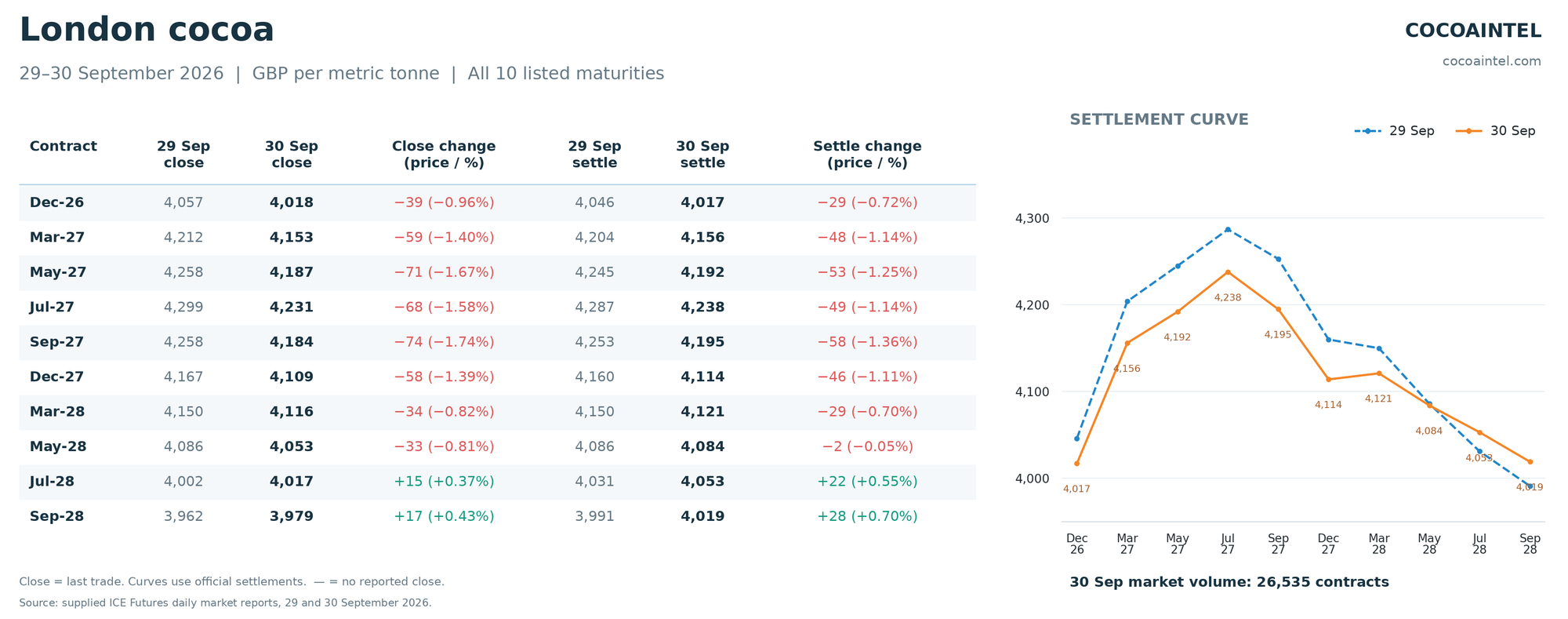
London declined across eight of its ten last-traded closes. December closed at £4,018/t, down £39 (−0.96%), while September 2027 underperformed with a 1.74% decline. December recovered from £3,938 to finish around the middle of its daily range, showing better recovery from the lows than New York. July and September 2028 gained 0.37% and 0.43%, respectively, but combined turnover of just 75 contracts provides limited confirmation of broader buying interest.
The settlement curve also fell across eight maturities, with December settling at £4,017, down 0.72%. Dec/Mar contango narrowed from £158 to £139/t and Dec/Jul from £241 to £221/t, as nearby cocoa held up better than the principal 2027 contracts. July 2027 remained the curve’s peak at £4,238. The narrowing discounts show that December held up better than the principal 2027 contracts, while mid-2027 delivery continues to command a substantial premium.
NY–London Dec-26 Spread
| Contract | NY close 29 Sep | London close 29 Sep | Spread 29 Sep | NY close 30 Sep | London close 30 Sep | Spread 30 Sep | Change |
|---|---|---|---|---|---|---|---|
| Dec-26 | $5,354 | £4,057 | −$14.22 | $5,338 | £4,018 | +$6.52 | +$20.74 |
| Mar-27 | $5,471 | £4,212 | −$102.32 | $5,443 | £4,153 | −$67.62 | +$34.70 |
| May-27 | $5,538 | £4,258 | −$96.19 | $5,506 | £4,187 | −$49.73 | +$46.46 |
| Jul-27 | $5,608 | £4,299 | −$80.44 | $5,558 | £4,231 | −$56.11 | +$24.32 |
| Sep-27 | $5,614 | £4,258 | −$20.19 | $5,566 | £4,184 | +$14.25 | +$34.44 |
| Dec-27 | $5,544 | £4,167 | +$30.23 | $5,526 | £4,109 | +$73.77 | +$43.54 |
| Mar-28 | $5,539 | £4,150 | +$47.72 | $5,430 | £4,116 | −$31.52 | −$79.24 |
$5,338 − (£4,018 × 1.3269) = +$6.52/t.
New York December moved from a $14.22/t discount to a $6.52/t premium, improving by $20.74/t as London’s last-traded close declined more sharply. At Tuesday’s exchange rate, the futures-price changes would have improved the spread by $35.60/t: New York fell $16, while London’s £39 decline equated to $51.60. Sterling’s appreciation increased London’s dollar-equivalent value, offsetting $14.87/t of that improvement. December consequently returned close to parity.
New York strengthened relative to London across six of the seven comparable maturities. Discounts narrowed in March, May and July 2027, while September moved into a modest premium. March 2028 was the exception, moving from a $47.72 premium to a $31.52 discount as its New York last trade underperformed. The broad improvement indicates relative resilience in New York during another session of falling prices.
Volume and Open Interest
New York cocoa
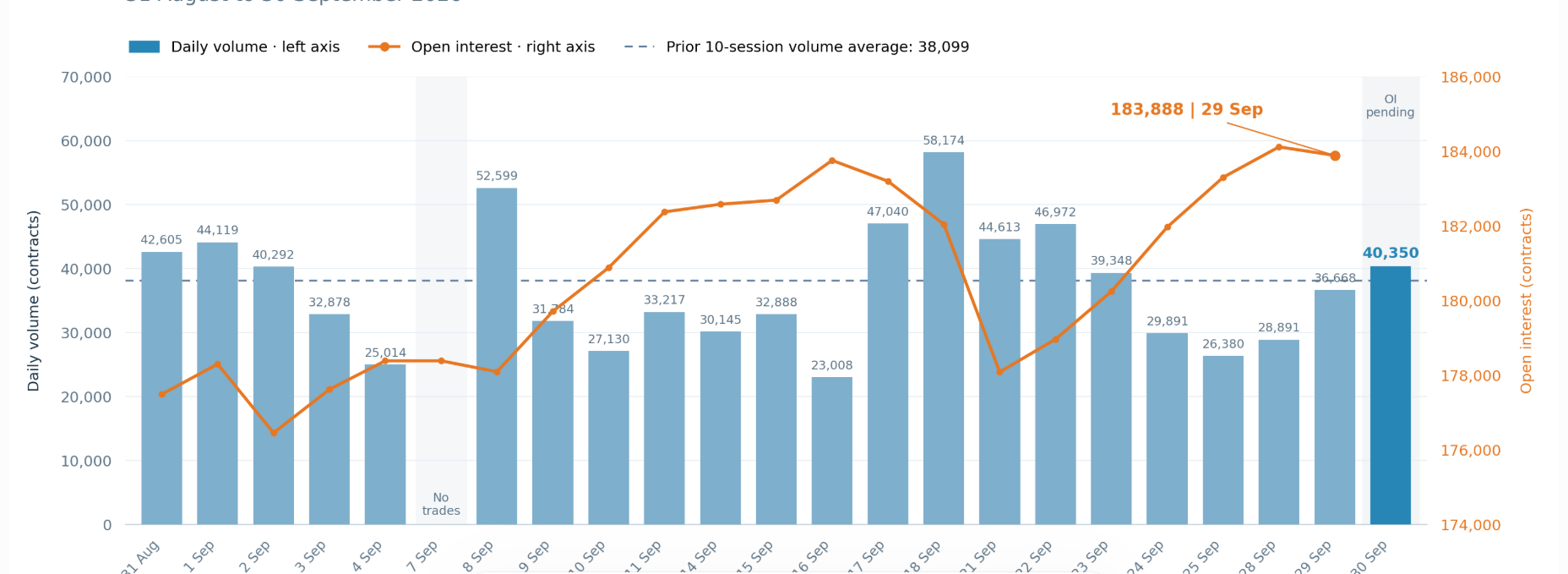
New York turnover increased to 40,350 contracts on Wednesday, 30 September, up 10.0% from Tuesday’s 36,668 and 5.9% above the preceding 10-session average of 38,099. December’s failed rebound and lower close occurred alongside stronger market-wide activity, reinforcing the evidence that sellers continued to cap recoveries. Participation strengthened, although the increase above the recent average was modest.
Open interest edged down 228 contracts (−0.12%) to 183,888 on 29 September, ending five consecutive increases. Tuesday’s sharp price decline therefore coincided with only limited net position reduction. OI remained 5,803 contracts above its 21 September level, meaning most of the subsequent expansion in outstanding exposure remained intact. The figures are consistent with some position unwinding, but do not establish that liquidation was extensive or that selling pressure has been exhausted. Further adjustment remains possible if price support fails.
London cocoa
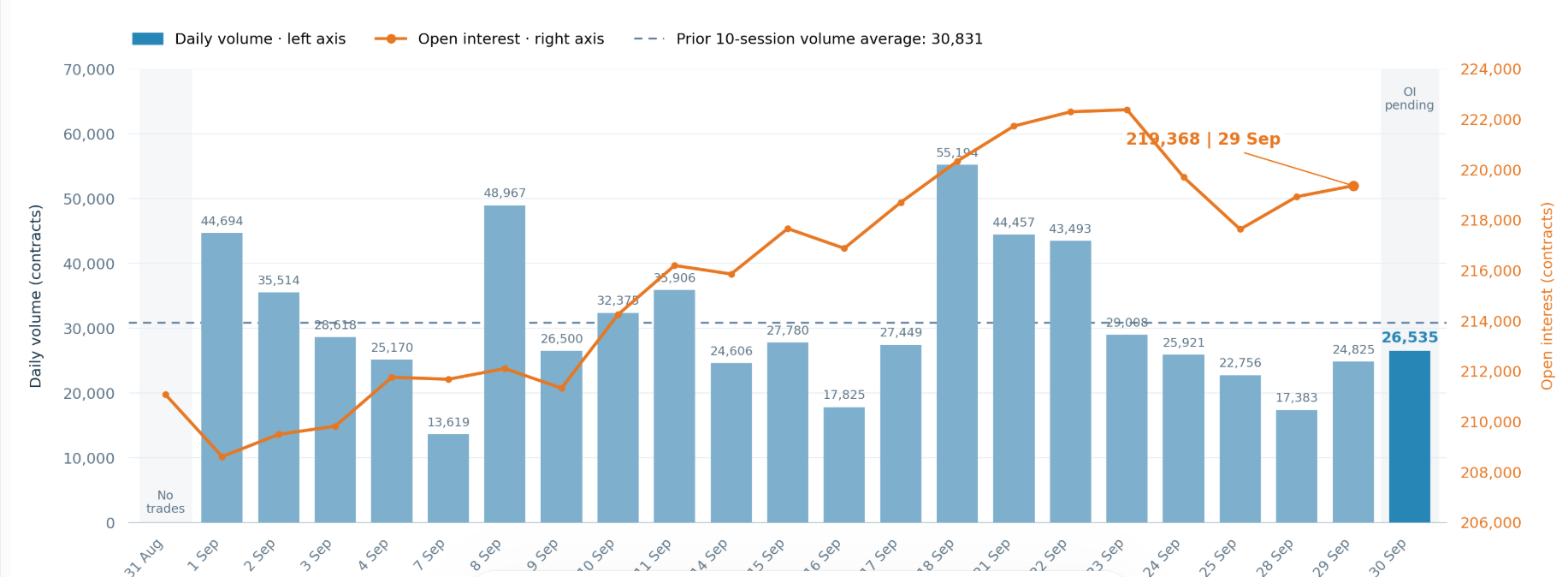
London turnover rose to 26,535 contracts on Wednesday, up 6.9% from Tuesday’s 24,825. Activity nevertheless remained 13.9% below the preceding 10-session average of 30,831. The lower close attracted increased participation, but volume provided more restrained confirmation of selling pressure than in New York.
Open interest increased 435 contracts (+0.20%) to 219,368 on 29 September, its second consecutive rise and a cumulative increase of 1,728 contracts since 25 September. Outstanding positions expanded during Tuesday’s decline, showing that new exposure was being established as prices weakened. This is consistent with fresh selling pressure, although aggregate OI cannot identify which participants initiated those positions. Further price weakness accompanied by rising OI would strengthen the continuation case; the latest modest increase alone does not establish aggressive short accumulation.
ICE Cocoa Stocks
| Market | Stock measure | Previous update | Latest update | Change | Change % |
|---|---|---|---|---|---|
| US | Total stocks in ICE-licensed warehouses | 3,467,854 bags | 3,481,504 bags | +13,650 bags | +0.39% |
| US | Certified stocks, included in warehouse total | 738,381 bags | 738,381 bags | 0 | 0.00% |
| London / Europe | Valid-warrant stocks, bag equivalents | 1,185,313 bags | 1,185,313 bags | 0 | 0.00% |
US warehouse stocks increased by 13,650 bags on Wednesday, 30 September, marking a third consecutive rise and bringing the cumulative increase since Friday to 48,748 bags (+1.42%). Certified stocks remained unchanged at 738,381 bags, representing 21.2% of the warehouse total.
London valid-warrant stocks remained unchanged at approximately 1,185,313 bag equivalents in the latest available report, dated 29 September.
The inventory cushion is substantially larger than a year ago. US warehouse holdings were 76.5% higher on 30 September, while certified stocks were up 136.0%. London valid-warrant stocks were 122.3% above their year-earlier level in the latest comparable reading. This rebuilding gives the market greater capacity to absorb potential crop weakness, although the extent of that protection depends on the size and duration of any production shortfall.
Thursday Trading Setup — ICE Futures U.S. Cocoa December 2026
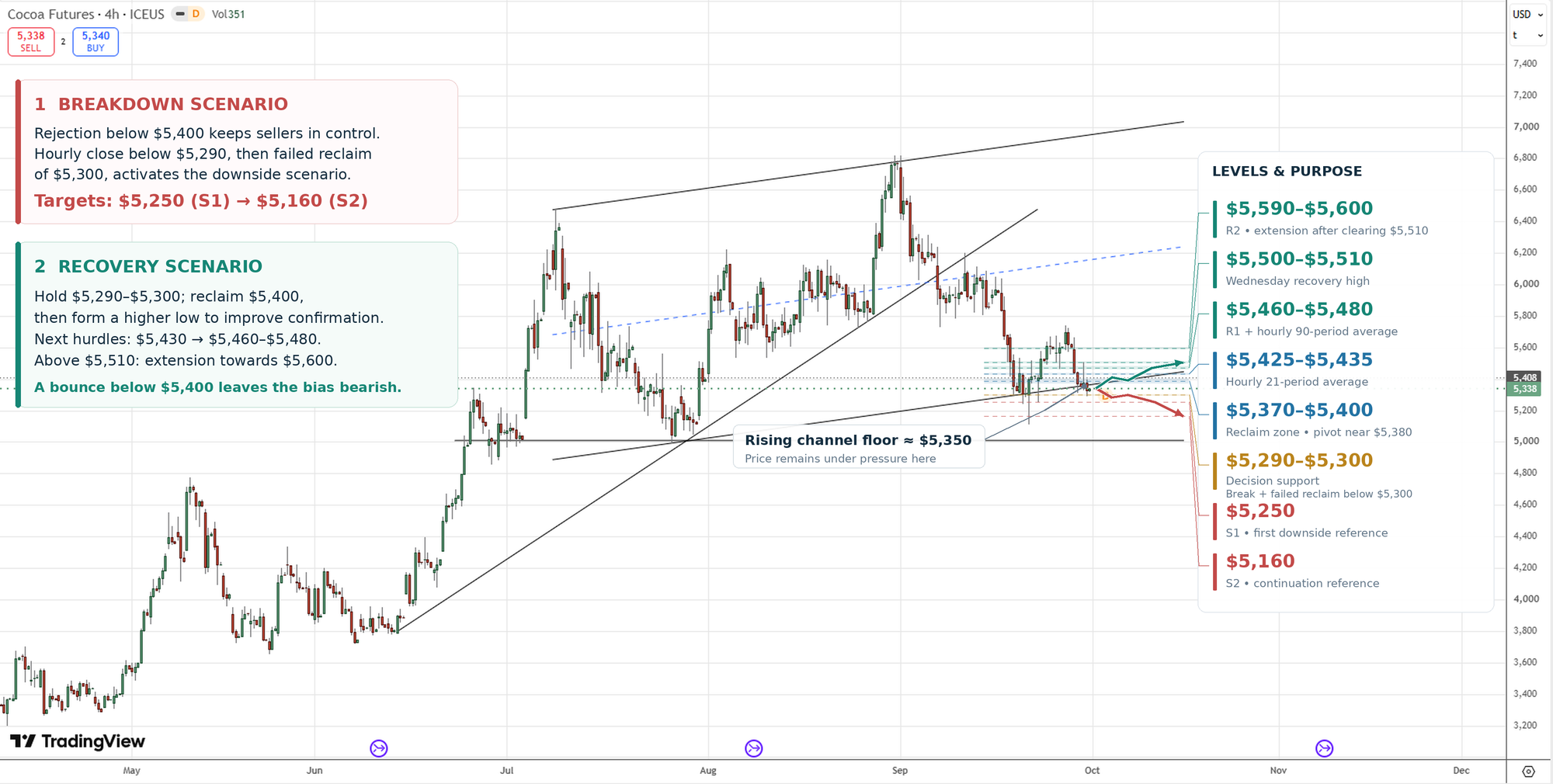
December cocoa enters Thursday, 1 October, with a bearish bias below $5,370–$5,400, where Wednesday’s VWAP, short hourly averages and the provisional pivot near $5,380 converge. The failed recovery towards $5,500 leaves the market pressing below the previously identified ascending-channel support around $5,350. Price remains below its daily 90-period average, while hourly RSI below 50, negative MACD and weak hourly OBV favour another test of $5,290–$5,300. An hourly close below that area, followed by a failed reclaim, would strengthen the continuation case towards $5,250, near calculated S1, and subsequently $5,160, near S2. Holding support alone would leave the broader bearish structure intact.
A corrective bounce remains possible: five-minute MACD and stochastic have improved, OBV has recovered, and contracting intraday ATR indicates consolidation after the sell-off. For that improvement to carry into Thursday, buyers need to defend $5,290–$5,300 and reclaim $5,370–$5,400, then establish a higher low. That would open $5,425–$5,435, around the hourly 21-period average, followed by $5,460–$5,480, where calculated R1 overlaps the hourly 90-period average. Sustained trading above this cluster would improve the prospect of retesting $5,500–$5,510; clearing Wednesday’s recovery high would weaken the immediate bearish case and expose $5,590–$5,600, around R2. Until those resistance levels are recovered, rallies remain vulnerable to renewed selling.
If you notice any discrepancies in these figures or have extra information, please email hello@cocoaintel.com or leave a comment – corrections and additional insights are always welcome.