
Cocoa consolidation continues as expectations of a breakout build (24 August 2026)


Cocoa began the week under renewed selling pressure, although both markets recovered substantially from their intraday lows. In New York, the December contract briefly traded above $6,000 and reached a session high of $6,007 before falling sharply to $5,775, close to the lower boundary of the developing triangle. Prices subsequently recovered to finish at $5,929, down $52, or 0.87%, from 21 August. London followed a similar pattern, with the December contract retreating from £4,334 to a low of £4,172 before rebounding to £4,291, a decline of £29, or 0.67%.
Main-Crop Weather Concerns
Rainfall was below average across most of Ivory Coast’s cocoa-growing regions last week. Farmers reported that stronger and more regular rainfall will be required to support the September-to-February main crop. Sunny periods have helped crop development, but insufficient moisture could limit bean size, concentrate harvesting between November and January, and cause production to decline more sharply by late December.
Rainfall shortages were particularly notable in key western and central-growing areas. Soubré received approximately 2 millimetres of rain, around 12.8 millimetres below its five-year average, while Daloa recorded only 1.3 millimetres—23.3 millimetres below average.
Rainfall Forecast
The latest rainfall forecast indicates more widespread precipitation across the West African cocoa belt through the end of August. This could provide some relief to developing pods, although the distribution and frequency of rainfall will be more important than headline accumulation totals. Several consecutive weeks of regular rain would be needed to materially improve the main-crop outlook.
Ivory Coast Arrivals
Cocoa arrivals at ports in Ivory Coast reached 1.999 million tonnes between the start of the season on 1 October and 23 August, representing a 20.2% increase from the same period last season. However, arrivals during 17–23 August slowed sharply to approximately 3,000 tonnes, compared with 10,000 tonnes during the equivalent week a year earlier. The reduced flow may partly reflect the transition between crop years, as the current intermediate campaign, under which the guaranteed farmgate price is 1,200 FCFA per kilogram ends on 31 August and the 2026/27 main campaign begins on 1 September. A new guaranteed price is expected to be announced for the main campaign, although no official figure has yet been released. Some producers or cooperatives may therefore be postponing deliveries until the new rate takes effect, particularly if they expect a higher price. This remains a plausible seasonal explanation rather than a confirmed cause of the weaker arrivals.
Cocoa Demand Outlook
Guan Chong, the world’s fourth-largest cocoa grinder, reported that second-quarter net profit increased to RM253.02 million from RM48.20 million a year earlier. Revenue nevertheless fell 53.6% to RM1.80 billion as cocoa-product selling prices declined. The profit improvement primarily reflected raw-material purchasing, ingredient pricing and lower financing costs, not confirmed growth in processing volumes. More importantly, management expects chocolate demand to recover gradually during the second half of 2026, particularly in the fourth quarter, as lower cocoa inflation improves affordability. The company also expects premium chocolate and a shift back from substitutes toward real chocolate to support longer-term demand. This represents a cautiously bullish demand signal, although it does not yet confirm that grindings have recovered.
Ghana Targets More Processed-Cocoa Exports
At the Ghana–China Joint Commission, Ghana’s finance minister called for increased exports of processed cocoa and greater Chinese investment in processing factories, technology transfer and workforce training. The announcement has little immediate price impact, but it supports Ghana’s longer-term strategy of processing more cocoa domestically rather than exporting raw beans.
Mandatory Producer Card in Côte d’Ivoire
Côte d’Ivoire reiterated that all cocoa purchases and sales will require a digital producer card from 1 September. Payment terminals will verify transactions, while sealed bags will support traceability from farms to export ports. The policy was originally announced in June, so it is not entirely new, but the approaching implementation date could create temporary logistical disruption if some producers remain unregistered.
Futures performance
New York cocoa
| Contract | 21 Aug | 24 Aug | Change | Change % |
|---|---|---|---|---|
| Sep-26 | $5,901 | $5,801 | -$100 | -1.69% |
| Dec-26 | $5,981 | $5,929 | -$52 | -0.87% |
| Mar-27 | $6,066 | $6,010 | -$56 | -0.92% |
| May-27 | $6,085 | $6,038 | -$47 | -0.77% |
| Jul-27 | $6,071 | $6,032 | -$39 | -0.64% |
New York cocoa declined across all five principal maturities on 24 August relative to 21 August. Losses ranged from $39 to $100 per tonne, equivalent to 0.64% to 1.69%. Sep-26 was the weakest contract, falling $100, or 1.69%, to $5,801. Jul-27 was the most resilient, declining $39, or 0.64%, to $6,032.
Intraday volatility remained substantial. The first five contracts traded through ranges of between $208 and $234 per tonne. Sep-26 recorded the widest range, trading between $5,689 and $5,923 before finishing at $5,801. Dec-26 traded between $5,775 and $6,007 before ending at $5,929.
The first five contracts finished approximately 47.9% to 67.3% above their respective daily lows, a marked improvement from the 2.0% to 45.4% range on 21 August. Prices therefore recovered meaningfully from the session lows, although Sep-26 ended just below the midpoint of its daily range.
Spread activity fell to 61.1% of total turnover from 75.4%. Implied outright volume nevertheless rose by 2,784 contracts, or 23.2%, to 14,779, indicating a shift away from spread trading despite lower overall turnover.
EFP activity declined to 281 contracts from 734, a reduction of 61.7%. EFS volume fell from 90 to 66 contracts, or 26.7%. No block volume was reported.
New York futures curve
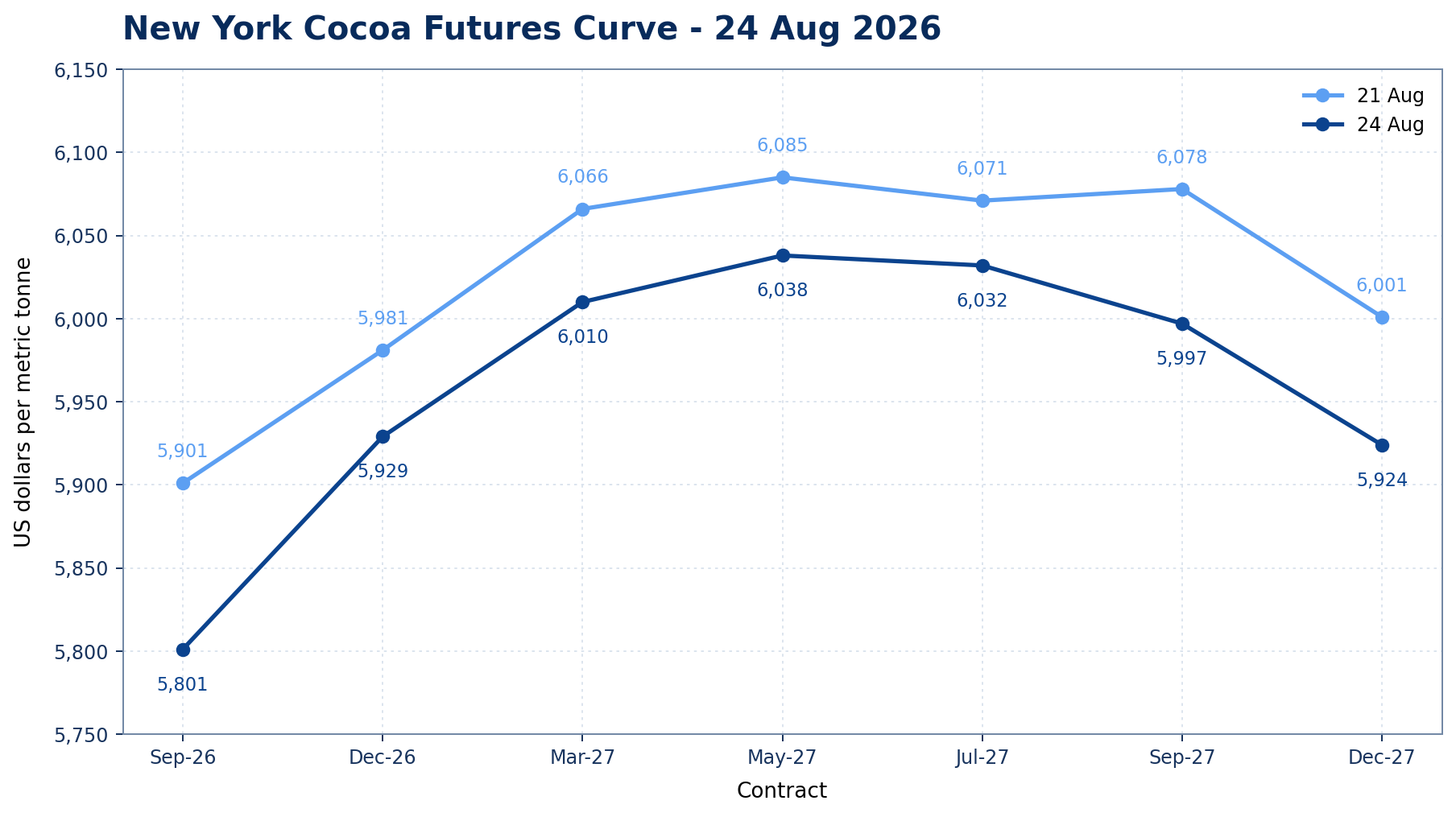
The New York curve weakened throughout, but the adjustment was not parallel. Selling pressure was greatest in Sep-26 and in the Sep-27/Dec-27 sector, while the middle of the curve proved relatively more resilient.
The most important structural move occurred in the Sep-26/Dec-26 relationship. The front contango widened from $80 on 21 August to $128 on 24 August, a further $48 weakening of the nearby contract relative to Dec-26. May-27 remained the peak of the curve at $6,038. From Sep-26 to May-27, the curve now rises by $237 per tonne, compared with $184 on 21 August, showing that the nearby structure steepened further.
Further along the curve, the May-27/Jul-27 backwardation narrowed from $14 to $6. By contrast, Jul-27/Sep-27 swung from a $7 contango to a $35 backwardation, a $42 change, as Sep-27 underperformed. Sep-27/Dec-27 backwardation eased only slightly, from $77 to $73.
The resulting curve combines a markedly bearish front-end contango with a firmer mid-2027 segment and renewed weakness toward the back.
London cocoa
| Contract | 21 Aug | 24 Aug | Change | Change % |
|---|---|---|---|---|
| Sep-26 | £4,270 | £4,240 | -£30 | -0.70% |
| Dec-26 | £4,320 | £4,291 | -£29 | -0.67% |
| Mar-27 | £4,444 | £4,399 | -£45 | -1.01% |
| May-27 | £4,450 | £4,403 | -£47 | -1.06% |
| Jul-27 | £4,446 | £4,400 | -£46 | -1.03% |
London cocoa also finished lower across all five principal maturities on 24 August relative to 21 August. Losses ranged from £29 to £47 per tonne, equivalent to 0.67% to 1.06%. Dec-26 recorded the smallest decline, falling £29 to £4,291, while May-27 was the weakest of the five, losing £47 to £4,403. Sep-26 declined £30, or 0.70%, to £4,240.
Intraday volatility increased substantially. The first five contracts traded through ranges of between £155 and £162 per tonne, compared with only £96 to £104 on 21 August. Sep-26 moved between £4,131 and £4,286 before recovering to £4,240, while Dec-26 traded between £4,172 and £4,334 before ending at £4,291.
The first five contracts finished approximately 61.8% to 73.5% above their respective daily lows, below the 74.0% to 78.1% range recorded on 21 August. London therefore recovered a substantial portion of its intraday decline, but the rebound was less complete, particularly across the March-to-July segment of the curve.
Spread volume rose by 6,679 contracts, or 61.4%, from 10,878 to 17,557. However, because outright trading expanded more quickly, spread activity declined to 57.7% of total turnover from 69.4% on 21 August.
EFP activity increased sharply from 852 to 5,139 contracts, a rise of 4,287 contracts, or 503.2%. It was concentrated overwhelmingly in Sep-26 and Dec-26, which recorded 3,002 and 2,065 contracts respectively. EFS volume edged down from 20 to 17 contracts, while no block volume was reported.
London futures curve
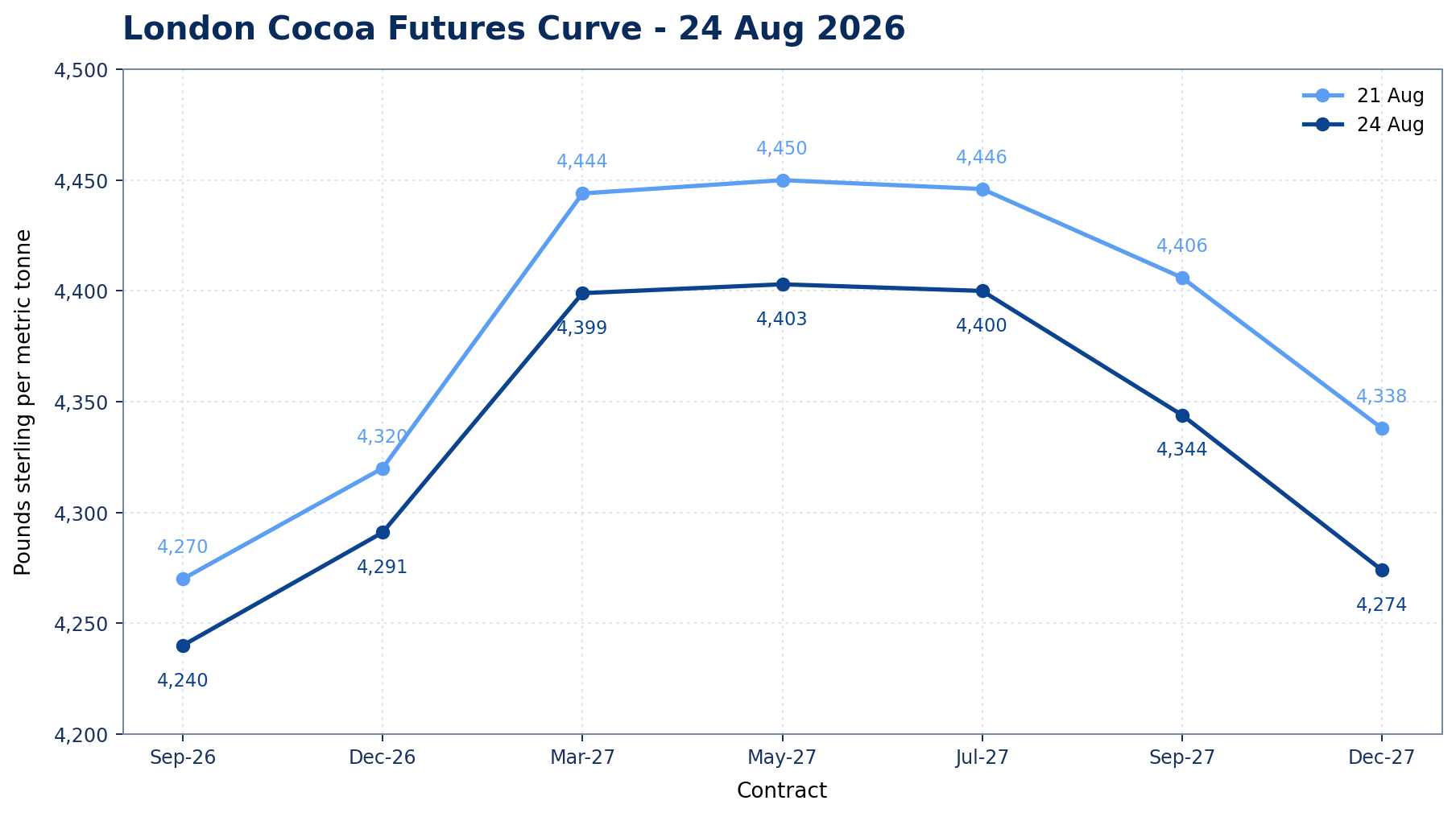
The London curve underwent a non-parallel downward adjustment on 24 August. The nearby Sep-26 and Dec-26 contracts lost £30 and £29 respectively, but weakness intensified further out: Mar-27 through Jul-27 fell by £45 to £47, while Sep-27 and Dec-27 declined by £62 and £64. The deferred end therefore underperformed the front of the curve.
May-27 remained the peak at £4,403. The rise from Sep-26 to May-27 narrowed to £163 per tonne from £180 on 21 August, indicating that the upward slope into the curve's peak became less pronounced. The Sep-26/Dec-26 contango nevertheless widened marginally from £50 to £51, while the Dec-26/Mar-27 contango narrowed from £124 to £108.
Beyond the peak, backwardation strengthened more clearly. The May-27/Dec-27 premium expanded from £112 to £129, while the Jul-27/Dec-27 premium widened from £108 to £126. Sep-27/Dec-27 backwardation also increased slightly, from £68 to £70.
The curve retained its hump-shaped structure, but the move was distinctly bearish at the deferred end. The ascent toward May-27 flattened, while the decline beyond the peak became steeper.
US–UK Spread
(Dec Contract)
$5,929 − (£4,298 x 1.364$/£) =$66ton (down from $92 ton)
Volume and Open Interest
New York cocoa
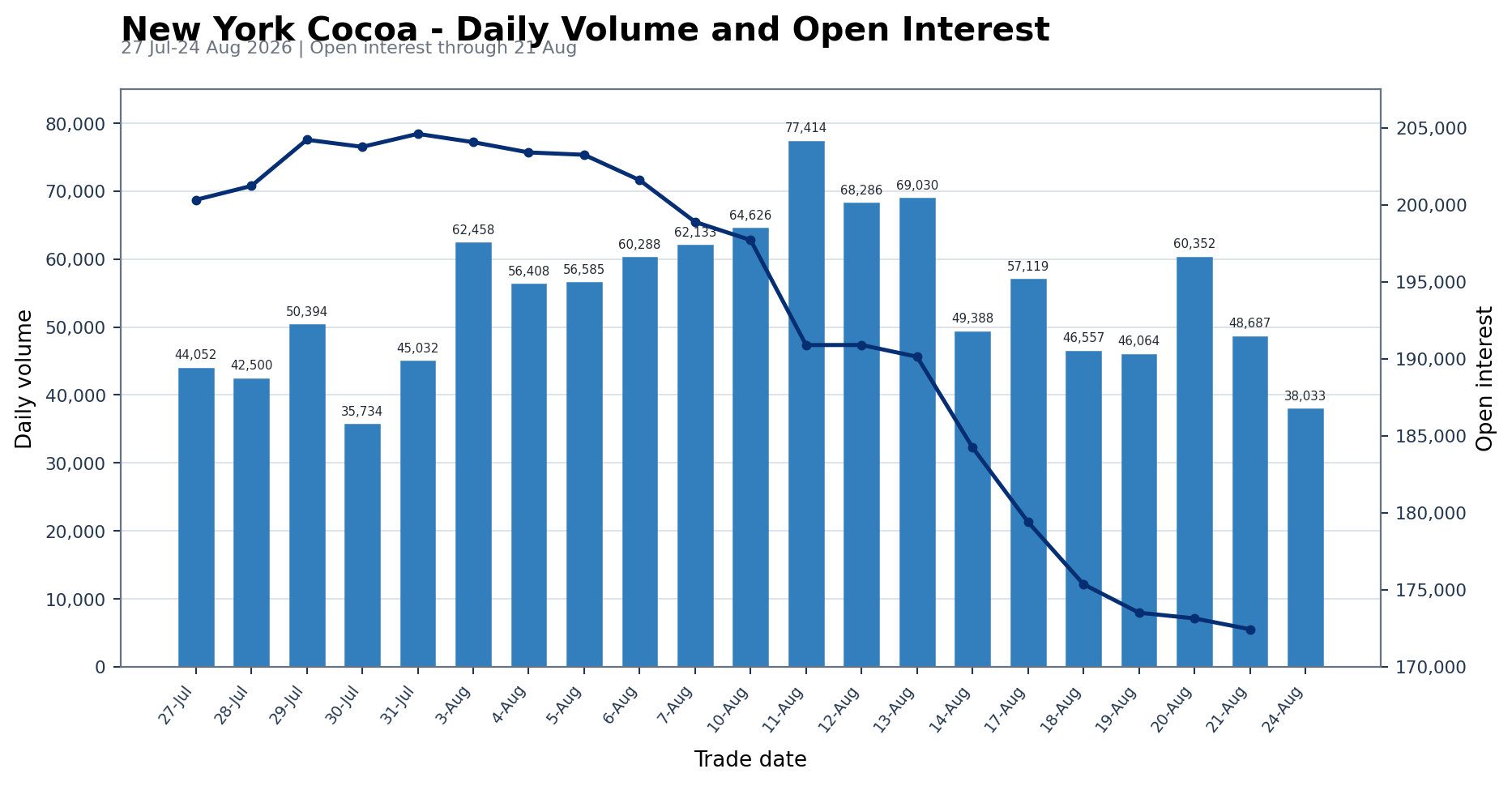
New York cocoa volume fell to 38,033 contracts on 24 August, down 10,654 contracts, or 21.9%, from 48,687 on 21 August. Activity moved further below recent norms, with turnover 31.0% below the preceding 20-session average of 55,155 contracts and 50.9% below the 11 August period peak of 77,414 contracts.
The latest available open interest, for 21 August, declined to 172,438 contracts from 173,143 on 20 August, a fall of 705 contracts, or 0.4%. Open interest has now contracted by 27,883 contracts, or 13.9%, since 27 July and by 32,168 contracts, or 15.7%, from the period peak of 204,606 recorded on 31 July. No open-interest figure was reported for 24 August.
The combination continues to point to a market characterised by weak participation and sustained deleveraging. The sharp fall in 24 August turnover after the already subdued 21 August session left activity at barely half the period high. Because 24 August open interest was unavailable, it is not yet possible to determine whether that session's price decline reflected fresh short selling or further liquidation; the latest evidence through 21 August nevertheless shows no rebuilding in outstanding positions.
London cocoa
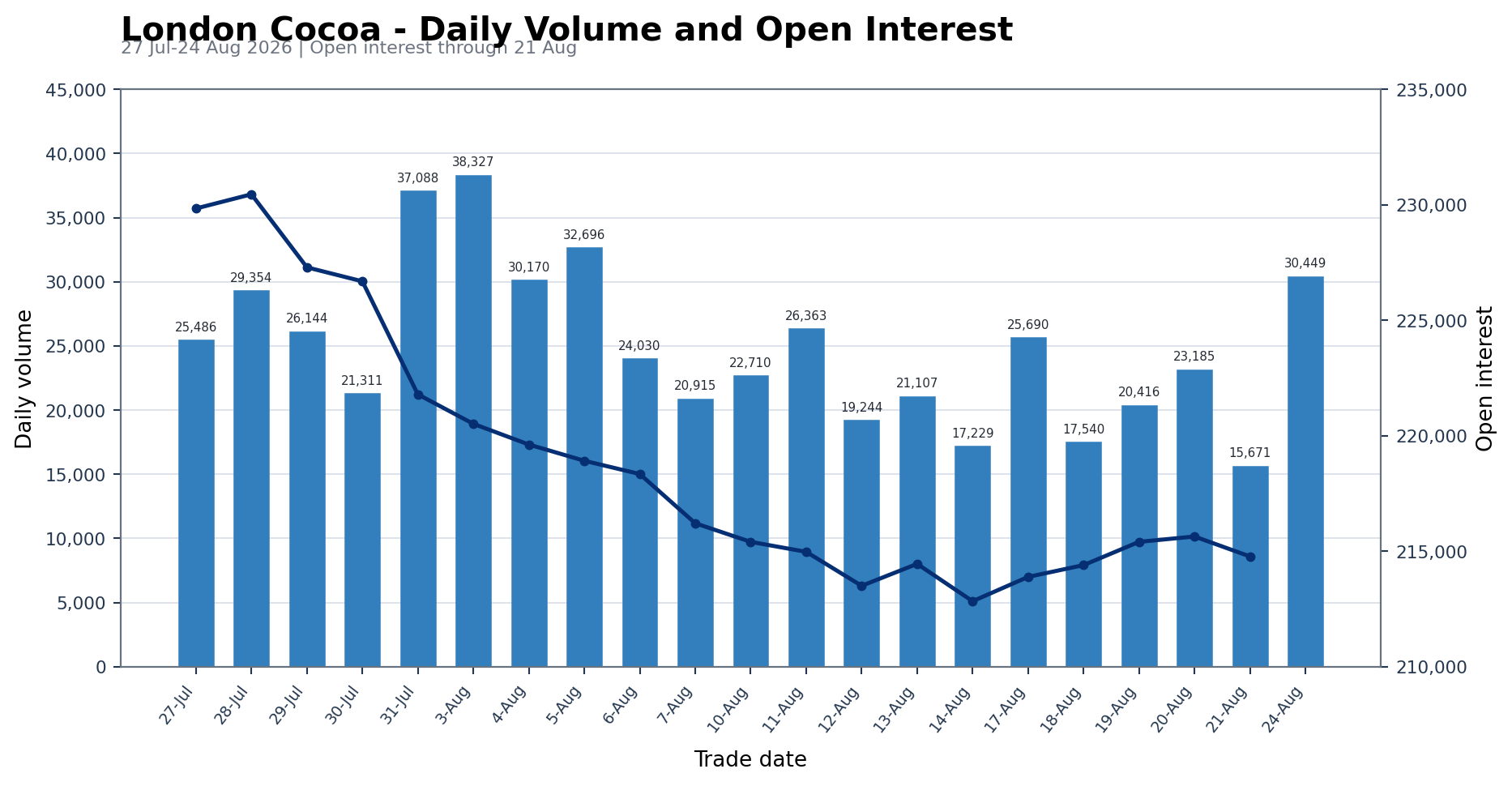
London cocoa volume rose to 30,449 contracts on 24 August, up 14,778 contracts, or 94.3%, from 15,671 on 21 August. Activity moved back above recent norms, with turnover 23.1% above the preceding 20-session average of 24,734 contracts, although it remained 20.6% below the 3 August period peak of 38,327 contracts.
The latest available open interest, for 21 August, declined to 214,776 contracts from 215,640 on 20 August, a fall of 864 contracts, or 0.4%. Open interest was down 15,063 contracts, or 6.6%, from 27 July and 15,679 contracts, or 6.8%, from the 28 July period peak of 230,455. No open-interest figure was reported for 24 August.
The combination points to a sharp recovery in trading activity following the exceptionally subdued 21 August session, but not yet to a confirmed rebuilding of outstanding positions. Open interest had stabilised modestly after its mid-August low, but the latest reading remained materially below late-July levels. Until the 24 August figure becomes available, it is not possible to determine whether the volume rebound reflected fresh position creation or predominantly short-term turnover within the existing market.
Exchange Trading Volume
| MARKET | 21 AUG 2026 | 24 AUG 2026 | CHANGE | CHANGE % |
|---|---|---|---|---|
| US | 3,354,833 | 3,373,003 | +18,170 | +0.54% |
| UK | 1,146,719 | 1,154,531 | +7,812 | +0.68% |
The measure is not a complete regional stock-to-grind ratio, as it includes only exchange-certified cocoa held at U.S. and EU delivery ports and excludes commercial inventories outside the ICE warehouse system. North America NCA grindings cover processors across North America, while ICE U.S. certified stocks are stored at U.S. delivery ports. ECA reports bean usage in European countries and London-certified cocoa is held in European and UK delivery locations.
Readers can explore detailed cocoa market datasets, futures statistics, and historical indicators in the CocoaIntel Data Hub:
 Cocoa Intel
Tuesday Outlook Dec Contract
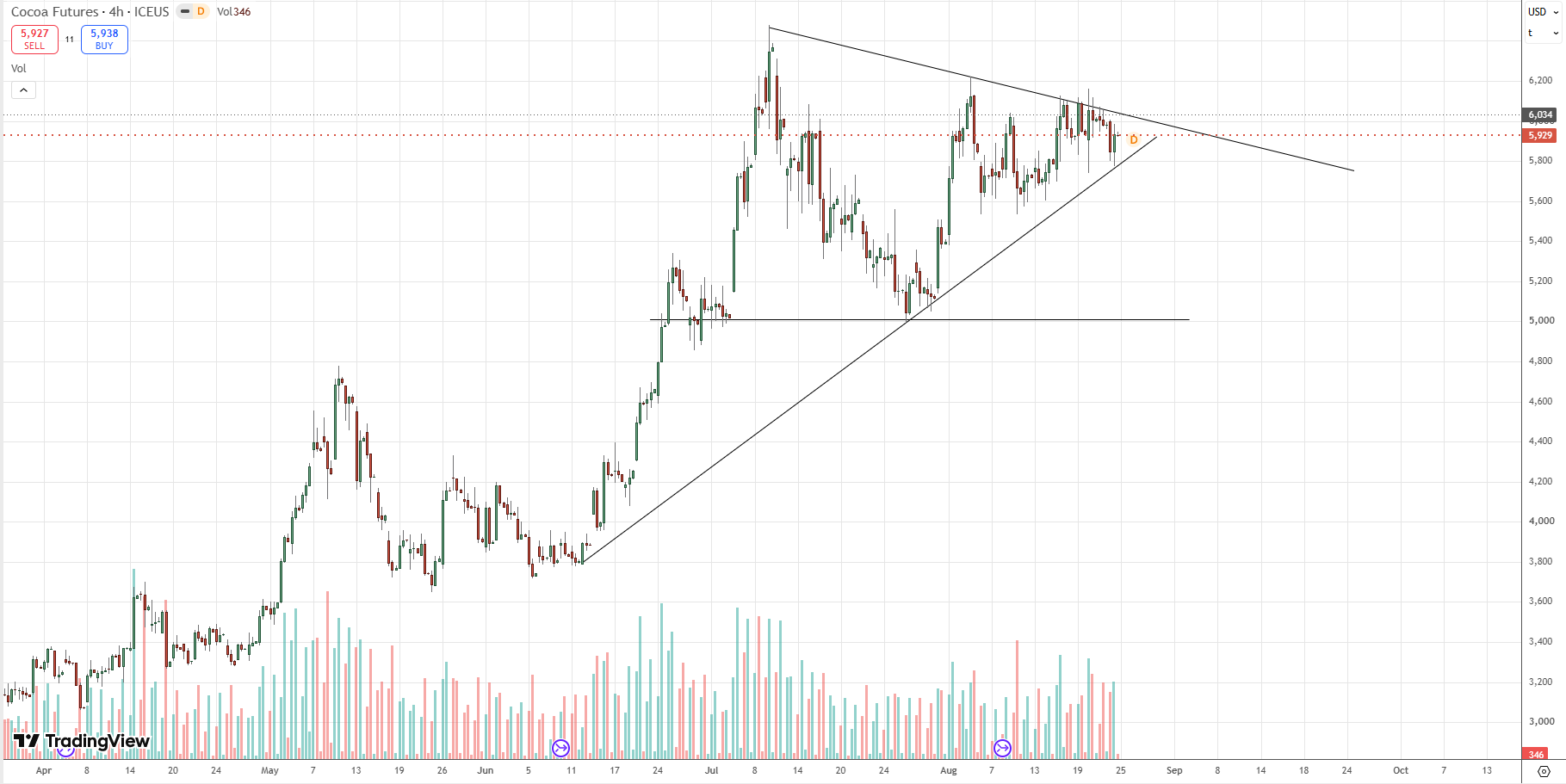
New York cocoa continues to consolidate within a tightening symmetrical triangle. Resistance remains around 6,100, while the rising lower boundary provides support near 5,750. The 21-day SMA is converging with this support zone and has helped underpin the market for approximately 15 trading sessions, strengthening its technical significance.
My primary scenario remains a bullish breakout. A decisive move above 6,100 should be supported by expanding volume and confirmed by a sustained hourly or daily close above resistance, ideally followed by a successful retest.
Such a breakout would initially expose the 6,250–6,500 area. If momentum and participation continue to strengthen, the move could extend considerably further, with 7,500 representing the broader upside objective.
A decisive break below 5,750, accompanied by stronger volume and confirmation beneath both the rising trendline and the 21-day SMA, would invalidate the constructive setup.
The initial downside levels would be approximately 5,100. If selling pressure accelerates and the triangle breaks decisively lower, the broader bearish objective would be around 4,500.
If you notice any discrepancies in these figures or have extra information, please email hello@cocoaintel.com or leave a comment – corrections and additional insights are always welcome.