
Cocoa Extends Rally Ahead of Côte d’Ivoire Farmgate Price Decision (31 August 2026)


New York December cocoa extended Friday’s breakout on Monday, settling 1.99% higher at $6,768 per tonne in a shortened session. The contract initially retreated to $6,552.50, but buying quickly re-emerged, lifting prices to an intraday high of $6,821 before a firm close near the upper end of the range. The late market opening explains the apparent gap on the five-minute chart, while London’s closure left New York as the sole venue for price discovery, making the session less representative than usual. Nevertheless, the recovery from the early low and the ability to retain most of the advance indicate that profit-taking was absorbed and that short-term momentum remains bullish ahead of the expected West African farmgate-price announcements.
Monday was marked by a lack of fresh fundamental developments, leaving the market to continue adjusting to last week’s supportive news and positioning ahead of the new West African farmgate-price decisions. Traders continued to price in expectations of delayed Ivorian crop arrivals, constrained near-term supply and uncertainty over farmer selling incentives.
The farmgate-price announcement has now been confirmed for Tuesday: Ivorian media reported that the official 2026/27 cocoa producer price will be unveiled on 1 September during the National Cocoa and Chocolate Days in Abidjan, reportedly by Vice-President Tiémoko Meyliet Koné on behalf of President Alassane Ouattara. No official final price had been announced by Monday evening, meaning the session remained driven by expectations rather than confirmation.
West Africa Weather: Forecast Rains Ease Immediate Concern, but September Distribution Remains Critical
Rainfall weakened across much of Côte d’Ivoire’s cocoa belt during the final week of August. According to the latest Reuters farmer survey, precipitation was below the five-year average in Soubre, Agboville, Divo, Abengourou, Daloa and Yamoussoukro, while Bongouanou recorded slightly above-average rainfall. Soubre reported only 1.7 mm, around 14.3 mm below its five-year average, representing the clearest weekly shortfall among the surveyed regions. Average temperatures across producing areas ranged from 25.1°C to 28.3°C.
The recent dryness is relevant because a large share of the pods intended for harvesting between October and December are still filling and require regular moisture. Farmers warned that prolonged dry conditions during September could cause cherelles and other small or medium-sized pods to wilt and fall prematurely. Continued moisture stress could therefore reduce early main-crop availability and, if dryness persists later in the season, shorten the tail of the September-to-February crop. Rainfall will also be needed to sustain flowering and support the development of pods intended for harvesting during the later part of the main crop.
However, the wider August rainfall picture is less negative than the latest weekly observations suggest. The monthly precipitation anomaly map indicates that cumulative August rainfall was around or above normal across much of Côte d’Ivoire’s inland western, central and eastern cocoa belt. Wetter-than-normal conditions are particularly evident across parts of the interior, including areas around Daloa, central Côte d’Ivoire and the eastern belt near Abengourou. Negative rainfall anomalies appear more concentrated along portions of the southern coastal zone, including areas around San-Pédro and Abidjan, as well as farther north outside the principal cocoa belt.
This suggests that the latest dry week represents a recent interruption in rainfall rather than a uniform, month-long moisture deficit across the entire producing region. Trees in inland districts that received favourable cumulative August rainfall should retain a stronger soil-moisture buffer. Nevertheless, positive monthly rainfall totals do not eliminate short-term crop risk: young pods can still be affected when rainfall is poorly distributed or when several consecutive dry days occur during a sensitive development stage. Coastal and southern districts displaying weaker monthly anomalies may therefore be more vulnerable if September rainfall underperforms.
The latest accumulation forecast through approximately September 8 is constructive. It indicates widespread rainfall across Côte d’Ivoire and Ghana, with broadly moderate accumulations over most inland cocoa-producing regions and locally heavier totals in parts of western and central West Africa. Based on the forecast map, many inland Ivorian growing areas could receive roughly 25–100 mm, although amounts are likely to vary considerably and some coastal districts may receive lower totals.
If the forecast rainfall materialises in several well-distributed events, it should replenish upper-soil moisture, support pod filling, reduce immediate cherelle-loss risk and maintain flowering for later crop rounds. The benefit would be smaller if the projected accumulation falls in one or two isolated heavy storms, as cocoa development responds more favourably to regular rainfall than to a similar total delivered over a very short period. Localised heavy rainfall could also increase fungal-disease pressure, but the current forecast does not indicate uniformly excessive rainfall across the Ivorian cocoa belt.
Conditions in Ghana are also broadly supportive. The monthly anomaly map shows positive rainfall anomalies across much of the central cocoa region, while the seven-day forecast indicates further precipitation. As in Côte d’Ivoire, however, rainfall distribution should be monitored closely, particularly across southern and coastal areas where the anomaly pattern is more mixed.
The measure is not a complete regional stock-to-grind ratio, as it includes only exchange-certified cocoa held at U.S. and EU delivery ports and excludes commercial inventories outside the ICE warehouse system. North America NCA grindings cover processors across North America, while ICE U.S. certified stocks are stored at U.S. delivery ports. ECA reports bean usage in European countries and London-certified cocoa is held in European and UK delivery locations.
Futures performance
New York cocoa
| Contract | 28 Aug | 31 Aug | Change | Change % |
|---|---|---|---|---|
| Sep-26 | $6,491 | $6,600 | +$109 | +1.68% |
| Dec-26 | $6,636 | $6,768 | +$132 | +1.99% |
| Mar-27 | $6,768 | $6,911 | +$143 | +2.11% |
| May-27 | $6,813 | $6,956 | +$143 | +2.10% |
| Jul-27 | $6,802 | $6,952 | +$150 | +2.21% |
New York cocoa advanced across all five principal maturities. Jul-27 recorded the largest increase, gaining $150, or 2.21%, to $6,952, while the active Dec-26 contract rose $132, or 1.99%, to $6,768. Sep-26 should be treated cautiously because the expiring contract was thinly traded and its quoted high, low and final price were all $6,600.
The actively traded Dec-26 through Jul-27 contracts moved through relatively narrow ranges of $267–$271 per tonne, compared with $451–$486 on Friday. They finished between 80.4% and 83.7% above their daily lows, showing that most of the advance was retained, although the closing strength was less extreme than Friday’s 89.3%–96.9%.
Total New York volume declined 41.2% to 42,605 contracts, from 72,441 on Friday, and stood around 24.2% below the preceding 20-session average. This should not be interpreted as clear evidence that bullish participation was fading: ICE delayed the New York cocoa opening until 7:30 a.m. ET, while London was closed, producing a shorter and less representative trading session.
New York futures curve
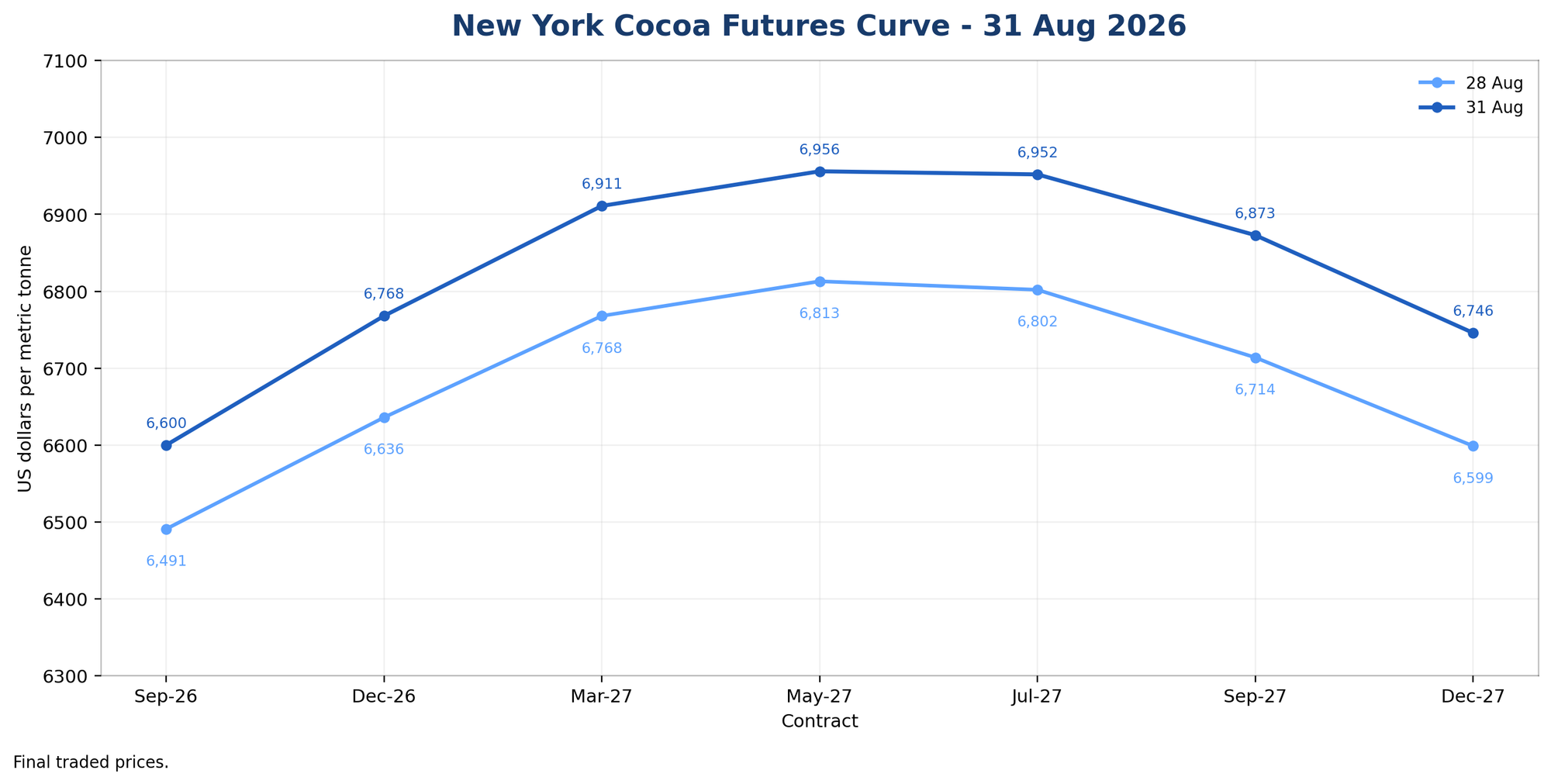
The New York curve shifted higher across every plotted maturity, with gains ranging from $109 to $159 per tonne. The curve continued to peak at May-27 at $6,956, although Jul-27 was only $4 lower at $6,952.
The Sep-26/May-27 contango widened from $322 to $356, but this change is partly distorted by the lack of meaningful Sep-26 liquidity. Among the active contracts, Dec-26/Mar-27 contango widened from $132 to $143, Mar-27/May-27 contango was unchanged at $45, and May-27/Jul-27 backwardation narrowed from $11 to $4.
The broad advance, including gains of $143–$150 across Mar-27 through Jul-27, indicates that Monday’s buying was not confined to the nearby contract. The highest risk premium remains concentrated around the first half of 2027, after which the curve falls by $210 between May-27 and Dec-27.
US–UK Spread
(Dec Contract)
$6,768 − (£4,845 x 1.355$/£) =$203ton (up from $47 ton)
Volume and Open Interest
New York cocoa
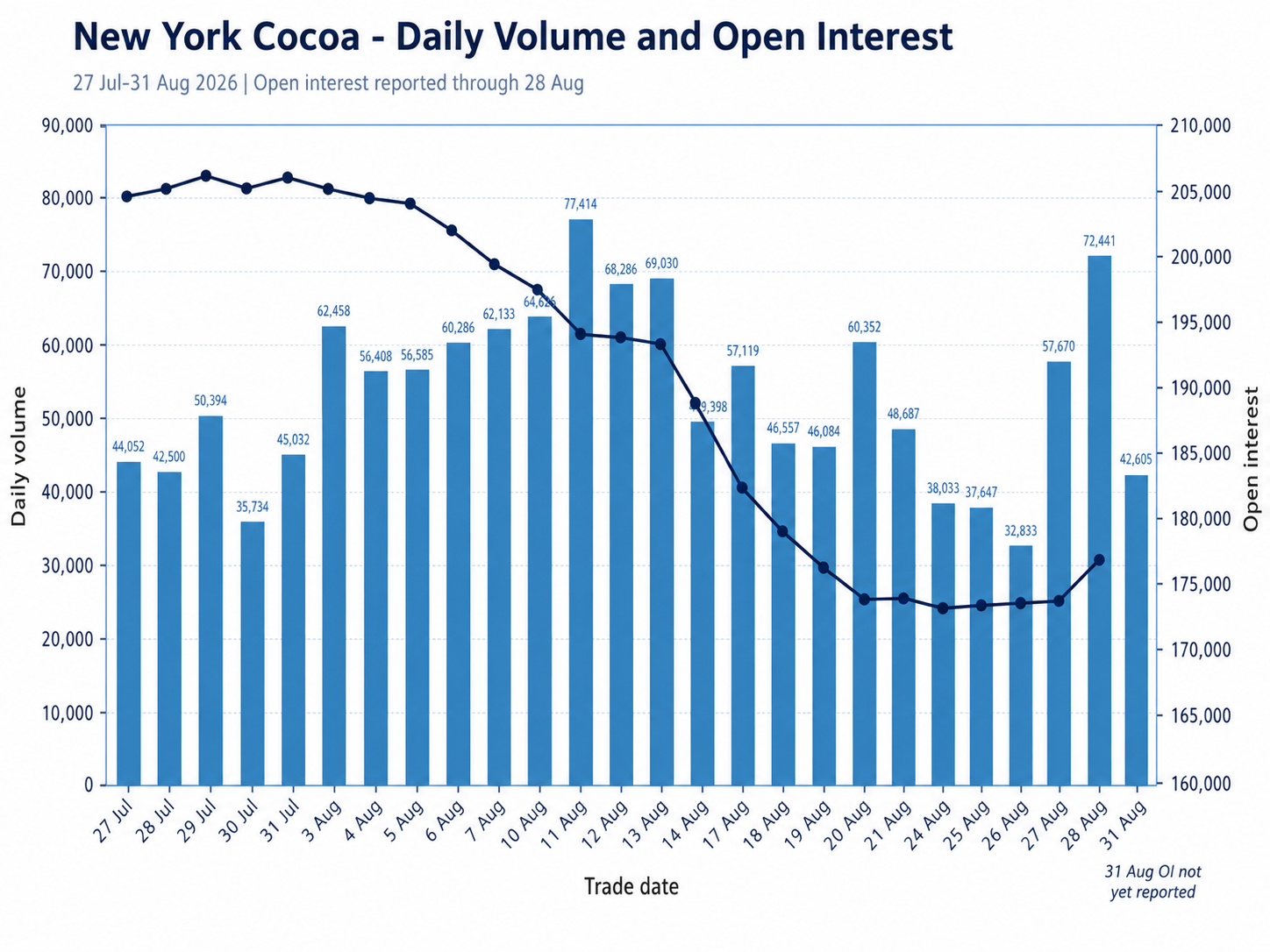
New York cocoa volume fell to 42,605 contracts on 31 August, down 29,836 contracts, or 41.2%, from 72,441 on 28 August. Turnover was 24.2% below the preceding 20-session average of 56,202 contracts and 45.0% below the displayed-period peak of 77,414 recorded on 11 August. It was the sixth-lowest daily volume in the 26-session window. However, the decline largely reflects Monday’s delayed opening and London’s bank-holiday closure, which reduced both the available trading time and cross-market participation.
The latest valid open-interest figure, for 28 August, increased to 176,065 contracts from 173,290 on 27 August, a rise of 2,775 contracts, or 1.6%. Open interest was 4,010 contracts, or 2.3%, above the period low of 172,055 recorded on 26 August, but remained 28,541 contracts, or 13.9%, below the period peak of 204,606 on 31 July. It was also 24,256 contracts, or 12.1%, below its 27 July level.
Friday’s combination of sharply higher prices, increased volume and rising open interest indicates that the breakout attracted fresh positioning and was not driven solely by the liquidation of short positions. Monday’s lower turnover does not materially weaken that signal because the session was shortened and London was closed.
Exchange Trading Volume
| MARKET | 28 AUG 2026 | 31 AUG 2026 | CHANGE | CHANGE % |
|---|---|---|---|---|
| US | 3,390,667 | 3,411,016 | +20,349 | +0.60% |
| UK | 1,126,406 | 1,126,406 | 0 | 0.00% |
Readers can explore detailed cocoa market datasets, futures statistics, and historical indicators in the CocoaIntel Data Hub:
 Cocoa Intel
Tuesday Outlook Dec Contract
Following Monday’s rise, December cocoa remains technically bullish but increasingly stretched after gaining almost 10% over two sessions.
The daily breakout above the multi-month triangle is supported by rising volume and OBV, while price remains above all major moving averages. Hourly momentum is overbought, however, making consolidation or a limited pullback likely before another advance.
I assign a 45% probability to consolidation between 6,650 and 6,850, a 35% probability to a breakout toward 6,950–7,100, and a 20% probability to a correction toward 6,550–6,450. Immediate resistance is 6,820–6,850; a sustained break above this area, particularly with London confirmation, would expose 7,000 and then 7,200. Initial support is 6,700, followed by 6,650–6,550. Only a daily close below 6,450 would materially weaken the breakout.
The direction of the market this week will probably be determined by the West African farmgate-price announcements. Confirmation of a low Ivorian price could be bullish if it encourages farmer withholding, weak official arrivals and cross-border smuggling. A higher, fully financed Ivorian price would generally be bearish because it would encourage selling and improve official procurement, particularly if it narrows the price gap with Ghana. An increase in Ghana’s price without a corresponding Ivorian adjustment could widen the cross-border differential and increase disruption to Ivorian arrivals. The market will therefore focus not only on the headline prices, but also on the relative price gap and whether the announced prices are adequately financed.
If you notice any discrepancies in these figures or have extra information, please email hello@cocoaintel.com or leave a comment – corrections and additional insights are always welcome.