
Cocoa Futures Reverse Lower as StoneX Warns of a Near-Balanced 2026/27 Market (29 July 2026)


New York September cocoa experienced another exceptionally volatile and bearish session on 29 July. After opening at 5,292, the contract initially advanced to an intraday high of 5,360, a gain of 68 points or 1.29% from the opening level. The early strength failed to hold, however, as aggressive selling reversed the entire advance and pushed prices through 5,250, 5,200 and 5,100 before the contract reached a session low of 5,075. This represented a decline of 285 points or 5.32% from the daily high and 217 points or 4.10% below the opening price. Prices recovered moderately during the final part of the session, but the rebound remained limited. September finished at a last-traded price of 5,169, 94 points or 1.85% above the intraday low, but 123 points or 2.32% below the opening level and 191 points or 3.56% below the daily high. Compared with the 28 July close of 5,206, the contract declined by 37 points or 0.71%.
Ecuador Exports Reach Record June Level
Ecuador’s cocoa exports rebounded strongly in June, providing another indication that South American supply is becoming increasingly important to the global market. Total bean and cocoa-product exports reached 42,059 tonnes, up approximately 15% from May and 30% from June 2025, making this the strongest June result on record. Cocoa-bean shipments accounted for 36,860 tonnes, while processed products contributed 5,199 tonnes on a bean-equivalent basis.
Exports during the first nine months of the 2025/26 cocoa year reached approximately 442,964 tonnes, around 4% above the same period last season. The United States was the leading destination for both beans and processed products.
StoneX Slashes 2026/27 Surplus Forecast
The most supportive fundamental development came from StoneX, which reduced its projected 2026/27 global cocoa surplus to only 25,000 tonnes, compared with its previous estimate of approximately 150,000 tonnes and a projected surplus of 422,000 tonnes for the current season. The revision reflected a more explicit allowance for a potentially strong El Niño event and reports of below-normal pod counts in West Africa.
StoneX expects global production to decline by approximately 6% to 4.83 million tonnes, while demand rises to around 4.75 million tonnes. Côte d’Ivoire’s crop was projected at approximately 1.78 million tonnes, down 11%, while Ghanaian production was estimated at around 586,000 tonnes. Ecuador was forecast to maintain production near 600,000 tonnes, potentially allowing it to overtake Ghana as the world’s second-largest producer.
Cargill Expands Indonesian Cocoa Investment
Cargill reaffirmed Indonesia’s importance to its Asia-Pacific cocoa strategy, highlighting investments in farmer partnerships, responsible sourcing, traceability, domestic processing and product innovation. Indonesia plans to replant approximately 7,000 hectares of cocoa during 2026 and 2027, while more than 7,800 farmers are already participating in Cargill’s Rainforest Alliance-certified programme.
The longer-term production outlook remains uncertain. Expana indicated that stronger El Niño conditions could reduce Southeast Asian cocoa production by approximately 20,000 tonnes, or slightly more than 5%, depending on weather developments during the coming months. This creates a moderately supportive supply risk for prices, although replanting and productivity programmes could eventually stabilise Indonesian output.
Cargill is also developing NextCoa, a cocoa-free confectionery ingredient produced from upcycled grape seeds. The product reflects manufacturers’ efforts to reduce exposure to cocoa-price volatility and improve supply-chain flexibility. While its immediate effect on cocoa consumption is likely to be limited, continued investment in cocoa alternatives represents a longer-term substitution risk for conventional cocoa demand.
Hershey Results to Test Chocolate-Demand Resilience
Hershey’s forthcoming second-quarter results were expected to provide an important test of consumer demand and manufacturer profitability. Analysts anticipated revenue growth of only around 1%, despite projected earnings growth of approximately 17%, indicating that margin recovery rather than volume expansion was expected to drive the result.
The principal concern was continued consumer resistance to elevated confectionery prices. Hershey’s first-quarter performance had included approximately ten percentage points of pricing but a volume decline of around 4%. Analysts were therefore watching for evidence that volumes had stabilised as earlier pricing measures and product weight reductions continued to affect purchasing behaviour.
Hershey is scheduled to publish its second-quarter results on Thursday, 30 July, ahead of its analyst conference call at 13:30 UK time (BST).
Ghana Reaffirms Rehabilitation and Farm-Support Measures
Ghana’s COCOBOD reiterated the government’s commitment to rehabilitating ageing and diseased cocoa farms, strengthening mass spraying programmes and improving the availability of agrochemicals. Officials also acknowledged delays affecting input distribution and payments to spraying teams, while regional traditional authorities called for faster rehabilitation and stronger producer incentives.
COCOBOD said the recent reduction in the producer price reflected the decline in international cocoa prices. Although this aligns domestic purchasing costs more closely with the global market, weaker farmer returns could limit spending on fertiliser, spraying and farm maintenance unless government support programmes are implemented effectively.
Futures performance
New York cocoa
| Contract | 28 Jul | 29 Jul | Change | Change % |
|---|---|---|---|---|
| Sep-26 | 5,206 | 5,169 | -37 | -0.71% |
| Dec-26 | 5,330 | 5,312 | -18 | -0.34% |
| Mar-27 | 5,421 | 5,395 | -26 | -0.48% |
| May-27 | 5,441 | 5,415 | -26 | -0.48% |
New York cocoa surrendered part of the previous session’s recovery on 29 July. September 2026 finished at a last-traded price of 5,169, declining by 37 points or 0.71% from Tuesday’s closing level of 5,206.
The session was characterised by another exceptionally wide trading range and a sharp intraday reversal. September opened at 5,292, already 86 points above the previous close, before advancing to an intraday high of 5,360. Buying momentum subsequently disappeared, and the contract fell 285 points from its high to a session low of 5,075.
Prices recovered by 94 points from the low into the close, but September still finished within the lower third of its daily range. The contract had traded as much as 154 points above the previous close before ultimately ending 37 points below it, highlighting the instability and lack of sustained directional conviction in the market.
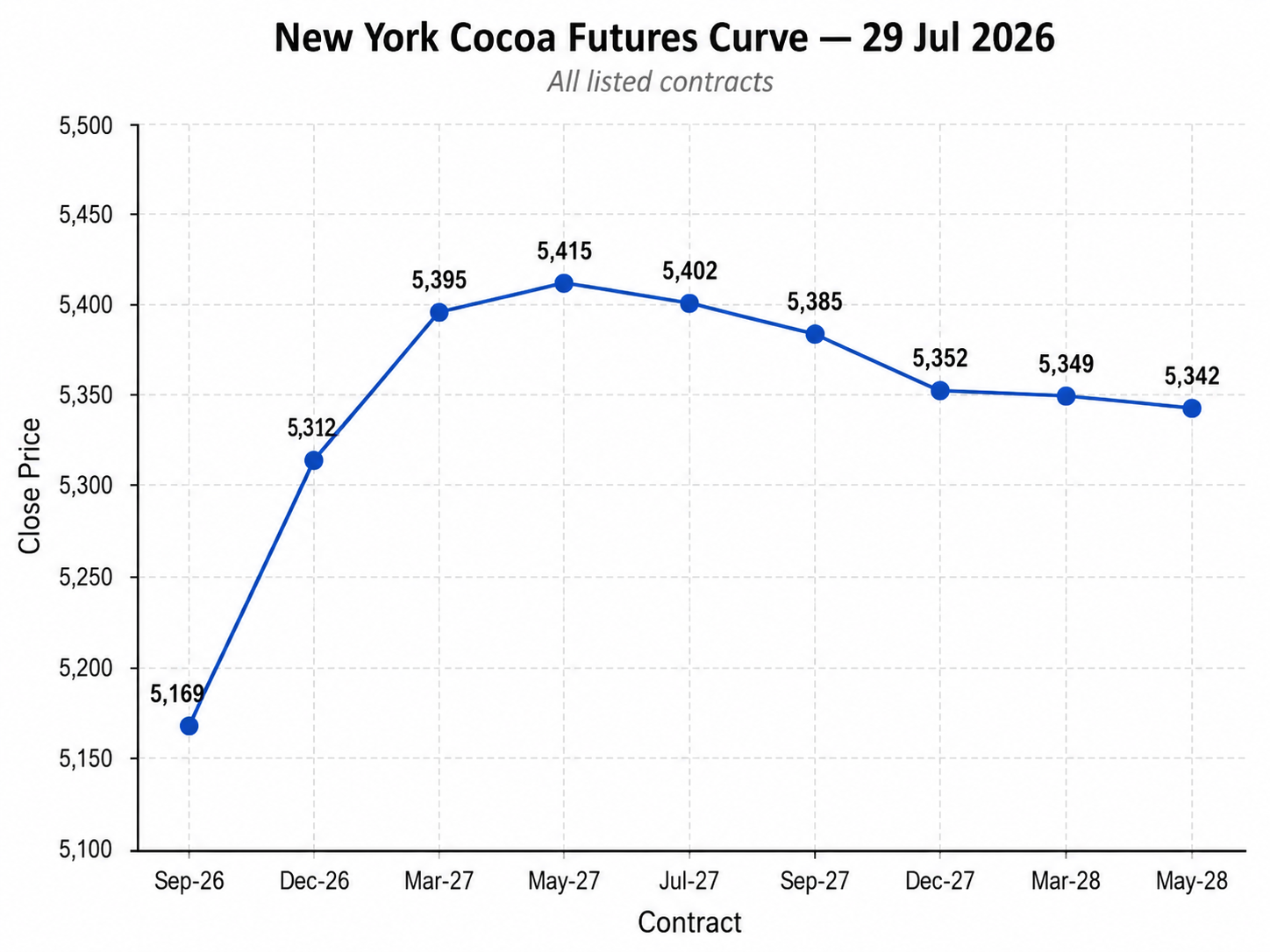
The New York forward curve remained upward-sloping between September 2026 and May 2027. However, the December-to-September premium widened from 124 points to 143 points as the nearby contract underperformed. The March-to-December premium narrowed from 91 points to 83 points, while the May-to-March premium remained unchanged at 20 points.
The widening of the front spread indicates renewed pressure on nearby cocoa relative to deferred delivery periods. Beyond May 2027, the curve turned progressively lower, with July at 5,402, September at 5,385, December at 5,352 and March 2028 at 5,349.
Official settlements were lower across the principal contracts. September settled at 5,185, down 16 points or 0.31%. December settled five points lower at 5,327, March declined by 13 points to 5,406 and May lost 10 points to settle at 5,427.
London cocoa
| Contract | 28 Jul | 29 Jul | Change | Change % |
|---|---|---|---|---|
| Sep-26 | 3,911 | 3,887 | -24 | -0.61% |
| Dec-26 | 3,964 | 3,951 | -13 | -0.33% |
| Mar-27 | 4,050 | 4,031 | -19 | -0.47% |
| May-27 | 4,050 | 4,036 | -14 | -0.35% |
London cocoa followed a similarly volatile pattern. September 2026 finished at a last-traded price of 3,887, falling by 24 points or 0.61% from the previous closing level of 3,911.
September opened slightly higher at 3,923 and initially rallied above the psychological 4,000-point level, reaching an intraday high of 4,027. The advance was not sustained, and the contract subsequently declined by 201 points to a session low of 3,826.
A modest recovery lifted September by 61 points from the low into the close, but the contract still finished within the lower 30% of its daily range. As in New York, the movement showed that early buying interest remained vulnerable to aggressive selling once prices approached the upper end of the recent range.
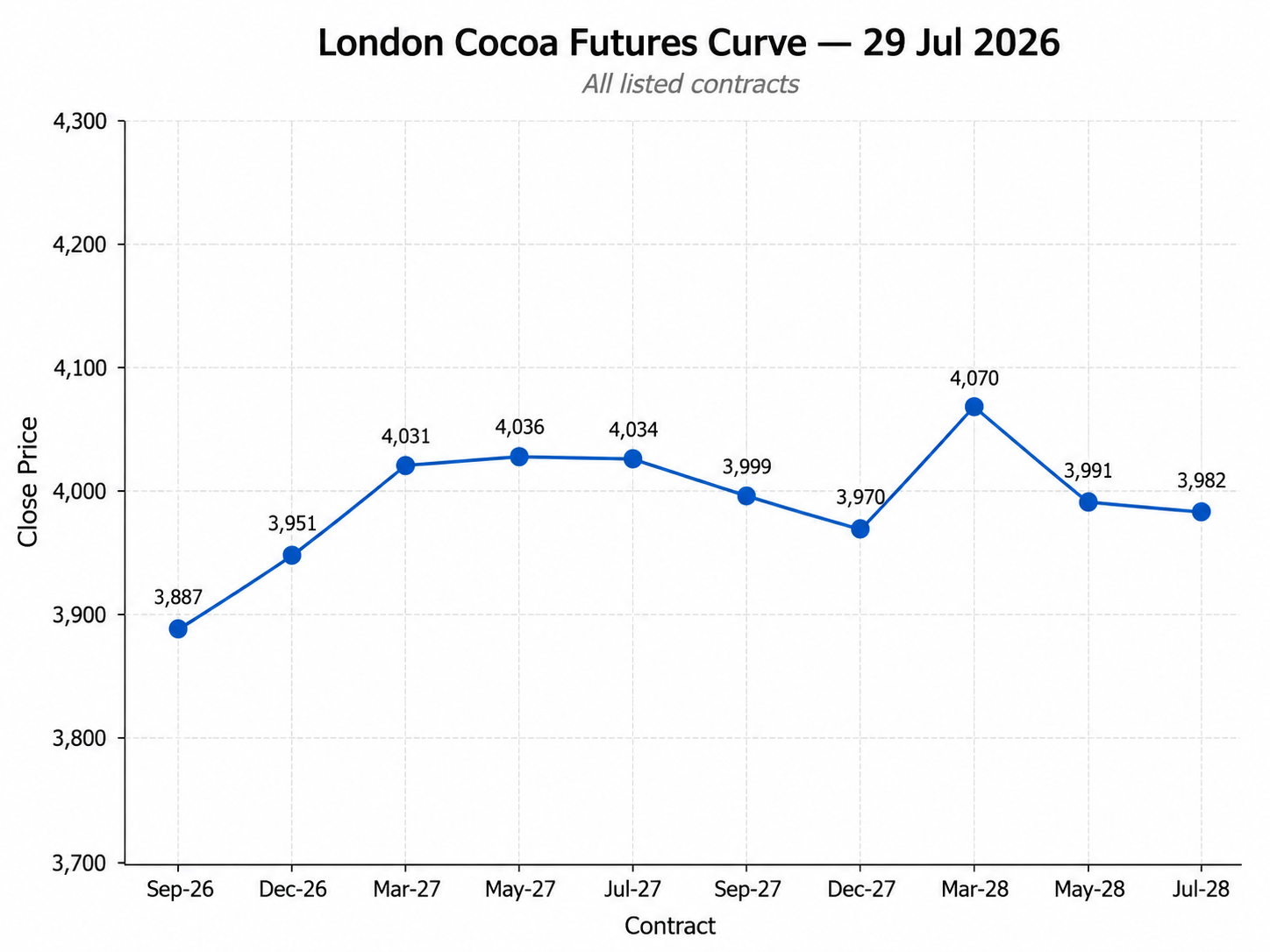
The London curve retained its upward slope through May 2027. The December-to-September premium widened from 53 points to 64 points, confirming the relative weakness of the nearby contract. The March-to-December premium narrowed from 86 points to 80 points, while May moved from parity with March to a five-point premium.
Official London settlements were slightly positive despite the lower last-traded closes. September settled one point higher at 3,902, December gained eight points to 3,962, March added seven points to 4,047 and May increased by eight points to 4,049. The divergence indicates that the final trades occurred below the prices established during the official settlement window.
EFP, EFS and Spread Activity
New York cocoa
New York recorded 382 EFP contracts, concentrated entirely in the two nearby delivery months. September accounted for 295 contracts, while December contributed the remaining 87. EFS activity was negligible at only 10 contracts, all registered in September.
Spread volume was substantial at 38,518 contracts. Activity was led by December with 15,439 contracts, followed by September with 11,890 and March 2027 with 6,951. The concentration in the nearby contracts indicates active calendar-spread positioning and contract-roll activity around the September–December portion of the curve. No block volume was reported.
London cocoa
London recorded 94 EFP contracts, consisting of 31 contracts in December and 63 in March 2027. EFS activity was considerably stronger than in New York, reaching 2,250 contracts. Of this total, 2,200 contracts were concentrated in September and 50 in December.
Spread volume totalled 17,119 contracts. December led with 5,662 contracts, followed by March 2027 with 3,937, September with 2,770 and May 2027 with 1,901. No block trades were reported.
US–UK Spread
(Sep Contract)
$5,169 − (£3,887 x 1.336$/£) =$-24ton (down from $12ton)
Volume and Open Interest
New York cocoa
| Date | Total volume | Total open interest |
|---|---|---|
| 23 Jul 2026 | 34,602 | 200,269 |
| 24 Jul 2026 | 48,210 | 199,322 |
| 27 Jul 2026 | 44,052 | 200,321 |
| 28 Jul 2026 | 42,500 | 201,223 |
| 29 Jul 2026 | 50,394 | Not available |
New York cocoa volume increased sharply on 29 July, reaching 50,394 contracts. This was 7,894 contracts, or 18.57%, above the 42,500 contracts traded on 28 July. It was also the highest daily volume recorded during the displayed period and approximately 18.7% above the preceding 12-session average of 42,466 contracts.
The elevated turnover accompanied an exceptionally volatile session in which September cocoa traded through a 285-point range. Strong participation during the intraday reversal indicates that the decline from the session high was not driven by thin liquidity. However, volume alone cannot determine whether the activity represented fresh short selling, long liquidation or a combination of both.
The latest available New York open-interest figure was 201,223 contracts on 28 July, up 902 contracts from 27 July. Open interest had increased by a cumulative 1,901 contracts from the recent low of 199,322 on 24 July. Nevertheless, it remained 6,832 contracts, or 3.28%, below the 17 July level of 208,055.
The recent recovery in open interest indicates that some positions were being rebuilt after the reduction recorded during the previous week. Confirmation of whether the 29 July decline attracted new bearish positioning will require the next open-interest release.
London cocoa
| Date | Total volume | Total open interest |
|---|---|---|
| 23 Jul 2026 | 21,204 | 227,960 |
| 24 Jul 2026 | 18,744 | 227,976 |
| 27 Jul 2026 | 25,486 | 229,839 |
| 28 Jul 2026 | 29,354 | 230,455 |
| 29 Jul 2026 | 26,144 | Not available |
London cocoa volume declined to 26,144 contracts on 29 July, down 3,210 contracts or 10.94% from the 29,354 contracts traded on 28 July. Volume was also approximately 17.6% below the average of the preceding 20 sessions.
Although London experienced a broad 201-point intraday range, participation was considerably lighter than in New York. This suggests that the London reversal occurred with less outright futures turnover, although the previously noted EFS and spread activity remained significant.
The latest published figure was 230,455 contracts on 28 July, an increase of 616 contracts from the previous session.
London open interest had risen by 2,479 contracts, or 1.09%, from 24 July through 28 July. However, it remained 5,670 contracts, or 2.40%, below its 9 July peak of 236,125. The pattern indicates a partial rebuilding of exposure following substantial position reduction during the middle of the month.
Exchange Trading Volume
| Exchange | 28 Jul 2026 | 29 Jul 2026 | Change | % change |
|---|---|---|---|---|
| ICE U.S. Cocoa | 3,375,119 | 3,374,810 | -309 | -0.01% |
| ICE Europe Cocoa | 1,150,313 | 1,148,750 | -1,563 | -0.14% |
| Combined | 4,525,432 | 4,523,560 | -1,872 | -0.04% |
The measure is not a complete regional stock-to-grind ratio, as it includes only exchange-certified cocoa held at U.S. and EU delivery ports and excludes commercial inventories outside the ICE warehouse system. North America NCA grindings cover processors across North America, while ICE U.S. certified stocks are stored at U.S. delivery ports. ECA reports bean usage in European countries and London-certified cocoa is held in European and UK delivery locations.
Readers can explore detailed cocoa market datasets, futures statistics, and historical indicators in the CocoaIntel Data Hub:
 Cocoa Intel
Tomorrow's Outlook
New York cocoa is likely to remain highly volatile, with two-way trading expected around the 5,100–5,300 area. The late-session recovery may support an initial rebound toward 5,200–5,250, but selling pressure could re-emerge if prices fail to hold above that zone.
Support is expected around 5,125, followed by the session low near 5,075. A break below 5,075 would increase the risk of a move toward the psychological 5,000 level. Conversely, a sustained advance above 5,250 could extend the recovery toward 5,300–5,360.
The near-term bias remains neutral to moderately bearish unless September cocoa establishes itself above 5,250.
If you notice any discrepancies in these figures or have extra information, please email hello@cocoaintel.com or leave a comment – corrections and additional insights are always welcome.