
Cocoa Holds $5,300; Côte d’Ivoire Deliveries Corrected, Ecuador Exports Surge ( 21 September 2026)


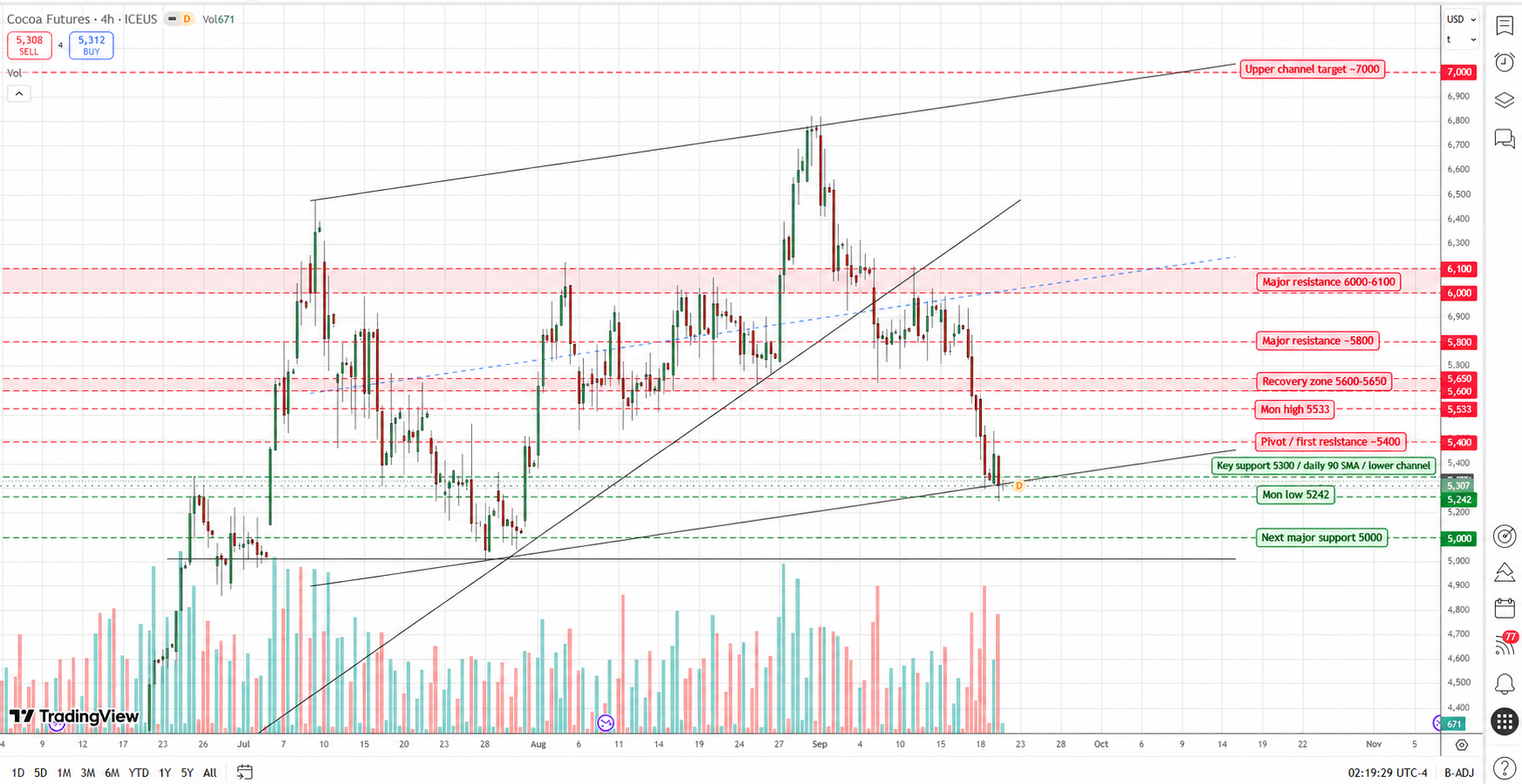
New York cocoa attempted to stabilise on Monday after Friday’s sharp sell-off, but the early recovery failed to hold. Dec-26 opened at $5,317 and rallied as high as $5,533, briefly reclaiming the $5,500 area, before renewed selling pushed the contract to an intraday low of $5,242. Prices recovered modestly into the final trades to $5,307, leaving the contract $23 below Friday’s last-traded close, although the official settlement rose $24 to $5,351. The session therefore showed a strong intraday rejection of higher prices but also an initial defence of the $5,300 support area, where the lower boundary of the broader rising channel and the daily 90-day moving average converge.
Côte d’Ivoire arrivals accelerate after Reuters sharply corrects early-season data
Côte d’Ivoire cocoa arrivals reached approximately 20,500 tonnes between the start of the new 2026/27 season on September 1 and September 20, based on corrected exporter estimates reported by Reuters.
The figure requires a substantial revision to previously reported data. Reuters corrected arrivals through September 13 to only 4,500 tonnes, rather than the approximately 26,000 tonnes initially reported. A further 16,000 tonnes arrived during the week ending September 20, bringing the corrected cumulative total to approximately 20,500 tonnes.
However, the opening flow should not be compared directly with October 2025 new-crop arrivals. September is normally one of the quietest periods for Ivorian cocoa harvesting and commercial activity, sitting at the tail end of the previous mid-crop and ahead of the much larger main-crop movement that traditionally begins in October. Côte d’Ivoire's decision to bring the official start of the 2026/27 marketing campaign forward from October 1 to September 1 therefore creates a misleading season-to-date comparison.
The distinction is particularly important this year because the physical crop itself is delayed. Industry sources previously told Reuters that weekly arrivals were expected to remain relatively subdued through October, with main-crop volumes beginning to increase more substantially in late October or early November and building toward a December peak.
Several additional factors could also depress official port arrivals independently of the underlying crop size.
The first is cross-border leakage. Côte d’Ivoire's guaranteed farmgate price of 1,200 CFA francs per kilogram is substantially below prices available in some neighbouring markets. Industry sources told Reuters before the start of the season that this differential could encourage cocoa to move unofficially into Ghana, Liberia and Guinea. Similar cross-border flows have occurred previously, meaning that cocoa harvested in Côte d’Ivoire does not necessarily appear in Ivorian port-arrival statistics.
The second is deliberate producer withholding. SYNAPCI, which launched an indefinite strike over the 1,200 CFA/kg farmgate price, has instructed participating farmers to retain harvested cocoa in producing areas rather than move it toward the ports. The objective is to increase pressure for improved producer remuneration.
Some farmers may therefore choose to delay sales in the hope that continued protests, tighter physical availability or political pressure eventually lead authorities to reconsider producer remuneration. There is currently no confirmation, however, that the government or the Coffee and Cocoa Council intends to revise the official 1,200 CFA/kg price. The regulator continued to display that guaranteed price as of September 18.
The next several weekly arrival figures will therefore be especially important in determining whether the increase develops into the expected main-crop flow or whether withholding, smuggling, weather problems and the delayed harvest continue to restrict the amount of cocoa reaching Abidjan and San Pedro.
Poor rainfall threatens the later portion of Côte d’Ivoire's main crop
Weather concerns intensified across Côte d’Ivoire on September 21 after farmers reported below-average rainfall across most of the country's principal cocoa-growing regions.
Reuters reported inadequate rainfall around Soubré, Agboville, Abengourou, Divo, Daloa, Bongouanou and Yamoussoukro. No rain fell around Soubré and Divo during the latest week, while Daloa received only 3.6 mm, approximately 26.1 mm below its historical average.
The principal risk concerns a newer generation of small pods that would contribute cocoa later in the main crop and into early 2027. Farmers said some of these pods are already falling from trees because of insufficient moisture and warned that continued irregular rainfall through mid-October could shorten the productive duration of the main crop.
One farmer near Soubré warned that if regular rainfall does not return before mid-October, harvesting could effectively finish in December rather than remaining productive deeper into the September-to-February main-crop period.
This does not imply an immediate collapse in cocoa availability. Farmers expect harvesting to increase significantly from late September through December. The more important risk is whether trees can retain and develop the younger pod population required to sustain production after the initial flush of mature cocoa has been harvested.
Bean quality presents an additional problem. Farmers also reported that overcast conditions were restricting effective drying of beans currently being harvested. The crop is therefore facing two distinct weather risks: inadequate soil moisture for developing pods and insufficient sunshine for proper post-harvest drying.
Rain returned to Daloa early on Monday, providing some relief, but regular precipitation over the coming weeks will be necessary before the threat to later main-crop production can be considered resolved.
Côte d’Ivoire farmers' strike continues and gains support in producing regions
The indefinite cocoa farmers' strike launched by SYNAPCI on September 16 remains active, with fresh evidence on September 21 that the movement is gaining participation in some producing areas.
In Haut-Sassandra, SYNAPCI representatives have instructed local delegates to keep cocoa purchasing stores closed until further notice. During meetings with producers around Bédiala, regional coordinator Koné Zakaria reiterated that cocoa should not be sold and purchasing stores should remain closed unless the farmgate price improves.
The movement has also spread to Arrah in the Moronou region, where producers announced their participation in the indefinite strike on September 17. Farmers there cited not only the new farmgate price but also marketing difficulties, cooperative indebtedness, outstanding payments for cocoa delivered during the previous campaign and difficulties associated with producer registration and cards.
The central dispute remains the guaranteed farmgate price of 1,200 CFA francs per kilogram for the 2026/27 main crop. The previous 2025/26 main crop opened at 2,800 CFA/kg before the price was subsequently reduced to 1,200 CFA/kg for the intermediate crop. SYNAPCI is demanding a higher producer price and the departure of Coffee and Cocoa Council Director-General Yves Brahima Koné.
The latest reports indicate that the strike is more than a national declaration, with identifiable participation in Haut-Sassandra and Moronou. Nevertheless, there is still insufficient evidence to describe the action as a nationwide shutdown of Côte d’Ivoire's cocoa supply chain. There are no confirmed reports of the ports of Abidjan or San Pedro being blocked, and nationwide closure of cocoa purchasing operations has not been established.
Ecuador's cocoa exports surged in August
Ecuador exported approximately 62,751 tonnes of cocoa beans and cocoa products in August, according to the latest ANECACAO data, representing an increase of approximately 21,008 tonnes, or around 50%, from July.
Cocoa bean exports accounted for approximately 59,366 tonnes and increased around 56% month on month. Cocoa-product exports declined by approximately 10% to 3,386 tonnes in bean-equivalent terms.
The August performance was also strong compared with last year. Total exports were approximately 12,857 tonnes, or 26%, above the 49,894 tonnes shipped in August 2025, making August 2026 the strongest August in the available historical series.
Grade 3 cocoa remained the dominant bean category at approximately 45,372 tonnes, equivalent to around 76% of bean exports. Cocoa liquor led processed-product shipments at approximately 2,646 tonnes, or 78% of cocoa-product exports.
Cumulative exports between October 2025 and August 2026 reached approximately 547,460 tonnes, around 30,529 tonnes or 6% above the corresponding first 11 months of the previous cocoa year.
The United States accounted for approximately 30% of August bean exports, followed by the Netherlands at 21% and Malaysia at 17%. For processed products, the United States represented approximately 46%, followed by Chile at 13% and Canada at 12%.
The exceptionally strong August shipment figure should not automatically be interpreted as an equivalent month-on-month increase in production because export timing, inventories and logistics can shift volumes between months. The 6% increase in cumulative October-to-August shipments, however, provides stronger evidence that Ecuador has supplied more cocoa to international markets during the current cocoa year than during the comparable period last season.
Against the uncertainty surrounding the next West African crop, Ecuador's sustained export growth is becoming increasingly important as an alternative source of cocoa for international buyers.
Futures performance
New York cocoa
| Contract | 18 Sep close | 21 Sep close | Change | Change % |
|---|---|---|---|---|
| Dec-26 | $5,330 | $5,307 | −$23 | −0.43% |
| Mar-27 | $5,445 | $5,427 | −$18 | −0.33% |
| May-27 | $5,504 | $5,490 | −$14 | −0.25% |
| Jul-27 | $5,529 | $5,537 | +$8 | +0.14% |
| Sep-27 | $5,519 | $5,539 | +$20 | +0.36% |
| Dec-27 | $5,439 | $5,509 | +$70 | +1.29% |
| Mar-28 | $5,425 | $5,451 | +$26 | +0.48% |
New York cocoa stabilised on 21 September after Friday's sharp decline, but performance diverged along the curve. Dec-26 fell another $23, or 0.43%, to $5,307, while Mar-27 and May-27 also finished modestly lower. From Jul-27 onward, contracts recovered, led by Dec-27 with a $70, or 1.29%, gain. The session therefore showed continued weakness at the front of the curve but firmer deferred pricing.
All seven comparable contracts traded on both sides of Friday's last-traded close, indicating a more two-sided session after the sharp sell-off. Dec-26 ranged between $5,242 and $5,533, crossing Friday's $5,330 close before finishing at $5,307, $23 lower and $65 above the session low. Its $291 range was around 26% narrower than Friday's $394. On a last-trade basis, Dec-26, Mar-27 and May-27 finished below Friday, while Jul-27 through Mar-28 retained gains. Dec-26 through Sep-27 nevertheless ended within the bottom 23% of their respective ranges, compared with around 40% for Dec-27 and 34% for Mar-28. The session therefore showed a failed intraday rebound in the nearby contracts, while deferred maturities held up better into the final trades.
New York cocoa futures curve
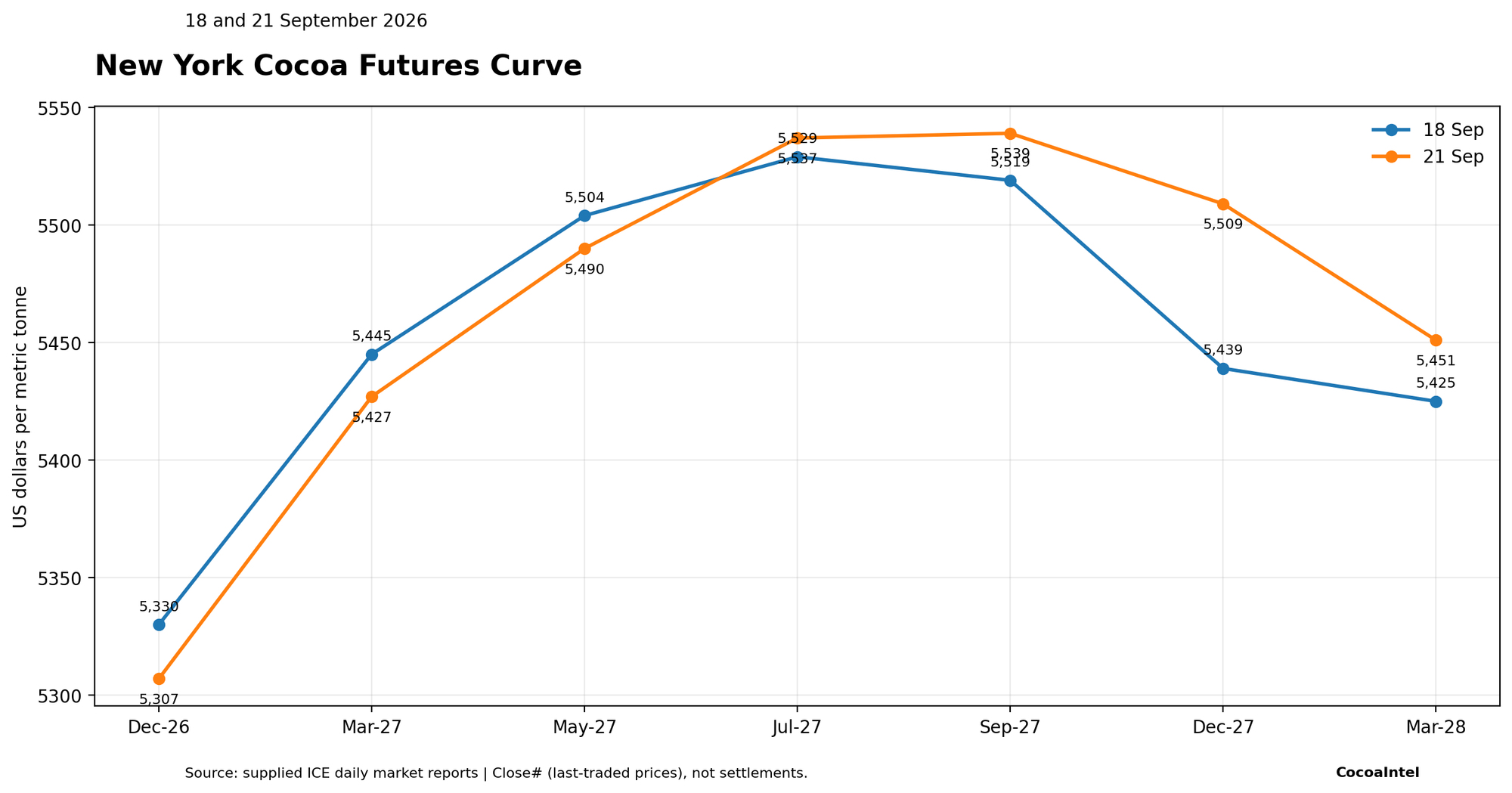
The New York curve steepened as deferred contracts outperformed. Dec-26/Mar-27 contango widened slightly from $115 to $120, while May-27/Jul-27 increased from $25 to $47. Jul-27/Sep-27 moved from $10 backwardation to just $2 contango, while Sep-27/Dec-27 backwardation narrowed sharply from $80 to $30. Dec-26/Dec-27 contango widened from $109 to $202, highlighting the continued relative weakness of nearby December.
On last-traded prices, the curve peak shifted from Jul-27 to Sep-27, although the difference was only $2. Official settlements still placed Jul-27 slightly above Sep-27. The Dec-27/Mar-28 relationship also requires caution: last trades show backwardation widening from $14 to $58, while official settlements show it narrowing slightly from about $55 to $51. The apparent change in the deferred last-trade curve should therefore not be interpreted as a confirmed structural move.
London cocoa
| Contract | 18 Sep close | 21 Sep close | Change | Change % |
|---|---|---|---|---|
| Dec-26 | £3,968 | £3,961 | −£7 | −0.18% |
| Mar-27 | £4,125 | £4,131 | +£6 | +0.15% |
| May-27 | £4,159 | £4,182 | +£23 | +0.55% |
| Jul-27 | £4,187 | £4,216 | +£29 | +0.69% |
| Sep-27 | £4,157 | £4,194 | +£37 | +0.89% |
| Dec-27 | £4,078 | £4,112 | +£34 | +0.83% |
| Mar-28 | £4,087 | £4,106 | +£19 | +0.46% |
London cocoa showed a broader stabilisation than New York. Dec-26 was the only comparable maturity to finish below Friday's last-traded price, slipping £7, or 0.18%, to £3,961. Mar-27 through Mar-28 all finished higher, with gains ranging from 0.15% in Mar-27 to 0.89% in Sep-27. The stronger performance was therefore concentrated beyond the nearby December contract.
All seven maturities traded both above and below Friday's last-traded prices during the session. Dec-26 ranged between £3,875 and £4,083 before finishing £86 above its low, approximately 41% of the way through its £208 range, compared with around 18% on Friday. The other contracts finished higher within their respective ranges: Mar-27 at about 47%, May-27 at 56%, Jul-27 at 59%, Sep-27 at 66%, Dec-27 at 63% and Mar-28 at 59%. The session therefore ended with substantially better intraday positioning than Friday, particularly from May-27 onward, although nearby Dec-26 remained the weakest contract on the last-trade comparison.
London cocoa futures curve
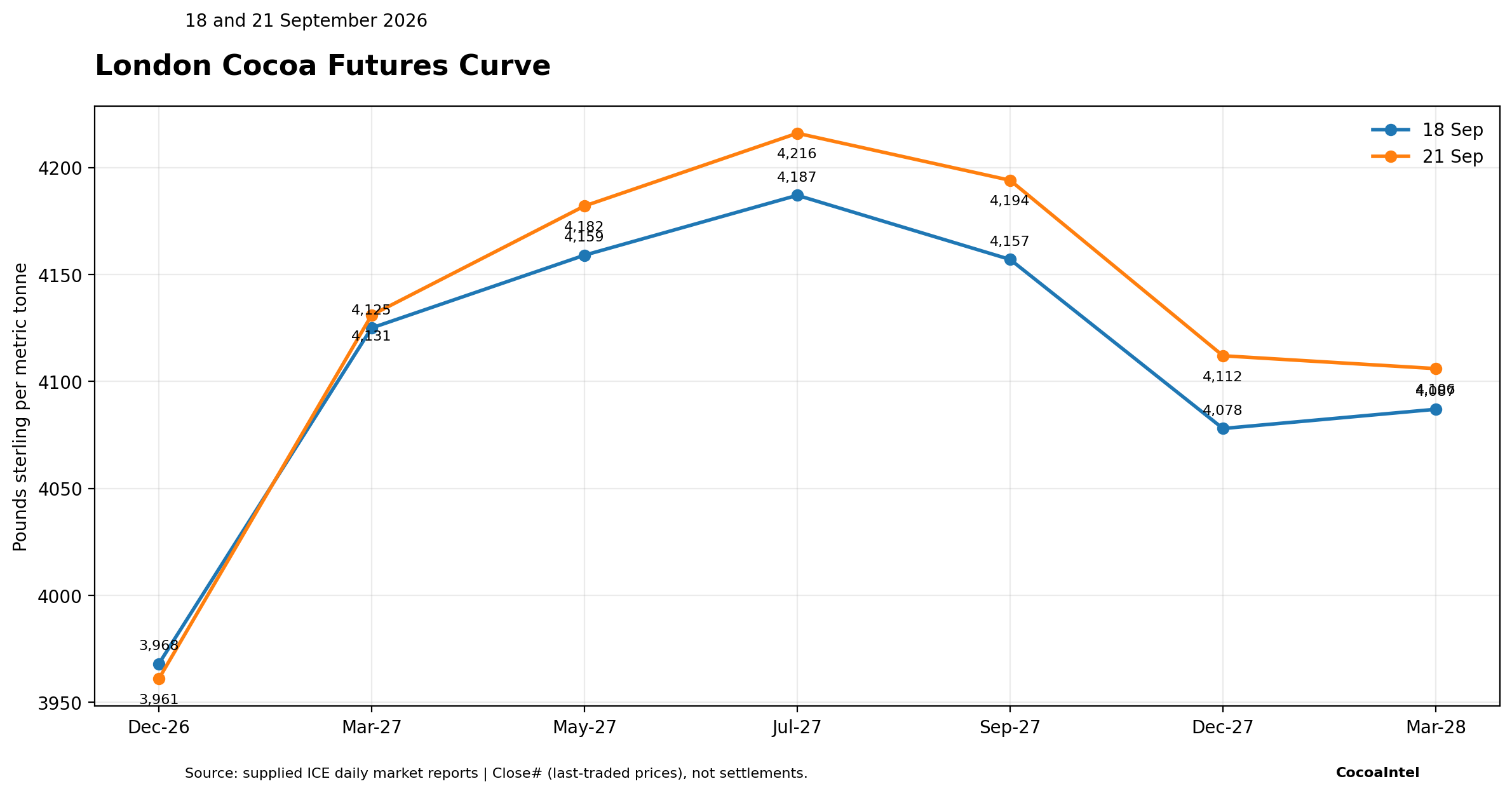
The London curve strengthened from March onward while nearby December continued to underperform. Dec-26/Mar-27 contango widened from £157 to £170, Mar-27/May-27 from £34 to £51, and May-27/Jul-27 from £28 to £34. Jul-27 remained the curve peak at £4,216. Jul-27/Sep-27 backwardation narrowed from £30 to £22, while Sep-27/Dec-27 was little changed at £82 versus £79 on Friday. Dec-26/Dec-27 contango widened from £110 to £151.
The Dec-27/Mar-28 relationship again requires caution. Last trades moved from £9 contango on Friday to £6 backwardation on Monday, suggesting a small inversion. Official settlements, however, left Dec-27 at £4,104 and Mar-28 at £4,105, equivalent to £1 contango. The apparent reversal in the last-trade curve is therefore not confirmed by settlement prices.
NY–London Dec-26 Spread
$5,307 − (£3,961 × 1.337 $/£) = +$11.1/t
New York December traded at approximately $11/t above London on 21 September, compared with a $14.9/t premium on 18 September, using each day’s exchange rate. The spread therefore narrowed by about $3.7/t, as New York weakened slightly more than London on an FX-adjusted basis.
Volume and Open Interest
New York Cocoa
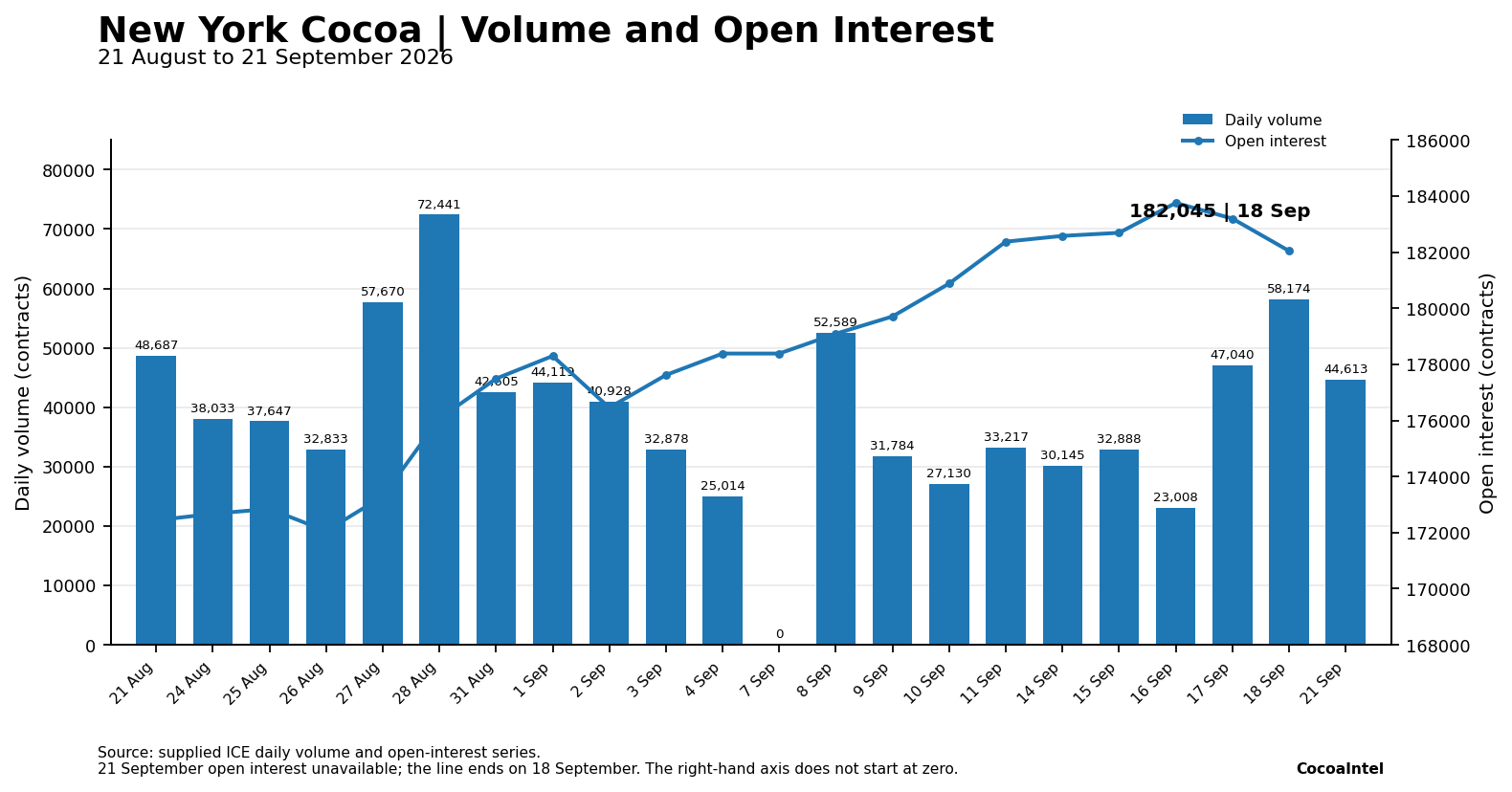
New York cocoa volume fell to 44,613 contracts on 21 September, down 23.3% from Friday's 58,174. Turnover nevertheless remained 10.3% above the recent 20-session average of approximately 40,442 contracts. Monday therefore saw a clear reduction in activity from Friday's heavy sell-off, but participation remained above its recent baseline.
The latest available open interest is 182,045 contracts for 18 September, down 1,152 contracts, or 0.63%, from 183,197 on Thursday and 1,711 contracts below the 16 September series high of 183,756. Friday's sharp price decline therefore coincided with a contraction in aggregate open interest, consistent with some net position reduction. The data do not establish which participant group was reducing exposure or whether long liquidation was the dominant driver.
Monday's above-average volume shows that participation remained significant despite the slower turnover relative to Friday.
London Cocoa
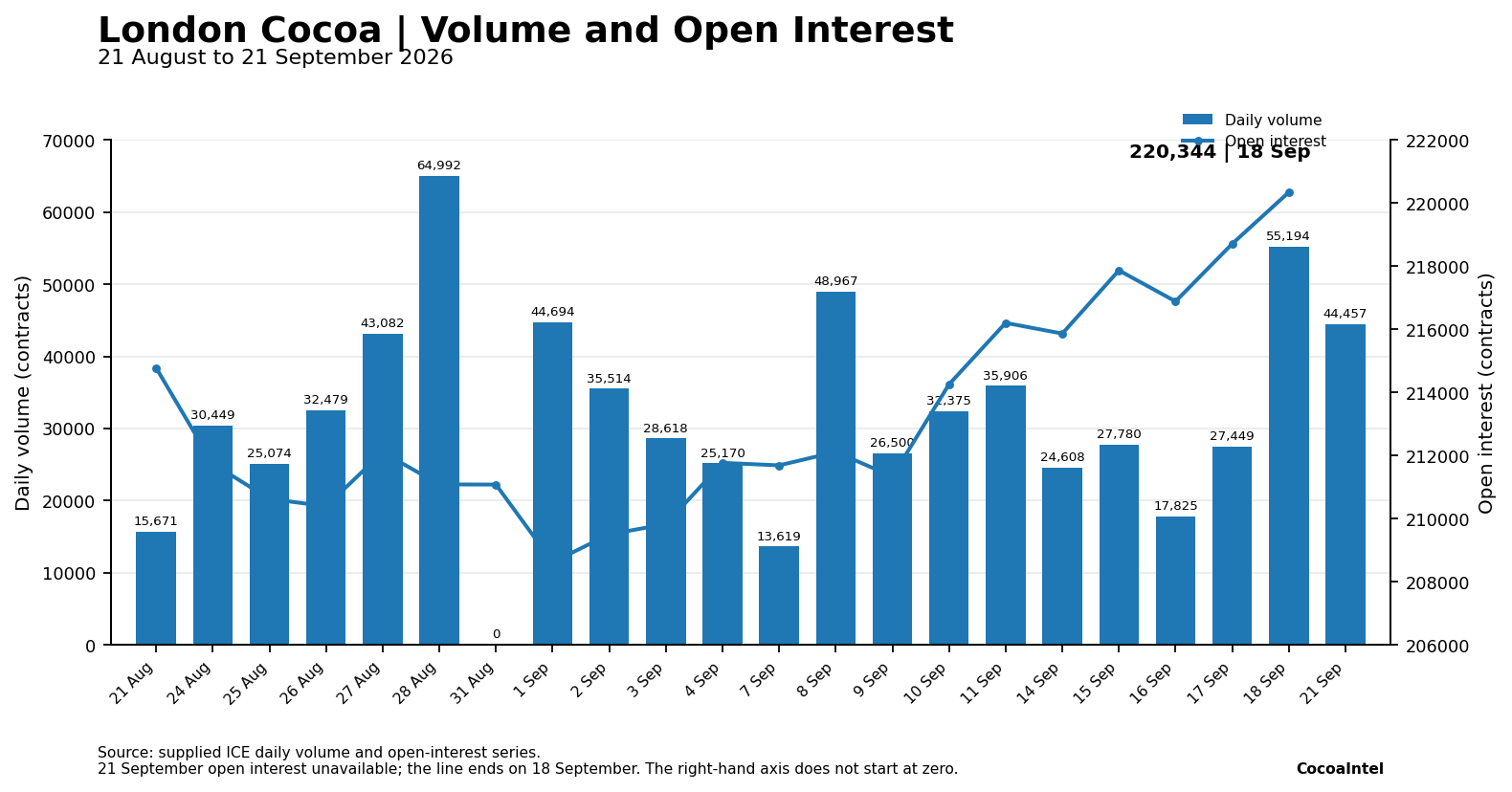
London cocoa volume declined to 44,457 contracts on 21 September from 55,194 on Friday, a fall of 19.5%. Activity nevertheless remained 35.5% above the recent 20-session average of approximately 32,798 contracts. As in New York, turnover eased from Friday's unusually active session but remained elevated relative to recent trading.
The latest available open interest rose to 220,344 contracts on 18 September, up 1,635 contracts, or 0.75%, from 218,709 on Thursday and the highest level in the period shown. Friday's sharp price decline therefore occurred alongside an expansion in outstanding positions, in contrast with the decline in New York open interest. This indicates that the London sell-off involved net position creation rather than an aggregate reduction in exposure, although total OI alone cannot identify whether speculative shorts, commercial hedges or other positions drove the increase.
ICE Cocoa Stocks
| Market | 18 Sep update | 21 Sep update | Change | Change % |
|---|---|---|---|---|
| US | 3,434,532 | 3,431,944 | −2,588 | −0.08% |
| UK / London | 1,161,250 | 1,163,125 | +1,875 | +0.16% |
US warehouse stocks declined modestly to 3,431,944 bags on 21 September, down 2,588 bags, or 0.08%, from the 18 September reading. The movement was small relative to the overall inventory base and does not indicate a meaningful acceleration in physical drawdown.
London valid stocks moved in the opposite direction, increasing by 1,875 bags, or 0.16%, to 1,163,125 bags. In tonnage terms, valid stocks rose from 74,320 tonnes to 74,440 tonnes, an increase of only 120 tonnes. The change is therefore similarly marginal.
Combined visible ICE stocks across the two markets slipped by just 713 bags, from 4,595,782 to 4,595,069 bags, effectively unchanged over the period. The latest update therefore provides little evidence of renewed inventory tightness: the small US draw was almost entirely offset by the increase in London stocks.
For the US specifically, the 21 September report shows 3,239,705 bags held in Delaware River warehouses and 192,239 bags in New York, for the 3,431,944-bag total. Separately, only 747,511 bags were listed as certified stock by origin and port, so the certified subset should not be confused with total warehouse inventories.
Tuesday Trading Setup Dec Contract
Dec-26 enters Tuesday at a major technical inflection point after closing at $5,307, with Monday's low at $5,242. The $5,300 area is critical support, combining the psychological level, the daily 90-SMA and the lower boundary of the broader rising channel. Short-term momentum remains bearish, with price below the main hourly moving averages and MACD still negative, but RSI and stochastic readings show the market is becoming increasingly stretched. Monday's recovery from below $5,300 therefore matters, although one rejection is not enough to confirm a bottom.
If $5,300-$5,242 holds, the first sign of improving structure would be a recovery above $5,400, followed by a break of Monday's $5,533 high. That would open the way toward $5,600-$5,650, while the more important resistance remains around $5,800-$6,100, where former support and several major moving averages converge. A sustained recovery through that zone would materially improve the broader trend and keep the upper side of the rising channel, currently around $6,900-$7,000, relevant as a medium-term objective.
If the market instead accepts below $5,300 and then breaks $5,242, the broader channel and daily 90-SMA support would both be failing, leaving $5,000 as the next major structural level. Tuesday should therefore be treated as a test of whether $5,300 becomes a durable base or merely a temporary pause in the decline. Holding support would favour a corrective recovery, while a confirmed break would keep the dominant bearish trend intact and shift focus toward $5,000.
If you notice any discrepancies in these figures or have extra information, please email hello@cocoaintel.com or leave a comment – corrections and additional insights are always welcome.