
Cocoa Prices Fall as Nearby Supply Outweighs Ghana Crop and El Niño Risks (3 September 2026)


New York cocoa declined across the curve on 3 September. Dec-26 finished at $6,140, down $150, or 2.38%, after trading between $6,025 and $6,319. Prices initially moved higher before reversing sharply, but buying near $6,000 produced a late recovery from the session low. Losses among the active Dec-26 through Jul-27 contracts ranged from 1.90% to 2.38%.
Cocoa news flow on 3 September was predominantly bullish for the 2026/27 outlook. Ghana’s Cocoa Marketing Company presented a substantially weaker production range, the World Meteorological Organization strengthened its El Niño warning, and Guan Chong published one of the most bullish global deficit scenarios currently in circulation.
At the same time, Mondelēz argued that existing inventories should cushion a modest production shortfall, while strong recent Ivorian arrivals and elevated exchange stocks continued to indicate comfortable nearby availability.
The principal distinction is therefore between current physical supply and future production risk. The market is not presently experiencing an acute shortage, but uncertainty surrounding the 2026/27 balance has increased.
| Development | Status of evidence | Primary horizon | Indicative implication |
|---|---|---|---|
| Ghana production range of 470,000–620,000 tonnes | CMC management estimate; not a final COCOBOD target | 2026/27 | Bullish |
| Very strong El Niño forecast | Official climate forecast; regional cocoa impact not yet observed | Late 2026–2027 | Bullish tail risk |
| Guan Chong deficit of 300,000–400,000 tonnes | Commercial processor forecast; not consensus | 2026/27 | Strongly bullish scenario |
| Mondelēz inventory assessment | Corporate view without a disclosed inventory volume | Nearby–2026/27 | Bearish counterweight |
| Ivorian farmgate price of CFA1,200/kg | Official price; associated farmer stock claims remain unverified | Immediate to 2027/28 | Mixed |
Ghana’s production range introduces substantial uncertainty
Wisdom Kofi Dogbey, managing director of the state-owned Cocoa Marketing Company Ghana, said Ghana’s cocoa production could fall to between 470,000 and 620,000 tonnes in 2026/27, compared with approximately 760,000 tonnes in 2025/26.
The upper estimate would represent a year-on-year reduction of 140,000 tonnes, or 18.4%, while the lower estimate would imply a decline of 290,000 tonnes, or 38.2%.
| CMC estimate | 2026/27 production | Change from 760,000 t | Year-on-year change |
|---|---|---|---|
| Upper estimate | 620,000 t | −140,000 t | −18.4% |
| Lower estimate | 470,000 t | −290,000 t | −38.2% |
Dogbey attributed the weaker outlook to ageing cocoa trees, disease and unusually poor pollination. He indicated that Ghana had not experienced pollination problems of the current severity for approximately two decades.
The latest comments follow earlier warnings concerning excessive rainfall, weaker cherelle development and disease pressure in some of Ghana’s most important producing regions. Western and Western North, which together account for a substantial proportion of national production, have continued to face structural problems related to ageing farms, swollen-shoot disease and the loss of cocoa land to illegal mining.
WMO strengthens its El Niño warning
The World Meteorological Organization confirmed that El Niño is firmly established and is expected to intensify into a very strong event before peaking towards the end of 2026. WMO forecasts indicate a near-100% probability that El Niño will persist through February 2027.
Oceanic indicators already demonstrate considerable strength. The Niño 3.4 sea-surface-temperature anomaly averaged approximately +1.5°C during May–July, increased to +2.0°C in July, and reached weekly values of approximately +2.2°C to +2.6°C between late July and mid-August.
The warming is not limited to the ocean surface. WMO reported subsurface anomalies exceeding +8°C in parts of the equatorial Pacific, providing additional support for further intensification.
WMO’s seasonal multi-model ensemble projects an approximately +3.6°C Niño 3.4 anomaly for September–November, with the event expected to peak during November–December. A positive Indian Ocean Dipole of approximately +0.9°C and warmer-than-normal tropical Atlantic conditions are also forecast.
These additional climate drivers are important because they can strengthen, weaken or alter the typical regional effects of El Niño. The global strength of the event alone is therefore insufficient to determine the eventual weather outcome in any individual cocoa-producing country.
For West African cocoa, the main risks include:
- irregular or below-normal rainfall during late pod development;
- higher maximum temperatures and faster soil-moisture depletion;
- an earlier or more severe transition into the dry season;
- stronger or more persistent Harmattan winds;
- increased physiological stress following the earlier period of excessive rainfall; and
- weaker flowering and cherelle survival for the 2027 mid-crop.
The timing of the event matters. A substantial part of the early 2026/27 main crop has already completed flowering and pod establishment. A late-2026 El Niño peak would therefore not automatically translate into a proportionate loss across the entire main crop.
The more important West African transmission window may involve the late main-crop tail, the December–February dry season and development of the 2027 mid-crop. An early or severe Harmattan could reduce soil moisture, damage young pods and weaken flowering, particularly where trees have already been stressed by disease or excessive rainfall.
The risk profile is different in Ecuador. Strong El Niño conditions can increase the probability of excessive coastal rainfall, flooding, waterlogged farms, transport disruption and fungal-disease pressure. Ecuador’s expanding contribution to global production makes this increasingly relevant to the world balance.
However, WMO explicitly cautioned that the strength of El Niño does not translate directly into the severity of its impact in a particular region. Historical events with similar Pacific anomalies have produced materially different rainfall outcomes in West Africa.
Guan Chong presents a 300,000–400,000-tonne deficit scenario
Guan Chong CEO Brandon Tay expects the global cocoa market to record a 300,000–400,000-tonne deficit in 2026/27, compared with an estimated surplus of approximately 100,000 tonnes in the preceding season.
The forecast implies a year-on-year deterioration in the global balance of approximately 400,000–500,000 tonnes. Tay expects weaker production to coincide with stabilising demand and believes cocoa futures could rise towards approximately $8,000 per tonne by December.
Hedgepoint expects a 111,000-tonne surplus in 2026/27, down from 325,000 tonnes in 2025/26. Its forecast incorporates an approximately 2% decline in global production and a roughly 2.5% increase in cocoa processing. BMI and StoneX have also retained surplus projections, although expected surpluses have narrowed.
Mondelēz sees inventories cushioning a modest production shortfall
A contrasting assessment was provided by Mondelēz Chief Cocoa Officer Darren O’Brien, who said existing cocoa inventories should provide a buffer against moderate production disruption. He also cautioned that the eventual impact of El Niño on global cocoa production remains speculative.
Mondelēz did not provide an inventory volume, location or stock-to-use estimate. Its comments should therefore not be interpreted as confirmation that every segment of the physical market is adequately supplied.
Exchange-certified stocks, inventories held at origin and commercial stocks within processor or manufacturer supply chains are different categories. They may vary in quality, location, certification status and immediate availability and are not necessarily interchangeable.
O’Brien also highlighted increasing production in Ecuador and Brazil as a source of geographical diversification. Additional supply from Latin America could partly offset weaker West African production, although an intensifying El Niño creates new uncertainty around Ecuador’s contribution.
On demand, Mondelēz warned that stronger retail sales may not translate proportionally into cocoa-bean consumption. Manufacturers adjusted product formulations, cocoa content and package sizes during 2024 and 2025 in response to historically high input costs.
These changes may have lowered the quantity of cocoa required for each unit of retail demand. Consequently, improving confectionery sales could coexist with a slower recovery in bean grindings.
Ivorian farmer organisations contest the CFA1,200 producer price
Seven cocoa farmer organisations in Côte d’Ivoire issued a joint declaration criticising the government’s CFA1,200/kg guaranteed producer price for the 2026/27 main crop.
The price is unchanged from the preceding mid-crop and approximately 57.1% below the CFA2,800/kg headline price announced at the opening of the previous main-crop season.
The organisations argued that the new price does not provide adequate protection to farmers following the sharp correction in international cocoa prices. They requested additional government support and the establishment of a joint state–farmer committee.
The groups also claimed that approximately 123,000 tonnes of old-crop cocoa had previously been identified, of which around 100,000 tonnes were covered by support measures. According to their declaration, approximately 23,000 tonnes remain with producers.
They additionally alleged a separate discrepancy involving more than 7,000 tonnes and approximately CFA20.3 billion. Neither the stock figures nor the associated financial claims have been independently confirmed by the Coffee and Cocoa Council. They should not be incorporated into national carryover estimates without further evidence.
There is currently no confirmed strike or physical supply disruption. The organisations said they remain open to dialogue. The development should therefore be classified as increased social and execution risk rather than an immediate supply stoppage.
Reformulation Cuts Cocoa Use by 8–10% at Major Brands
CCO Executive Director Michel Arrion told the CAA International Cocoa Conference that an ICCO-commissioned study indicated major brands had reduced the amount of cocoa incorporated into certain products by approximately 8–10%, according to CocoaRadar. If confirmed, the finding would suggest that reformulation is allowing manufacturers to maintain product sales while using fewer cocoa beans, weakening the relationship between chocolate consumption and cocoa demand. The underlying study has not yet been published, however, so the estimate should be treated as an attributed conference statement rather than an audited statistic. The development represents a potentially bearish structural demand signal that could partly offset production risks in the 2026/27 balance, but it should not yet be converted into a quantitative balance-sheet adjustment.
Futures performance
New York cocoa
| Contract | 2 Sep | 3 Sep | Change | Change % |
|---|---|---|---|---|
| Sep-26 | $6,347 | $6,166 | -$181 | -2.85% |
| Dec-26 | $6,290 | $6,140 | -$150 | -2.38% |
| Mar-27 | $6,399 | $6,262 | -$137 | -2.14% |
| May-27 | $6,429 | $6,307 | -$122 | -1.90% |
| Jul-27 | $6,435 | $6,299 | -$136 | -2.11% |
New York cocoa declined across every plotted maturity on 3 September. Among the actively traded Dec-26 through Jul-27 contracts, Dec-26 recorded the largest fall, losing $150 per tonne, or 2.38%. May-27 registered the smallest decline at $122, or 1.90%, while losses in Mar-27 and Jul-27 reached 2.14% and 2.11%, respectively. Sep-26 fell $181, or 2.85%, but only one contract traded in that maturity, making the move unrepresentative. Losses among the main contracts therefore ranged from 1.90% to 2.38%.
The active Dec-26 through Jul-27 contracts traded through ranges of $270 to $294 per tonne, markedly narrower than the $404 to $422 ranges recorded on 2 September. Each contract traded $15 to $35 above its previous final price during the session before reversing. Final prices finished 39.1% to 44.1% above their daily lows, compared with 26.6% to 35.1% in the previous session. Prices therefore remained in the lower half of their ranges, but the finish was less compressed towards the lows than on Wednesday.
Spread volume declined 27.0% to 16,746 contracts and represented 50.9% of total turnover, compared with 56.9% previously.
New York futures curve
The New York curve shifted lower by $122 to $181 per tonne across the seven plotted maturities. Sep-26/Dec-26 backwardation narrowed from $57 to $26, while Dec-26/Mar-27 contango widened from $109 to $122. Mar-27/May-27 contango increased from $30 to $45.
The curve peak moved from Jul-27 to May-27 as the May-27/Jul-27 relationship changed from $6 of contango to $8 of backwardation. Farther out, Jul-27/Sep-27 backwardation widened from $56 to $63, while Sep-27/Dec-27 backwardation narrowed from $126 to $114.
London cocoa
| Contract | 2 Sep | 3 Sep | Change | Change % |
|---|---|---|---|---|
| Sep-26 | £4,497 | £4,413 | -£84 | -1.87% |
| Dec-26 | £4,588 | £4,518 | -£70 | -1.53% |
| Mar-27 | £4,720 | £4,645 | -£75 | -1.59% |
| May-27 | £4,712 | £4,641 | -£71 | -1.51% |
| Jul-27 | £4,695 | £4,622 | -£73 | -1.55% |
London cocoa declined across all seven plotted maturities on 3 September. Among the five principal contracts, Sep-26 recorded the largest fall, losing £84 per tonne, or 1.87%. Mar-27 declined £75, or 1.59%, while losses in Dec-26, May-27 and Jul-27 ranged from 1.51% to 1.55%. Farther along the curve, the decline moderated to 1.30% in Sep-27 and 0.96% in Dec-27.
The five principal contracts traded through ranges of £191 to £205 per tonne, markedly narrower than the £281 to £299 ranges on 2 September. Every contract traded above its previous final price during the session before reversing. Final prices finished 49.0% to 52.3% above their daily lows, compared with only 23.4% to 25.1% previously. Despite the additional decline, London therefore ended close to the midpoint of its daily ranges rather than near the lower quarter.
Spread volume declined 26.4% to 15,789 contracts and represented 55.2% of turnover, down from 60.4% previously.
London futures curve
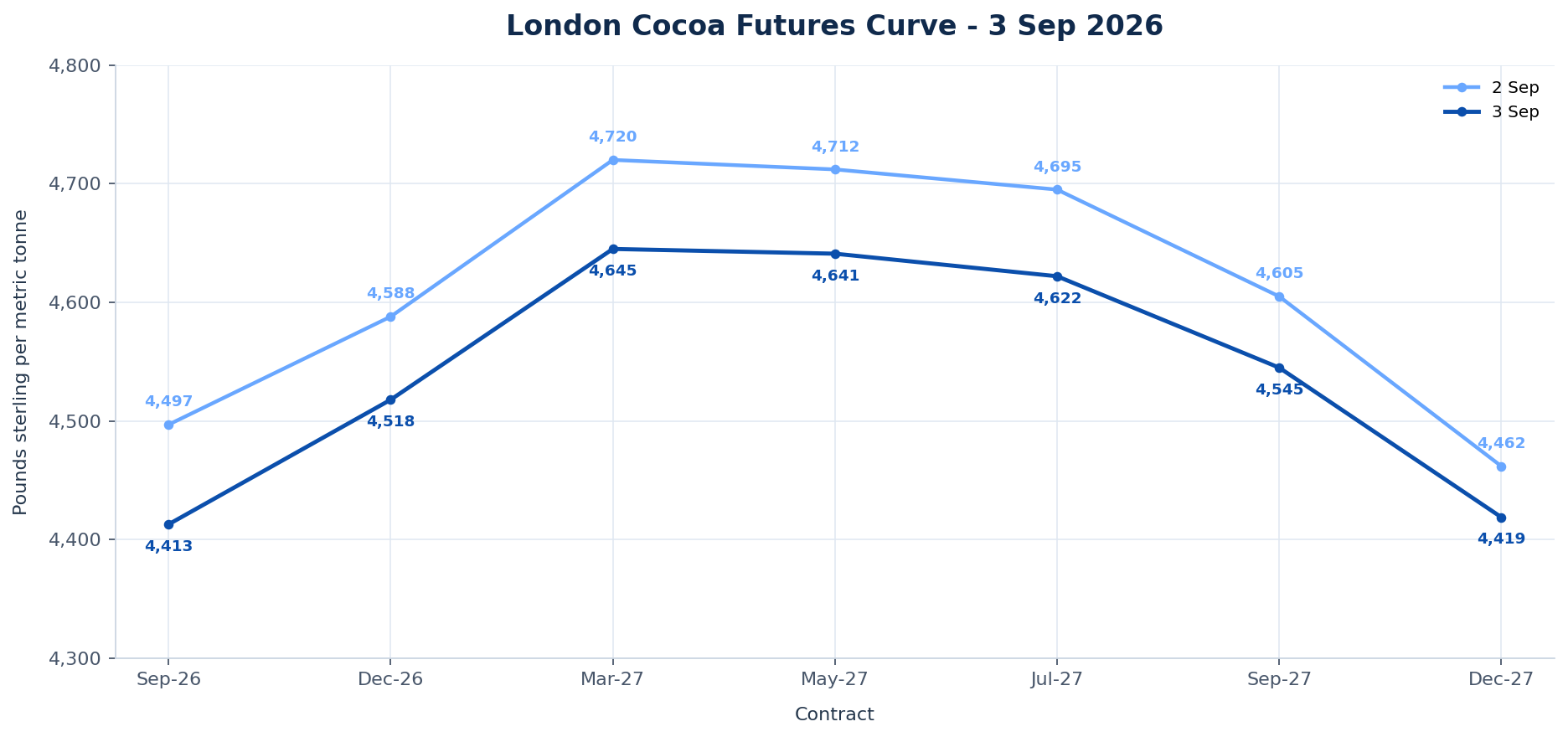
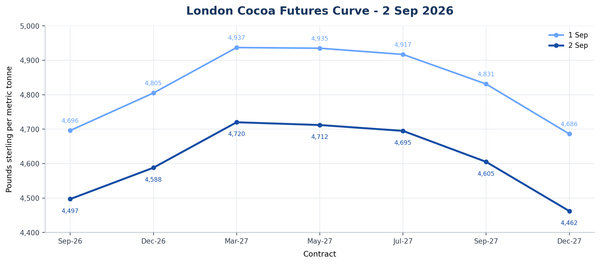
The London curve shifted lower by £43 to £84 per tonne across the seven plotted maturities, with the decline generally easing towards the back. Sep-26/Dec-26 contango widened from £91 to £105, while Dec-26/Mar-27 contango narrowed from £132 to £127.
Mar-27 remained the curve peak, with its backwardation to May-27 narrowing from £8 to £4. May-27/Jul-27 backwardation widened slightly from £17 to £19. Farther out, Jul-27/Sep-27 backwardation narrowed from £90 to £77, while Sep-27/Dec-27 backwardation narrowed from £143 to £126.
US–UK Spread
(Dec Contract)
$6,140 − (£4,518 x 1.353$/£) =$27ton (down from $105ton)
Volume and Open Interest
New York cocoa
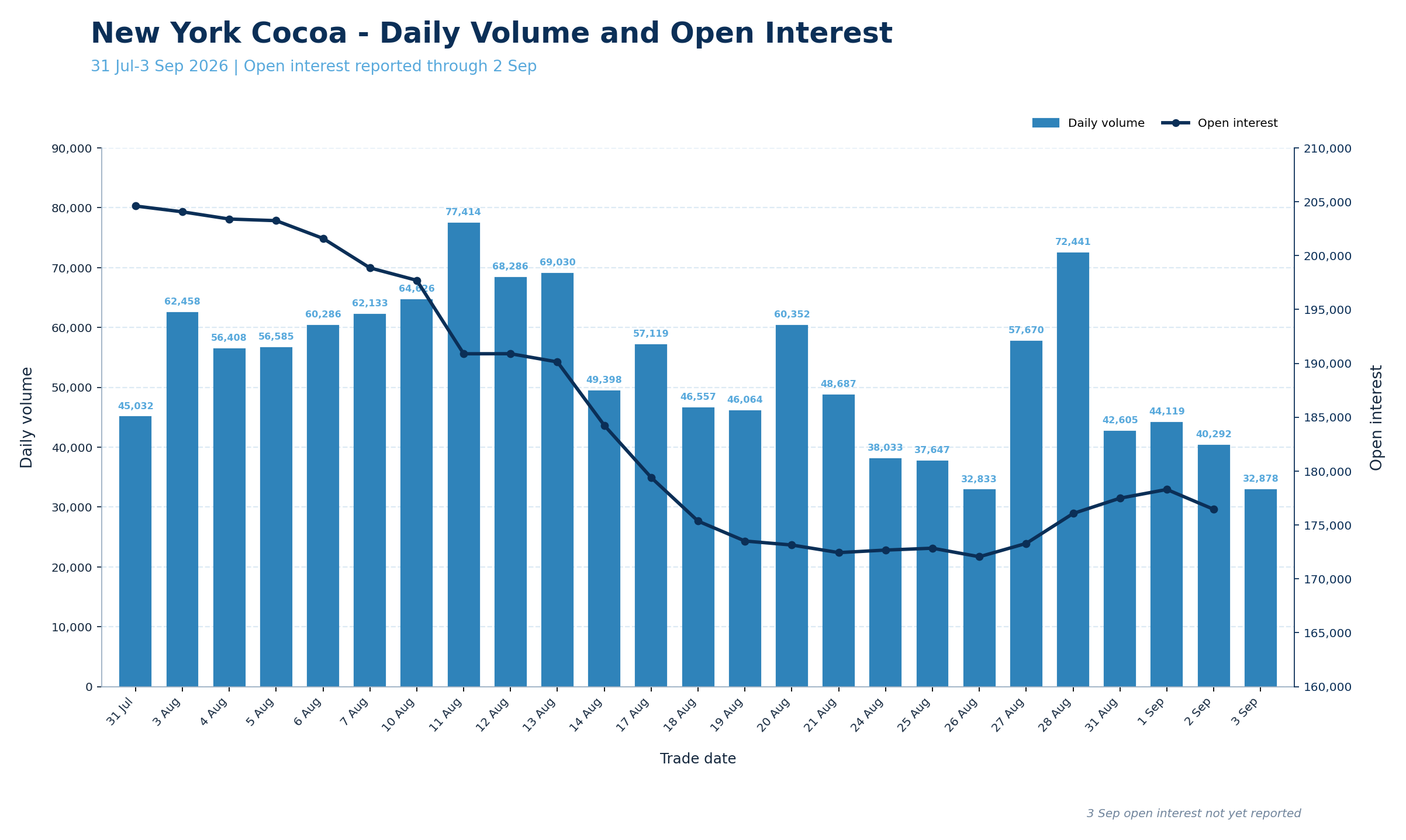
New York cocoa volume fell to 32,878 contracts on 3 September, down 7,414 contracts, or 18.4%, from 40,292 on 2 September. Turnover was 38.9% below the preceding 20-session average of 53,780 and 38.2% below the displayed-period average of 53,158.
It was the second-lowest daily volume in the 25-session window, exceeding only the 32,833 contracts recorded on 26 August. Turnover stood 44,536 contracts, or 57.5%, below the period peak of 77,414 on 11 August. Participation therefore weakened for a second consecutive session and returned to near the period low.
The latest available open-interest figure, for 2 September, declined to 176,454 contracts from 178,298 on 1 September, a fall of 1,844 contracts, or 1.0%. This ended four consecutive increases from the 26 August low of 172,055. Open interest remained 4,399 contracts, or 2.6%, above that low but was still 28,152 contracts, or 13.8%, below the 31 July level.
The combination of lower prices and falling open interest on 2 September is consistent with positions being closed during the decline, potentially including long liquidation.
London cocoa
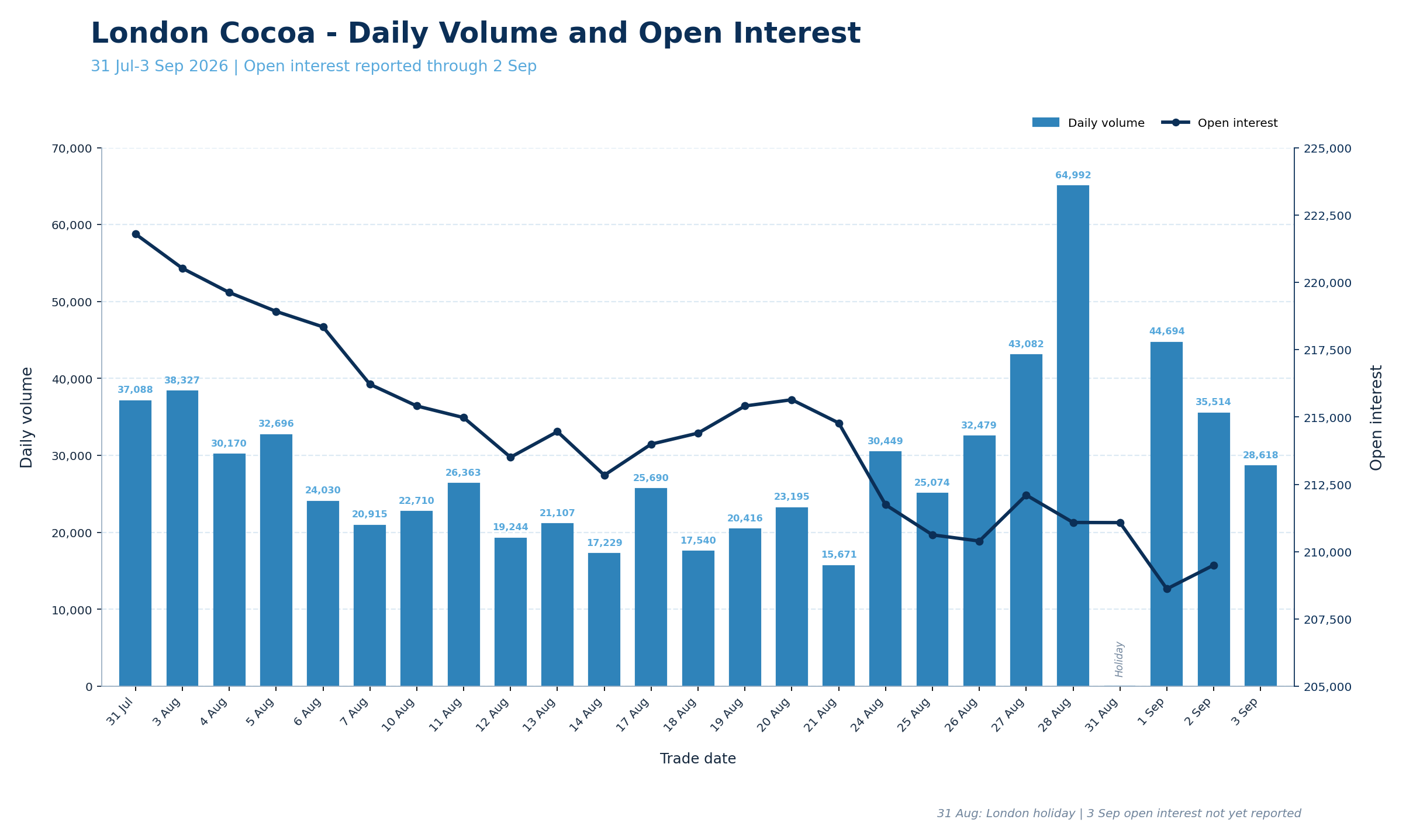
London cocoa volume fell to 28,618 contracts on 3 September, down 6,896 contracts, or 19.4%, from 35,514 on 2 September. Turnover was 1.6% above the preceding 20-active-session average of 28,155, but 1.5% below the displayed active-period average of 29,054. The 31 August holiday is excluded from both calculations.
It was the 14th-lowest volume in the 24-active-session window and stood 36,374 contracts, or 56.0%, below the period peak of 64,992 recorded on 28 August. The day-on-day decline therefore returned activity to roughly its recent norm rather than to an unusually weak level.
The latest available open-interest figure, for 2 September, increased to 209,500 contracts from 208,617 on 1 September, a rise of 883 contracts, or 0.4%. This recovered 35.8% of the decline between 28 August and 1 September. Open interest nevertheless remained 12,293 contracts, or 5.5%, below its 31 July level and only 883 contracts above the displayed-period low.
London prices declined on 2 September while open interest increased, a combination consistent with new positions entering during the sell-off and potentially including fresh short participation.
Exchange Trading Volume
| MARKET | 2 SEP 2026 | 3 SEP 2026 | CHANGE | CHANGE % |
|---|---|---|---|---|
| US | 3,406,661 | 3,398,273 | -8,388 | -0.25% |
| UK | 1,191,875 | 1,200,625 | +8,750 | +0.73% |
The measure is not a complete regional stock-to-grind ratio, as it includes only exchange-certified cocoa held at U.S. and EU delivery ports and excludes commercial inventories outside the ICE warehouse system. North America NCA grindings cover processors across North America, while ICE U.S. certified stocks are stored at U.S. delivery ports. ECA reports bean usage in European countries and London-certified cocoa is held in European and UK delivery locations.
Readers can explore detailed cocoa market datasets, futures statistics, and historical indicators in the CocoaIntel Data Hub:
 Cocoa Intel
Friday Outlook Dec Contract
New York cocoa enters Friday at a key technical inflection point. Thursday’s decline tested $6,000–$6,050 before recovering to $6,140. This area combines the psychological $6,000 level, the rising 21-day moving average and the former triangle boundary, creating strong confluence support. Oversold daily and hourly momentum also increases the possibility of a technical rebound.
However, the bullish case remains unconfirmed. Price has broken below the daily nine-day moving average, while the hourly structure, MACD and on-balance volume remain weak. Thursday’s volume was the second lowest for the past 20 sessions, reducing the conviction behind the decline, but open interest has not yet been reported.
The short-term bias is therefore cautiously bullish while $6,000 holds. A recovery above $6,200–$6,250 would improve the outlook, while a sustained move through $6,250–$6,300 could open the way towards $6,400–$6,500. Conversely, a close below $6,000 would invalidate the rebound scenario and expose $5,900–$5,850.
If you notice any discrepancies in these figures or have extra information, please email hello@cocoaintel.com or leave a comment – corrections and additional insights are always welcome.