
Cocoa Rebounds as Côte d’Ivoire Weather and Arrivals Raise Supply Risks (14 September 2026)

Cocoa futures rebounded on Monday after Friday’s broad sell-off, with gains recorded across both the New York and London curves. In New York, Dec-26 cocoa rose from $5,913 to $6,023, gaining $110, or 1.86%, while the rest of the comparable curve advanced by roughly 1.56% to 1.82%. London followed the same direction, with Dec-26 rising from £4,313 to £4,382, up £69, or 1.60%, while gains across the comparable maturities ranged from 0.81% to 1.58%. Despite the broad recovery in prices, trading volumes declined in both markets, suggesting that Monday’s rebound lacked strong participation and may have been driven partly by short covering following Friday’s weakness.
Côte d’Ivoire Weather Risk Is Becoming More Material
According to Reuters, weather conditions across Côte d’Ivoire are becoming a more important source of risk for the upcoming 2026/27 main crop. Farmers in several of the country's major cocoa-growing regions reported below-average rainfall during the past week, raising concerns that pod development could be impaired and that the September-to-February crop may finish earlier than last season. The weakness has been particularly pronounced in key western and central producing areas, while only Abengourou in the east and Bongouanou in the centre received rainfall above their five-year averages.
Conditions around Soubré, the country's most important cocoa-producing region, are particularly notable. Only 0.5 mm of rainfall was recorded during the week, around 16.7 mm below the five-year average. Farmers in Daloa, where rainfall was approximately 28 mm below normal, reported that some small pods are already drying because of insufficient moisture. Similar concerns were reported around Agboville, Divo and Yamoussoukro. Harvesting remains limited for now and meaningful volumes are not expected to begin leaving farms until October, but the condition of developing pods over the next several weeks will increasingly determine both the size and duration of the main crop.
The concern is reinforced by broader regional weather data. Satellite observations continue to indicate a below-normal precipitation bias across central and southern Côte d’Ivoire and parts of southwestern Ghana. Rainfall is expected to become more widespread across West African cocoa areas during the next seven to ten days, including Côte d’Ivoire, Ghana, Nigeria and Cameroon. However, the expected rainfall is mostly light to moderate and may not be sufficient to eliminate the accumulated moisture deficits. Temperatures are also expected to remain somewhat above normal.
Ivorian Port Arrivals Start Slowly
Cocoa arrivals at Côte d’Ivoire's ports reached approximately 26,800 tonnes between the beginning of the new season on September 1 and September 13. Around 21,000 tonnes were delivered to San Pedro and roughly 5,000 tonnes to Abidjan. No cocoa arrivals were recorded during the first week of September, meaning essentially all of the reported volume entered the ports between September 7 and September 13.
At first glance, arrivals are running about 46% below the 48,000 tonnes recorded during the comparable opening period last season. However, the comparison needs to be treated carefully. Côte d’Ivoire brought the official start of the 2026/27 season forward by one month, from October 1 to September 1, while September is normally a relatively quiet period for both harvesting and commercial activity. Comparing September arrivals this year directly with October arrivals last year therefore exaggerates the apparent deterioration.
There may also be behavioural factors temporarily restricting the flow of beans into the official marketing system. Some farmers and intermediaries could be holding cocoa back in anticipation of a possible increase in the official farmgate price, particularly if they believe selling later could generate a materially better return. When expectations of a price adjustment are strong, even a relatively short delay in selling can reduce reported arrivals without necessarily implying that the beans are absent from the crop.
Cross-border leakage is another potential factor. Differences between the prices available to farmers in Côte d’Ivoire and neighbouring producing countries could be creating an incentive for some beans to move outside official domestic channels. Where the price differential is sufficiently wide, cocoa produced in Côte d’Ivoire may be sold across borders rather than delivered through the Ivorian marketing system. Such flows are difficult to quantify in real time, but they can distort official arrival data and make port receipts appear weaker than the underlying level of production.
Traceability Changes Are Complicating the Arrival Signal
The interpretation of Côte d’Ivoire's early arrivals is further complicated by the introduction of the country's new cocoa traceability and marketing system. From September 1, cocoa purchases must be conducted using electronic producer cards, while cooperatives and authorized buyers are required to provide documentation demonstrating that beans were purchased in accordance with the new traceability procedures.
The reforms are intended to strengthen compliance with European deforestation requirements and improve transparency throughout the Ivorian supply chain. However, their introduction has created delays while producer cards, electronic payment terminals and other equipment are distributed and market participants adapt to the new process. Exporters have previously warned that implementation problems could disrupt cocoa movements during October and November.
The Coffee and Cocoa Council remains relatively optimistic. CCC Director General Yves Brahima Koné said the system was functioning without major difficulties despite some initial delays and indicated that activity should accelerate once equipment distribution is completed. The regulator expects the system to be fully prepared for the larger volumes normally arriving in October and said roughly another 18,000–19,000 tonnes of cocoa should reach ports shortly.
Brazil's Irrigated Cocoa Expansion Highlights Longer-Term Supply Diversification
Outside West Africa, Brazil continues to demonstrate the potential for significant productivity improvements through irrigated cocoa production. New cocoa projects in northeastern and western Brazil are using full-sun cultivation, irrigation and more intensive agronomic management to achieve yields far above those traditionally associated with Brazilian cocoa production.
Some commercial farms in western Bahia are reportedly producing around 3,000–3,500 kilograms per hectare, while new projects are targeting yields of 3,000–4,500 kilograms per hectare. This compares with a Brazilian national average of only around 330–400 kilograms per hectare. Several projects are now expanding, including a roughly 500-hectare irrigated operation in western Bahia, smaller developments in Ceará and plans for significantly larger planted areas in Piauí.
These volumes are not large enough to materially influence the current global balance, and large-scale development will require substantial investment in irrigation infrastructure, genetics and farm management. Nevertheless, the yield differential is important. It demonstrates that cocoa production is technically capable of expanding well beyond the traditional humid West African model when irrigation and modern agronomic systems are applied.
Over the longer term, such projects could contribute to a gradual diversification of global cocoa supply. The extraordinarily high prices experienced during the recent cocoa shortage have created a powerful economic incentive to invest in non-traditional producing regions, and Brazil is currently one of the clearest examples of how that investment could translate into future production growth.
Ghana Sustainability and Supply Developments
Ghana also remains relevant to the broader West African supply picture. Moisture deficits have been observed in parts of southwestern Ghana, suggesting that the weather issue is not confined to Côte d’Ivoire. This adds another layer of uncertainty to a Ghanaian crop that is already expected to remain well below historical production levels following several seasons of disease pressure, adverse weather and structural problems within the sector.
Separately, Ghana signed a new cocoa-sustainability cooperation agreement with Japan's Meiji Holdings. The agreement strengthens the company's long-standing relationship with Ghana and forms part of Meiji's strategy to source cocoa with greater traceability and sustainability assurance. While the announcement does not materially alter near-term supply or demand, it reflects the broader movement toward more direct relationships between chocolate manufacturers and producing countries as traceability requirements become increasingly important.
September Cocoa Contract Approaches Final Notice
The September 2026 New York cocoa contract is approaching the final stage of its delivery cycle. According to ICE, the contract's last trading day is August 15 and first notice day was August 25, while the last notice day and final settlement date are both scheduled for September 16. The delivery period began on September 9 and can continue through September 30. With only two days remaining until final notice, attention is likely to remain on warehouse stocks, grading activity and any additional cocoa tendered for delivery. Although the September contract is no longer actively trading and therefore should not be viewed as the main driver of Dec-26 price action, expiry-related movements can still influence certified inventories and nearby physical-market signals, making the next few ICE stock reports particularly important.
Futures performance
New York cocoa
| Contract | 11 Sep | 14 Sep Close | Change | Change % |
|---|---|---|---|---|
| Dec-26 | $5,913 | $6,029 | +$116 | +1.96% |
| Mar-27 | $6,036 | $6,157 | +$121 | +2.00% |
| May-27 | $6,092 | $6,198 | +$106 | +1.74% |
| Jul-27 | $6,087 | $6,181 | +$94 | +1.54% |
| Sep-27 | $6,034 | $6,129 | +$95 | +1.57% |
| Dec-27 | $5,923 | $6,018 | +$95 | +1.60% |
| Mar-28 | $5,841 | $5,927 | +$86 | +1.47% |
New York cocoa rebounded across every comparable maturity on 14 September, reversing the weak tone seen at the end of the previous session. Mar-27 recorded the strongest advance, gaining $121, or 2.00%, while Dec-26 rose $116 to $6,029. Gains remained broad further along the curve, with contracts from May-27 through Mar-28 rising between 1.47% and 1.74%.
The intraday price action was also notably stronger than on 11 September. Dec-26 traded across a wide $5,821–$6,113 range before closing at $6,029, around 71% of the way up its daily range. Mar-27 and May-27 both finished around 73% into their ranges, while Mar-28 closed particularly strongly near the upper end of the session. This contrasts with the previous session, when most contracts finished close to their daily lows. The move therefore looks more like a broad recovery in buying interest, although the fact that several nearby contracts initially traded below their 11 September closes before reversing higher suggests that short-covering may also have contributed to the rebound.
New York Futures Curve
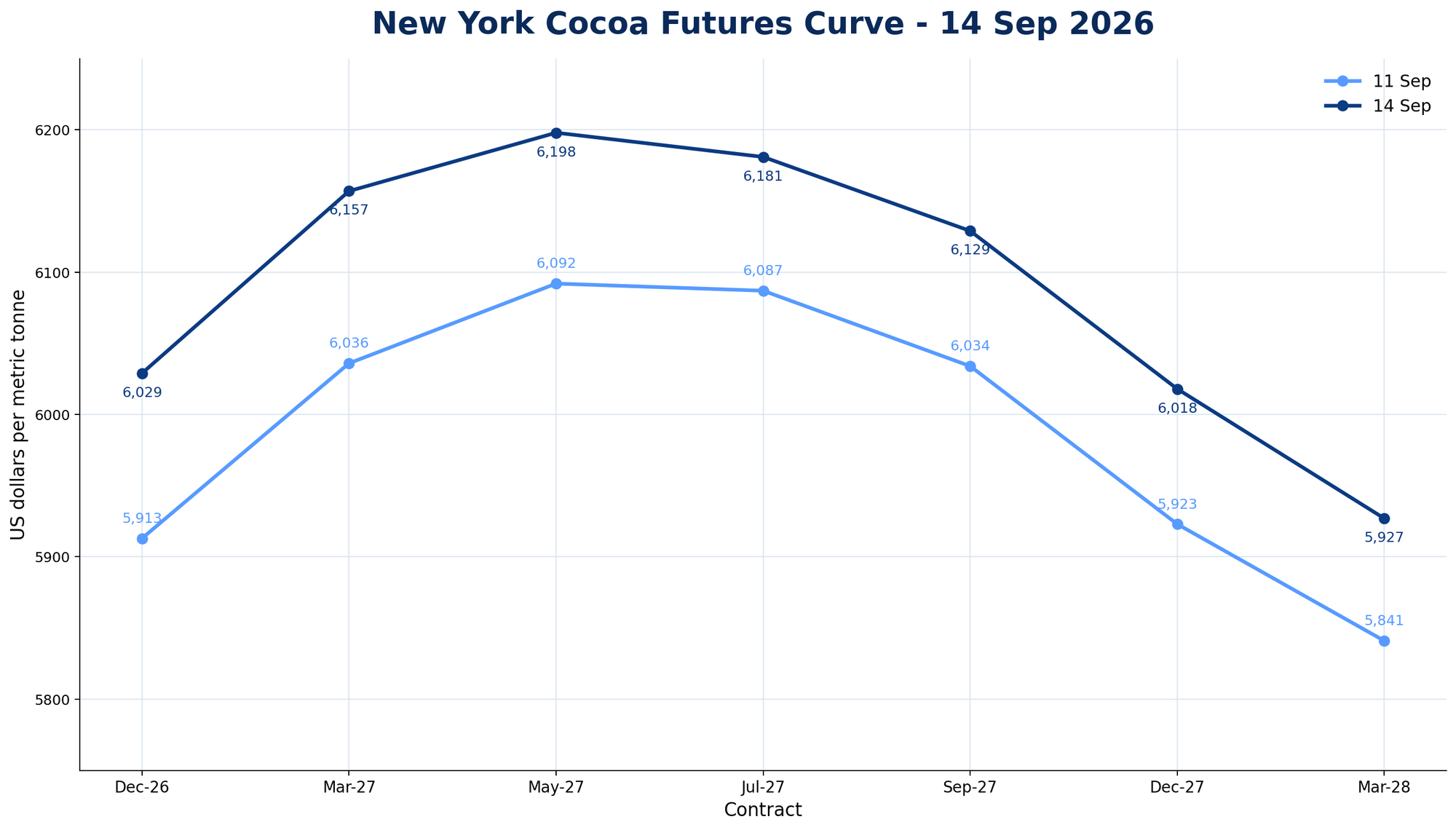
The entire New York curve shifted higher on 14 September, but the rebound was somewhat stronger in nearby and mid-2027 contracts than at the back of the curve. Mar-27 gained $121 and Dec-26 gained $116, compared with an $86 increase in Mar-28. May-27 remained the highest-priced contract at $6,198, followed closely by Jul-27 at $6,181.
There were also some meaningful changes in the curve structure. The May-27/Jul-27 backwardation widened from only $5 on 11 September to $17, while the Jul-27/Sep-27 backwardation remained almost unchanged at around $52–53. More notably, the Dec-26/Dec-27 relationship moved from a $10 contango on 11 September to an $11 backwardation on 14 September as Dec-26 strengthened more aggressively. This suggests that the rebound was accompanied by greater relative support for nearer supply rather than being purely a parallel upward shift of the entire curve. However, the curve still rises substantially from Dec-26 into the May-27 peak, so the structure is not yet signalling broad near-term scarcity.
London cocoa
| Contract | 11 Sep | 14 Sep Close | Change | Change % |
|---|---|---|---|---|
| Sep-26 | £4,109 | £4,210 | +£101 | +2.46% |
| Dec-26 | £4,313 | £4,386 | +£73 | +1.69% |
| Mar-27 | £4,477 | £4,540 | +£63 | +1.41% |
| May-27 | £4,493 | £4,564 | +£71 | +1.58% |
| Jul-27 | £4,491 | £4,551 | +£60 | +1.34% |
| Sep-27 | £4,422 | £4,485 | +£63 | +1.42% |
| Dec-27 | £4,300 | £4,374 | +£74 | +1.72% |
| Mar-28 | £4,311 | £4,347 | +£36 | +0.84% |
London cocoa also advanced across every comparable maturity on 14 September. Sep-26 recorded the largest percentage increase, rising £101, or 2.46%, to £4,210, although the nearby contract is approaching expiry and its price action should therefore be interpreted with some caution. Dec-26 gained £73, or 1.69%, while gains across the core Mar-27 to Sep-27 section ranged from 1.34% to 1.58%.
The quality of the close was considerably stronger than on 11 September. Sep-26 finished exactly at its £4,210 session high, while most contracts from Dec-26 through Dec-27 closed within roughly the upper third of their daily ranges. Mar-28 finished particularly strongly at £4,347 against a session high of £4,358. The broad recovery and stronger closes show that buyers regained control during the session after the persistent selling pressure seen on 11 September.
London Futures Curve
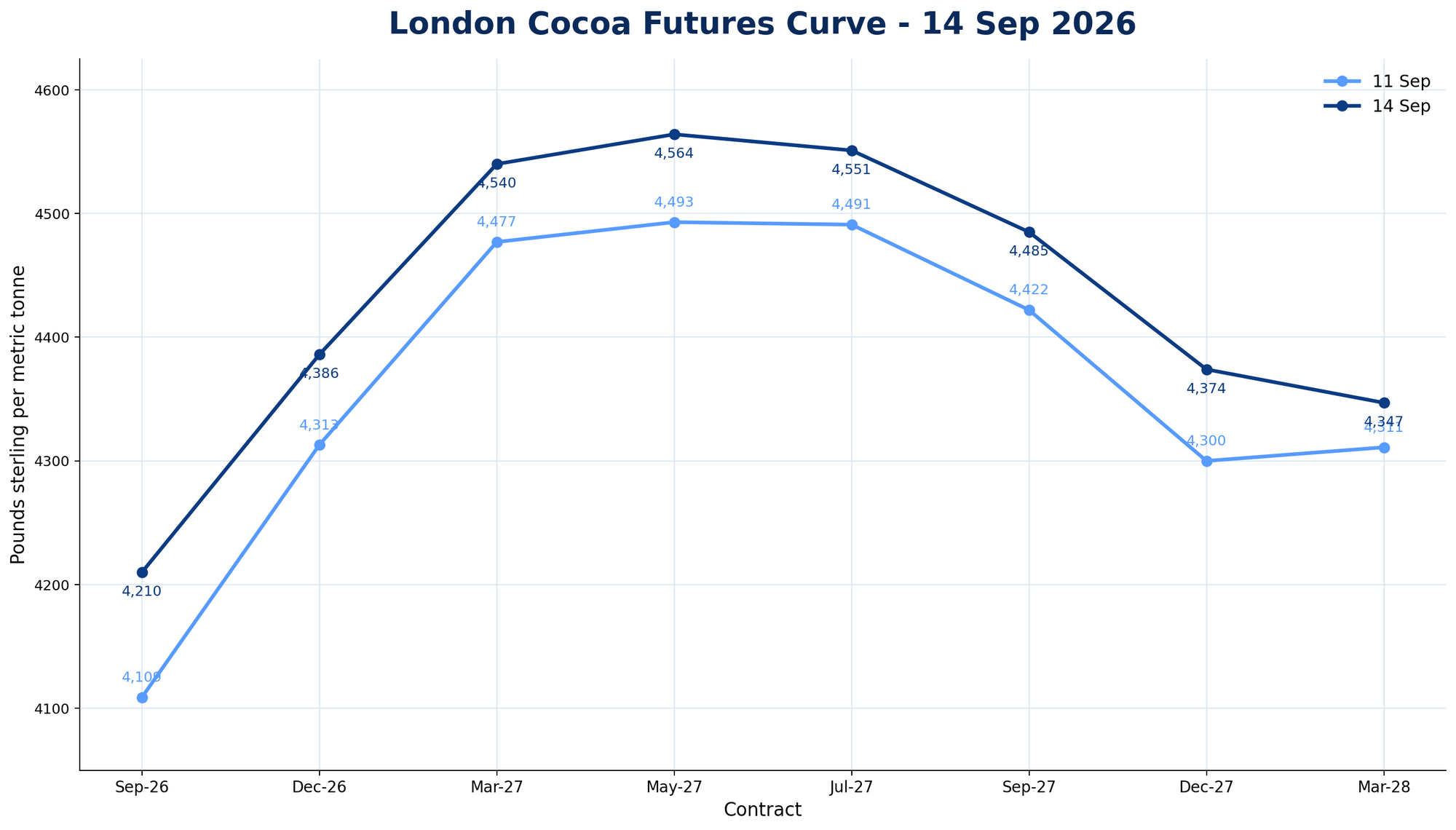
The London curve also shifted higher across its full length, although the strongest increase was concentrated in the expiring Sep-26 contract. Excluding that maturity, the advance was relatively even, with Dec-26 through Dec-27 gaining £60–£74 while Mar-28 lagged with a £36 increase. May-27 remained the peak of the curve at £4,564, slightly above Jul-27 at £4,551 and Mar-27 at £4,540.
The curve structure became moderately firmer at the front. Sep-26/Dec-26 contango narrowed from £204 to £176, although expiry effects make this spread less informative. More importantly, Dec-26/Mar-27 contango narrowed from £164 to £154, while May-27/Jul-27 moved from only £2 of backwardation to £13. By contrast, Jul-27/Sep-27 backwardation was broadly stable, easing slightly from £69 to £66. The Dec-26/Dec-27 relationship also remained essentially unchanged in slight backwardation.
US–UK Spread
$6,029 − (£4,386 x 1.350$/£) =$108ton
NY Dec-26 premium to London Dec-26: approximately $108/t, down from roughly $81/t on 10 September.
Volume and Open Interest
New York cocoa
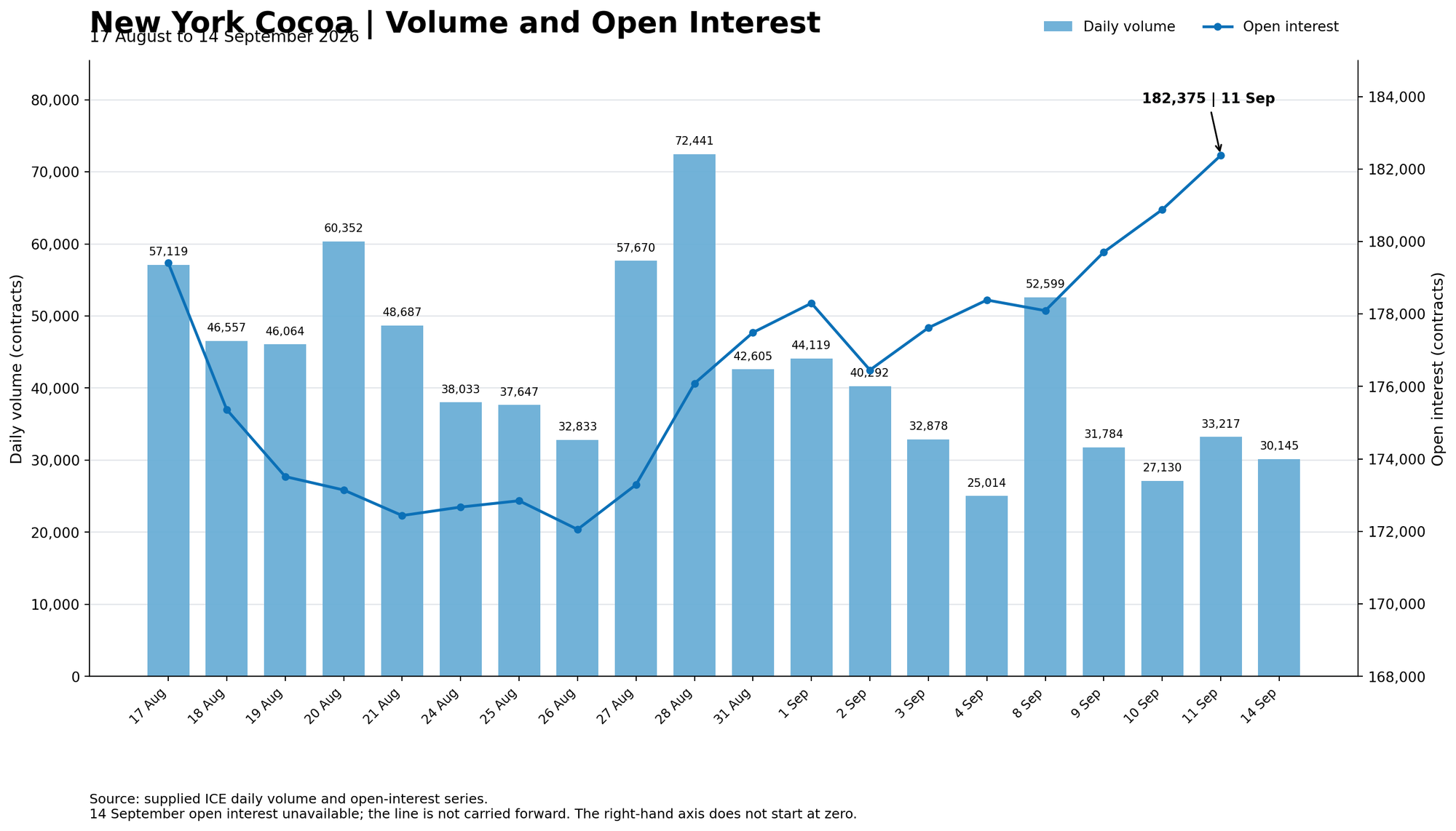
New York cocoa volume declined to 30,145 contracts on 14 September, down 9.2% from 33,217 contracts on 11 September. Turnover remained relatively subdued despite the broad rebound in futures prices: volume was 29.7% below the 20-session average of approximately 42,859 contracts and ranked as the third-lowest session in the latest 20-session period. It was also 58.4% below the recent peak of 72,441 contracts recorded on 28 August.
The latest available open-interest reading is for 11 September, when OI increased by 1,494 contracts to 182,375, extending the recovery from the 26 August low of 172,055. Open interest has therefore risen by 10,320 contracts, or 6.0%, from that low and is at its highest level since mid-August. This shows that market participation had been rebuilding into the end of last week after the substantial contraction seen earlier in August.
Monday's price rebound therefore occurred against an interesting backdrop: positioning had been rebuilding, but actual trading volume fell and remained well below average. The rise in prices cannot yet be classified confidently as either fresh long accumulation or short covering because 14 September open interest is not yet available. If the next OI reading rises alongside Monday's higher prices, it would provide stronger evidence that fresh positions were entering the market and would make the rebound more convincing. If OI falls, the move would look more consistent with short covering following Friday's sell-off.
London Cocoa
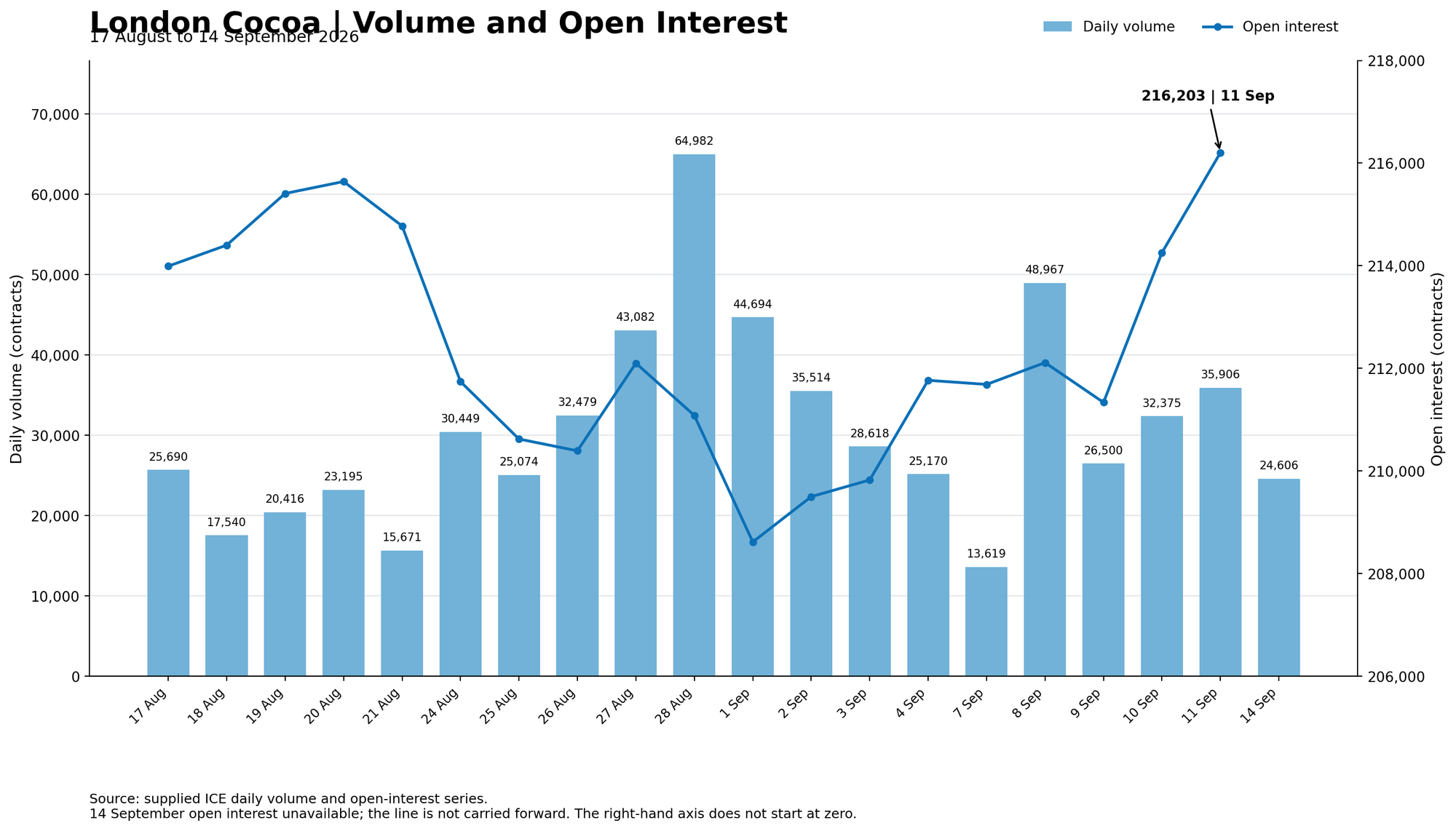
London cocoa activity weakened more sharply. Volume fell to 24,606 contracts on 14 September from 35,906 contracts on 11 September, a decline of 31.5%. Turnover was around 19.9% below the latest 20-session average of approximately 30,727 contracts and ranked only 15th among the 20 sessions. Activity was also 62.1% below the 64,982-contract peak recorded on 28 August.
The latest available London open-interest reading is also for 11 September. OI rose by 1,948 contracts, or 0.9%, to 216,203, its highest level in the period shown. This represents an increase of 7,586 contracts, or 3.6%, from the 1 September low of 208,617. The recent rise in open interest therefore indicates that positioning had been expanding again ahead of Monday's rally rather than continuing the reduction seen during late August and early September.
Monday's strong price recovery was accompanied by a substantial drop in trading activity. This is particularly notable in London because prices rose across the curve while volume contracted by almost one-third. The rebound therefore had considerably less participation behind it than Friday's session.
ICE Inventory stocks
| MARKET | 11 SEP 2026 | 14 SEP 2026 | CHANGE | CHANGE % |
|---|---|---|---|---|
| US | 3,415,952 | 3,421,126 | +5,174 | +0.15% |
| UK | 1,337,188 | 1,422,656 | +85,468 | +6.39% |
Total cocoa held in ICE U.S. licensed warehouses increased slightly to 3.421 million bags on 14 September, up 5,174 bags, or 0.15%, from 11 September. However, the more important certified-stock figure moved in the opposite direction. Certified cocoa declined by 5,569 bags to 737,445, equivalent to approximately 4,924 exchange lots. As a result, certified cocoa now represents about 21.6% of total warehouse stocks, down slightly from 21.8% on 11 September.
This distinction matters because the increase in total warehouse inventory does not necessarily represent additional cocoa immediately available for delivery against futures. The latest data actually show a small contraction in certified supply even as overall warehouse holdings increased. Ecuadorian cocoa continues to dominate the certified pool, accounting for roughly 65% of the total, while 7,260 bags of Ecuadorian cocoa are still pending grading.
London Stocks Jump Sharply
Total valid tonnage rose from 85,580 tonnes on 10 September to 91,050 tonnes on 11 September, an increase of 5,470 tonnes, or 6.39%. In 64-kg bag-equivalent terms, stocks increased by roughly 85,500 bags to 1.423 million.
Almost the entire increase came from Antwerp, where valid stocks rose by 5,220 tonnes, while Liverpool added another 250 tonnes. Antwerp now holds 53,000 tonnes, or about 58% of total London deliverable inventory, while Amsterdam accounts for another 34,540 tonnes, or roughly 38%. Together, the two ports hold more than 96% of the available stock.
The Broader Stock Trend Remains Bearish for Scarcity
Despite the small decline in U.S. certified stocks on 14 September, the broader 2026 trend continues to show substantial rebuilding of exchange inventories. U.S. total warehouse stocks have more than doubled from around 1.63 million bags at the beginning of January, while certified stocks have risen from just 103,405 bags to more than 737,000. London valid stocks have increased from 36,210 tonnes at the start of the year to 91,050 tonnes in the latest report.
Readers can explore detailed cocoa market datasets, futures statistics, and historical indicators in the CocoaIntel Data Hub:
 Cocoa Intel
Tuesday Outlook Dec Contract
For Tuesday, the most likely scenario is a volatile consolidation with a slight upside bias as long as Dec-26 cocoa holds above the $6,000 area. The hourly chart is improving, with short-term momentum turning higher, but the market is approaching a heavy resistance cluster around $6,090–6,115 and then $6,130–6,175, so the first test will be whether buyers can extend Monday’s rebound through those levels. A sustained break above $6,115 would likely trigger further short covering toward $6,150–6,175, with $6,200–6,230 becoming the next target. However, failure to break the $6,100–6,175 zone could bring renewed selling, especially because the daily MACD remains bearish and price is still below the main short-term daily moving averages. A move back below $6,000 would weaken the recovery and expose $5,960–5,980, followed by $5,900, while a break of Monday’s $5,821 low would turn the technical picture decisively more bearish.
If you notice any discrepancies in these figures or have extra information, please email hello@cocoaintel.com or leave a comment – corrections and additional insights are always welcome.