Cocoa Reverses Sharp Sell-Off as Buyers Defend Key Support (1 October 2026)


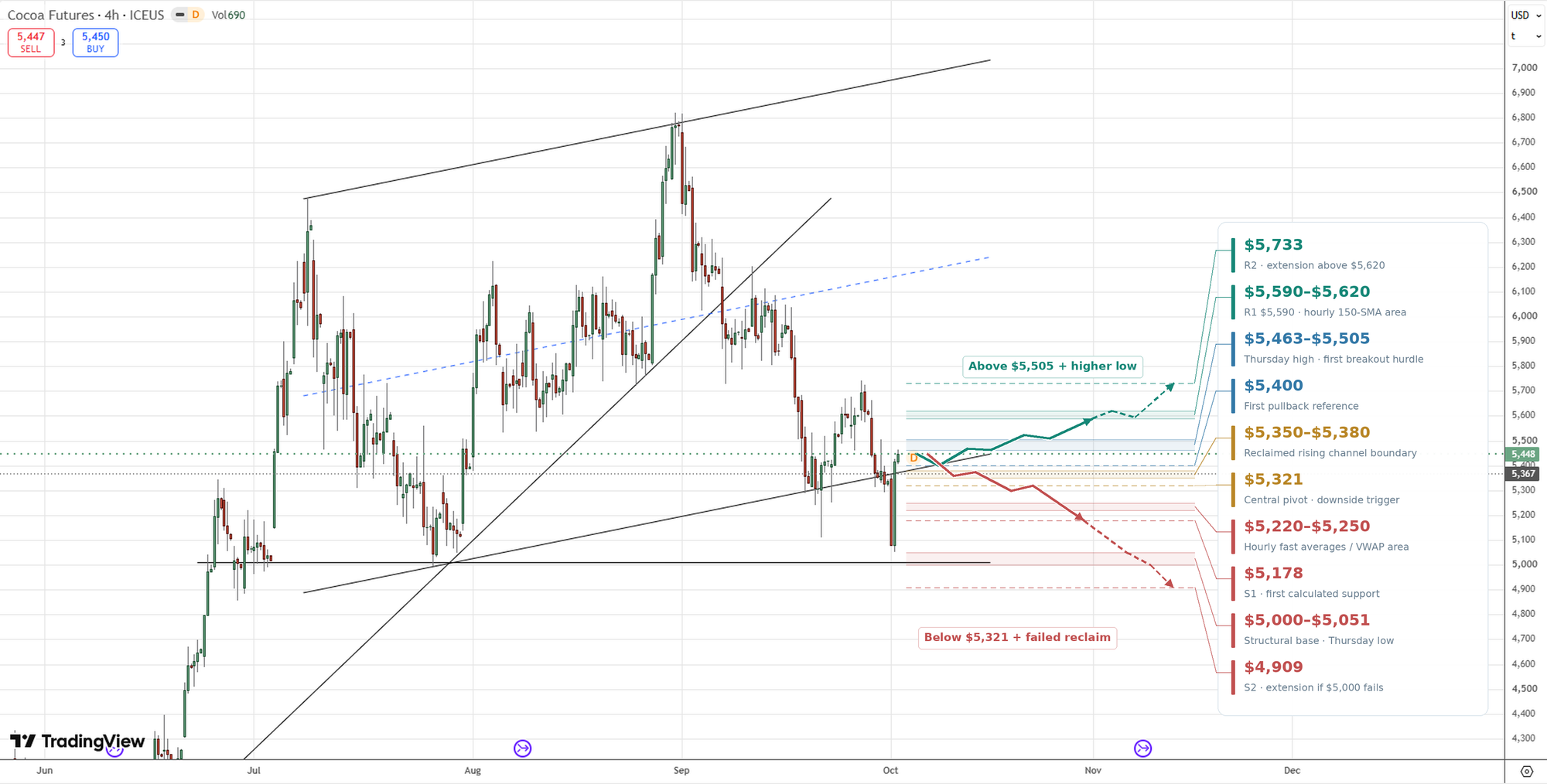
New York December cocoa reversed a sharp sell-off on Thursday, 1 October, after opening at $5,354/t. Following an early decline, a recovery towards $5,220 failed to hold, and renewed selling pushed the contract to $5,051, 5.38% below Wednesday’s last-traded close. Buying subsequently strengthened, with prices reclaiming $5,300 and $5,400 before finishing at $5,448/t, up $110 (+2.06%). The close was $397 above the session low and just $15 below the $5,463 high, placing it in the top 4% of the $412 daily range. The official settlement rose more modestly, gaining $14 (+0.26%) to $5,381/t. The strong late recovery showed rejection of lower prices and restored the rising channel boundary, although December remained below Wednesday’s $5,505 recovery high.
Côte d’Ivoire’s September cocoa exports reportedly surged
Ousmane Attai Ouedraogo, citing port sources, reported that Côte d’Ivoire’s September cocoa shipments increased 160.20% compared with the same period last year, despite continuing concern over the pace of port arrivals. “The volumes shipped are said to have increased by 160.20%,” he wrote. That would put reported shipments at approximately 2.6 times the previous September’s level.
Ouedraogo identified two possible drivers: accelerated shipments ahead of European market-access requirements, and the release of cocoa retained at ports while operators awaited the producer-price announcement. According to his account, the unchanged price encouraged operators to dispatch those stocks. The relevant EUDR application dates are 30 December 2026 for large and medium operators and 30 June 2027 for micro and small operators.
If stock releases explain the increase, stronger exports and weaker fresh arrivals can coexist: shipments draw on previously accumulated inventories. This would shift more available cocoa towards consuming markets while reducing stocks at origin, making shipment timing and inventory movements central to interpreting the reported surge.
Indonesia raises October cocoa export benchmarks
Indonesia’s Trade Ministry announced on 1 October that October’s cocoa export valuation benchmark had increased by $416, or 7.88%, to $5,686/t. The reference price rose $422.12, or 7.49%, to $6,057.87/t. Director-General of Foreign Trade Tommy Andana attributed the increase to concerns about the effect of El Niño on the quantity and quality of West African cocoa production. The ministry said its calculations also considered market conditions, international logistics costs and trade developments.
The government set the cocoa export duty and separate export levy at 7.5% each for October. The revised benchmarks are relevant to exporters’ calculations of charges and net returns from bean shipments. Where duties are assessed against a benchmark value, a higher valuation can increase the charge per tonne even with an unchanged percentage rate. Exporters’ resulting net returns can influence the prices they offer for domestic beans and the competitiveness of overseas sales.
New International Cocoa Agreement strengthens focus on producer income and processing
The ICCO announced that the International Cocoa Agreement 2026 entered into force on 1 October, following the signatories’ consensus on 15 September. Adopted in Geneva on 13 February, the agreement succeeds the 2010 framework and introduces an open-ended structure in place of the previous fixed-term renewal model. Its priorities include decent producer incomes through fair and rewarding prices, processing in producing countries, and economic, environmental and social sustainability.
Implementation will include work on market transparency, production and consumption statistics, and support for origins adapting to international market requirements. For Côte d’Ivoire, these priorities connect with its national traceability programme and efforts to retain more value through local processing. Better crop and grinding data could improve assessments of supply, demand and marketed flows, while cooperation on compliance could help producers and exporters maintain access to destination markets.
Peru details innovation and certification support across its cocoa chain
Peru’s Production Ministry reported on 1 October that its ProInnóvate programme had provided more than S/28 million in non-repayable funding to 182 businesses, cooperatives, producer associations and ventures across 19 regions. After Lima, the largest concentrations of supported projects were in San Martín, Piura, Huánuco, Junín, Amazonas and Pasco. Beneficiaries used the funding to improve production processes and develop products and services.
The programme also financed 40 certification projects covering food-safety systems, Fairtrade, organic standards and ISO 9001 quality management. Examples of product development included cocoa-butter cosmetics produced by Amyra in Pasco and artisanal chocolates using Chuncho cocoa developed by the Cusco-based venture Kontiti. Together, the projects support a broader commercial use of Peruvian cocoa, with certification helping businesses meet buyers’ quality requirements and compete in specialised export channels.
Futures Performance
New York cocoa
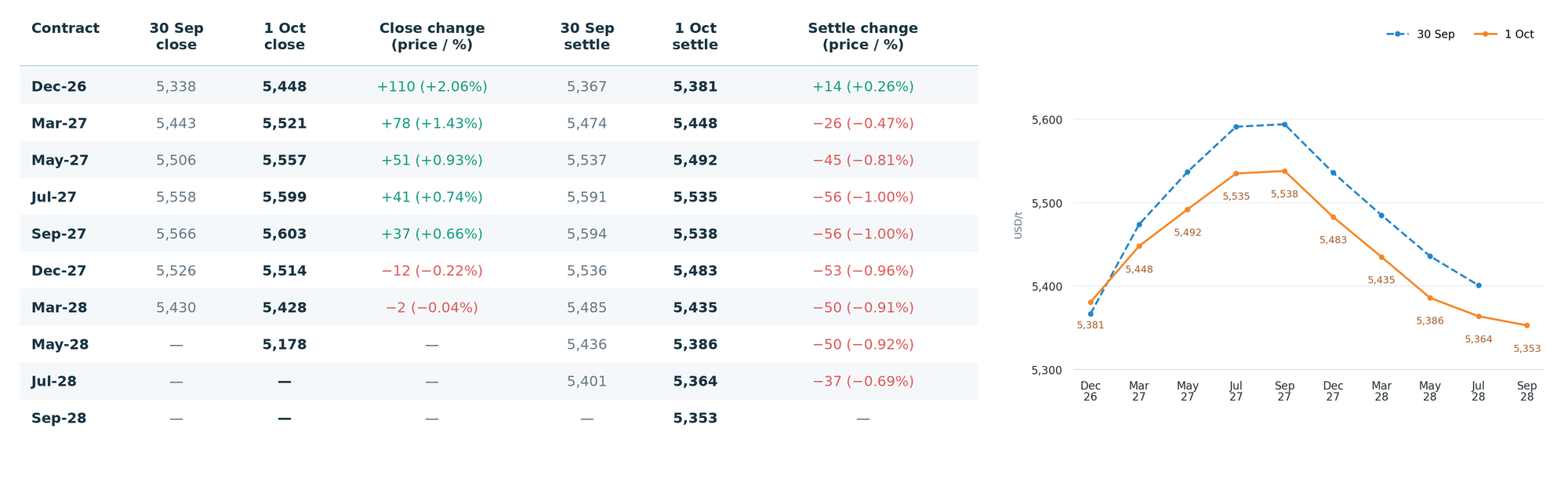
New York rose across five of the seven comparable last-traded closes on Thursday. December closed at $5,448/t, up $110 (+2.06%), while July and September 2027 gained 0.74% and 0.66%, respectively. December 2027 and March 2028 finished marginally lower. December traded between $5,051 and $5,463 and finished just $15 below its high, in the top 4% of its daily range, marking a substantially stronger closing response than Wednesday’s weak finish.
The settlement curve showed a more restrained recovery. December settled at $5,381, up $14 (+0.26%), while all eight comparable deferred settlements declined. Dec/Mar contango narrowed from $107 to $67/t and Dec/Jul from $224 to $154/t, indicating stronger nearby pricing against an easing deferred curve. September 2027 remained the peak at $5,538. The tighter discounts improve December’s relative position, but continued contango and weakness beyond the nearby contract leave a broader reversal unconfirmed. Thin far-dated last trades also warrant caution: May 2028’s close was $208 below settlement on turnover of only 26 contracts.
London cocoa
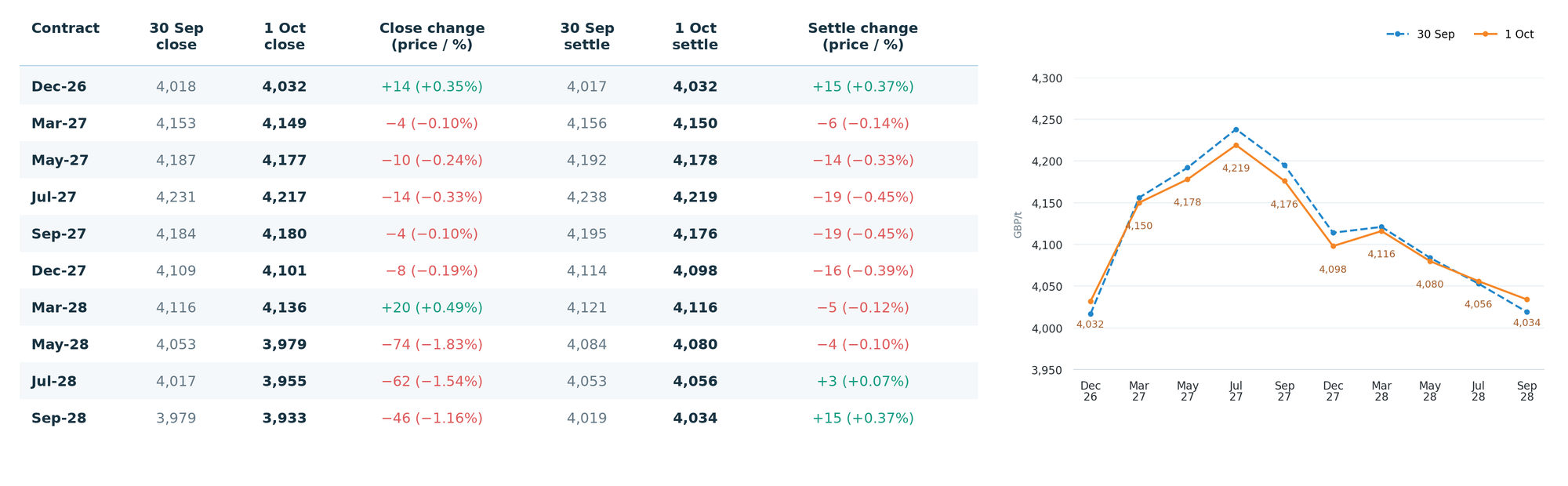
London declined across eight of its ten last-traded closes. December closed at £4,032/t, up £14 (+0.35%), while March 2028 gained £20 (+0.49%). December finished £35 below its £4,067 high, approximately 87% of the way up its daily range, showing a firmer closing response than Wednesday. May 2028 recorded the largest closing decline at 1.83%, although turnover of only 251 contracts limits the strength of that signal.
The settlement curve fell across seven maturities, while December settled at £4,032, up £15 (+0.37%). Dec/Mar contango narrowed from £139 to £118/t and Dec/Jul from £221 to £187/t. July 2027 remained the peak at £4,219. The structure therefore shows improved nearby support, although mid-2027 delivery still commands a substantial premium. July and September 2028 settlements rose by £3 and £15 despite lower last-traded closes, underscoring that the sharp closing losses at the thinly traded back of the curve did not represent equivalent declines in official valuations.
NY–London Dec-26 Spread
| Contract | NY close 1 Oct | London close 1 Oct | Spread 1 Oct ($/t) |
|---|---|---|---|
| Dec-26 | $5,448 | £4,032 | +$124.95 |
| Mar-27 | $5,521 | £4,149 | +$43.49 |
| May-27 | $5,557 | £4,177 | +$42.52 |
| Jul-27 | $5,599 | £4,217 | +$31.72 |
| Sep-27 | $5,603 | £4,180 | +$84.56 |
| Dec-27 | $5,514 | £4,101 | +$99.86 |
| Mar-28 | $5,428 | £4,136 | −$32.35 |
| May-28 | $5,178 | £3,979 | −$75.08 |
New York December’s premium widened from $6.52 to $124.95/t, an increase of $118.44/t. At Wednesday’s exchange rate, futures-price changes alone would have widened the premium by $91.42/t: New York rose $110, while London’s £14 increase equated to $18.58. Sterling’s depreciation reduced London’s dollar-equivalent price, adding approximately $27.01/t. The improvement therefore reflects stronger New York closing prices, reinforced by the currency move.
New York strengthened relative to London across six of the seven maturities comparable on both days. March, May and July 2027 moved from discounts into premiums, while December 2027’s premium widened to $99.86/t. March 2028 was the exception, with its discount edging wider to $32.35/t. May 2028 showed a $75.08/t discount, but New York turnover of only 26 contracts and a last trade $208 below settlement make that point less representative of the wider curve.
Volume and Open Interest
New York cocoa
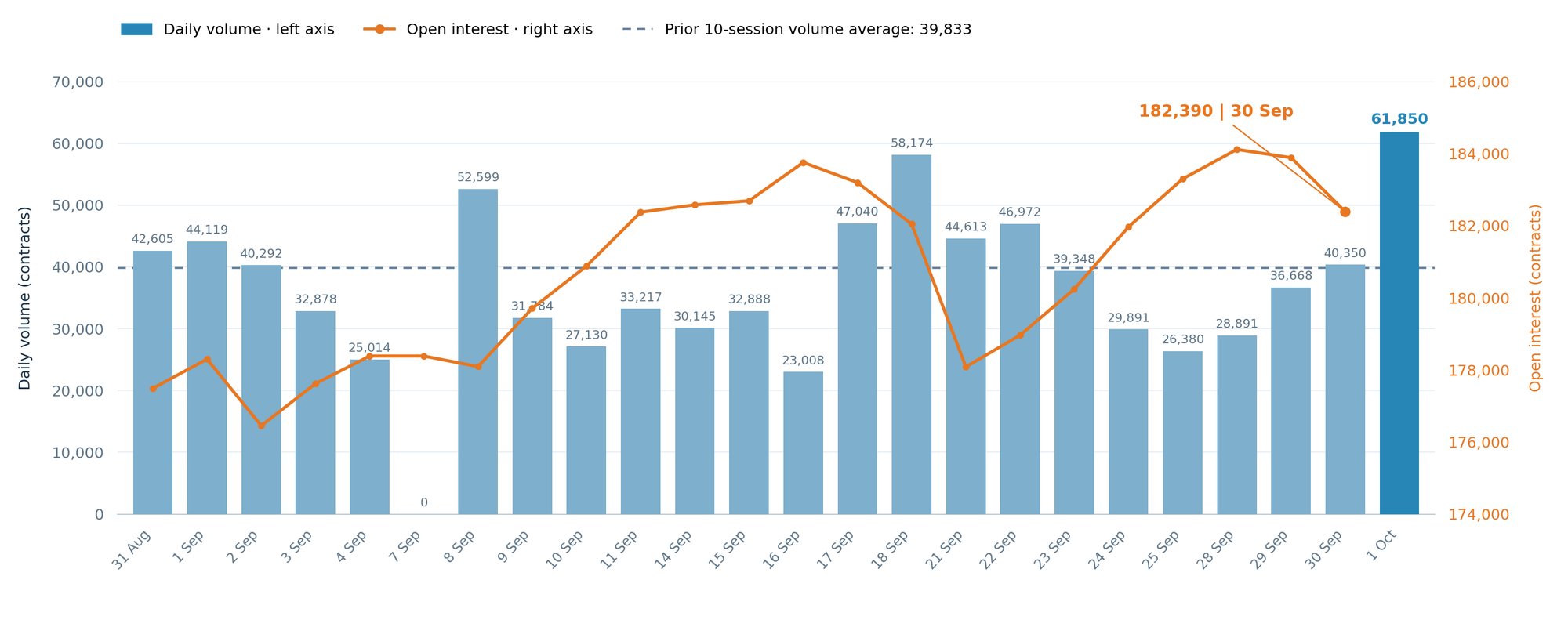
New York turnover increased to 61,850 contracts on Thursday, 1 October, up 53.3% from Wednesday’s 40,350 and 55.3% above the preceding 10-session average of 39,833. December’s 2.06% closing gain and finish near the session high therefore coincided with substantially stronger participation. This gives the nearby rebound stronger volume confirmation, although declines in deferred settlements show that the recovery remained uneven across maturities.
Open interest fell 1,498 contracts (−0.81%) to 182,390 on 30 September, its second consecutive decline and a cumulative reduction of 1,726 contracts since Monday. Wednesday’s lower price therefore coincided with a more substantial reduction in outstanding positions than Tuesday’s decline. OI nevertheless remained 4,305 contracts above its 21 September level, leaving most of the subsequent position expansion intact. The figures show net position reduction without identifying the initiating traders. Renewed OI growth alongside firmer prices would strengthen confirmation of the recovery; continued contraction would show that exposure is still being reduced.
London cocoa
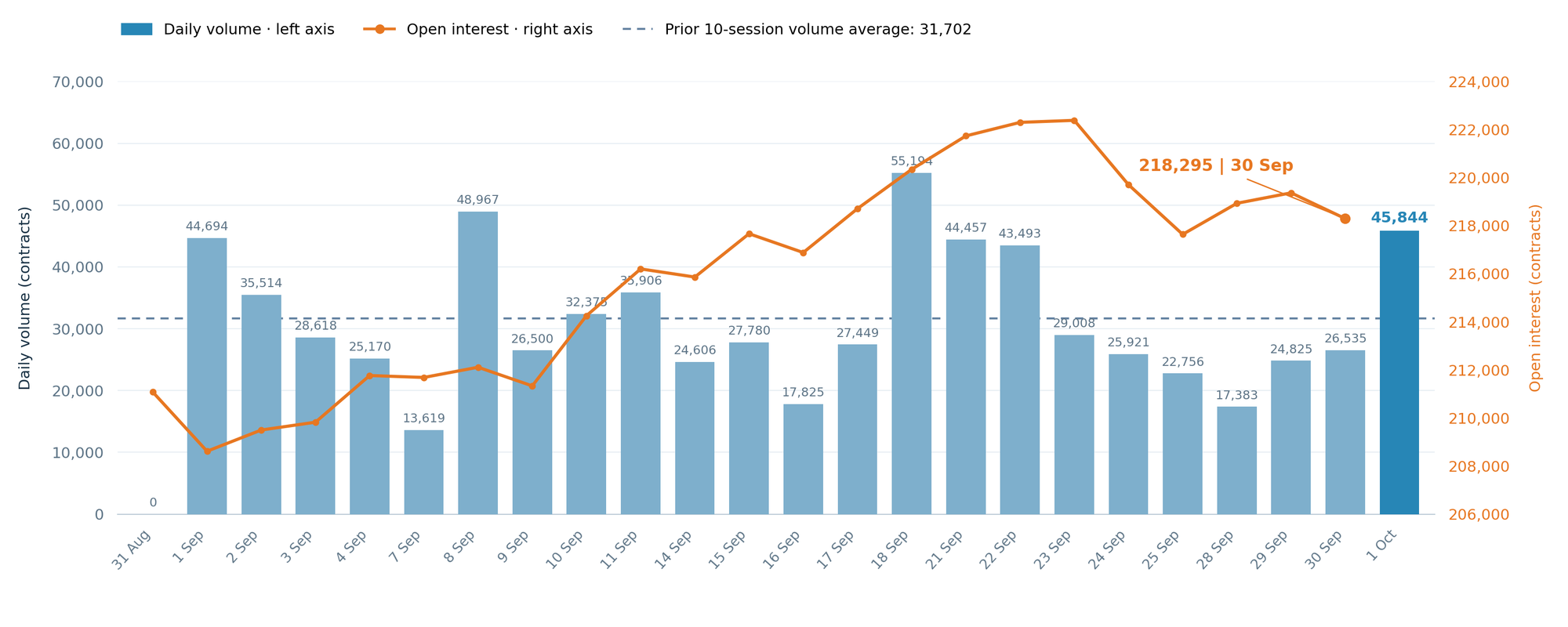
London turnover rose to 45,844 contracts on Thursday, up 72.8% from Wednesday’s 26,535 and 44.6% above the preceding 10-session average of 31,702. Participation strengthened sharply, but December’s closing gain was only 0.35%, while eight of ten last-traded closes declined. The higher turnover confirms substantially stronger participation across a session that included both a steep sell-off and a strong recovery
Open interest declined 1,073 contracts (−0.49%) to 218,295 on 30 September, reversing most of the 1,728-contract increase recorded since 25 September. The remaining net increase over that period was just 655 contracts. Wednesday’s price decline thus coincided with net position reduction, following two sessions of position expansion. This is consistent with an unwind, although aggregate OI cannot distinguish long liquidation from short covering or identify the initiating traders. Broader price gains accompanied by renewed OI growth would provide stronger confirmation of a developing recovery.
ICE Cocoa Stocks
| Market | Stock measure | Previous update | Latest update | Change | Change % |
|---|---|---|---|---|---|
| US | Total stocks in ICE-licensed warehouses | 3,481,504 bags | 3,485,609 bags | +4,105 bags | +0.12% |
| US | Certified stocks, included in warehouse total | 738,381 bags | 423,725 bags | −314,656 bags | −42.61% |
| London / Europe | Valid-warrant stocks, bag equivalents | 1,185,313 | 1,185,313 | 0 | 0.00% |
U.S. warehouse holdings rose by 4,105 bags on 1 October. Certified stocks fell by 314,656 bags, but this was the first report after September’s delivery month ended. ICE cocoa delivery months are March, May, July, September and December; certificates of grade have limited validity across delivery periods. The ICE report also presents grading results for the current and next contract months.
The timing is consistent with certificate expiry or reclassification following September’s delivery period. The certified-stock reduction does not establish an equivalent physical withdrawal: total warehouse holdings increased. This suggests the October change reflects a rollover in the stock counted as eligible under the active delivery cycle, rather than a physical withdrawal of 314,656 bags.
London valid-warrant stocks were unchanged at 75,860 tonnes in the report dated 30 September, matching the 29 September reading. That is approximately 1,185,313 64-kg bag equivalents.
Friday Trading Setup — ICE Futures U.S. Cocoa December 2026
Friday begins with scope for further recovery after Thursday’s rebound to $5,448 reclaimed the rising channel boundary around $5,350–$5,380. Hourly price is above its 9- and 21-period averages, RSI has recovered towards 60 and OBV has improved. MACD’s bullish signal-line crossover supports improving momentum, although the indicator remains below zero. The immediate hurdle is $5,463–$5,505, covering Thursday’s high, the nearby hourly 90-period average and Wednesday’s recovery high. An hourly close above $5,505 followed by a higher low would favour an extension towards $5,590–$5,620, combining calculated R1 with the hourly 150-period average area. Clearing that zone would bring $5,700–$5,733 into view, around the hourly 200-period average and R2. Daily price remains below its 9- and 21-period averages, with negative MACD, leaving the broader reversal unconfirmed.
Elevated five-minute RSI and stochastic, alongside easing late momentum, make an initial pullback towards $5,400 plausible. Holding $5,350–$5,380 would preserve the channel reclaim; an hourly close below the $5,321 central pivot, followed by a failed recovery, would instead favour renewed weakness towards $5,220–$5,250, then $5,178 (S1). Below S1, Thursday’s $5,051 low and $5,000 structural base become the main downside references; a sustained break below $5,000 would expose $4,909 (S2). Elevated hourly ATR increases the importance of closes and retests when judging a breakout.