
Côte d’Ivoire Keeps 2026/27 Cocoa Farmgate Price at CFA1,200/kg (1 September 2026)


Tuesday’s session was dominated by a failed attempt to extend Monday’s rally. December cocoa opened at $6,743 and initially gained $76, or 1.13%, to reach $6,819, but the move above $6,800 attracted heavy selling. A break below $6,700 accelerated the decline to an intraday low of $6,407, representing a drop of $412, or 6.04%, from the session high. Prices subsequently rebounded toward the mid-$6,600s, but the recovery could not be sustained and renewed selling pushed the contract back to $6,509 by the end of trading. This represented a decline of $259, or 3.83%, from Monday’s final traded price and left the contract in the lower quarter of its $412, or 6.11%, daily range. The price action indicates strong profit-taking and short-term momentum loss, although the broader daily breakout remained intact.
Côte d’Ivoire Maintains Farmgate Price at CFA1,200/kg
Côte d’Ivoire opened its 2026/27 main-crop season with the farmgate price unchanged at CFA1,200/kg, equivalent to approximately $2,120 per tonne. Although unchanged from the mid-crop, it is 57.1% below the CFA2,800/kg paid at the beginning of the previous main season.
The price reflects earlier forward sales rather than current futures. The Coffee and Cocoa Council normally pre-sells around 80% of the projected crop, and more than 1.1 million tonnes were reportedly contracted between March and June when London cocoa was substantially lower. The government consequently selected the bottom of the proposed CFA1,200–1,500/kg range to avoid another costly subsidy programme.
Commercially Workable but Negative for Farmers
The record CFA2,800 price became unsustainable after futures declined. Exporters reduced purchases, cooperatives accumulated stocks and farmer payments were delayed, forcing the government to mobilise a combined CFA511 billion to support stock evacuation.
At CFA1,200/kg, cocoa should be easier to finance, purchase and deliver against existing export contracts. This is moderately bearish for commercial availability once beans reach the market. However, farmers will receive substantially less income for labour, fertiliser, disease treatment, pruning and farm rehabilitation.
Smaller Crop Reflects Weather and Poor Farm Care
The 2026/27 main crop is expected to be smaller not only because of unfavourable weather, but also because high input and labour costs have limited plantation maintenance. Inadequate fertiliser application, insufficient disease treatment, ageing trees and delayed rehabilitation have weakened the crop’s underlying yield potential.
The newly announced price did not cause the underinvestment already affecting the current crop. However, maintaining the price 57.1% below the previous main-crop level could prolong the problem by leaving farmers with insufficient funds to improve plantation care.
The harvest may be delayed by eight to ten weeks. Main-crop estimates range from approximately 1.4 million to 1.45 million tonnes, while October–December arrivals are projected at around 900,000 tonnes, 18.2% below the updated 1.1 million tonnes recorded during the same period in 2025. Lower pricing cannot release beans that have not yet matured.
Leakage and Logistical Risks Remain
Ghana’s currently published producer price is equivalent to approximately CFA2,000/kg—CFA800/kg or 66.7% above the Ivorian price. This gap creates a strong incentive for cocoa to move unofficially into Ghana, Liberia or Guinea, potentially reducing official Ivorian arrivals and complicating traceability.
A delayed concentration of arrivals during November and December may also coincide with new EU deforestation requirements. Documentation, storage and shipping constraints could slow exports and widen the premium for fully traceable cocoa.
 Georgi Uzunov
ICCO Reduces Its Estimated Global Surplus
The ICCO’s August bulletin was published late on 31 August. The organisation estimated 2024/25 global production at 4.733 million tonnes, up 8.5% year on year, while grindings declined by 3.3% to 4.649 million tonnes.
The resulting global surplus was estimated at 37,000 tonnes, with ending stocks of 1.309 million tonnes and a stocks-to-grindings ratio of 28.2%. Compared with the May bulletin, the estimated surplus was reduced from 48,000 tonnes, stocks from 1.320 million tonnes and the stocks-to-grindings ratio from 28.5%.
The revision is marginally supportive because it indicates a slightly tighter balance than previously estimated. However, the year-on-year increase in production and decline in grindings continue to confirm the broader recovery in supply and weakness in demand.
The figures are also backward-looking. ICCO temporarily withheld production and grinding estimates for 2025/26, meaning the bulletin does not provide a new assessment of the current global balance.
New Traceability Rules Take Effect
Côte d’Ivoire also activated its national cocoa traceability system and made the producer card compulsory from 1 September. More than one million farmers have reportedly been registered, while over 900,000 producer cards have been distributed.
The system should improve transaction security and support compliance with European traceability requirements. In the short term, however, farmers who have not yet received their cards could experience difficulties selling through official channels. This may temporarily slow some early-season deliveries.
Processing Capacity Set to Expand
Côte d’Ivoire processed approximately 650,000 tonnes of cocoa domestically in 2025/26, compared with installed capacity of 1.155 million tonnes. Installed capacity is projected to increase by 16.4% to 1.344 million tonnes during 2026/27.
The expansion is potentially supportive for domestic bean demand, but it should not be interpreted as an immediate doubling of grindings. Current capacity utilization is approximately 56.3%, meaning actual demand will continue to depend on processors’ access to beans, financing and profitable export markets.
Weather Risk Remains, but Forecast Rain Limits Immediate Concern
Below-average rainfall across most Ivorian cocoa regions during the final week of August added some weather-related support to the market, particularly because pods intended for harvesting between October and December remain dependent on regular moisture.
However, the weekly shortfall should be viewed alongside the broader weather picture. Cumulative August rainfall was around or above normal across much of the inland cocoa belt, while forecasts through approximately 8 September indicate renewed rainfall of roughly 25–100 mm across many producing areas.
If the forecast rainfall materialises and is well distributed, it should replenish soil moisture, support pod filling and reduce the immediate risk of cherelle losses. Conversely, poorly distributed rainfall or another prolonged dry period later in September could reduce early main-crop availability and shorten the crop’s later stages.
A strengthening El Niño adds uncertainty farther forward, but there is currently no evidence of confirmed production damage. The present weather signal is therefore neutral to mildly bullish, with rainfall distribution during September more important than headline accumulation totals.
COCOBOD Meets Debt Obligation
Ghana’s COCOBOD paid GH¢2.306 billion, approximately $204.4 million, to meet its September debt-restructuring obligation. Including an earlier coupon payment, total restructuring payments during 2026 reached approximately GH¢2.68 billion.
The payment is credit-positive and may help rebuild investor confidence. Its immediate effect on physical cocoa supply is neutral, however, because the funds went to bondholders rather than farmers or licensed buying companies.
The development would become mildly bearish for cocoa only if COCOBOD successfully raises new financing and directs it towards faster crop purchasing and exports. Until then, liquidity constraints within Ghana’s internal purchasing system remain a potential source of supply disruption.
Futures performance
New York cocoa
| Contract | 31 Aug | 1 Sep | Change | Change % |
|---|---|---|---|---|
| Sep-26 | $6,600 | $6,603 | +$3 | +0.05% |
| Dec-26 | $6,768 | $6,509 | −$259 | −3.83% |
| Mar-27 | $6,911 | $6,643 | −$268 | −3.88% |
| May-27 | $6,956 | $6,688 | −$268 | −3.85% |
| Jul-27 | $6,952 | $6,687 | −$265 | −3.81% |
New York cocoa reversed sharply across the actively traded maturities. Mar-27 and May-27 recorded the largest declines, each losing $268 per tonne, while Dec-26 fell $259 and Jul-27 declined $265. Sep-26 edged $3 higher, but only one contract traded in that maturity, making the movement unrepresentative of the wider market.
The active Dec-26 through Jul-27 contracts traded through ranges of $390–$413 per tonne, substantially wider than the $267–$271 ranges on 31 August. They initially traded above Monday’s final prices before reversing and finishing only 24.5%–26.4% above their daily lows, compared with 80.4%–83.7% on Monday. This indicates broad selling pressure and a distinctly weak finish.
Total New York volume increased 3.6% to 44,119 contracts, from 42,605. Dec-26 accounted for 22,712 contracts, or 51.5% of the total, while total spread volume declined 8.7%. However, the comparison partly reflects Monday’s delayed opening and shorter session while London was closed. With no open-interest figures reported, the decline cannot reliably be divided between liquidation and new short positions.
New York futures curve
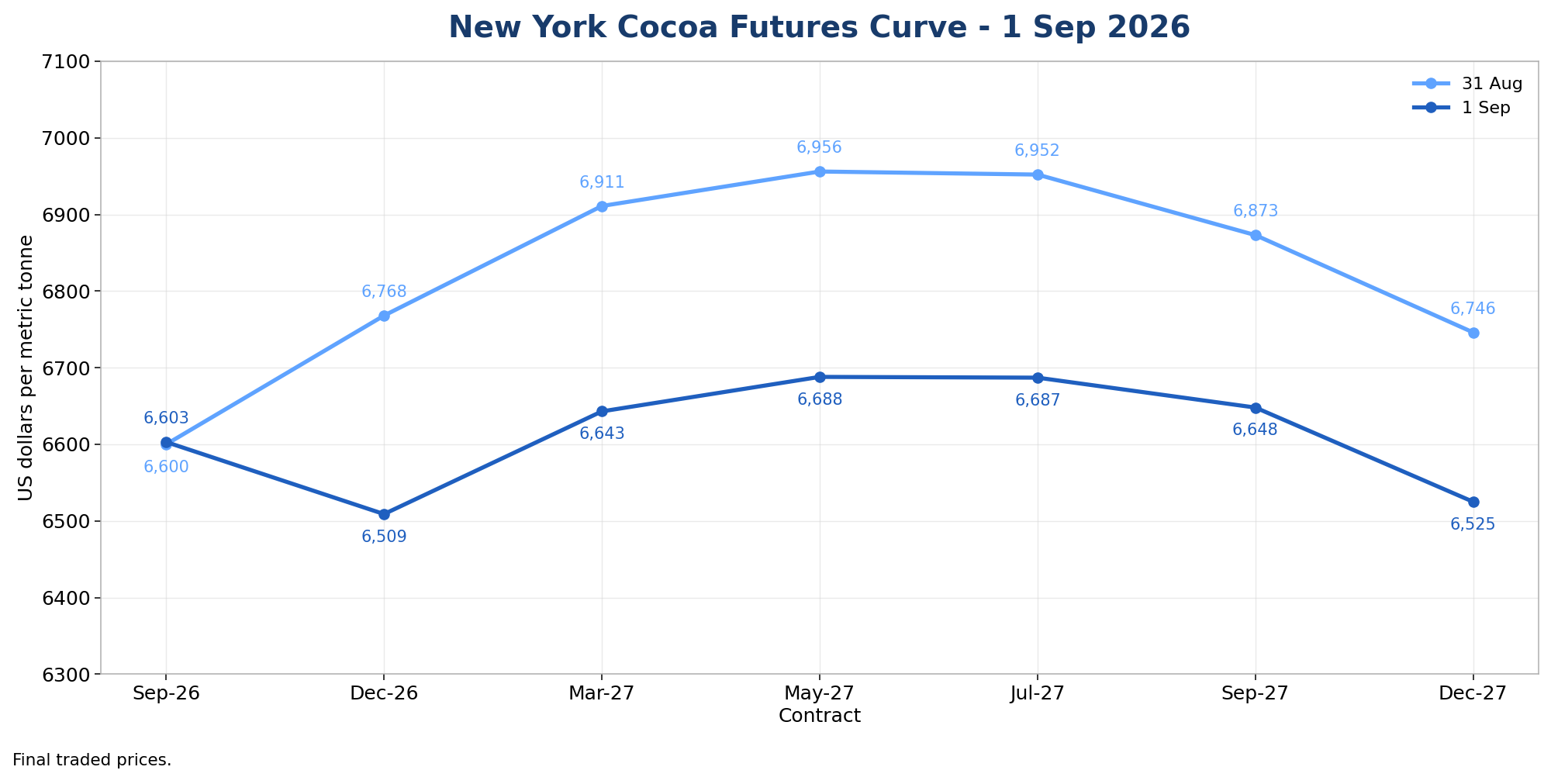
The active New York curve shifted sharply lower. Dec-26 through Jul-27 declined by $259–$268 per tonne, while losses moderated to $225 in Sep-27 and $221 in Dec-27. The apparent strength in Sep-26 is not meaningful because it was based on a single contract.
The curve continued to peak at May-27 at $6,688, although Jul-27 was only $1 lower. Dec-26/Mar-27 contango narrowed from $143 to $134, Mar-27/May-27 contango remained unchanged at $45, and May-27/Jul-27 backwardation narrowed from $4 to $1.
Deferred contracts outperformed: Jul-27/Sep-27 backwardation narrowed from $79 to $39, while May-27/Dec-27 backwardation contracted from $210 to $163. The curve remained hump-shaped but became flatter after its mid-2027 peak.
London cocoa
| Contract | 31 Aug reference¹ | 1 Sep | Change | Change % |
|---|---|---|---|---|
| Sep-26 | £4,753 | £4,696 | −£57 | −1.20% |
| Dec-26 | £4,845 | £4,805 | −£40 | −0.83% |
| Mar-27 | £4,969 | £4,937 | −£32 | −0.64% |
| May-27 | £4,964 | £4,935 | −£29 | −0.58% |
| Jul-27 | £4,939 | £4,917 | −£22 | −0.45% |
London cocoa reopened lower across all five principal maturities. Sep-26 recorded the largest decline, falling £57 per tonne, or 1.20%. The losses progressively diminished along the curve, reaching £22, or 0.45%, in Jul-27.
The principal contracts traded through ranges of £275–£296 per tonne, approximately 20%–23% narrower than Friday’s £343–£375 ranges. Their final prices finished 34.1%–43.3% above the session lows, compared with around 91%–92% on Friday. The market therefore surrendered much of Friday’s late-session strength, although the reversal was considerably smaller than in New York.
London volume totalled 44,694 contracts. Dec-26 and Mar-27 together accounted for 27,868 contracts, or 62.4% of the total. The zero volume shown for 31 August is purely a holiday effect and should not be used for comparison.
London futures curve
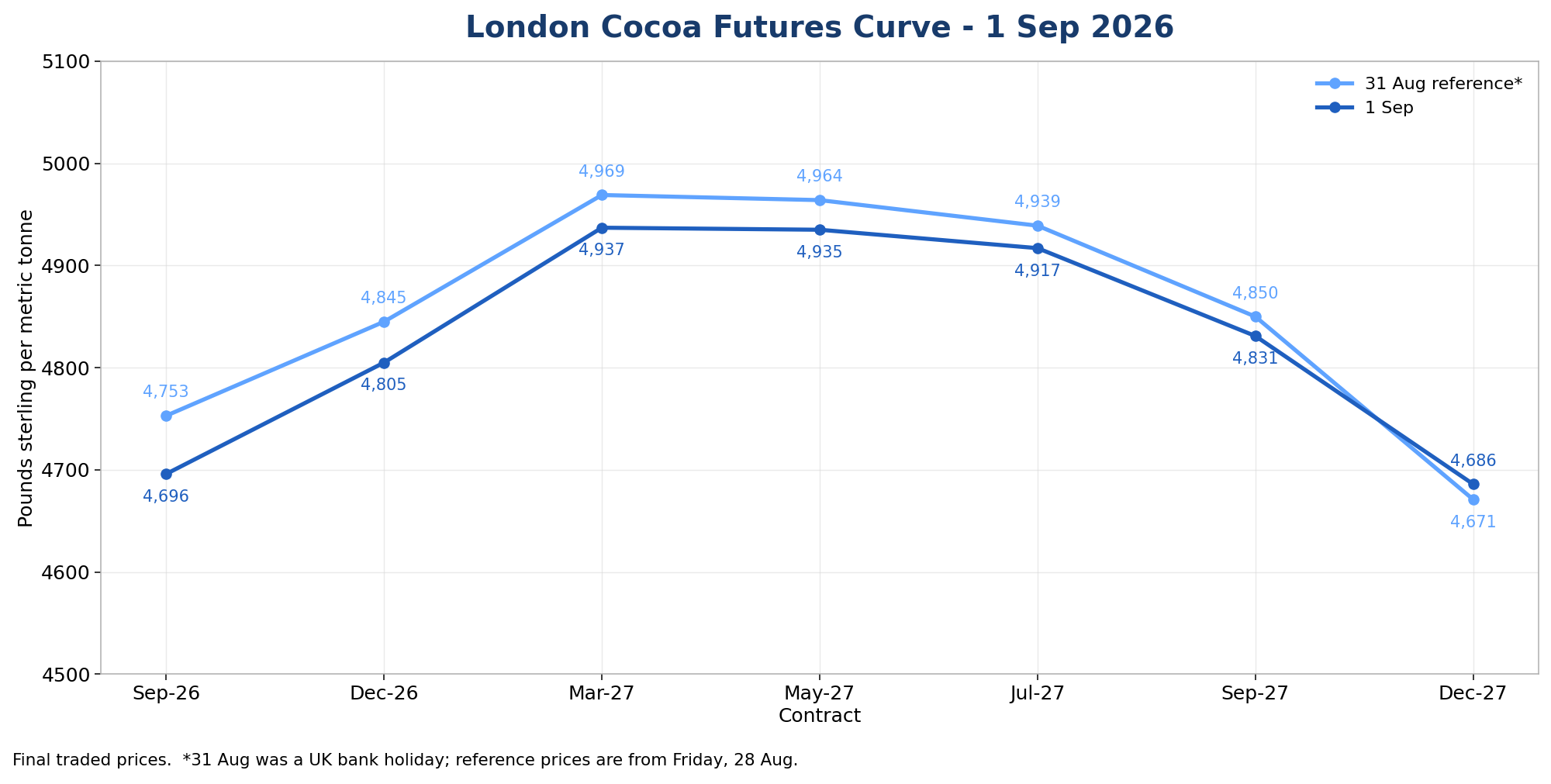
The London curve twisted rather than shifting uniformly lower. Losses diminished from £57 in Sep-26 to £19 in Sep-27, while Dec-27 gained £15. This shows that the reopening pressure was concentrated toward the front of the curve.
Mar-27 remained the peak at £4,937, only £2 above May-27. Sep-26/Mar-27 contango widened from £216 to £241, while Dec-26/Mar-27 contango increased from £124 to £132.
Mar-27/May-27 backwardation narrowed from £5 to £2, May-27/Jul-27 backwardation contracted from £25 to £18, and May-27/Dec-27 backwardation narrowed from £293 to £249. The curve therefore became less inverted beyond its early-2027 peak.
US–UK Spread
(Dec Contract)
$6,509 − (£4,805 x 1.351$/£) =$17ton (down from $203 ton)
Volume and Open Interest
New York cocoa
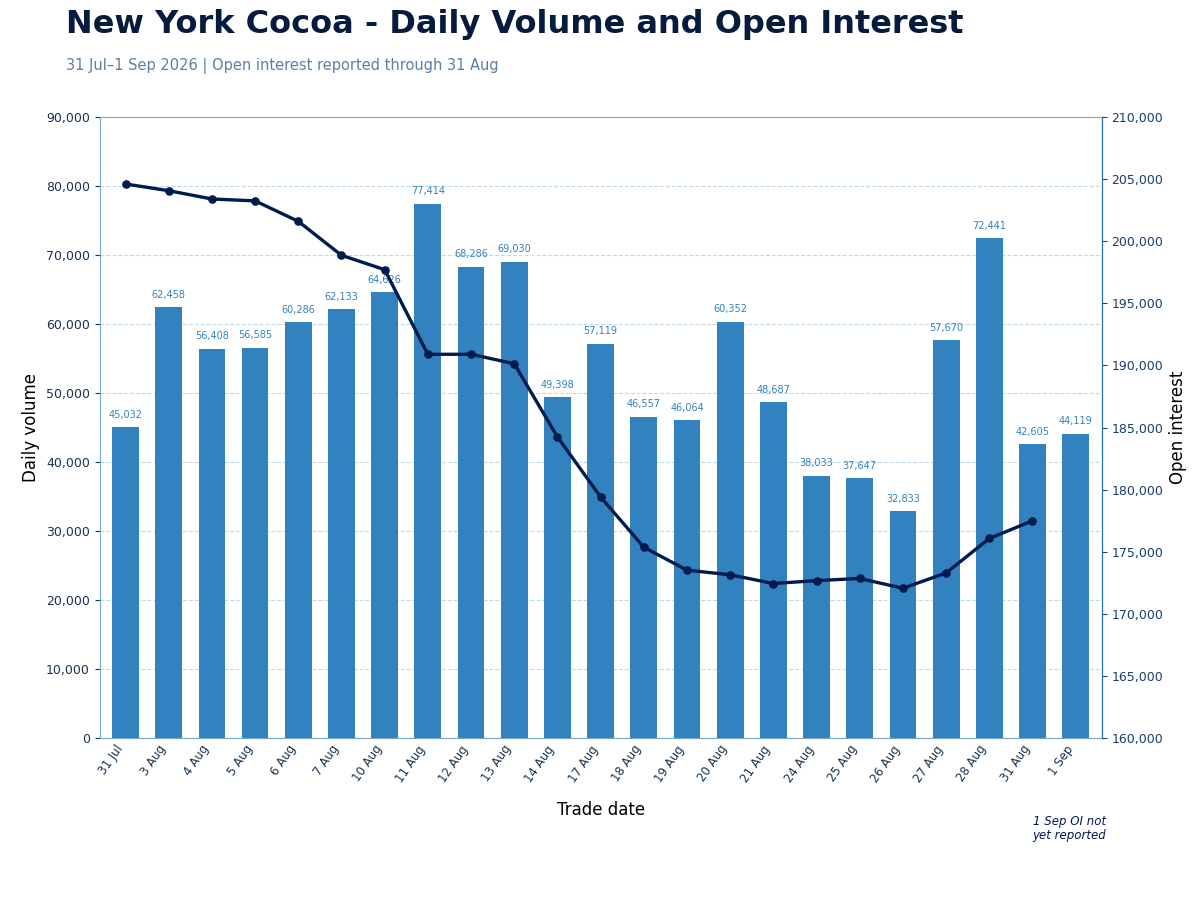
New York cocoa volume rose to 44,119 contracts on 1 September, up 1,514 contracts, or 3.6%, from 42,605 on 31 August. Turnover nevertheless remained 20.1% below the preceding 20-session average of 55,209 contracts and 19.2% below the displayed-period average of 54,599.
It was the fifth-lowest daily volume in the 23-session window and stood 33,295 contracts, or 43.0%, below the period peak of 77,414 recorded on 11 August. The modest increase should be viewed against Monday’s delayed New York opening and London’s bank-holiday closure. Despite the return of a full cross-market session, participation remained subdued.
The latest valid open-interest figure, for 31 August, increased to 177,489 contracts from 176,065 on 28 August, a rise of 1,424 contracts, or 0.8%. This was the third consecutive increase from the period low of 172,055 on 26 August, lifting open interest by 5,434 contracts, or 3.2%. It nevertheless remained 27,117 contracts, or 13.3%, below the 31 July peak of 204,606.
Monday’s combination of higher prices and rising open interest suggests that fresh positioning contributed to that session’s advance.
London cocoa
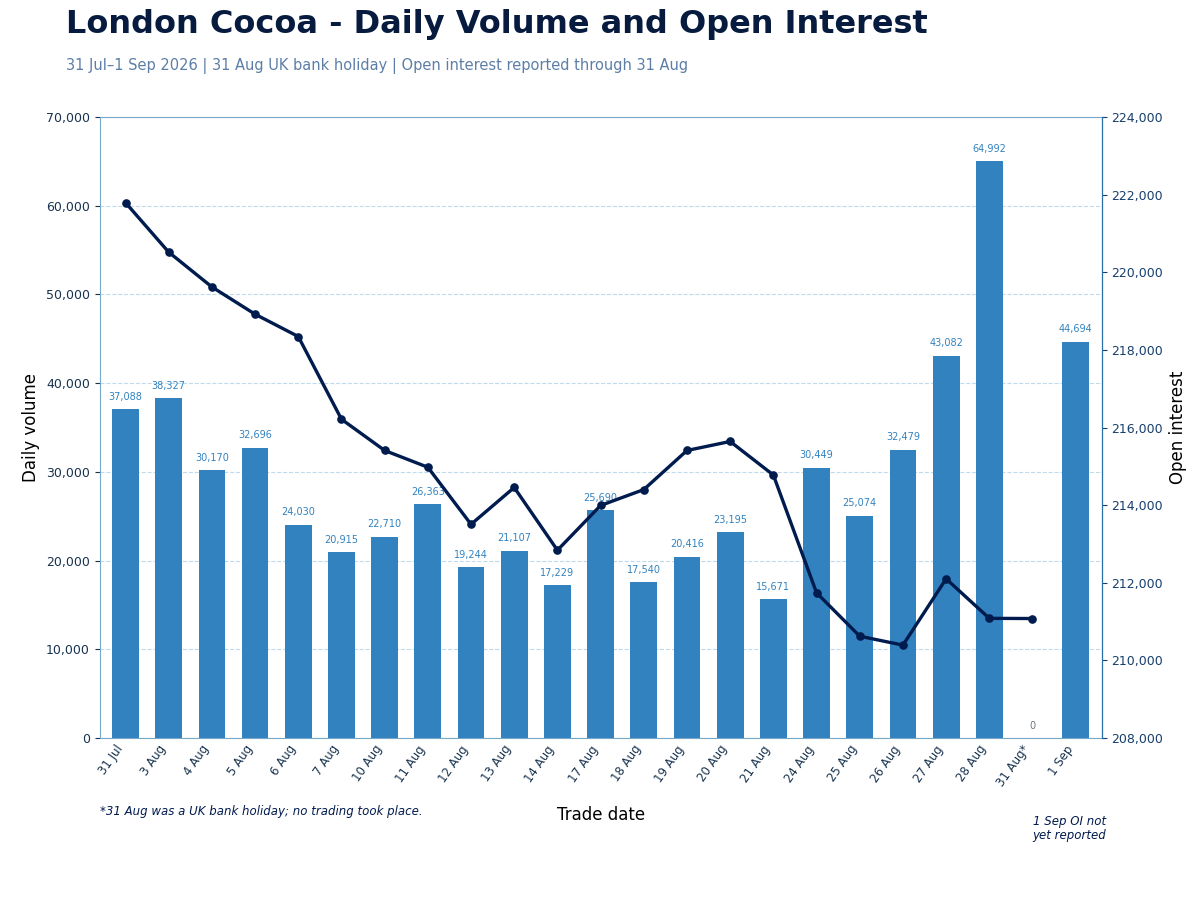
London cocoa volume totalled 44,694 contracts on 1 September, down 20,298 contracts, or 31.2%, from Friday’s period high of 64,992. The comparison excludes 31 August, when the exchange was closed for the UK bank holiday.
Although turnover eased from Friday’s exceptional level, it remained 62.1% above the preceding 20-active-session average of 27,569 contracts. It was also the second-highest active-day volume in the displayed period, exceeded only by 28 August.
Open interest for 1 September had not yet been reported. The latest active-session figure, 211,083 contracts on 28 August, was 1,018 contracts, or 0.5%, below 27 August. It stood only 690 contracts, or 0.3%, above the period low of 210,393 recorded on 26 August and remained 10,710 contracts, or 4.8%, below the 31 July peak of 221,793.
The 211,078 figure reported for the 31 August holiday was effectively unchanged from Friday and should not be interpreted as evidence of fresh positioning. Strong turnover on 1 September confirms broad participation in London’s reopening decline.
Exchange Trading Volume

The measure is not a complete regional stock-to-grind ratio, as it includes only exchange-certified cocoa held at U.S. and EU delivery ports and excludes commercial inventories outside the ICE warehouse system. North America NCA grindings cover processors across North America, while ICE U.S. certified stocks are stored at U.S. delivery ports. ECA reports bean usage in European countries and London-certified cocoa is held in European and UK delivery locations.
Readers can explore detailed cocoa market datasets, futures statistics, and historical indicators in the CocoaIntel Data Hub:
 Cocoa Intel
Wednesday Outlook Dec Contract
Following Tuesday’s sharp reversal, December cocoa enters Wednesday with a cautiously bullish broader structure but a still-fragile short-term setup. The contract declined $259, or 3.83%, from Monday’s final traded price to finish at $6,509, after trading between $6,407 and $6,819. The rejection from $6,800 and the finish in the lower quarter of the daily range indicate that the correction may not yet be fully complete.
The five-minute chart shows price below its short-term moving averages, with weakening MACD and relatively soft OBV. However, the stochastic indicator is approaching oversold territory, leaving room for an early technical rebound. Hourly momentum has also cooled, with RSI retreating from overbought levels, stochastic moving lower and MACD rolling below its signal line. The daily structure remains constructive: the multi-month breakout is intact, price remains above all major daily moving averages, and the preceding advance was supported by rising volume and OBV. This still looks more like a pullback within the new bullish structure than a confirmed trend reversal.
I assign a 45% probability to a bullish rebound, a 35% probability to consolidation and a 20% probability to further bearish continuation. A rebound would require the $6,450–$6,407 support area to hold, followed by a sustained recovery above $6,575–$6,600. This would expose $6,650–$6,675, followed by $6,750 and the $6,800–$6,821 resistance area. A decisive break above $6,821 would reopen the path toward $6,950–$7,000. Consolidation is likely to remain broadly contained between $6,400 and $6,650 while hourly momentum resets.
A sustained break below Tuesday’s $6,407 low would weaken the immediate bullish case and expose $6,350–$6,300, followed by $6,200. However, the larger daily breakout would only be materially damaged by a return below approximately $6,050–$6,000.
If you notice any discrepancies in these figures or have extra information, please email hello@cocoaintel.com or leave a comment – corrections and additional insights are always welcome.