
New York Cocoa Continues to Rally as London Slips on a Consolidation Day with Limited Fundamental News (4 August 2026)


Cocoa prices showed a clear transatlantic divergence during the session. In New York, September cocoa initially fell to $5,815 per tonne before reversing sharply, breaking above $6,000 and reaching a high of $6,108. The contract closed at $6,089, up $186, or 3.15%, and only $19 below the session high, indicating that buyers remained firmly in control into the close. London was considerably weaker: September cocoa failed to retain its intraday gains and closed at £4,370 per tonne, down £9, or 0.21%.
U.S. Cocoa Bean Imports Decline Sharply
The latest U.S. trade data delivered a mixed signal for cocoa demand. Imports of non-organic cocoa beans fell to 38.46 million kilograms in June, down from 49.84 million kilograms in May, representing a monthly decline of 22.8%.
Imports of several processed cocoa products moved higher during the same period. Cocoa butter imports rose by 11.5%, unsweetened cocoa powder imports increased by 7.5%, and imports of confectionery containing chocolate were 8.5% higher.
Ghana Warns of a 16% Production Decline
West African supply concerns remained the principal bullish factor for the cocoa market. Ghana’s COCOBOD expects the country’s 2026/27 cocoa production to decline by at least 16%.
The anticipated reduction has been attributed to adverse weather, the cocoa tree’s natural production cycle, disease pressure, ageing farms and the continued impact of illegal mining.
Côte d’Ivoire Farmers Call for More Sunshine
In Côte d’Ivoire, farmers reported that additional sunshine would be needed to support development of the main crop following below-average rainfall and cooler conditions.
Soil moisture was nevertheless described as adequate, and crop prospects remain broadly favourable provided that weather conditions improve and farm treatments continue.
Chocolate Manufacturers Reduce Exposure to Cocoa Volatility
Recent industry analysis highlighted how major chocolate manufacturers, including Mondelēz and Hershey, are seeking to reduce their exposure to cocoa-market volatility.
The strategies include recipe adjustments, broader sourcing practices and improved agricultural forecasting. While this did not represent a new corporate announcement, it reinforces the extent to which prolonged cocoa-price volatility is reshaping procurement and product strategies across the chocolate industry.
Futures performance
New York cocoa
New York cocoa recorded another strong and broad-based advance. September 2026 ended at $6,089 per tonne, gaining $186, or 3.15%, from 3 August. The following four nearby contracts gained between $178 and $189 per tonne, confirming that the move extended across the front and middle sections of the curve.
The market’s last recorded trades were also close to the upper end of the daily ranges. The five nearest contracts finished within approximately 94%–99% of their respective ranges:
| Contract | 3 Aug | 4 Aug | Change | Change % |
|---|---|---|---|---|
| Sep-26 | $5,903 | $6,089 | +$186 | +3.15% |
| Dec-26 | $6,029 | $6,218 | +$189 | +3.13% |
| Mar-27 | $6,126 | $6,309 | +$183 | +2.99% |
| May-27 | $6,132 | $6,314 | +$182 | +2.97% |
| Jul-27 | $6,109 | $6,287 | +$178 | +2.91% |
July 2027 finished only $3 below its reported daily high, while May finished $9 below its high. December and March were each $13 below their highs, and September was $19 below its high. This indicates that the upward move remained well supported through the final recorded trades rather than being driven solely by an intraday spike.
May 2027 remained the highest-priced closing contract at $6,314 per tonne. From that point, the curve moved into backwardation, declining to $6,287 in July, $6,246 in September and $6,203 in December.
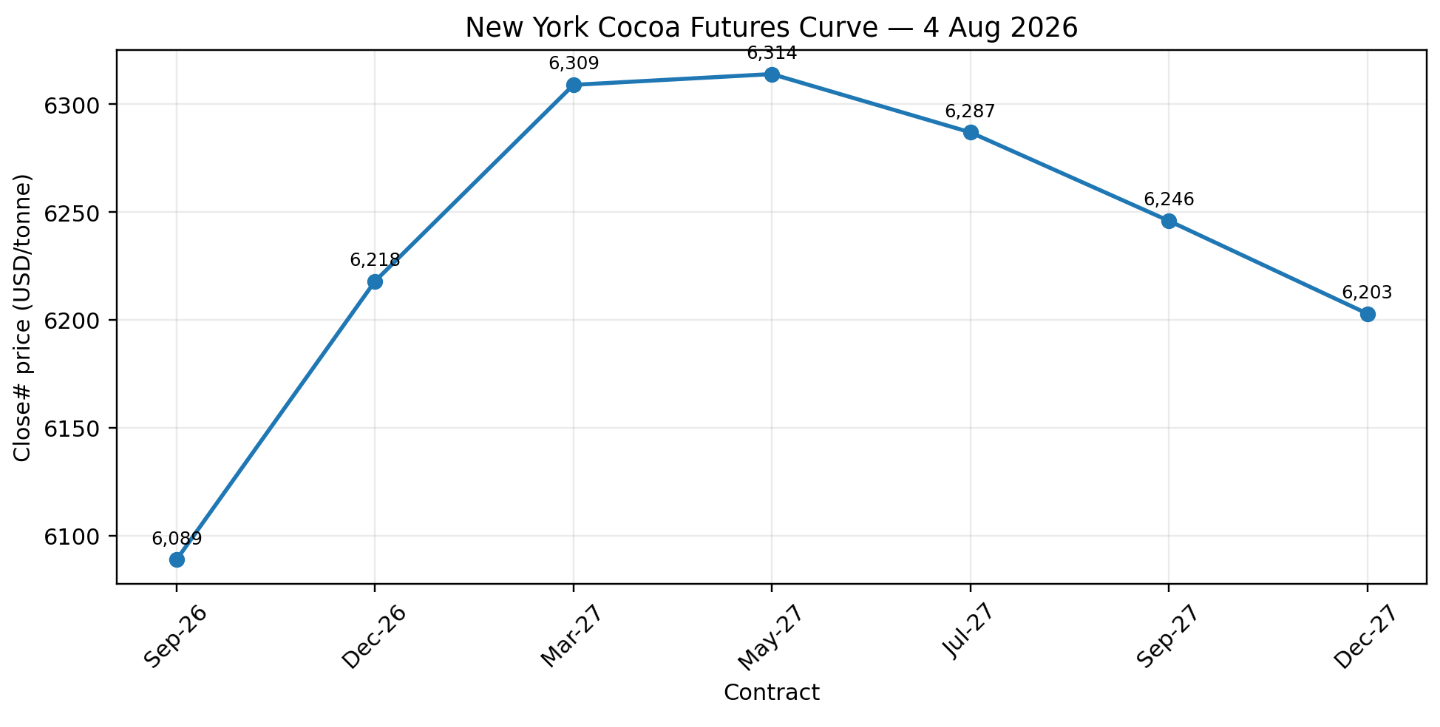
The September-to-May premium narrowed slightly from $229 to $225 per tonne. September therefore marginally outperformed May during the session, producing a small flattening of the front section of the curve.
Nevertheless, the $129 September–December contango shows that the market was still not pricing an immediate shortage of nearby deliverable cocoa. The principal risk premium remained concentrated in the March–May 2027 crop period.
London cocoa
London cocoa diverged materially from New York. September ended at £4,370 per tonne, falling £9, or 0.21%, from 3 August. December recorded the largest decline among the five nearest contracts, losing £19 or 0.43%, while July was the only nearby contract to record a small increase.
| Contract | 3 Aug | 4 Aug | Change | Change % |
|---|---|---|---|---|
| Sep-26 | £4,379 | £4,370 | −£9 | −0.21% |
| Dec-26 | £4,433 | £4,414 | −£19 | −0.43% |
| Mar-27 | £4,530 | £4,518 | −£12 | −0.26% |
| May-27 | £4,513 | £4,511 | −£2 | −0.04% |
| Jul-27 | £4,500 | £4,503 | +£3 | +0.07% |
Unlike the previous session, the last recorded trades were not close to the session highs. The five nearest contracts finished at only approximately 37%–40% of their respective daily ranges. They were also between £114 and £124 below their reported highs.
This indicates that London was unable to retain the strength seen at the upper end of the intraday range. The result was a broadly stable to slightly weaker Close# performance despite the significant advance in New York.
The London curve reached its principal peak at £4,518 in March 2027. It then declined gradually to £4,511 in May, £4,503 in July, £4,457 in September, £4,413 in December, £4,404 in March 2028 and £4,342 in May 2028.
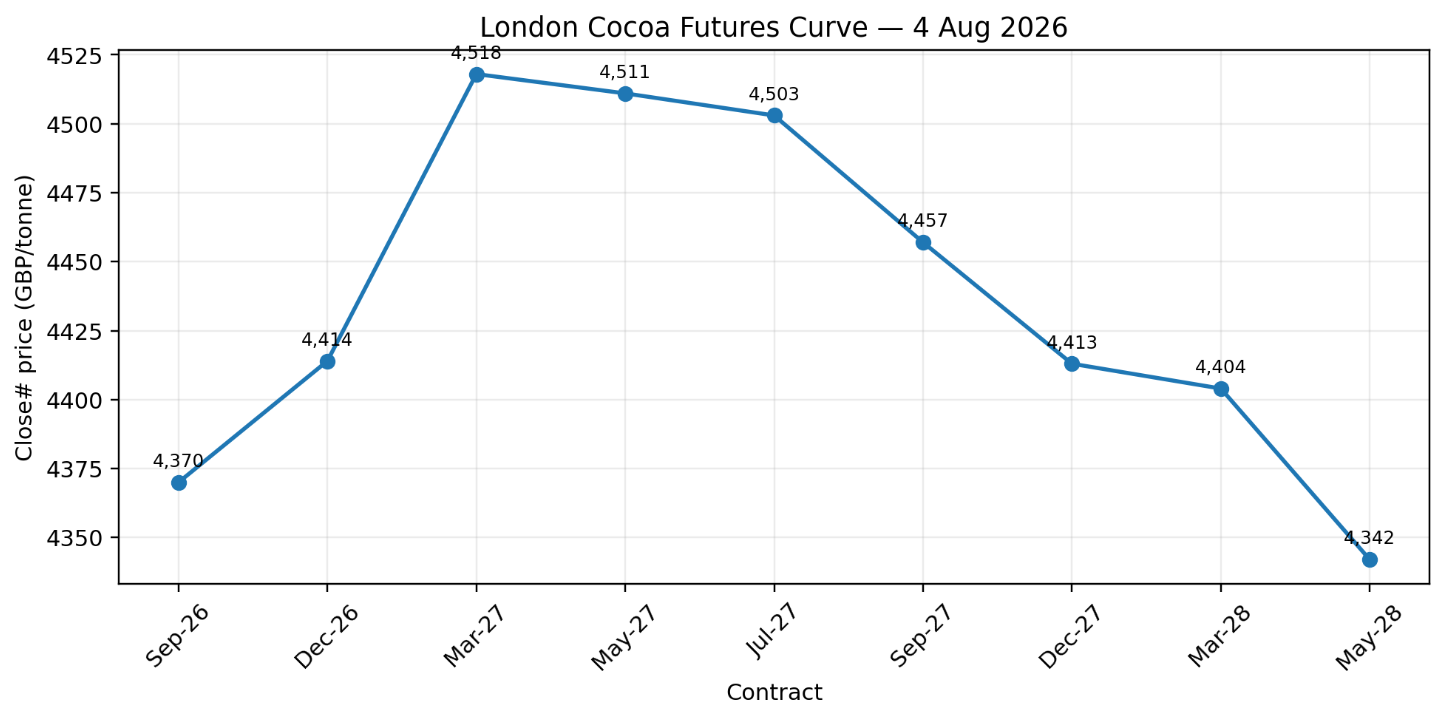
The front of the curve therefore remained in contango through March 2027, after which the structure moved into sustained backwardation.
The May-over-September premium widened from £134 to £141 per tonne. This represented a modest steepening of the front contango, as September weakened more than May.
The secondary increase previously visible between December 2027 and March 2028 disappeared. The curve instead declined from £4,413 in December to £4,404 in March and £4,342 in May, producing a more consistent downward slope across the deferred contracts.
US–UK Spread
(Sep Contract)
$6,089 − (£4,370 x 1.345$/£) =$211ton (up from $ 90 ton )
Volume and Open Interest
New York cocoa
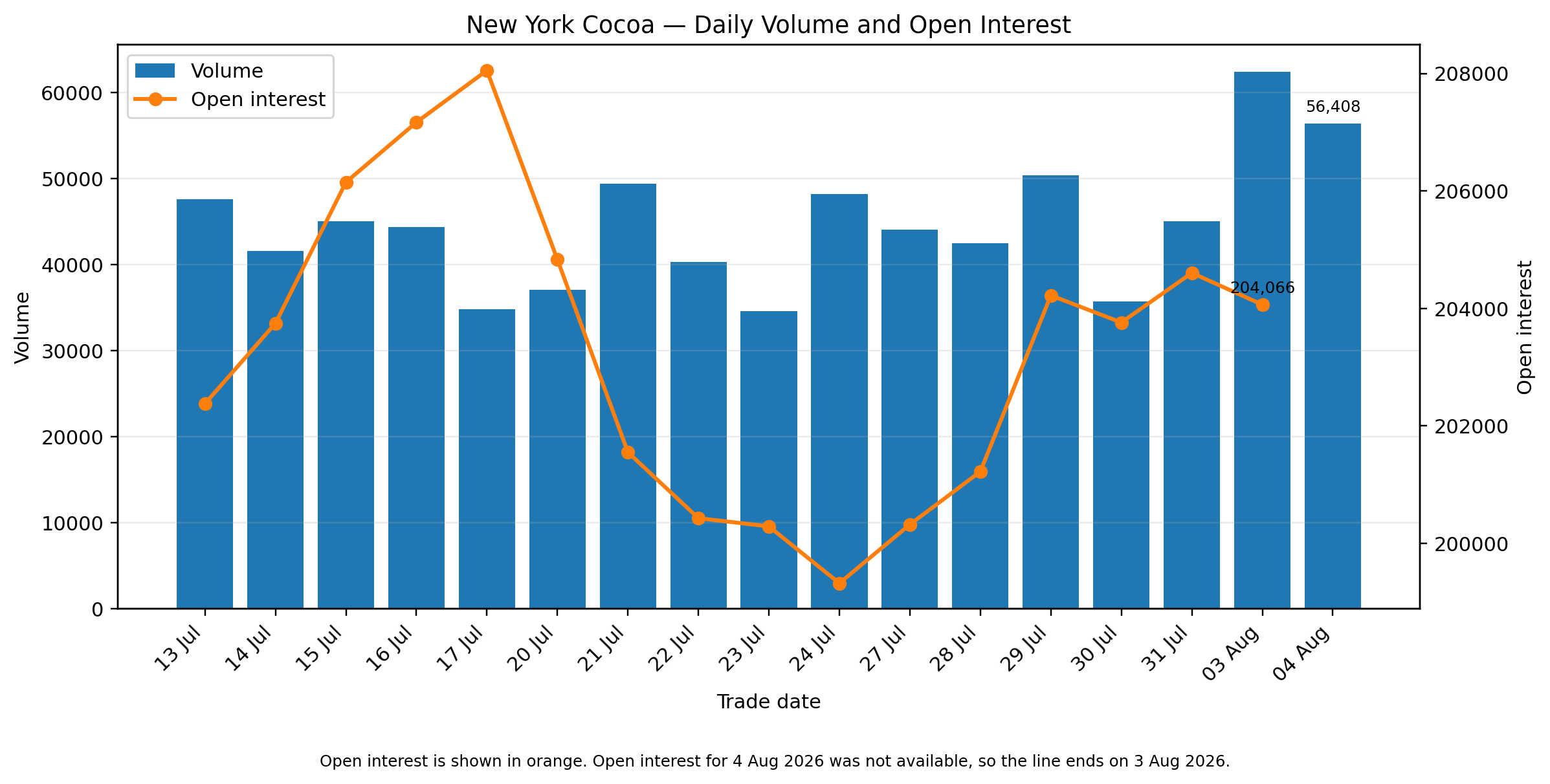
New York cocoa volume remained very strong on 4 August, although it eased from the exceptional level recorded in the previous session. Daily volume reached 56,408 contracts, down 6,050 contracts, or 9.7%, from 62,458 on 3 August.
Even with that decline, turnover remained elevated. Volume was approximately 29.0% above the average of the preceding 15 sessions, indicating that participation stayed strong and that interest in the market remained well above recent norms.
This suggests that 4 August was not simply a quiet consolidation day after the rally, but rather another active session with substantial market engagement, even if activity was somewhat less intense than on 3 August.
Open interest for 4 August was not yet available in the exchange data. The latest available observation was 204,066 contracts on 3 August, compared with 204,606 contracts on 31 July. That represents a modest decline of 540 contracts.
Looking at the broader pattern, open interest had recovered from the late-July trough but remained below the mid-July high of 208,055 contracts recorded on 17 July. In other words, positioning had improved from the lows, but there was still no clear sign of a major fresh build in total exposure.
This may indicate that the recent strength in New York was supported by active trading and some renewed participation, but without the 4 August open-interest figure it is not yet possible to determine how much of the move reflected new long positioning and how much came from short-covering or position rotation.
London cocoa
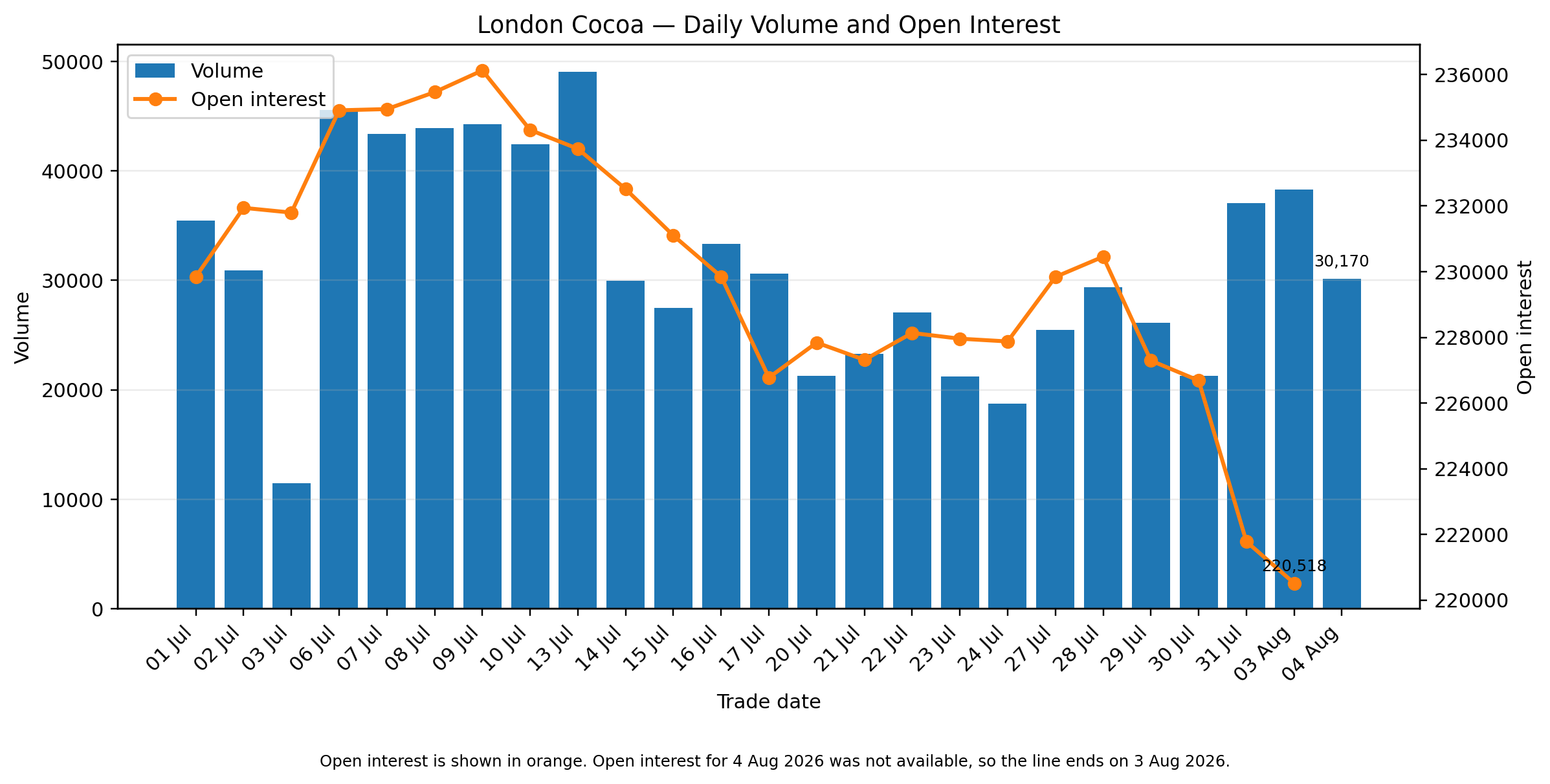
London cocoa volume weakened noticeably on 4 August after the stronger turnover seen in the previous session. Daily volume came in at 30,170 contracts, down 8,157 contracts, or 21.3%, from 38,327 on 3 August.
This brought activity back to a more ordinary level. Compared with the average of the July sessions, volume on 4 August was about 3.5% below average, indicating that the stronger participation seen on 3 August was not sustained into the following session.
The decline therefore suggests that the London market lost some momentum in terms of trading activity, even though volume remained respectable in absolute terms.
Open interest for 4 August was also unavailable, so the latest available figure remains 220,518 contracts on 3 August. That was down from 221,783 contracts on 31 July, a decline of 1,265 contracts.
More importantly, London open interest has been trending lower for some time. It stood as high as 236,125 contracts on 9 July, meaning that by 3 August it had fallen by 15,607 contracts from that peak. This shows a fairly persistent reduction in outstanding positions over the course of July and into early August.
That pattern suggests that recent market moves in London may have been influenced at least partly by short-covering and position reduction, rather than by a strong wave of fresh speculative buying. However, because the 4 August open-interest figure is not yet available, it is not possible to determine whether the lower volume on the day was accompanied by fresh liquidation or simply reflected a pause after the prior session’s activity.
Exchange Trading Volume
| EXCHANGE | 3 AUG 2026 | 4 AUG 2026 | CHANGE | % CHANGE |
|---|---|---|---|---|
| ICE U.S. Cocoa | 3,370,811 | 3,338,898 | −31,913 | −0.95% |
| ICE Europe Cocoa | 1,148,906 | 1,149,219 | +313 | +0.03% |
| Combined | 4,519,717 | 4,488,117 | −31,600 | −0.70% |
The measure is not a complete regional stock-to-grind ratio, as it includes only exchange-certified cocoa held at U.S. and EU delivery ports and excludes commercial inventories outside the ICE warehouse system. North America NCA grindings cover processors across North America, while ICE U.S. certified stocks are stored at U.S. delivery ports. ECA reports bean usage in European countries and London-certified cocoa is held in European and UK delivery locations.
Readers can explore detailed cocoa market datasets, futures statistics, and historical indicators in the CocoaIntel Data Hub:
 Cocoa Intel
Tomorrow's Outlook
New York cocoa is expected to remain firm tomorrow after the strong official close at $6,089, near the session high. The first test is $6,108; a sustained break above it could extend the rally toward $6,300. Some early profit-taking would be normal after the sharp advance, but pullbacks holding above $6,000–$6,050 would preserve the bullish structure. A move below $5,951 would weaken the outlook and suggest that the market is returning to consolidation.
If you notice any discrepancies in these figures or have extra information, please email hello@cocoaintel.com or leave a comment – corrections and additional insights are always welcome.