
Sharp Futures Losses and Divergent 2026/27 Balance Forecasts (2 September 2026)


New York cocoa came under heavy selling pressure on Wednesday, with the principal maturities declining by 3.36% to 3.88%. Dec-26 fell $219, or 3.36%, from $6,509 to $6,290 per tonne. The intraday chart shows selling accelerating sharply after an initially steadier period, briefly pushing prices below the daily 9-day SMA before a partial recovery. The rebound allowed prices to finish above the daily average, but failed to overcome the hourly 9-period SMA, leaving short-term pressure intact. London cocoa recorded heavier losses, with the principal contracts falling by 4.24% to 4.52%. Dec-26 declined £217, or 4.52%, from £4,805 to £4,588 per tonne.
ICCO narrows its completed 2024/25 surplus
The ICCO’s August bulletin, published late on 31 August, revised the organisation’s estimates for the completed 2024/25 cocoa year.
Global gross production was estimated at 4.733 million tonnes, an increase of 8.5% year on year, while grindings declined by 3.3% to 4.649 million tonnes. ICCO placed the resulting global surplus at 37,000 tonnes, with ending stocks of 1.309 million tonnes and a stocks-to-grindings ratio of 28.2%.
Compared with the May bulletin, production was revised 10,000 tonnes higher, while grindings were raised by 21,000 tonnes. This reduced the estimated surplus from 48,000 to 37,000 tonnes. Ending stocks were lowered from 1.320 million to 1.309 million tonnes, and the stocks-to-grindings ratio was reduced from 28.5% to 28.2%.
The 37,000-tonne surplus cannot be calculated simply by subtracting grindings from gross production. ICCO bases its balance on the net crop after adjustments for weight loss.
Trade data in the bulletin showed that global exports of cocoa beans and semi-finished products, expressed in bean equivalent, reached 2.09 million tonnes between January and March 2026. This was 2.8% lower than in the same period a year earlier.
The figures remain backward-looking. ICCO temporarily withheld its production and grinding estimates for 2025/26, meaning the bulletin provides no updated assessment of the current-season surplus or deficit. The reported 1.309 million tonnes of ending stocks are also an accounting estimate for the end of 2024/25 and should not automatically be treated as cocoa that is currently available in the required location, origin or quality.
Mondelēz says inventories provide a buffer against a small deficit
Darren O’Brien, chief cocoa officer at Mondelēz International, said at the Cocoa Association of Asia conference in Singapore that the industry was carrying a healthy cocoa inventory that could cushion modest production variations.
O’Brien said this stock buffer should allow the market to absorb a small deficit, although he did not quantify the inventory or identify where it was held. His remarks were also not an explicit reference to ICCO’s 1.309-million-tonne end-2024/25 stock estimate.
He said it remained too early to determine how El Niño would affect cocoa production. Although the weather event is developing, its influence on rainfall, temperature and the Harmattan in individual West African growing areas remains uncertain.
O’Brien also highlighted the growing contribution of Ecuador and Brazil to global supply. Around half of global cocoa production still comes from Côte d’Ivoire and Ghana, but expansion in South America is gradually broadening the range of origins available to buyers.
Ecuador, currently the world’s third-largest producer, has ambitions to become the second largest within the next two years. This remains an industry ambition rather than a new independent production forecast. Brazil is also expanding, although its contribution to global exportable supply remains much smaller and its growth path is less advanced than Ecuador’s.
The more significant demand observation concerned changes made by chocolate and snack manufacturers during 2024 and 2025. O’Brien said companies had adjusted cocoa content, product sizes and other elements of their portfolios in response to exceptionally high input costs.
Consequently, a recovery in chocolate and snack sales would not necessarily generate a proportional recovery in cocoa-bean demand. Higher unit or value sales may now contain less cocoa than comparable sales before the reformulation and pack-size changes. The comments indicate reduced cocoa intensity in parts of the snacking portfolio, although Mondelēz did not quantify the reduction or suggest that every change would be permanent.
Forecasts diverge sharply over the 2026/27 balance
The widest-ranging new forecast came from Malaysian processor Guan Chong. Chief executive Brandon Tay told Bloomberg that he expected a global cocoa deficit of between 300,000 and 400,000 tonnes in 2026/27, compared with an estimated surplus of around 100,000 tonnes in 2025/26.
Tay cited excessive rainfall, waterlogged farms and disease pressure in West Africa, together with the possibility that El Niño could intensify the dry Harmattan later in the season. He also expects cocoa demand to continue stabilising after the contraction caused by the previous price surge. Tay projected that futures could reach approximately $8,000 a tonne by December.
ICCO executive director Michel Arrion separately told the conference that upcoming global production was likely to be relatively poor. This was a qualitative conference comment, however, and not the reinstatement of ICCO’s withheld official production or balance forecast.
Guan Chong’s deficit estimate contrasts sharply with BMI and Hedgepoint, which continue to forecast positive, but substantially smaller, surpluses in 2026/27.
BMI expects the global surplus to contract from 442,000 tonnes in 2025/26 to 82,000 tonnes in 2026/27. The firm forecasts Côte d’Ivoire’s production falling by 17.5% to 1.7 million tonnes and Ghana’s output declining by 9.1% to 627,000 tonnes.
BMI also raised its forecast for the full-calendar-2026 average of the second-month ICE cocoa contract from $4,000 to $4,990 a tonne. It expects quarterly averages of $5,870 in the third quarter and $6,175 in the fourth quarter, followed by an average of $5,670 in 2027. The $4,990 figure is an annual average forecast rather than a spot-price or three-month target.
BMI cited combined second-quarter grindings of 650,671 tonnes across Europe, Asia and North America, an increase of 6.1% year on year. Asian grindings rose by 25.1% and North American grindings by 7.7%, while European processing fell by 4.6% to 316,366 tonnes.
These figures require some qualification. The North American reporting panel has changed, limiting direct year-on-year comparability. Asian grindings measure where beans are processed rather than where the resulting cocoa products are ultimately consumed. They can therefore be influenced by processing relocation and inventory rebuilding as well as final chocolate demand.
Hedgepoint, in a forecast first reported on 19 August, expects a 111,000-tonne surplus in 2026/27, down from 325,000 tonnes in 2025/26. Its projection assumes an approximately 2% decline in global production and a 2.5% increase in processing.
BMI and Hedgepoint therefore agree that the surplus will narrow materially, but their starting estimates for 2025/26 differ by 117,000 tonnes. Guan Chong’s forecast lies on the other side of the balance entirely, producing a range from an 82,000-tonne surplus to a 400,000-tonne deficit across the available private estimates.
Weather is central to all three assessments. NOAA’s latest outlook assigns a 95% probability to a very strong El Niño during October to December. NOAA nevertheless cautions that the strength of an ENSO event does not automatically determine its effects on rainfall or agriculture in individual regions.
Citi reiterates an unchanged neutral cocoa view
Citi’s 1 September research did not contain a new cocoa recommendation. The bank raised its raw-sugar forecasts but retained its neutral cocoa view and its existing targets of $5,000 a tonne in three months and $6,000 in 12 months.
Citi said weather-related production risks were being partly offset by recovering inventories and still-subdued grindings, particularly in Europe. The cocoa targets and neutral assessment had already been published previously, so the item is best presented as a reiteration rather than a forecast revision.
Asian cocoa association backs ASEAN reforestation initiative
The Cocoa Association of Asia became the first industry association formally to support the ASEAN One Billion Trees Growing Initiative at the opening of its conference in Singapore on 2 September.
CAA Secretary-General Shirley Choo signed a formal statement of support and said the cocoa industry could contribute experience in agroforestry, landscape regeneration, soil protection and crop resilience. The commitment also places cocoa within wider regional discussions concerning traceability and responsible agricultural trade.
The announcement did not include a cocoa-specific planting target, committed funding, an implementation timetable or a binding delivery plan. It should therefore be described as an institutional commitment rather than a quantified tree-planting programme.
Conference speakers also discussed preparations for the EU Deforestation Regulation. The current implementation timetable applies the regulation to large and medium operators from 30 December 2026 and to most micro and small operators from 30 June 2027.
Brazil presents traceability as an export advantage
In a separate cocoa-specific development, Jaime Recena, executive president of Brazil’s chocolate and confectionery association ABICAB, said that 96% of the country’s existing cocoa area was potentially able to produce for export to the European Union.
Recena said that, in Pará, approximately 80% of the cocoa-planted area was located on land deforested by 1998. Expanding cocoa on previously degraded land could support landscape restoration while avoiding cultivation in more recently cleared areas.
The 96% figure is an industry assertion rather than an independent compliance audit. Historical land-use eligibility alone does not establish EUDR compliance at shipment level. Exporters and EU operators will still need plot-level geolocation, legality documentation, traceability and the required due-diligence statements.
Weather forecast: 2 to 8 September 2026
Widespread showers and thunderstorms are forecast across the West African cocoa belt, with no broad dry pattern expected.
Most cocoa areas in Côte d’Ivoire are expected to receive 40 to 80 mm, with 70 to 100 mm possible in western and southwestern districts. The selected point in the central cocoa belt shows 50.7 mm.
Ghana’s main producing areas, including Western North, Ashanti and Bono, are forecast to receive 50 to 100 mm, with isolated totals above 100 mm. Daytime temperatures across Côte d’Ivoire and Ghana should range from 28°C to 33°C, with overnight lows of 21°C to 25°C.
Southwestern Nigeria is expected to be comparatively drier, with 20 to 50 mm, while southeastern areas could receive 40 to 80 mm. Cameroon’s Southwest and Littoral regions may receive 75 to 150 mm, with lower totals of 25 to 60 mm across the Centre and South regions.
Futures performance
New York cocoa
| Contract | 1 Sep | 2 Sep | Change | Change % |
|---|---|---|---|---|
| Sep-26 | $6,603 | $6,347 | -$256 | -3.88% |
| Dec-26 | $6,509 | $6,290 | -$219 | -3.36% |
| Mar-27 | $6,643 | $6,399 | -$244 | -3.67% |
| May-27 | $6,688 | $6,429 | -$259 | -3.87% |
| Jul-27 | $6,687 | $6,435 | -$252 | -3.77% |
New York cocoa declined across every listed maturity on 2 September. Among the actively traded Dec-26 through Jul-27 contracts, May-27 recorded the largest fall, losing $259 per tonne, or 3.87%. Sep-26 fell $256, or 3.88%, but only two contracts traded in that maturity, making the move unrepresentative. Losses among the main contracts ranged from 3.36% to 3.87%.
The active Dec-26 through Jul-27 contracts traded through ranges of $404 to $422 per tonne, slightly wider than the $390 to $413 ranges on 1 September. Each contract traded above its previous final price during the session before reversing. Final prices finished 26.6% to 35.1% above their daily lows, compared with 24.5% to 26.4% on Tuesday. Prices therefore remained in the lower third of their ranges, although they ended farther above the lows than in the previous session.
Total New York volume declined 8.7% to 40,292 contracts from 44,119. Dec-26 and Mar-27 accounted for 32,810 contracts, or 81.4% of total volume, up from 78.7% on 1 September. Spread volume fell 11.3% to 22,931 contracts and represented 56.9% of total turnover, compared with 58.6% previously. Open-interest figures were not reported, so the fall cannot be divided reliably between long liquidation and new short positions.
New York futures curve
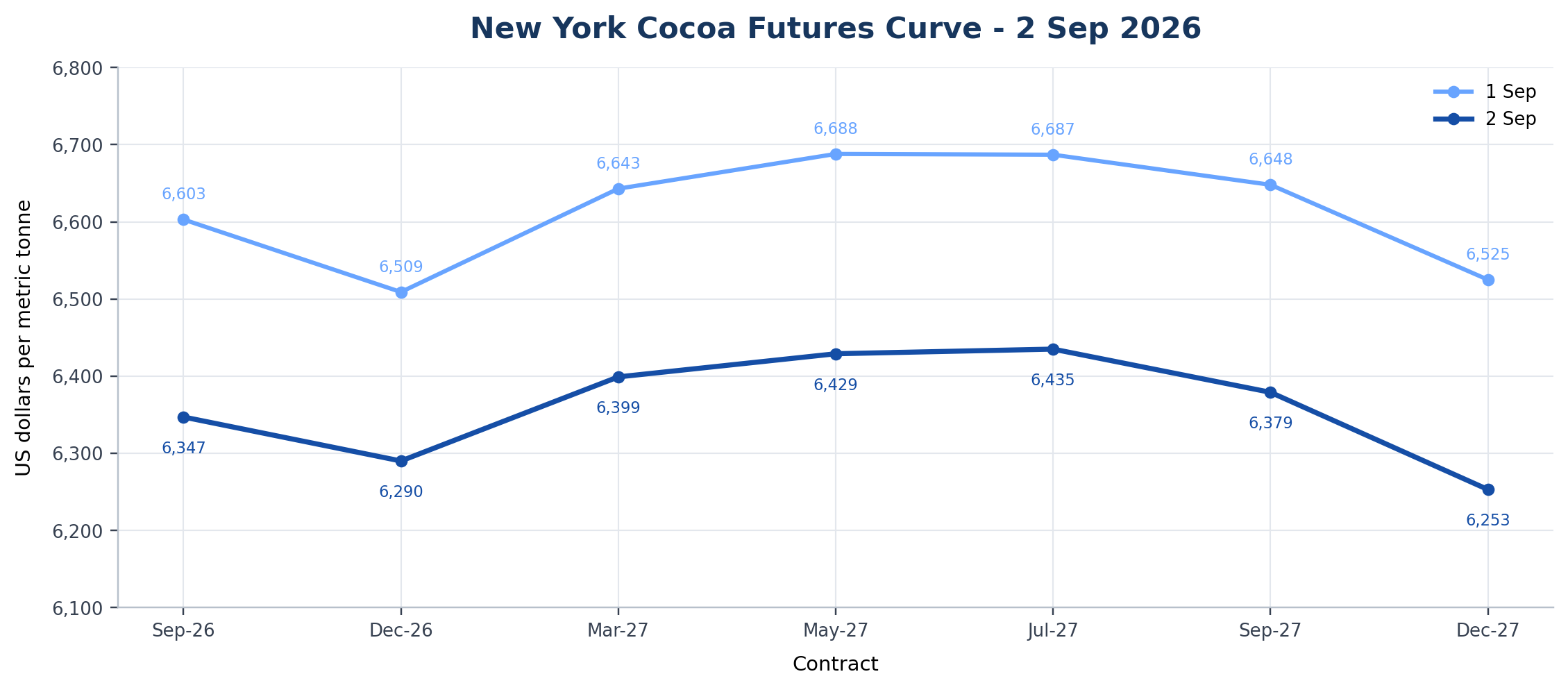
The New York curve shifted lower by $219 to $272 per tonne across the seven plotted maturities. Sep-26/Dec-26 backwardation narrowed from $94 to $57, while Dec-26/Mar-27 contango narrowed from $134 to $109. The curve peak moved from May-27 to Jul-27. Farther out, Jul-27/Sep-27 backwardation widened from $39 to $56, while Sep-27/Dec-27 backwardation widened slightly from $123 to $126.
London cocoa
| Contract | 1 Sep | 2 Sep | Change | Change % |
|---|---|---|---|---|
| Sep-26 | £4,696 | £4,497 | -£199 | -4.24% |
| Dec-26 | £4,805 | £4,588 | -£217 | -4.52% |
| Mar-27 | £4,937 | £4,720 | -£217 | -4.40% |
| May-27 | £4,935 | £4,712 | -£223 | -4.52% |
| Jul-27 | £4,917 | £4,695 | -£222 | -4.51% |
London cocoa declined across all seven plotted maturities on 2 September. Among the five principal contracts, May-27 recorded the largest absolute fall, losing £223 per tonne, or 4.52%, while Jul-27 declined £222, or 4.51%. Dec-26 and Mar-27 each lost £217. Sep-26 recorded the smallest fall at £199, or 4.24%. Losses extended to 4.68% in Sep-27 and 4.78% in Dec-27.
The five principal contracts traded through ranges of £281 to £299 per tonne, broadly similar to £275 to £296 on 1 September. Sep-26 and Dec-26 briefly traded above their previous final prices, while Mar-27, May-27 and Jul-27 remained below them throughout the session. Final trades were only 23.4% to 25.1% above their daily lows, compared with 34.1% to 43.3% previously, indicating a distinctly weaker finish.
London volume fell 20.5% to 35,514 contracts from 44,694. Dec-26 and Mar-27 together accounted for 23,833 contracts, or 67.1% of the total, compared with 62.4% on 1 September. Spread volume declined 22.8% to 21,448 contracts and represented 60.4% of turnover, down from 62.1%. Open interest figures were unavailable, preventing a reliable assessment of how much of the decline reflected liquidation rather than new short selling.
London futures curve
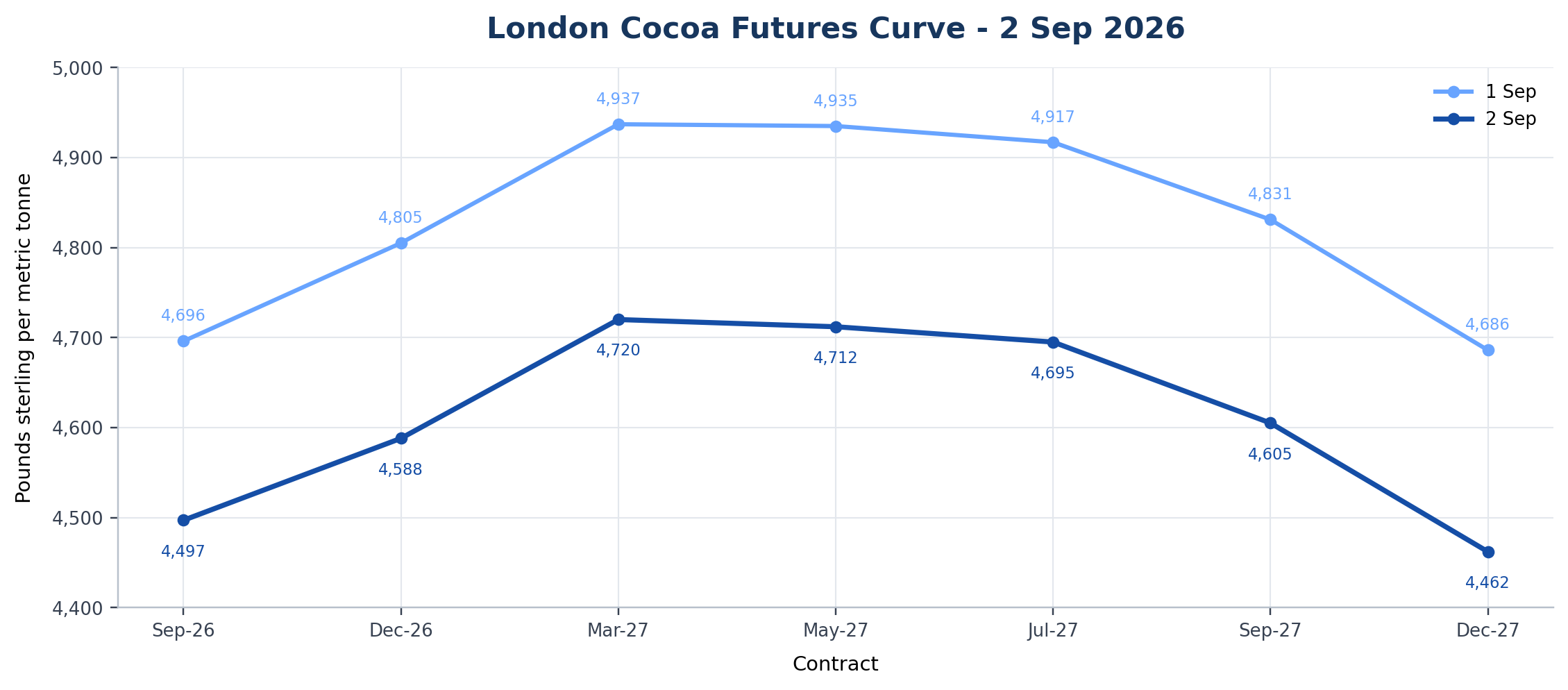
The London curve moved lower by £199 to £226 per tonne. From Dec-26 onward, the shift was comparatively parallel. Sep-26/Dec-26 contango narrowed from £109 to £91, while Dec-26/Mar-27 contango remained unchanged at £132. Mar-27 remained the curve peak, with Mar-27/May-27 backwardation widening from £2 to £8. Jul-27/Sep-27 backwardation widened slightly from £86 to £90, while Sep-27/Dec-27 backwardation narrowed slightly from £145 to £143.
US–UK Spread
(Dec Contract)
$6,290 − (£4,588 x 1.348$/£) =$105ton (down from $17ton)
Volume and Open Interest
New York cocoa
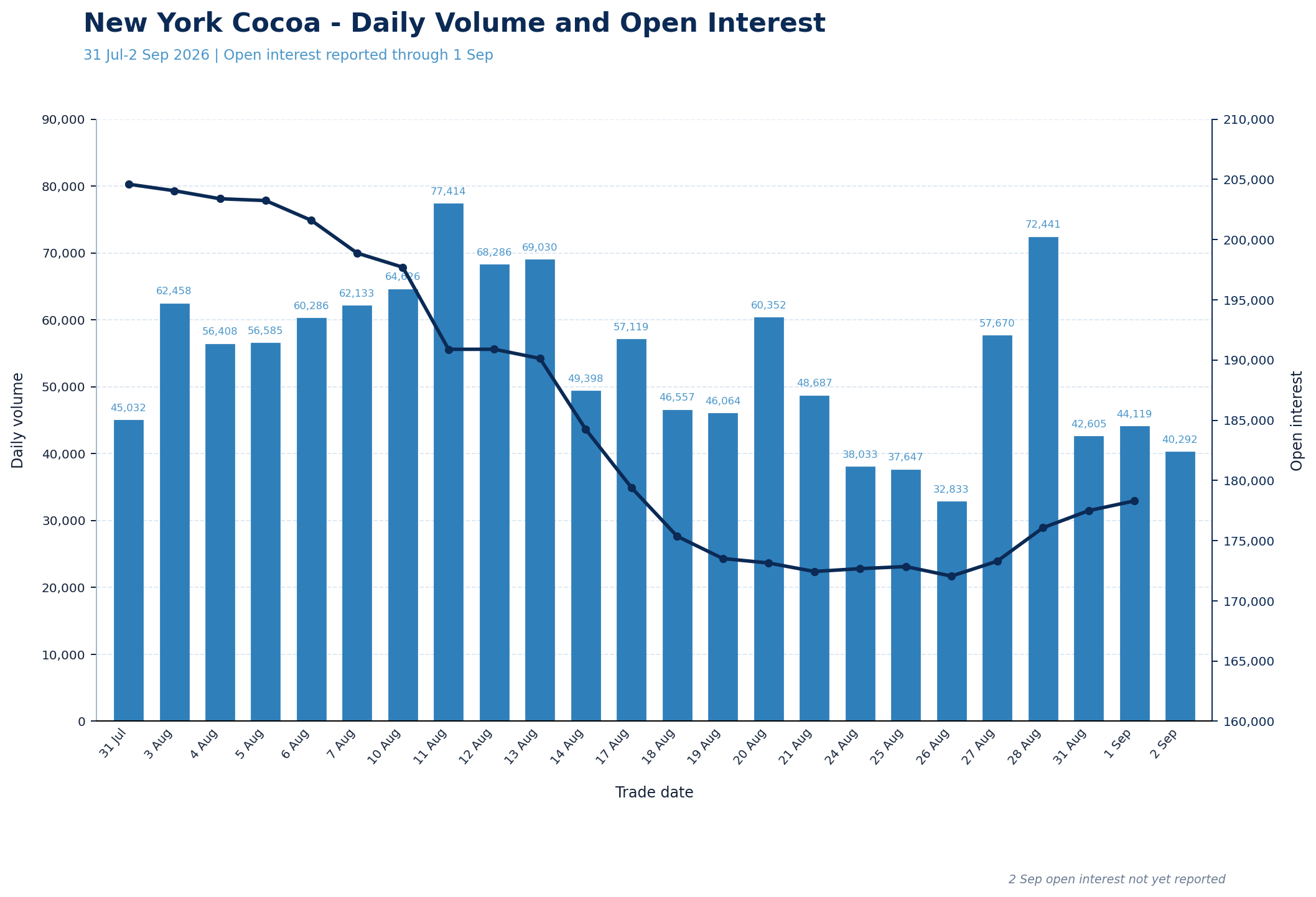
New York cocoa volume fell to 40,292 contracts on 2 September, down 3,827 contracts, or 8.7%, from 44,119 on 1 September. Turnover was 26.2% below the preceding 20-session average of 54,594 and 25.4% below the displayed-period average of 54,003.
It was the fourth-lowest daily volume in the 24-session window and stood 37,122 contracts, or 48.0%, below the period peak of 77,414 recorded on 11 August. Participation therefore weakened again following the modest increase on 1 September and remained subdued.
The latest valid open-interest figure, for 1 September, increased to 178,298 contracts from 177,489 on 31 August, a rise of 809 contracts, or 0.5%. This was the fourth consecutive increase from the period low of 172,055 on 26 August, lifting open interest by 6,243 contracts, or 3.6%. It nevertheless remained 26,308 contracts, or 12.9%, below the 31 July peak of 204,606.
The combination of lower prices and rising open interest on 1 September is consistent with new positions entering during the decline, potentially including fresh short participation.
London cocoa
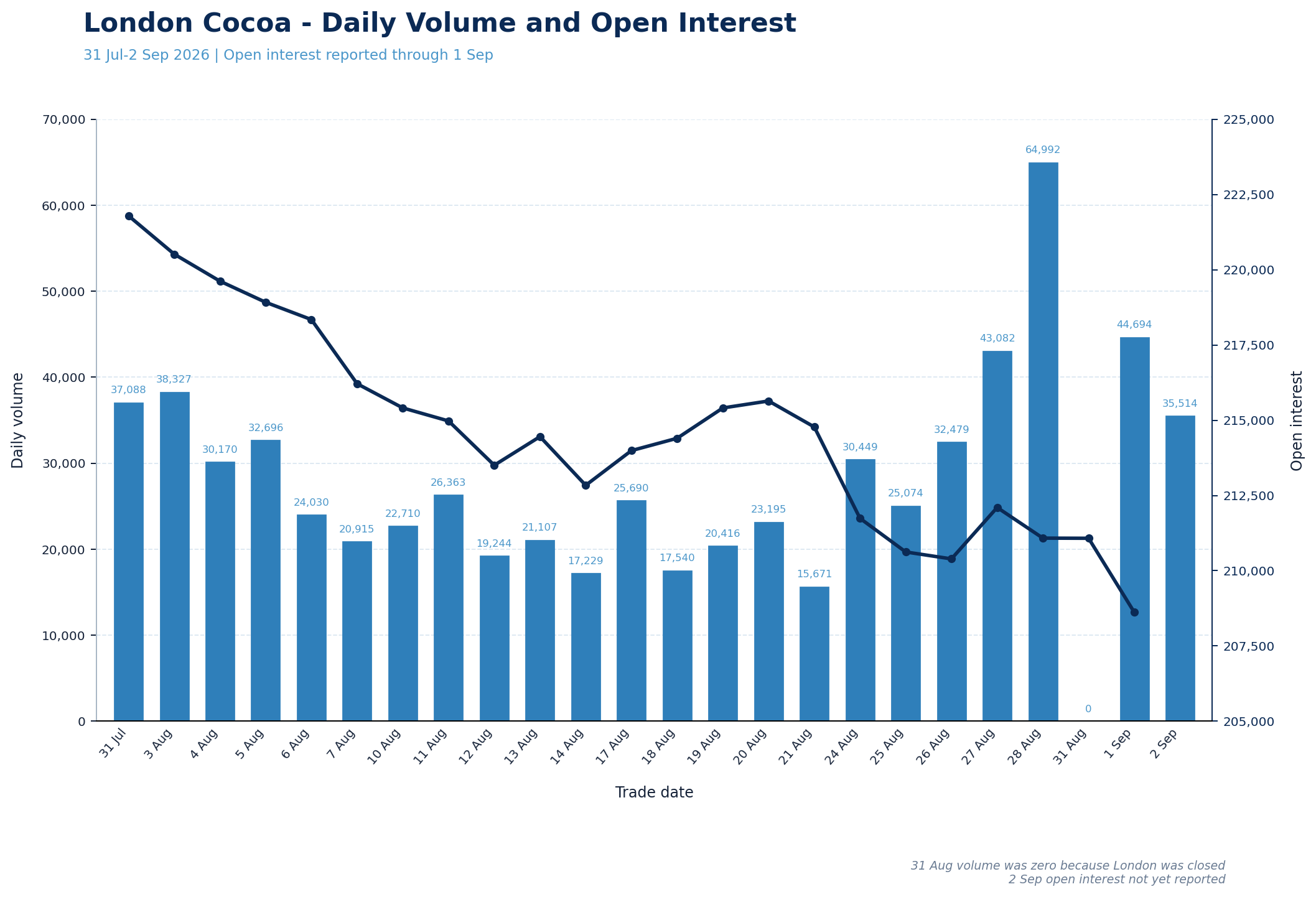
London cocoa volume fell to 35,514 contracts on 2 September, down 9,180 contracts, or 20.5%, from 44,694 on 1 September. Despite the decline, turnover remained 27.3% above the preceding 20-active-session average of 27,887 and 22.2% above the displayed-period average of 29,073. The 31 August holiday is excluded from both averages.
It was the sixth-highest daily volume among the 23 active sessions shown and stood 29,478 contracts, or 45.4%, below the period peak of 64,992 recorded on 28 August. Participation eased from the strong reopening volume on 1 September but remained above the recent norm.
The latest valid open-interest figure, for 1 September, fell to 208,617 contracts from 211,078 on 31 August, a decline of 2,461 contracts, or 1.2%. From 27 August, open interest decreased by 3,484 contracts, or 1.6%, and reached a new low for the displayed period. It was 13,176 contracts, or 5.9%, below the 31 July peak of 221,793.
The combination of lower prices and declining open interest on 1 September is consistent with position reduction or long liquidation rather than a clear build-up of new short positions.
Exchange Trading Volume
| MARKET | 1 SEP 2026 | 2 SEP 2026 | CHANGE | CHANGE % |
|---|---|---|---|---|
| US | 3,411,776 | 3,406,661 | -5,115 | -0.15% |
| UK | 1,180,469 | 1,191,875 | +11,406 | +0.97% |
The measure is not a complete regional stock-to-grind ratio, as it includes only exchange-certified cocoa held at U.S. and EU delivery ports and excludes commercial inventories outside the ICE warehouse system. North America NCA grindings cover processors across North America, while ICE U.S. certified stocks are stored at U.S. delivery ports. ECA reports bean usage in European countries and London-certified cocoa is held in European and UK delivery locations.
Readers can explore detailed cocoa market datasets, futures statistics, and historical indicators in the CocoaIntel Data Hub:
 Cocoa Intel
Thursday Outlook Dec Contract
New York cocoa enters Thursday with conflicting signals across the timeframes. The daily chart remains constructive after Wednesday’s decline briefly breached the 9-day SMA but recovered to close above it at $6,290. This rejection of lower prices suggests that buyers are still defending the short-term daily trend. However, the large bearish candle means that a bullish reversal has not yet been confirmed.
The hourly chart remains weaker. The 9-period SMA, currently around $6,320 to $6,350, has capped rebound attempts during the past two sessions. Hourly momentum also remains negative, although the RSI and stochastic readings are approaching oversold territory. This creates scope for a relief rebound, but the short-term bias will remain cautious while prices stay below $6,350.
The 5-minute chart ended in compression around $6,290, with the shorter moving averages converging and momentum indicators close to neutral. This suggests that Thursday’s direction is likely to be determined by an early break from the $6,250 to $6,350 area.
The most likely scenario is an initially volatile and two-sided session. Prices could test $6,320 to $6,350 early in the day. If this resistance holds, selling pressure may return, initially targeting $6,250 and then the $6,200 area. Wednesday’s low at $6,142 is the more important downside trigger.
A sustained hourly close above $6,350 would improve the immediate outlook and could extend the recovery towards $6,400, followed by $6,450 to $6,500. A move above Wednesday’s high at $6,564 would provide stronger confirmation that the correction has ended.
On the downside, a break below $6,200 would weaken Wednesday’s recovery. A move below $6,142 would expose the main support zone between $6,000 and $6,100. This area remains critical because it combines psychological support with the broader rising structure. A daily close below $6,000 would materially weaken the medium-term bullish outlook.
If you notice any discrepancies in these figures or have extra information, please email hello@cocoaintel.com or leave a comment – corrections and additional insights are always welcome.