
Cocoa Consolidates After Sharp Sell-Off as Traders Assess the Next Move (12 August 2026)


December 2026 cocoa staged a volatile rebound on Wednesday, opening at $5,650 per tonne and trading across a wide $205 range between $5,574 and $5,779. An early advance was followed by a sharp reversal toward support, but buyers re-emerged around the hourly 200-period SMA and daily 21-day SMA, driving the contract back above $5,700. It finished at a last-traded price of $5,719, up $82, or 1.45%, from 11 August and approximately 71% above its session low, although the retreat from the high showed that resistance near $5,800 remains firmly in place.
Côte d’Ivoire–Ghana Cocoa Initiative concerning the increasing use of cocoa substitutes and the reformulation of products to contain less cocoa. CIGCI argued that these practices risk weakening demand and producer incomes at the same time that farmers and producing countries are being required to bear higher sustainability, traceability and regulatory-compliance costs. The organisation called for clearer disclosure of cocoa content, more rigorous use of chocolate-related product names and sustainability claims, an assessment of the effects of reformulation on cocoa demand and farmer remuneration, and a permanent consultation framework involving producers, manufacturers and regulators.
The statement is important because it confirms that demand destruction is no longer only a market concern but has become a formal policy issue for the two largest producing countries. Nevertheless, it did not introduce a ban on cocoa substitutes, alter the Living Income Differential or origin differentials, change farm-gate prices, or impose legally binding composition and labelling requirements. Its immediate influence on physical demand is therefore limited, although it may increase political and regulatory pressure on manufacturers over the medium term.
Downstream company news provided a mixed signal. Delfi’s half-year results, released after the Singapore close on 11 August, showed net sales rising by 2.7% and Own Brands sales increasing by 13.3%, suggesting that demand for its branded chocolate products remained comparatively resilient. However, EBITDA declined by 3.7% and gross margin contracted by 180 basis points to 25.7%, primarily because of elevated raw-material costs and weaker regional currencies. The figures therefore indicate that some consumer demand is holding up, but they also demonstrate the continuing pressure faced by chocolate manufacturers following the earlier surge in cocoa prices.
Futures performance
New York cocoa
New York cocoa rebounded after Tuesday’s sharp decline, although the recovery became progressively weaker along the curve. This front-loaded pattern indicates that nearby contracts attracted the strongest buying interest.
| Contract | 11 Aug | 12 Aug | Change | Change % |
|---|---|---|---|---|
| Sep-26 | $5,527 | $5,617 | +$90 | +1.63% |
| Dec-26 | $5,637 | $5,719 | +$82 | +1.45% |
| Mar-27 | $5,727 | $5,796 | +$69 | +1.20% |
| May-27 | $5,744 | $5,809 | +$65 | +1.13% |
| Jul-27 | $5,731 | $5,796 | +$65 | +1.13% |
Intraday volatility remained substantial. The five nearest contracts traded across ranges of $138–$205 per tonne. September covered the widest range, from $5,465 to $5,666, before closing at $5,617—$49 below its session high and approximately 76% above the bottom of its range.
The five contracts all finished in the upper 61–76% of their respective daily ranges, showing that buyers retained control into the close despite some late-session retreat from the highs.
Liquidity remained heavily concentrated at the front. September, December and March generated 62,742 contracts, equivalent to 91.9% of total outright volume of 68,286 contracts. December was the most actively traded maturity, with 30,195 contracts.
Futures curve
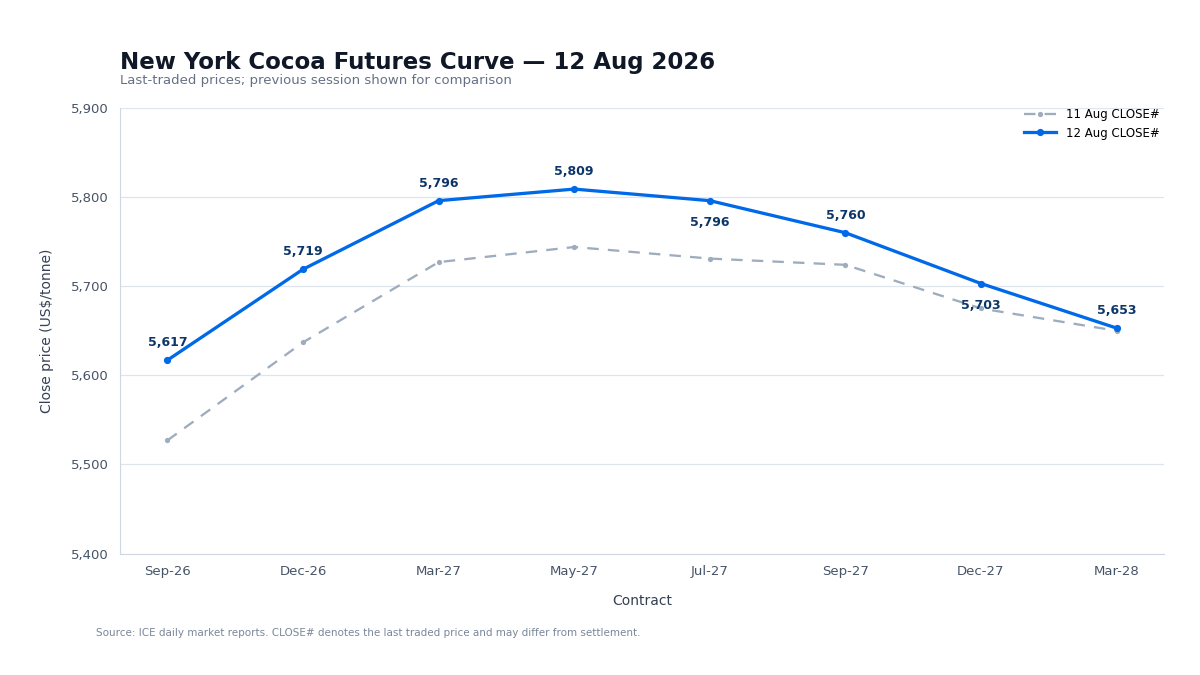
The rebound was not parallel. September gained $90, while March 2028 advanced by only $3. This compressed the front-to-peak contango while making the decline beyond the May 2027 peak considerably steeper.
September-to-December contango narrowed from $110 to $102 per tonne, while December-to-March contango contracted from $90 to $77. May 2027 remained the curve peak at $5,809, commanding a $192 premium over September, down from $217 on 11 August.
London cocoa
London cocoa also recovered, with gains distributed more evenly across the curve than in New York. All five nearby contracts advanced by between 1.28% and 1.56%.
| Contract | 11 Aug | 12 Aug | Change | Change % |
|---|---|---|---|---|
| Sep-26 | £4,062 | £4,114 | +£52 | +1.28% |
| Dec-26 | £4,098 | £4,162 | +£64 | +1.56% |
| Mar-27 | £4,203 | £4,261 | +£58 | +1.38% |
| May-27 | £4,211 | £4,268 | +£57 | +1.35% |
| Jul-27 | £4,205 | £4,268 | +£63 | +1.50% |
Intraday ranges across the five nearest contracts measured £115–£158 per tonne. September traded between £4,002 and £4,160 before closing at £4,114. December closed at £4,162, only £36 below its session high.
The five contracts finished approximately 71–76% above their session lows. This relatively consistent positioning confirms that the recovery was broad across the liquid portion of the London curve.
Futures curve
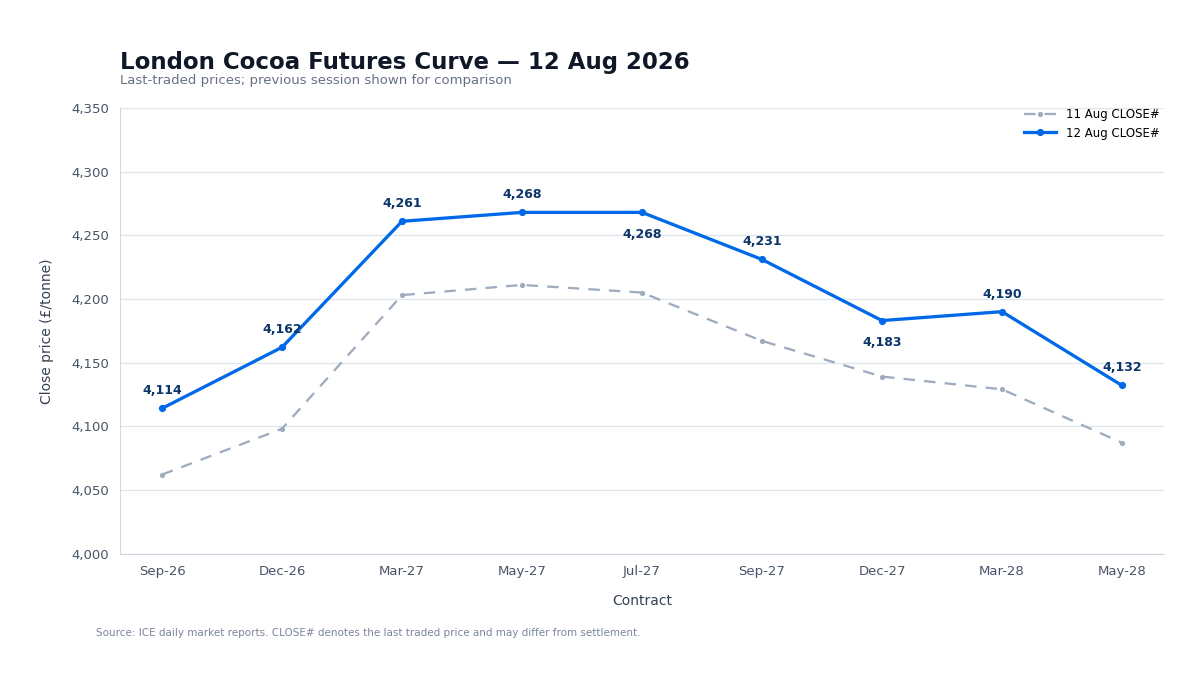
The nearby London curve changed only moderately. September-to-December contango widened from £36 to £48 per tonne, while December-to-March contango narrowed from £105 to £99. March-to-May contango eased from £8 to £7.
May and July 2027 closed at the joint curve peak of £4,268, leaving that section completely flat. The peak stood £154 above September, compared with £149 on 11 August.
US–UK Spread
(Sep Contract)
$5,617 − (£4,114 x 1.348$/£) =$71ton (up from $43 ton )
Volume and Open Interest
New York cocoa
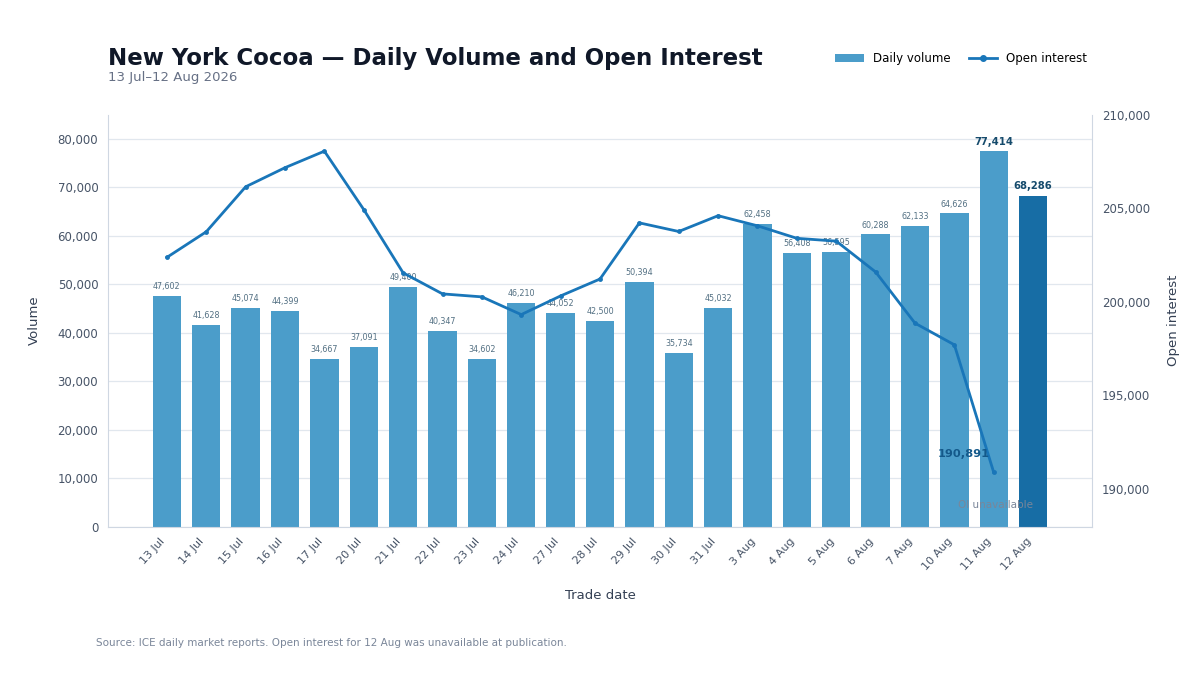
New York cocoa trading activity remained exceptionally elevated during the 12 August rebound. Daily volume reached 68,286 contracts, down 9,128 contracts, or 11.8%, from the 77,414-contract peak recorded on 11 August.
Despite the decline, this was the second-highest daily volume for the past month. Turnover stood 39.3% above the preceding 22-session average of 49,030 contracts and 5.7% above the 64,626 contracts traded on 10 August.
The five nearest contracts advanced by 1.13–1.63%, meaning the recovery attracted substantial participation and did not occur in a thin market. Nevertheless, volume was lower than during the previous session’s sell-off, indicating that the rebound generated slightly less participation than the liquidation that preceded it.
The latest valid open-interest reading was 190,891 contracts on 11 August, down 6,817 contracts, or 3.45%, from 10 August. This was the seventh consecutive decline and the lowest reading in the displayed period. Since 31 July, open interest has fallen by 13,715 contracts, or 6.7%.
The combination of falling prices and sharply declining open interest on 11 August points to substantial position liquidation rather than aggressive new short accumulation. Open interest for 12 August was unavailable, however, so it is not yet possible to determine whether the subsequent rebound was driven primarily by short covering, fresh long positioning or a combination of both.
London cocoa
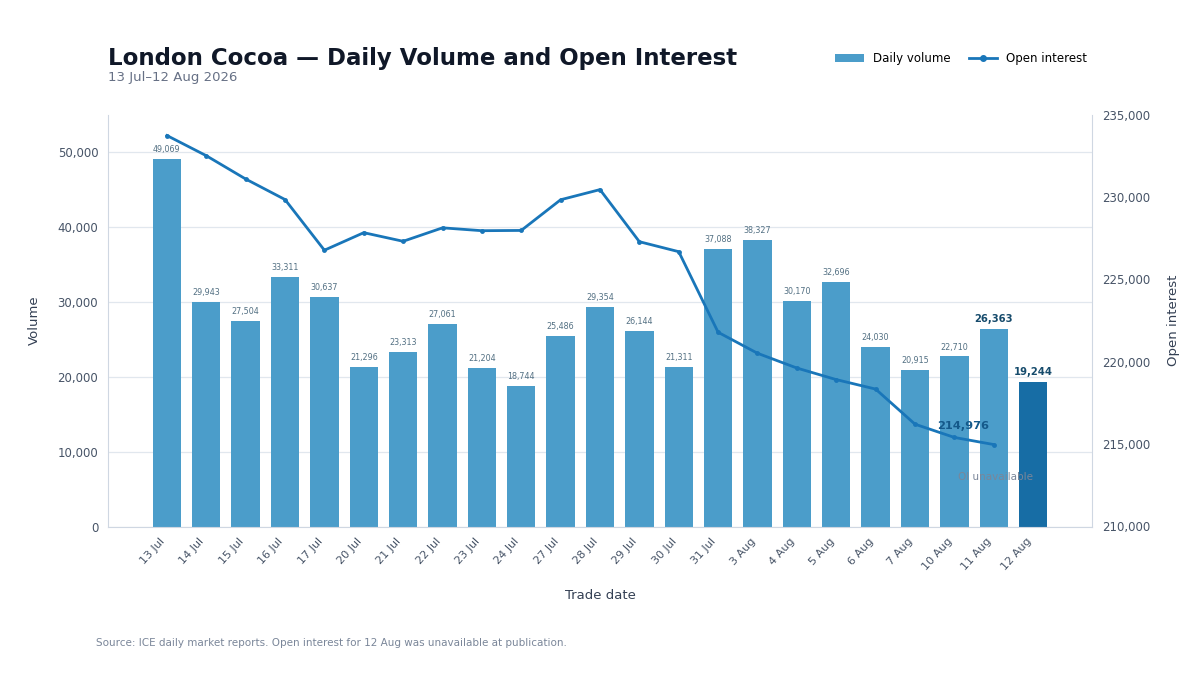
London cocoa trading activity weakened markedly on 12 August. Daily volume fell to 19,244 contracts, a decline of 7,119 contracts, or 27.0%, from the 26,363 contracts traded on 11 August.
This was the second-lowest daily volume in the displayed 23-session period, exceeding only the 18,744 contracts recorded on 24 July. It was also 31.3% below the preceding 22-session average of 28,031 contracts.
The five nearest London contracts nevertheless rose by 1.28–1.56%. The rebound therefore occurred on comparatively limited participation, making it less convincing from a volume perspective than the recovery in New York.
The latest valid open-interest reading was 214,976 contracts on 11 August, down 432 contracts, or 0.20%, from 10 August. This represented the tenth consecutive decline. Since the 28 July reading of 230,455 contracts, open interest has fallen by 15,479 contracts, or 6.7%, reaching its lowest level in the displayed period.
The persistent contraction indicates that traders have continued to reduce exposure across the London market. However, because open interest for 12 August was unavailable, the extent to which the price recovery reflected short covering rather than new buying cannot yet be established.
Exchange Trading Volume
| Market | 11 Aug 2026 | 12 Aug 2026 | Change | Change % |
|---|---|---|---|---|
| US | 3,344,636 | 3,335,795 | −8,841 | −0.26% |
| UK | 1,145,938 | 1,145,938 | 0 | 0.00% |
The measure is not a complete regional stock-to-grind ratio, as it includes only exchange-certified cocoa held at U.S. and EU delivery ports and excludes commercial inventories outside the ICE warehouse system. North America NCA grindings cover processors across North America, while ICE U.S. certified stocks are stored at U.S. delivery ports. ECA reports bean usage in European countries and London-certified cocoa is held in European and UK delivery locations.
Readers can explore detailed cocoa market datasets, futures statistics, and historical indicators in the CocoaIntel Data Hub:
 Cocoa Intel
Thursday Outlook Dec Contract
December 2026 cocoa is likely to remain in consolidation between approximately $5,600 and $5,900 per tonne, with the daily 21-day SMA and the hourly 200-period SMA providing an important support cluster beneath the current price. Momentum remains mixed, favouring further range-bound trading unless either boundary breaks decisively. The main upside barrier is near $5,800, a sustained, volume-supported break above it could open retest of the July high near $6,500. Conversely, a decisive break below $5,550 would weaken the consolidation structure and expose the next major support zone around $5,200–$5,000.
If you notice any discrepancies in these figures or have extra information, please email hello@cocoaintel.com or leave a comment – corrections and additional insights are always welcome.