
Cocoa Extends Recovery on Lighter Volume Ahead of Ghana’s Expected Season Opening (24 September 2026)


December New York cocoa extended Wednesday’s rebound on Thursday but failed to hold the session highs. Dec-26 traded between $5,489 and $5,671/t, a $182/t range, equivalent to about 3.3% of Wednesday’s close, before finishing at $5,594/t. That left the contract $75/t, or 1.36%, above Wednesday’s $5,519 close. At the intraday high, December was up about 2.75% versus Wednesday’s close, but subsequently retreated $77/t, or 1.36%, from the high, indicating that selling pressure re-emerged as prices approached the $5,670–5,680 resistance area. Even so, the session preserved the recovery from the recent $5,300 support zone and kept the short-term rebound intact heading into Friday.
Ghana to open 2026/27 season on Friday as farmgate price decision moves into focus
Ghana is expected to open its 2026/27 cocoa season on Friday, September 25, with the Finance Ministry also expected to announce the new producer price, Reuters reported on Thursday. The Reuters report points to a likely resolution of the uncertainty over the season-opening date, although the official opening and producer-price announcement remained pending at the time of writing.
For the physical market, however, the opening date is only the first step. The key question now changes from when the season will begin to whether sufficient liquidity reaches Licensed Buying Companies quickly enough for cocoa to move normally from farms through the internal marketing system once purchasing starts.
That issue was prominent in COCOBOD's latest stakeholder engagements. Chief Executive Dr. Ransford Abbey and Deputy Chief Executive for Finance and Administration Ato Boateng met major international cocoa traders and processors in London this week, in discussions organised by Ghana Cocoa Marketing Company UK. The talks covered the newly enacted Ghana Cocoa Board Act, 2026, Act 1182, the proposed commercial-paper and bond financing programme, seasonal liquidity arrangements, private-sector financing for LBCs, EUDR readiness and operational preparations for the new crop year.
COCOBOD has also been consulting domestic farmer organisations and cocoa marketers ahead of the opening. Those discussions have focused on producer pricing, sector liquidity and implementation of the policy requiring farmers to receive at least 70% of the achieved gross FOB price. Ghana is simultaneously pursuing a longer-term objective of processing at least 50% of its cocoa domestically.
The farmgate-price announcement will therefore be the immediate number to watch on Friday, but the more important subsequent test will be operational. Whatever producer price is announced, its effectiveness will depend on licensed buyers having sufficient working capital to purchase cocoa and pay farmers promptly. Early purchasing activity, payment speed and any evidence of farmers retaining beans should consequently provide a better indication of whether Ghana's new financing architecture is functioning as intended.
Côte d’Ivoire producer mobilisation continues, but farmer organisations are not presenting a unified front
On Thursday, AfriqueInfos reported that SYNAP-CI had extended its mobilisation campaign into Guémon, with meetings in Guézon, Duékoué and Kéminsson on September 22. Union president Koné Moussa has continued to challenge the CFA1,200/kg farmgate price and has called on producers to prepare for the organisation's next instruction, with a larger gathering eventually planned in Abidjan.
Private-sector EUDR mapping expands across four African origins
A separate development highlights the continuing build-out of cocoa traceability infrastructure ahead of tighter European sourcing requirements. Sunbeth Global said on Thursday that it has mapped almost 80% of farms covered by its EUDR programmes across Nigeria, Cameroon, Ghana and Côte d’Ivoire, alongside farmer and cooperative training on compliance requirements.
The figure should be interpreted carefully. It represents farms covered by Sunbeth's own programmes rather than 80% of the cocoa farms in those four countries, so it is not a measure of national or regional EUDR readiness.
Cameroon farmgate prices retreat but remain well above Côte d’Ivoire
Producer prices in Cameroon have eased from the elevated levels reached around the start of the 2026/27 season. Data from the National Cocoa and Coffee Board's Sector Information System showed the lower end of reported farmgate prices falling from CFA2,750/kg on August 31 to around CFA2,600/kg by September 21, while the upper end declined from CFA2,900 to CFA2,700/kg.
Despite the decline, Cameroonian farmers are still receiving more than twice Côte d’Ivoire's fixed CFA1,200/kg producer price. Cameroon operates a liberalised pricing system under which producers negotiate with buyers rather than receiving a nationally fixed farmgate price.
Futures Performance
New York cocoa
| Contract | 23 Sep Close | 24 Sep Close | Change | Change % |
|---|---|---|---|---|
| Dec-26 | $5,519 | $5,594 | +$75 | +1.36% |
| Mar-27 | $5,652 | $5,725 | +$73 | +1.29% |
| May-27 | $5,724 | $5,806 | +$82 | +1.43% |
| Jul-27 | $5,763 | $5,851 | +$88 | +1.53% |
| Sep-27 | $5,750 | $5,852 | +$102 | +1.77% |
| Dec-27 | $5,678 | $5,772 | +$94 | +1.66% |
| Mar-28 | $5,626 | $5,687 | +$61 | +1.08% |
New York extended its recovery for a third session, with gains across every comparable maturity. December rose 1.36% to $5,594/t, while Sep-27 led the curve with a 1.77% advance. The December contract traded between $5,489 and $5,671, a $182/t range, but finished only around 58% of the way up that range after giving back part of the intraday rally. That is still constructive price action, although less convincing than a close near the session high.
Participation weakened materially. Total futures volume fell to 29,891 contracts from 39,348, a decline of 24.0%, while December and March accounted for approximately 69.7% of turnover versus 75.3% the previous day. The rally therefore broadened across maturities but occurred on substantially lighter activity, reducing the strength of the confirmation from volume.
New York futures curve
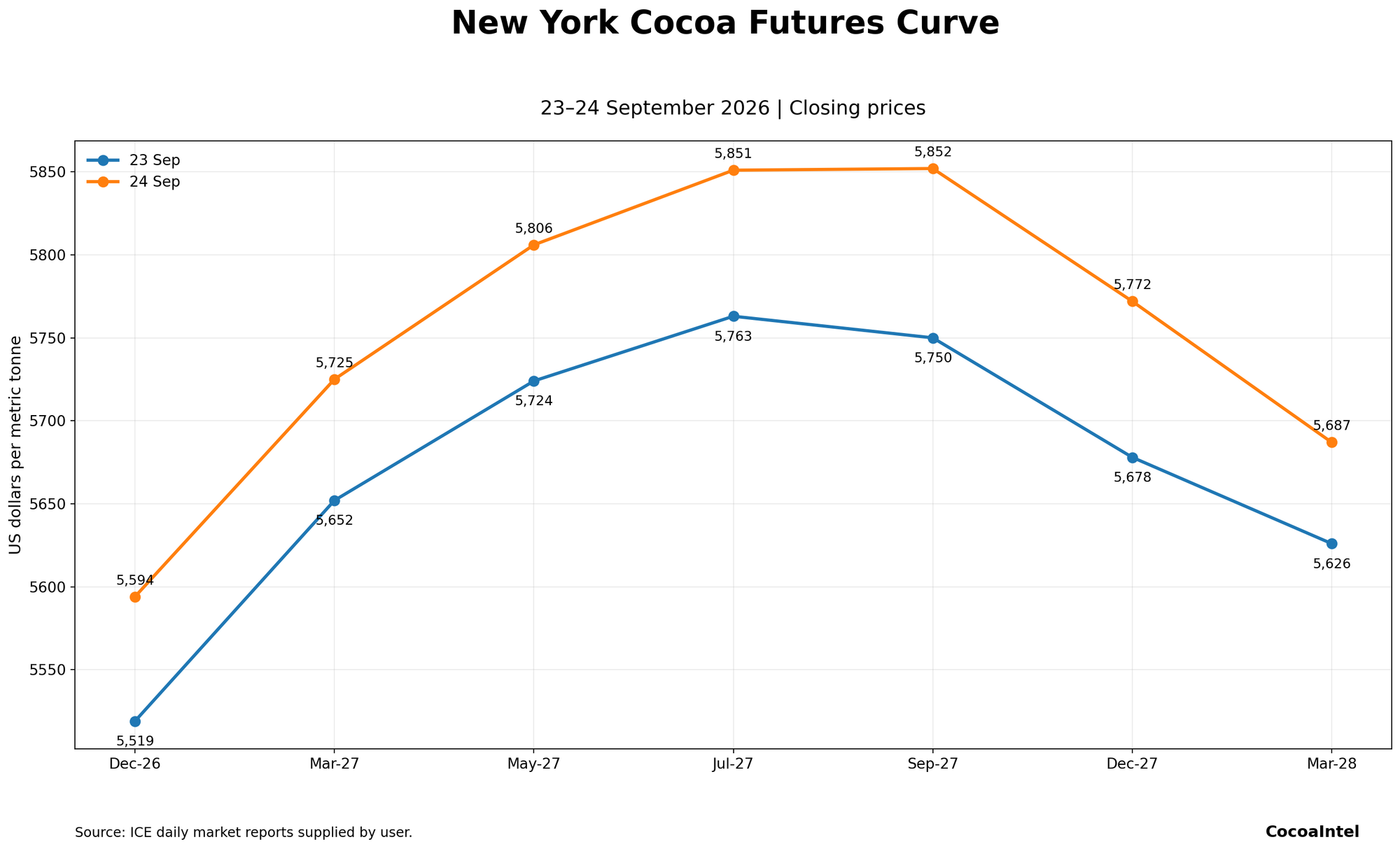
The curve strengthened outright but produced mixed relative-value signals. December/March contango narrowed slightly from $133 to $131/t, providing a small improvement in nearby structure. Beyond that, however, Mar/May contango widened from $72 to $81/t and May/July from $39 to $45/t. The previous $13/t July premium over September disappeared completely, with Sep-27 ending $1/t above July.
Further out, Sep/Dec-27 backwardation strengthened from $72 to $80/t, but Dec-26/Dec-27 contango widened from $159 to $178/t. The curve peak also shifted from July to September, albeit by only $1/t. The overall message is therefore a broad flat-price recovery with stronger performance in parts of the deferred curve, rather than clear evidence of tightening prompt availability.
London cocoa
| Contract | 23 Sep Close | 24 Sep Close | Change | Change % |
|---|---|---|---|---|
| Dec-26 | £4,139 | £4,192 | +£53 | +1.28% |
| Mar-27 | £4,303 | £4,355 | +£52 | +1.21% |
| May-27 | £4,348 | £4,406 | +£58 | +1.33% |
| Jul-27 | £4,385 | £4,445 | +£60 | +1.37% |
| Sep-27 | £4,339 | £4,407 | +£68 | +1.57% |
| Dec-27 | £4,238 | £4,305 | +£67 | +1.58% |
| Mar-28 | £4,215 | £4,286 | +£71 | +1.68% |
London also advanced across every comparable maturity, but the strongest percentage gains were concentrated further along the curve. December gained 1.28% to £4,192/t, while Mar-28 led with a 1.68% increase. December traded between £4,105 and £4,233 and closed around 68% of the way through its daily range, retaining more of the intraday advance than New York.
Total volume declined to 25,921 contracts from 29,008, down 10.6%. December and March represented approximately 64.6% of turnover, compared with 67.2% the previous session. London therefore continued higher on declining participation, although the contraction in volume was considerably smaller than in New York.
London futures curve
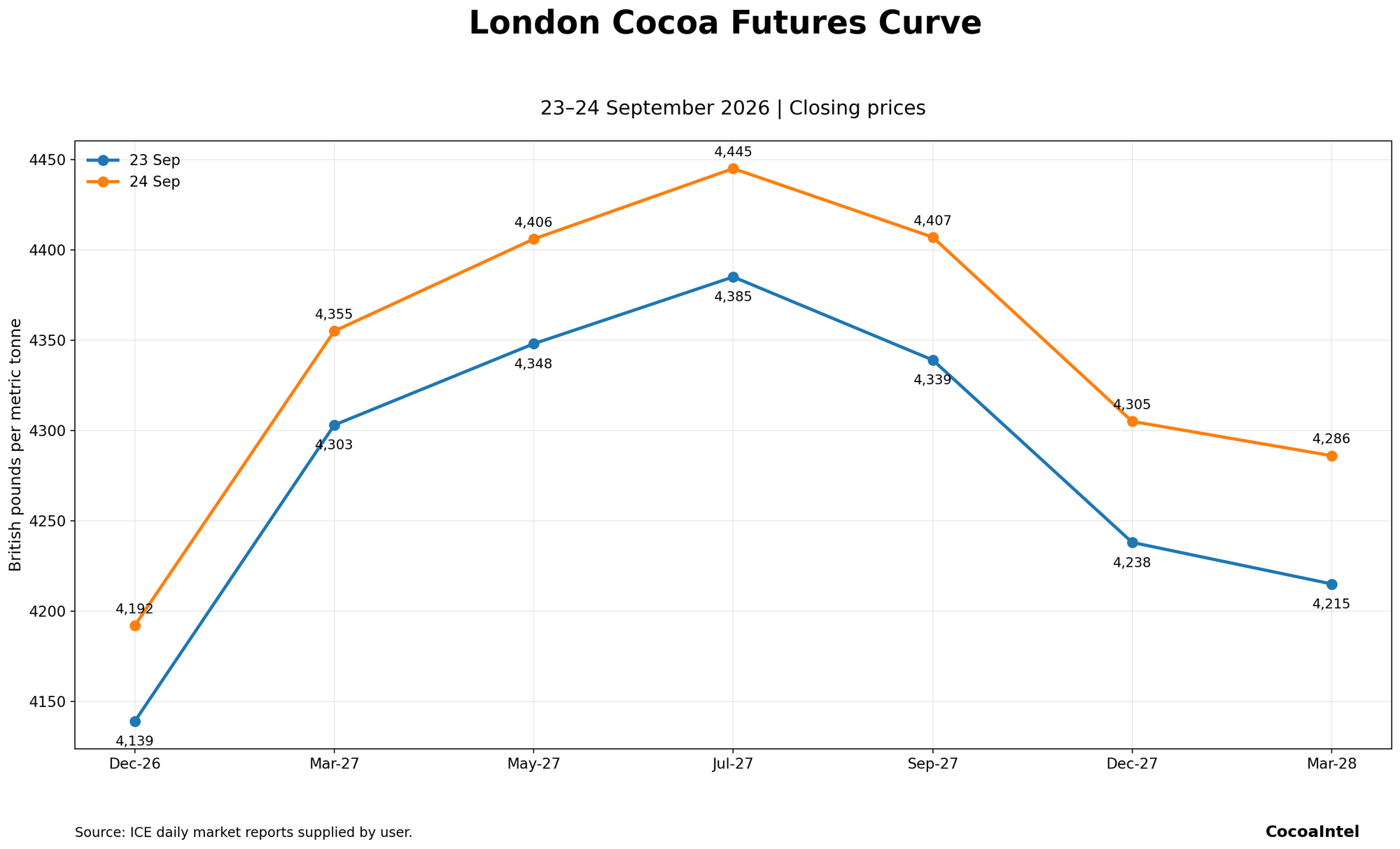
The curve again gives a more restrained signal than the outright rally. December/March contango narrowed marginally from £164 to £163/t, but March/May widened from £45 to £51/t and May/July from £37 to £39/t. July remained the highest-priced maturity at £4,445/t, although its premium over September narrowed from £46 to £38/t.
Sep/Dec-27 backwardation edged up from £101 to £102/t, while Dec-26/Dec-27 contango widened more materially from £99 to £113/t. The stronger percentage gains in Sep-27, Dec-27 and Mar-28 therefore point to better deferred performance rather than pronounced front-end tightening. As in New York, Thursday's move is best characterised as a continued outright recovery with mixed curve confirmation and no clear signal yet of an immediate nearby supply squeeze.
NY–London Dec-26 Spread
| Contract | New York | London | London in USD | NY–London Spread |
|---|---|---|---|---|
| Dec-26 | $5,594 | £4,192 | $5,538 | +$56/t |
| Mar-27 | $5,725 | £4,355 | $5,753 | −$28/t |
| May-27 | $5,806 | £4,406 | $5,820 | −$14/t |
| Jul-27 | $5,851 | £4,445 | $5,872 | −$21/t |
| Sep-27 | $5,852 | £4,407 | $5,822 | +$30/t |
| Dec-27 | $5,772 | £4,305 | $5,687 | +$85/t |
| Mar-28 | $5,687 | £4,286 | $5,662 | +$25/t |
$5,594 − (£4,192 × 1.321) = +$56.37/t, rounded to +$56/t.
The December New York premium over London widened to approximately +$56/t, compared with the +$40/t shown in the previous report. Part of that apparent $16/t widening, however, reflects the change in GBP/USD from 1.3238 to 1.321 rather than futures-price performance alone. Recalculating September 23 at the same 1.321 exchange rate gives a Dec-26 spread of about +$51/t, implying an underlying day-on-day widening of only around $5/t. New York therefore strengthened modestly relative to London at the front of the curve, rather than experiencing a major cross-market repricing.
Volume and Open Interest
New York cocoa
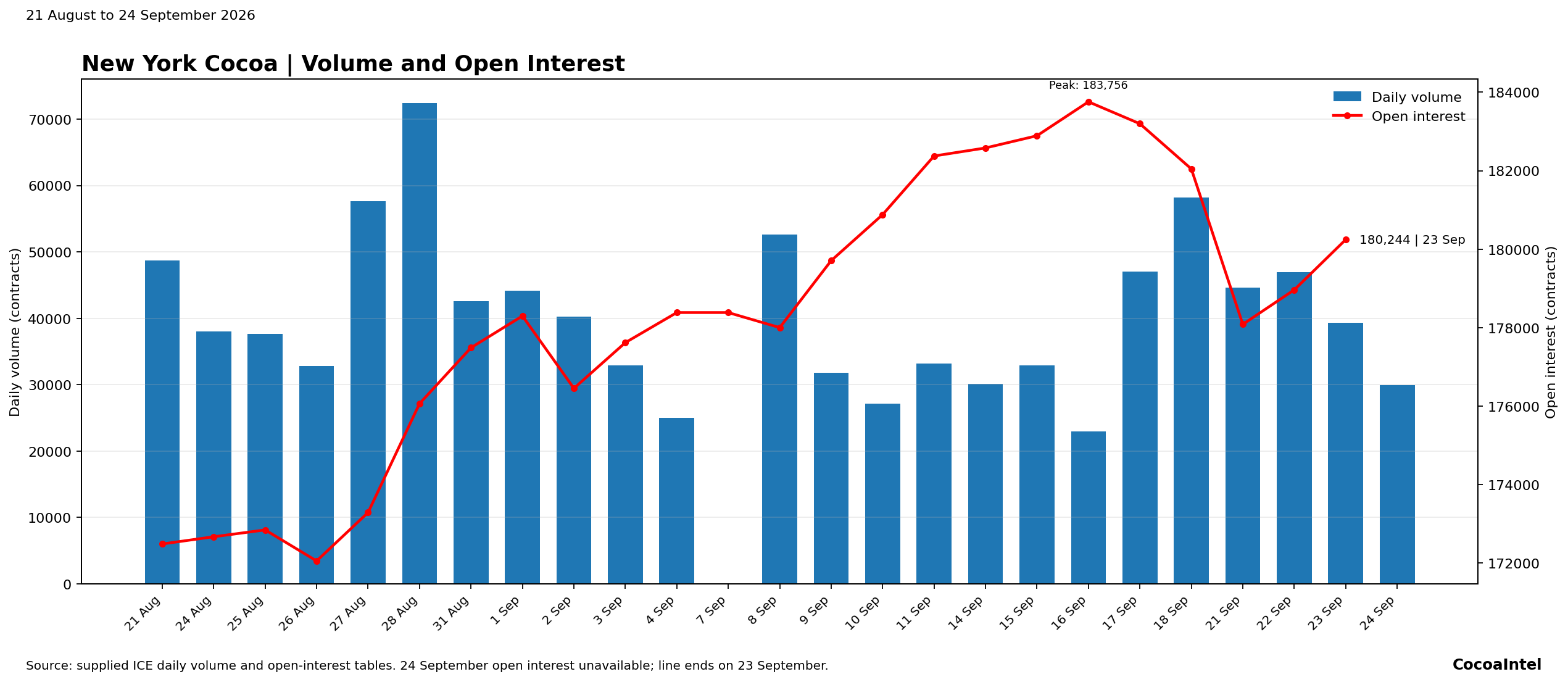
New York volume fell to 29,891 contracts on 24 September, down 24.0% from 39,348 on 23 September. That leaves Thursday’s activity not only below the previous day, but also around 21.9% below the previous 10-session average of roughly 38,254 contracts. The recovery therefore extended for another day, but with clearly lighter participation. That weakens the confirmation from volume and suggests the rally is not yet being accompanied by broad trading conviction.
The latest verified open-interest reading rose by 1,280 contracts, or 0.72%, to 180,244 on 23 September. Wednesday’s price recovery therefore coincided with net contract creation, although aggregate OI does not identify which participants added positions or establish what drove the advance. Open interest remained 3,512 contracts, or 1.9%, below its 16 September peak.
London cocoa
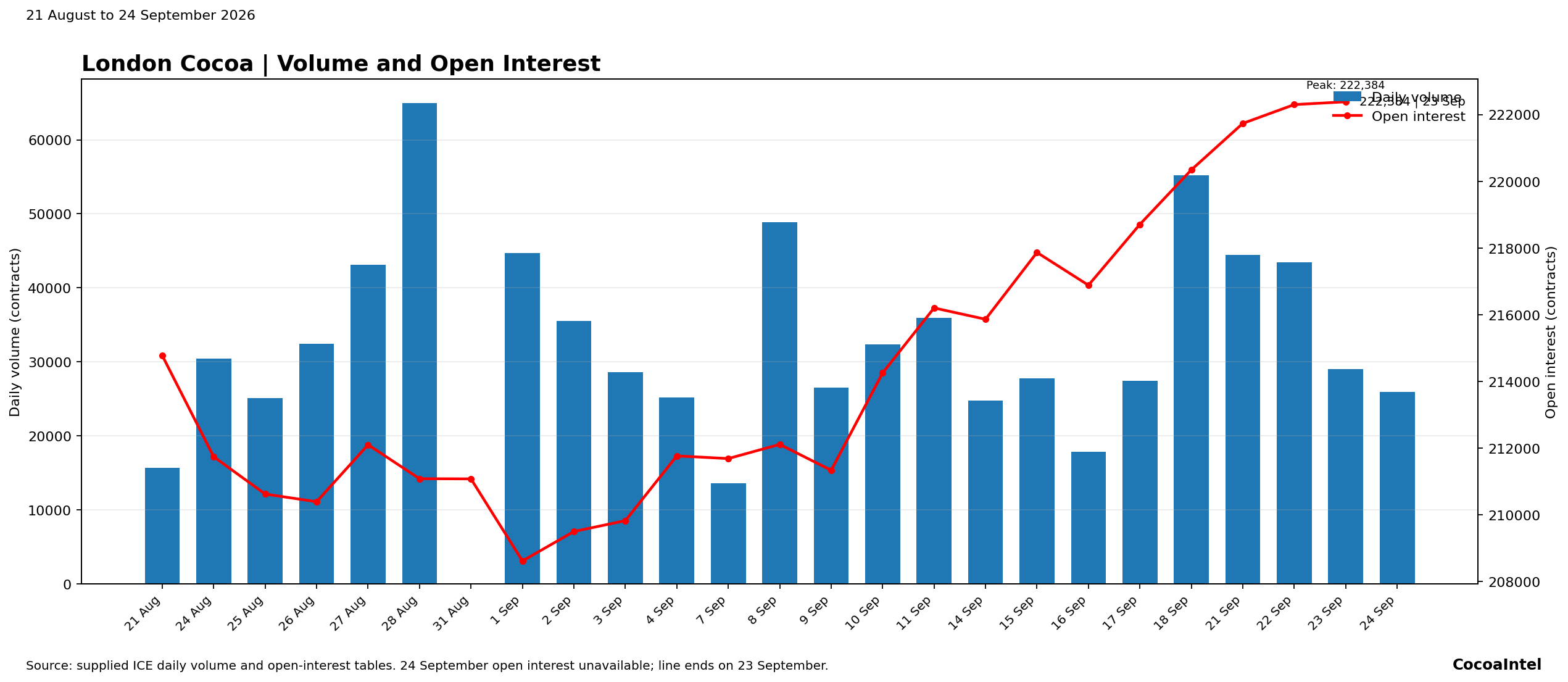
London volume also declined on Thursday, but the drop was less severe than in New York. Total volume fell to 25,921 contracts on 24 September, down 10.6% from 29,008 on 23 September. Even so, activity was still about 23.4% below the previous 10-session average of roughly 33,829 contracts, showing that London’s continued price recovery also took place on lighter turnover than normal. As in New York, the flat-price move was constructive, but participation did not strengthen alongside it.
London open interest edged up by just 84 contracts, or 0.04%, to 222,384 on 23 September, a fresh high for the period shown but essentially unchanged on the day. The broader increase in outstanding positions remains notable, although Wednesday’s marginal addition offers little incremental confirmation of the recovery.
ICE Cocoa Stocks
| Market | Previous Update | Latest Update | Change | Change % |
|---|---|---|---|---|
| US | 3,437,710 bags | 3,436,831 bags | −879 | −0.03% |
| UK / London | 1,180,781 bags | 1,180,781 bags | 0 | 0.00% |
| Combined | 4,618,491 bags | 4,617,612 bags | −879 | −0.02 |
Friday Trading Setup - Dec Contract
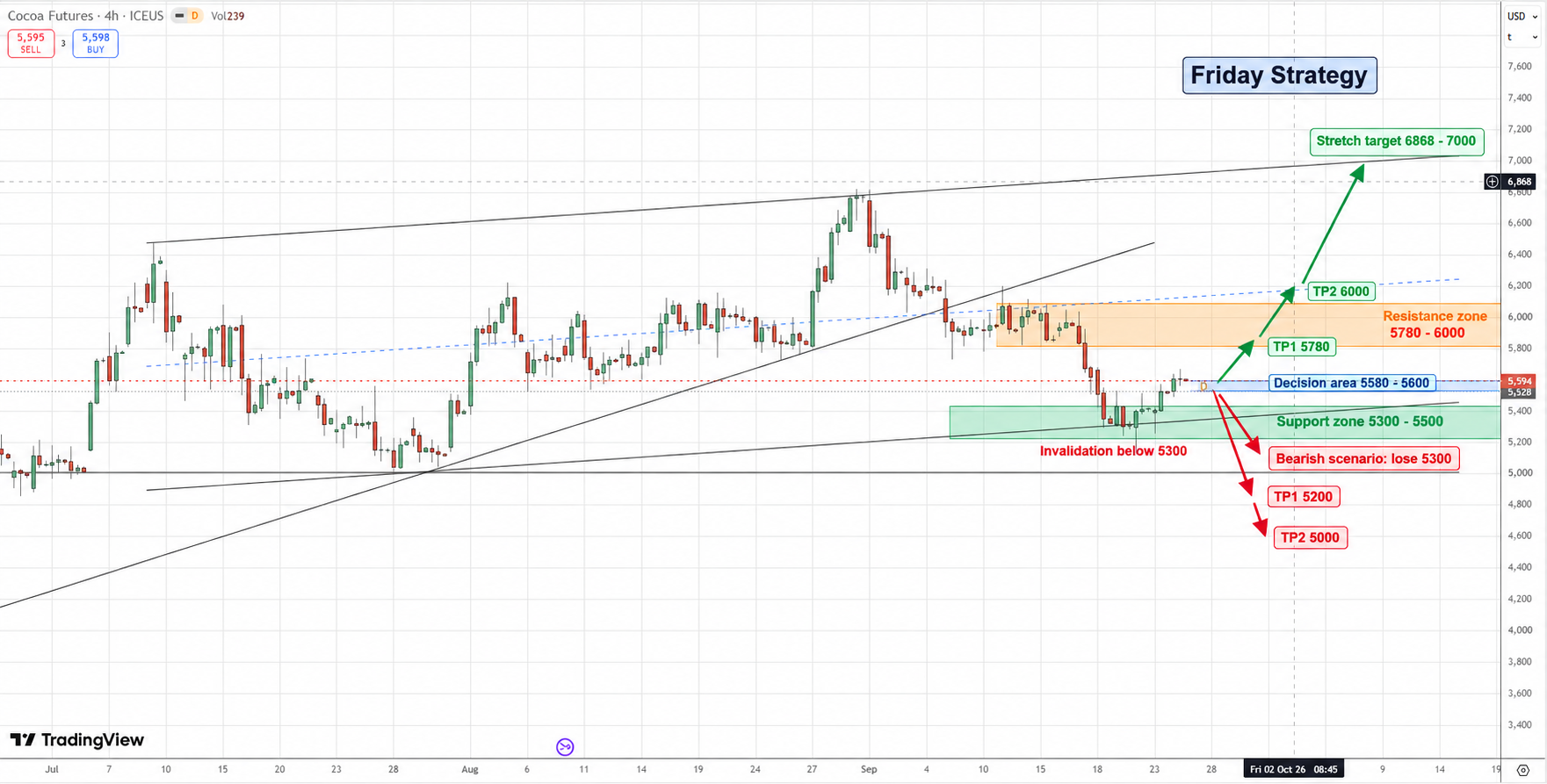
December cocoa enters Friday with a constructive hourly recovery but no confirmed reversal of the broader September decline. The official ICE close was $5,594/t, after trading between $5,489 and $5,671. Price remains above the rising hourly 21-period average around $5,500–5,515, while the first important resistance area is $5,650–5,680, incorporating Thursday's $5,671 high and the nearby hourly 90-period average. Hourly RSI remains around 60 and MACD is positive, supporting the rebound, but the contracting histogram, rolling stochastic and softer hourly OBV indicate that momentum is losing some strength. On the daily chart, RSI remains below 50 and MACD is still negative despite improving stochastic and momentum readings. Hourly ATR has fallen toward roughly $80/t while daily ATR remains near $340–350/t, leaving short-term volatility compressed inside a still-elevated broader volatility regime.
Classic pivot is $5,585, with resistance at $5,680, $5,767 and $5,949, and support at $5,498, $5,403 and $5,221. The strongest near-term confluence is therefore around $5,490–5,515, where first support, Thursday's low and the hourly 21-period average converge, while $5,670–5,680 combines Thursday's high with first pivot resistance. The central pivot sits only about $9 below Thursday's close, so Thursday’s close was only about $9 above the central pivot, leaving little directional separation from that reference ahead of Friday’s opening.
The initial working range is therefore approximately $5,490–5,680. An hourly close above $5,680, followed by a successful retest and stronger volume, would favour extension toward $5,760–5,820, where second pivot resistance overlaps the lower boundary of the former consolidation zone. Sustained acceptance above that area would expose $5,949–6,000, although the wider $5,780–6,100 resistance band still needs to be recovered before the medium-term structure becomes materially stronger. Conversely, a move below the $5,585 pivot would increase the probability of another support test; an hourly close below $5,490 followed by a failed reclaim would weaken the rebound and expose $5,403, then $5,300–5,350. A failure of that broader support region would bring $5,221, the recent $5,111 low, and ultimately $5,000 back into consideration.
If you notice any discrepancies in these figures or have extra information, please email hello@cocoaintel.com or leave a comment – corrections and additional insights are always welcome.