
Cocoa Falls Back to Support as Lindt Cuts Sales Outlook (29 September 2026)


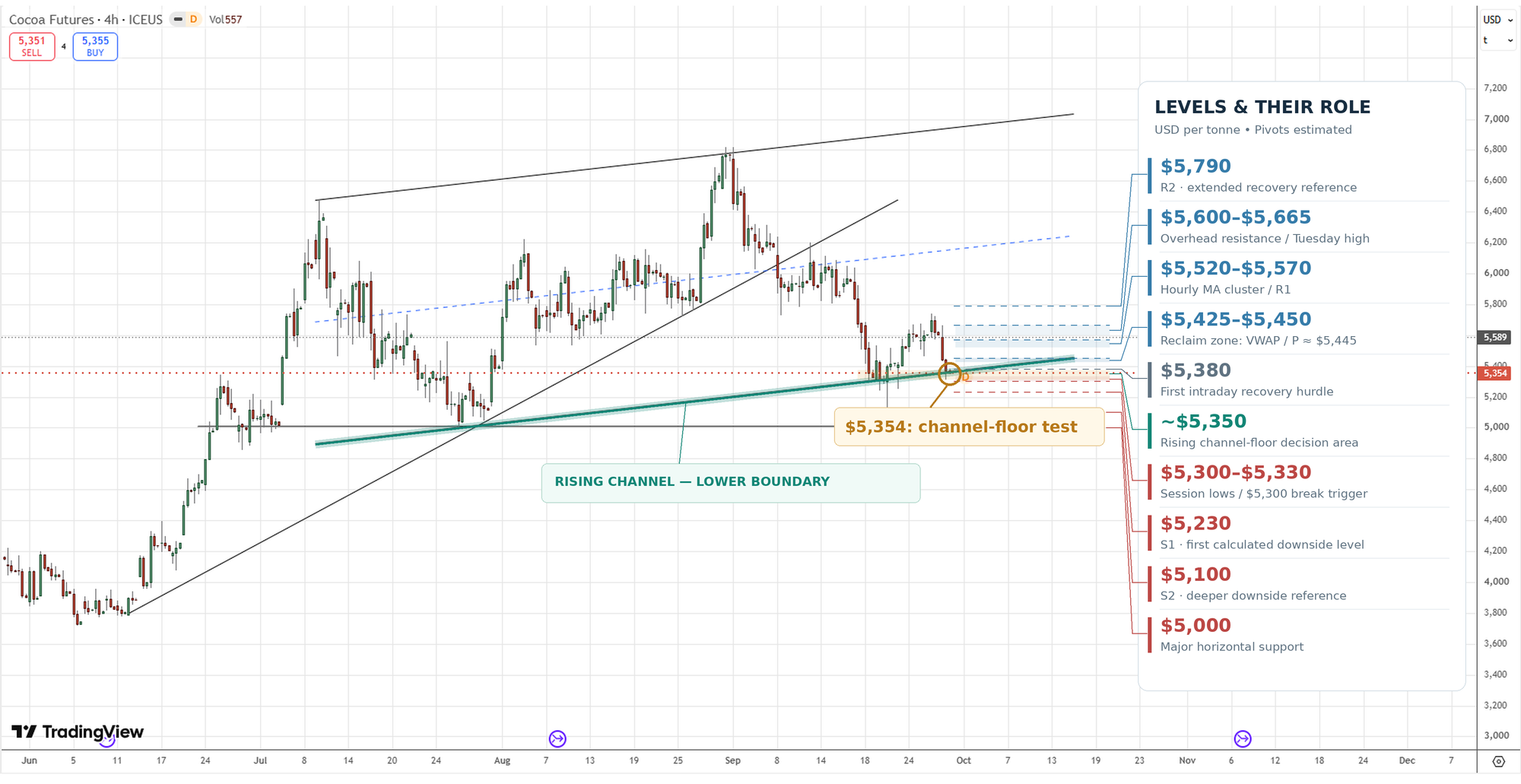
New York December cocoa reversed an early gain of 1.03% on Tuesday, 29 September, reaching $5,665/t before sustained selling took control. The contract broke below $5,500 and $5,400, touching $5,314—5.23% below Monday’s last-traded close. A subsequent rebound towards $5,420 failed to hold, leaving the last-traded close at $5,354/t, down $253 (−4.51%) from Monday’s $5,607. December finished just $40 above its low, in the bottom 11.4% of its $351 daily range. The official settlement was $5,408/t, down $181 (−3.24%). The decline returned cocoa to ascending-channel support around $5,350, with the weak finish leaving that support test unresolved.
Lindt cuts its sales outlook as price sensitivity and summer heat weaken demand
Lindt & Sprüngli lowered its 2026 organic sales-growth forecast to 0–2% from 4–6% on 29 September, its second reduction this year. The company reported weaker-than-expected orders in parts of Europe, particularly for seasonal products, as earlier price increases and summer heat weighed on purchases. Germany, Switzerland and Austria were especially affected, while North America and Asia remained more resilient. Lindt retained its target for a 20–40-basis-point improvement in its operating margin.
The pricing response adds to the significance for cocoa demand. Bloomberg reported that Lindt is reducing prices on Christmas products and plans broader reductions from January. Chief executive Adalbert Lechner said hedging had delayed the benefit of lower cocoa prices, with greater cost relief expected next year. The company expects positive volume growth in 2027, but that remains a forecast.
EU import values decline from major cocoa-producing countries
European Commission figures show that EU agri-food import values from Côte d’Ivoire fell 21% year-on-year in January–July 2026, while those from Cameroon and Nigeria declined 46%. The Commission linked the reductions to lower cocoa prices. These figures cover total agri-food imports from each country, rather than cocoa alone. They indicate lower import expenditure but do not establish equivalent declines in physical cocoa shipments or European grindings.
COCOBOD defends its shift to domestic financing
COCOBOD deputy chief executive Ato Boateng said international banks had approached the board about resuming overseas borrowing, but management had chosen domestic funding following difficulties with earlier arrangements. He cited lower local interest rates and currency-stability considerations, while arguing that reliance on international buyers had left cocoa purchasing vulnerable when those buyers withdrew financing.
Côte d’Ivoire’s forest funding targets longer-term resilience
Carbon Pulse reported on 29 September on a $24.07 million financing package for forest restoration and climate resilience in Côte d’Ivoire’s former cocoa belt. The African Development Bank’s release was dated 28 September and described a launch held in Bouaké on 16 September. The additional financing supports the Ivorian component of the PIDACC-BN programme. Its market relevance concerns longer-term land restoration and rural resilience; the reviewed material provides no quantified increase in cocoa available for the current season.
Futures Performance
New York cocoa
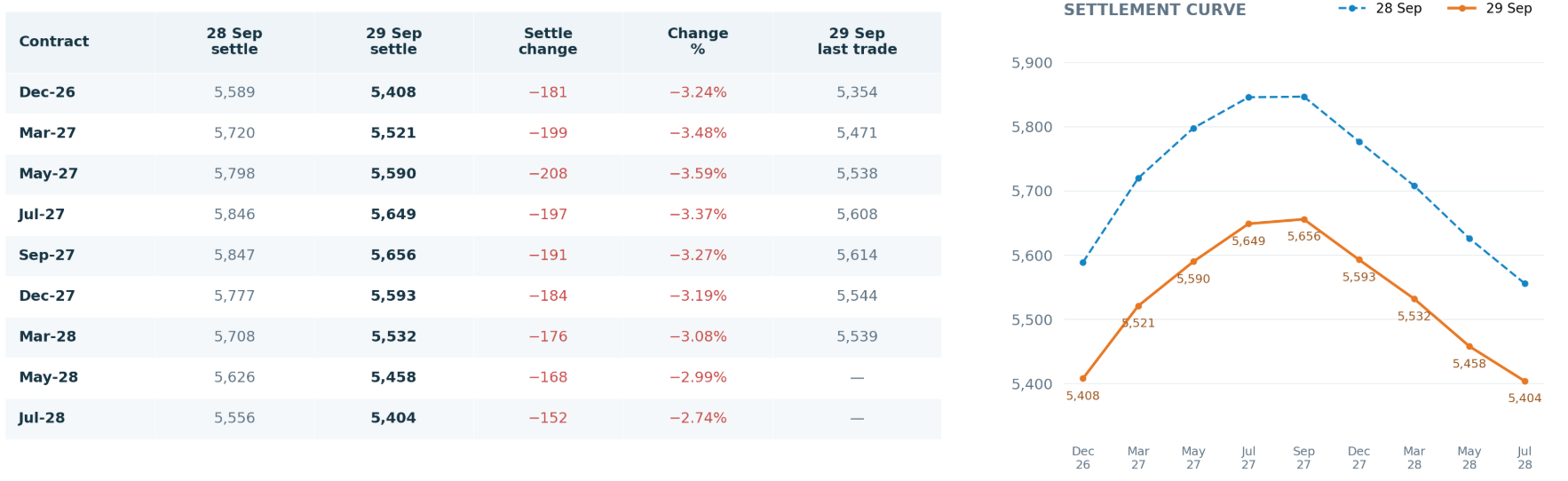
New York’s settlement curve fell across all nine listed maturities on Tuesday, with losses ranging from 2.74% to 3.59%. December settled at $5,408/t, down $181 (−3.24%), while May-27 recorded the largest decline. The last-traded December close was weaker at $5,354, down 4.51% from Monday’s last trade. It finished just $40 above the confirmed $5,314 session low, approximately 11% of the way up its daily range, showing limited recovery from the selling pressure.
Despite the outright decline, December strengthened relative to the middle of the curve. Dec/Mar contango narrowed from $131 to $113/t and Dec/Jul from $257 to $241/t, reversing Monday’s widening. This provides some relative support for nearby cocoa, but does not establish a bullish reversal. The curve still peaked at September-27’s $5,656, before declining to $5,404 for July-28, leaving December at a substantial discount to mid-2027 delivery.
London cocoa
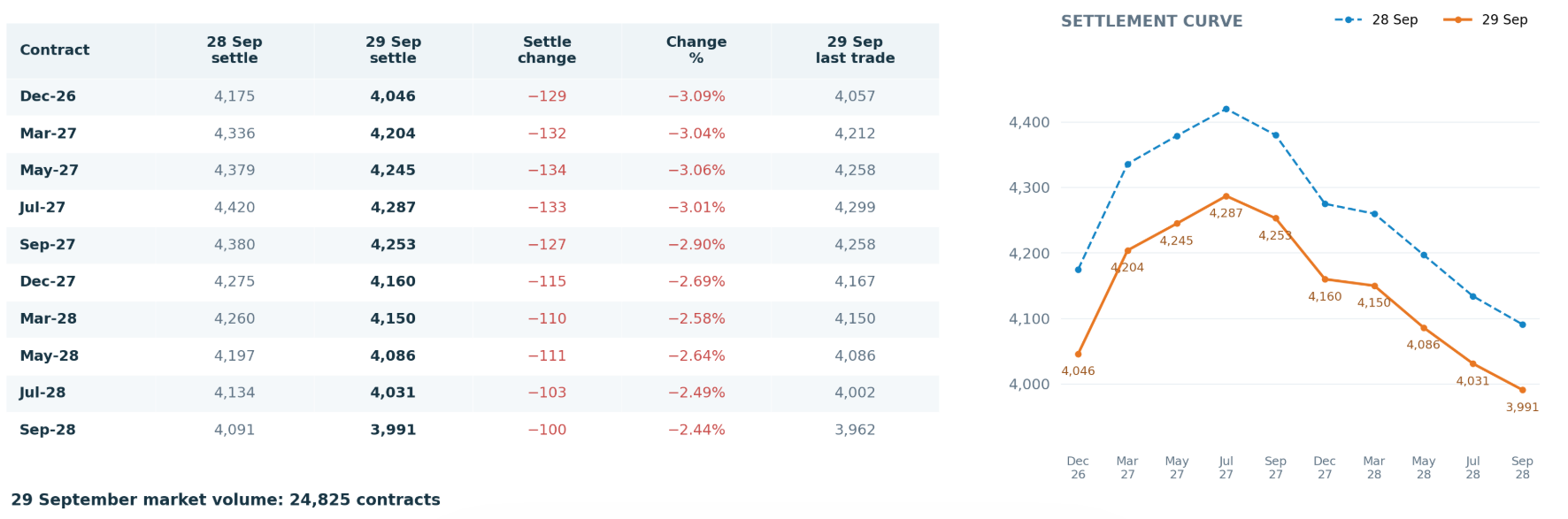
London’s settlement curve also moved lower across all ten listed maturities. December settled at £4,046/t, down £129 (−3.09%), recording the largest percentage decline, while losses generally moderated further along the curve to 2.44% for September-28. December traded as low as £3,983 before recovering to a last-traded close of £4,057. Buyers recovered the £4,000 level, but the session still left the entire curve substantially below Monday’s settlements.
Nearby spread support was modest. Dec/Mar contango narrowed from £161 to £158/t and Dec/Jul from £245 to £241/t, considerably smaller adjustments than in New York. Further out, Dec-26/Dec-27 contango widened from £100 to £114/t, reflecting greater resilience in the later contract. The curve retained its July-27 peak at £4,287, then declined towards £3,991 for September-28. The mixed spread changes point to broad downward repricing with limited nearby support, rather than a clear strengthening of prompt delivery demand.
NY–London Futures Spreads
| Contract | NY close 28 Sep | London close 28 Sep | Spread 28 Sep | NY close 29 Sep | London close 29 Sep | Spread 29 Sep | Change |
|---|---|---|---|---|---|---|---|
| Dec-26 | $5,607 | £4,181 | +$65.50 | $5,354 | £4,057 | −$23.15 | −$88.65 |
| Mar-27 | $5,734 | £4,341 | −$19.56 | $5,471 | £4,212 | −$111.58 | −$92.02 |
| May-27 | $5,812 | £4,385 | +$0.12 | $5,538 | £4,258 | −$105.55 | −$105.67 |
| Jul-27 | $5,857 | £4,425 | −$7.90 | $5,608 | £4,299 | −$89.89 | −$82.00 |
| Sep-27 | $5,854 | £4,384 | +$43.45 | $5,614 | £4,258 | −$29.55 | −$73.00 |
| Dec-27 | $5,778 | £4,279 | +$106.61 | $5,544 | £4,167 | +$21.06 | −$85.56 |
| Mar-28 | $5,724 | £4,263 | +$73.82 | $5,539 | £4,150 | +$38.59 | −$35.23 |
$5,354 − (£4,057 × 1.3254) = −$23.15/t.
New York’s December contract moved from a $65.50/t premium to a $23.15/t discount, a deterioration of $88.65/t at unchanged exchange rates. New York declined $253, while London’s £124 fall equated to $164.35. Tuesday’s selling therefore weighed more heavily on New York, reversing Monday’s relative improvement.
New York weakened against London across all seven comparable maturities. March and May 2027 developed discounts exceeding $100/t, with May recording the largest deterioration at $105.67/t. December 2027 and March 2028 retained premiums, but both narrowed substantially. The broad shift indicates relative resilience in London rather than an isolated December-contract adjustment.
Volume and Open Interest
New York cocoa
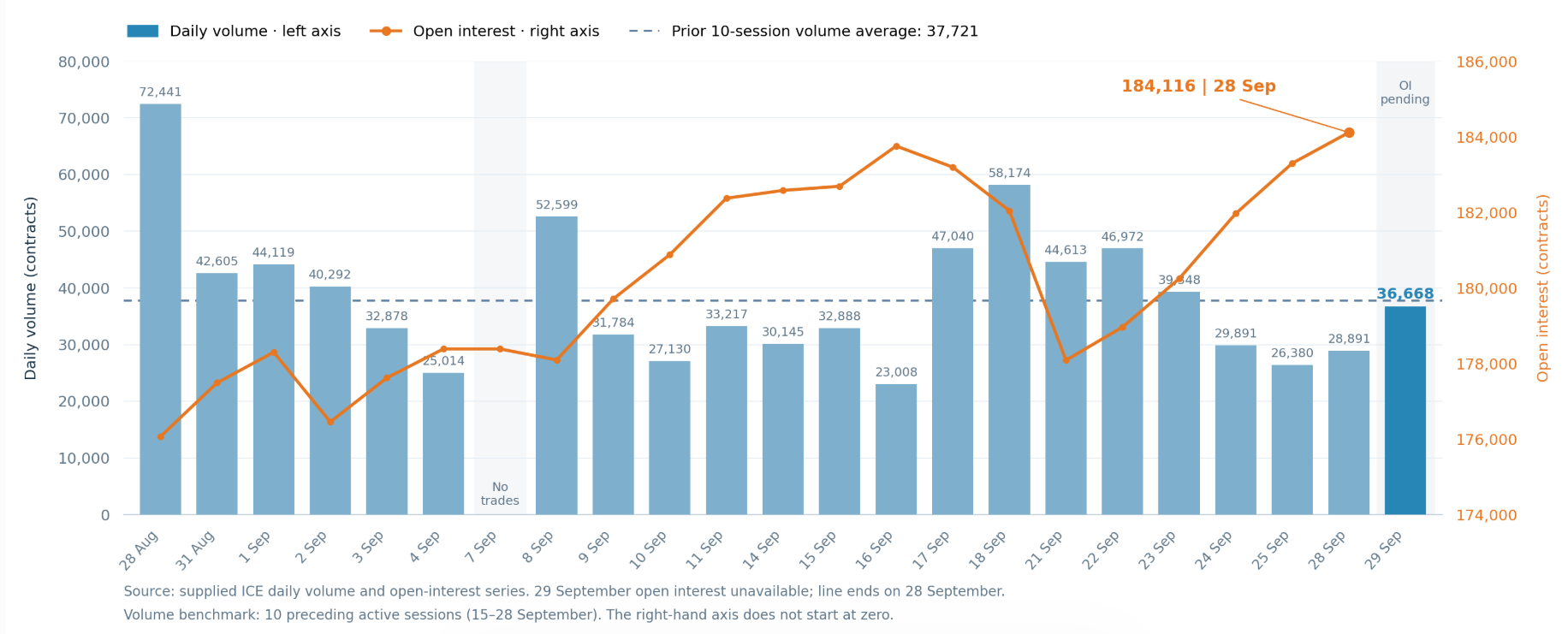
New York volume increased to 36,668 contracts on Tuesday, up 26.9% from Monday’s 28,891. Turnover nevertheless remained 2.8% below the preceding 10-session average of 37,721 contracts. Tuesday’s decline therefore attracted greater participation, strengthening the evidence of renewed selling pressure, but activity remained close to recent norms and does not establish a capitulation event.
Open interest increased by 816 contracts (+0.45%) to 184,116 on Monday, extending the rebuilding of positions by 6,031 contracts (+3.39%) since 21 September. This left more outstanding exposure in the market ahead of Tuesday’s reversal. The sharp decline put buyers who entered during the recent recovery under pressure, making the unwinding of those positions a plausible contributor to selling. A fall in Tuesday’s OI would support that liquidation interpretation, while an increase would indicate that new positions were being established into the decline, consistent with fresh bearish participation. For Wednesday, continued price weakness alongside rising OI would provide stronger evidence of an expanding downtrend; falling OI would suggest position reduction, although it would not establish that selling had finished.
London cocoa
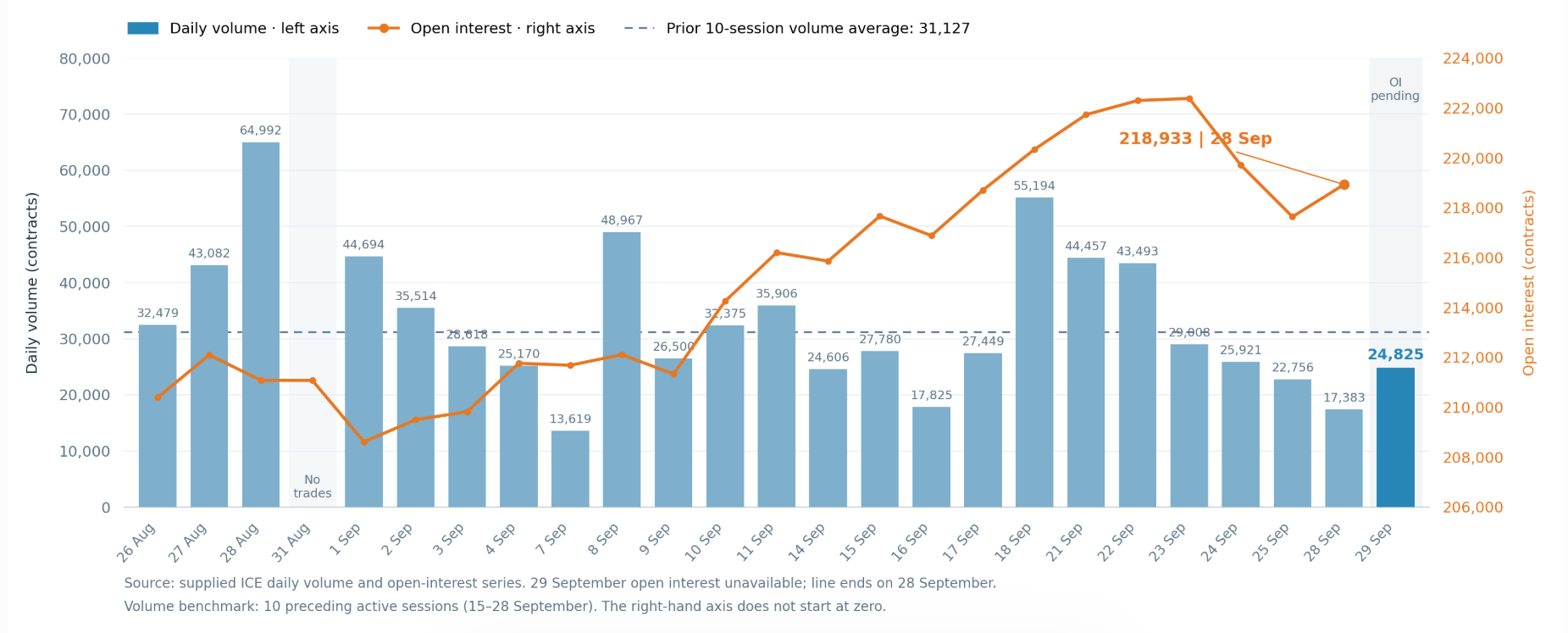
London volume recovered to 24,825 contracts on Tuesday, up 42.8% from Monday’s 17,383. Despite the substantial percentage increase, turnover remained 20.2% below the preceding 10-session average of 31,127 contracts. The rebound largely reflects Monday’s low activity: participation improved, but remained subdued against the recent trading baseline.
Open interest increased by 1,293 contracts (+0.59%) to 218,933 on Monday, partially reversing the previous two sessions’ contraction. This represented a tentative rebuilding of exposure: OI remained 3,451 contracts below its 23 September level. Tuesday’s 42.8% increase in turnover shows more trading activity, but could accompany either renewed position building or the unwinding of Monday’s additions. A renewed decline in OI would suggest that the rebuilding was short-lived, with position closures contributing to activity. An increase accompanying weaker prices would instead be consistent with fresh bearish positioning. The distinction matters for Wednesday: sustained growth in positions during further price weakness would strengthen the continuation case, while renewed contraction would point to an ongoing adjustment of existing exposure.
ICE Cocoa Stocks
| Market | Stock measure | Previous update | Latest update | Change | Change % |
|---|---|---|---|---|---|
| US | Total stocks in ICE-licensed warehouses | 3,452,949 bags | 3,467,854 bags | +14,905 bags | +0.43% |
| US | Certified stocks, included in warehouse total | 738,381 bags | 738,381 bags | 0 bags | 0.00% |
| London / Europe | Valid-warrant stocks | ≈1,182,656 bags | ≈1,185,313 bags | ≈+2,656 bags | +0.22% |
US warehouse stocks increased by 14,905 bags on Tuesday, extending Monday’s build. Certified stocks remained unchanged at 738,381 bags, representing 21.3% of the warehouse total. The increase therefore adds to broader warehouse availability without expanding the certified stock available for exchange delivery.
London valid-warrant stocks increased by 170 tonnes, equivalent to approximately 2,656 bags, to 75,860 tonnes, or approximately 1,185,313 bags.
Wednesday Trading Setup - Dec Contract
Wednesday’s key question is whether cocoa can defend its ascending-channel support near $5,350, which also broadly coincides with the daily 90-period moving average. At $5,354, price is testing a meaningful support area, but the hourly structure remains bearish: price is below its moving averages, MACD is negative, RSI is weak and OBV has deteriorated. An hourly close below $5,300, followed by a failed reclaim, would expose approximately $5,230, the first calculated pivot support, then $5,100. A sustained four-hour close below the channel boundary would strengthen that breakdown signal; earlier intrabar breaches show why a brief penetration alone is insufficient. $5,000 remains the broader horizontal support beneath these levels.
If the channel floor holds, depressed hourly stochastic and contracting five-minute ranges leave room for a corrective bounce. Clearing $5,380 would bring $5,425–$5,450 into focus, where Tuesday’s VWAP, the hourly nine-period average and the estimated $5,445 central pivot converge. An hourly reclaim followed by a higher low, stronger participation and improving OBV would favour an extension towards $5,520–$5,575, combining hourly moving-average resistance with first pivot resistance. Sustained trading above that zone would expose $5,600–$5,665. Until $5,425–$5,450 is recovered, the channel test offers potential for a rebound while the immediate trend remains bearish.
If you notice any discrepancies in these figures or have extra information, please email hello@cocoaintel.com or leave a comment – corrections and additional insights are always welcome.