
Cocoa Futures Reverse Intraday Gains Despite Stronger El Niño Warning (13 August 2026)


Cocoa futures experienced volatile two-way trading on 13 August, with strong intraday rallies in both markets largely reversing by the final trade. In New York, the December contract opened at $5,748 per tonne and climbed to $5,854 before falling as low as $5,665 and recording a final trade at $5,710, down $9 from its 12 August close. September was the only nearby New York contract to retain a gain, while December through July finished lower. London followed a similar intraday pattern: December opened at £4,152, rallied to £4,255, declined to £4,106 and last traded at £4,163, only £1 above the previous day.
On 13 August NOAA raised the probability of a very strong El Niño during the Northern Hemisphere autumn and winter of 2026/27 to more than 90%, while assigning a 69% probability that the October–December reading could exceed the strength of every previous event in its record since 1950. This does not guarantee lower West African cocoa production, but it reinforces the medium-term weather risk already affecting expectations for the 2026/27 crop. Fairtrade also warned that cocoa-producing regions could experience abnormally high temperatures or excessive rainfall and flooding, potentially reducing yields and farmer incomes, although it provided no new production estimate.
In Ghana, cocoa farmers urged President John Dramani Mahama to withhold assent from the newly passed Ghana Cocoa Board Bill until growers have been properly consulted. The legislation would give cocoa farms protected status and restrict their conversion to mining, alternative crops or other uses without COCOBOD approval, with violations carrying fines and possible prison sentences. Although the measure is intended to preserve cocoa-growing land, farmers are concerned that its provisions could restrict their ability to rehabilitate diseased or commercially unproductive farms. The immediate market impact appears limited because the bill has not yet been signed, but its longer-term effect could be mixed: stronger land protection may preserve cocoa acreage, while rigid implementation could complicate farm rehabilitation and discourage investment.
Futures performance
New York cocoa
| Contract | 12 Aug | 13 Aug | Change | Change % |
|---|---|---|---|---|
| Sep-26 | $5,617 | $5,657 | +$40 | +0.71% |
| Dec-26 | $5,719 | $5,710 | −$9 | −0.16% |
| Mar-27 | $5,796 | $5,793 | −$3 | −0.05% |
| May-27 | $5,809 | $5,800 | −$9 | −0.15% |
| Jul-27 | $5,796 | $5,771 | −$25 | −0.43% |
New York cocoa rallied strongly during the session but surrendered most of the advance by the final trade. September was the only nearby contract to retain a gain, rising $40, or 0.71%, from $5,617 to $5,657 per tonne. December declined $9 to $5,710, March slipped $3 to $5,793, May fell $9 to $5,800 and July lost $25 to finish at $5,771. This reflected concentrated front-month strength rather than a broad recovery across the curve.
Liquidity remained concentrated at the front of the curve. September, December and March generated 62,311 contracts, representing 90.3% of the day’s volume, with December the most actively traded maturity at 29,420 lots. The front-three share eased moderately from 91.9% on the previous day. Separately, ICE reported 55,794 contracts of spread volume, equivalent to 80.8% of total activity, indicating that a large share of turnover involved inter-month, roll or other defined spread strategies rather than purely outright directional trading.
Futures curve
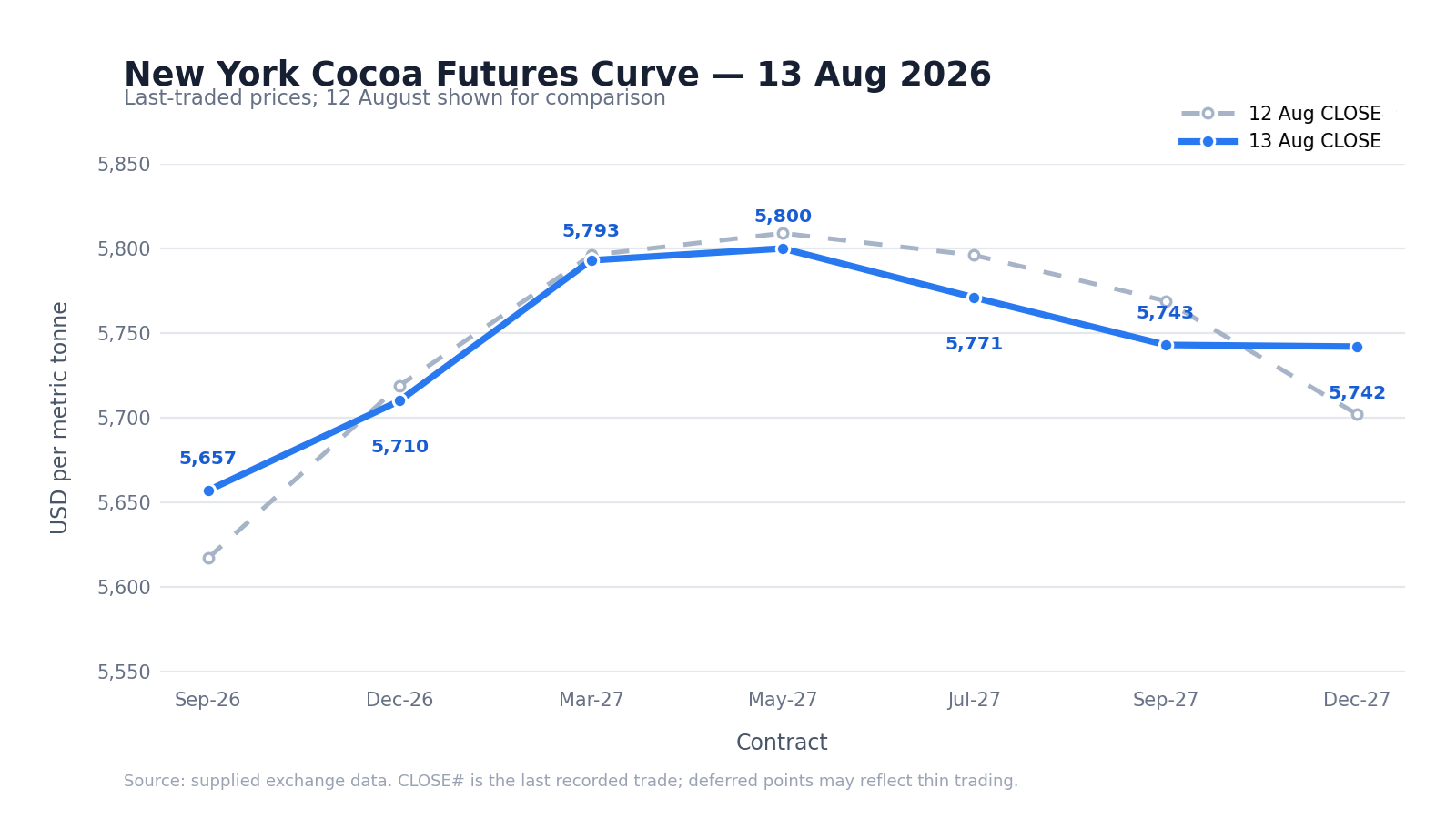
The New York curve changed most noticeably at the front. September-to-December contango narrowed sharply from $102 to $53 per tonne as September outperformed, while December-to-March contango widened from $77 to $83. May 2027 remained the curve peak at $5,800, but its premium over September contracted from $192 to $143. May-to-July backwardation deepened from $13 to $29. The nearly flat September-to-December 2027 section should be interpreted cautiously because those contracts traded only 391 and 132 lots, respectively.
London cocoa
London cocoa retained positive close changes across the nearby curve, although the advances were much smaller than the settlements. The five contracts gained only £1–£16 per tonne, with May 2027 leading and December 2026 virtually unchanged.
| Contract | 12 Aug | 13 Aug | Change | Change % |
|---|---|---|---|---|
| Sep-26 | £4,114 | £4,120 | +£6 | +0.15% |
| Dec-26 | £4,162 | £4,163 | +£1 | +0.02% |
| Mar-27 | £4,261 | £4,269 | +£8 | +0.19% |
| May-27 | £4,268 | £4,284 | +£16 | +0.37% |
| Jul-27 | £4,268 | £4,278 | +£10 | +0.23% |
December was the most active London maturity with 8,110 contracts, representing 38.4% of the day’s volume, followed by March with 6,336 contracts, or 30.0%. The three front contracts accounted for 79.9% of activity, while the five nearest represented 97.4%. Separately, ICE reported 14,804 contracts of spread volume, equivalent to 70.1% of total activity. London’s modest price gains therefore occurred with comparatively weak overall participation and a substantial share of spread-related trading.
Futures curve
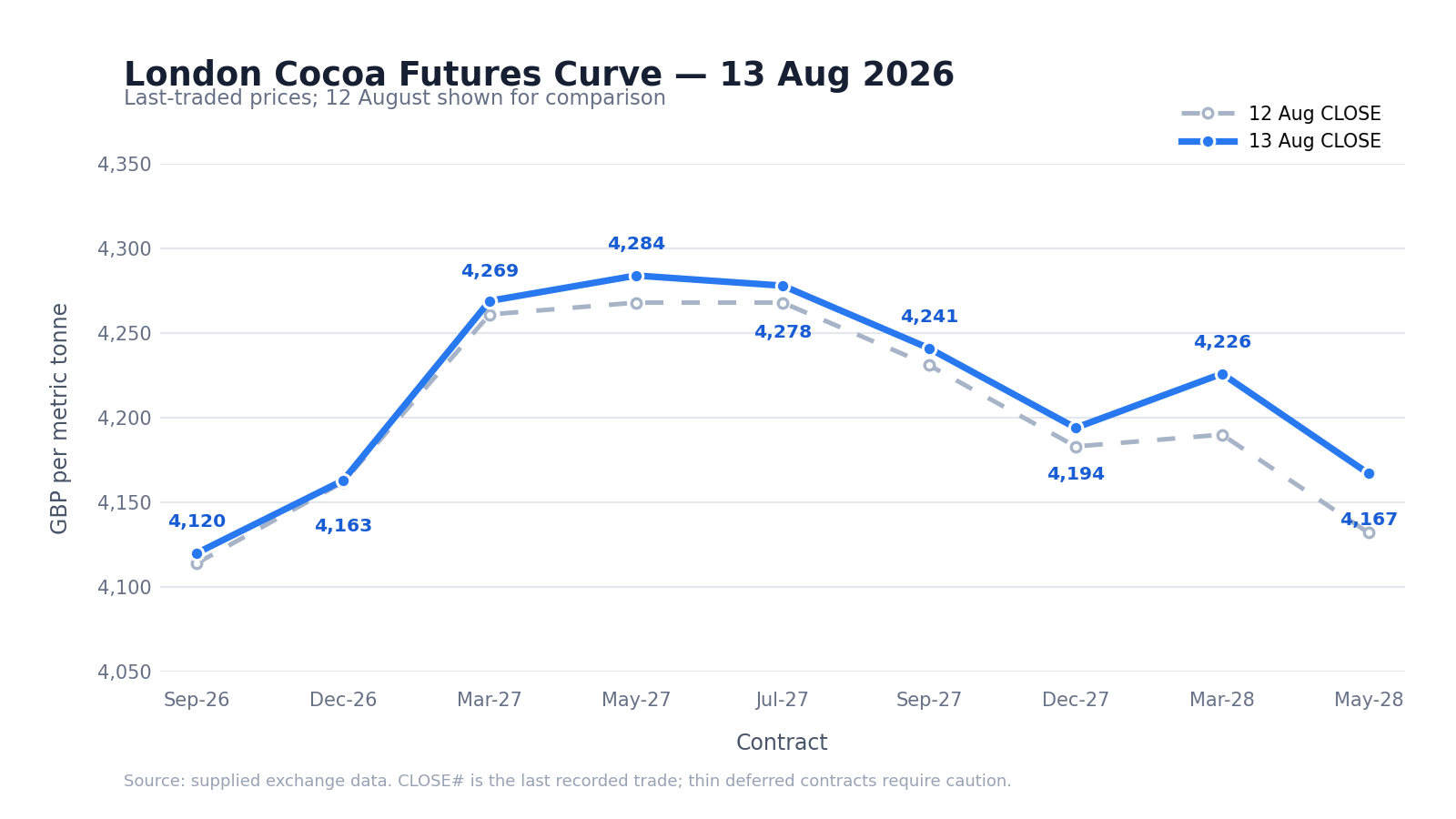
The London curve adjustment was uneven despite uniformly positive nearby closes. September-to-December contango narrowed from £48 to £43 per tonne, while December-to-March contango widened from £99 to £106 and March-to-May increased from £7 to £15. May remained the curve peak at £4,284, raising its premium over September from £154 to £164, while the previously flat May-to-July relationship moved into a £6 backwardation. The larger changes in March and May 2028 should be treated cautiously because those contracts traded only 106 and 27 lots, respectively.
US–UK Spread
(Dec Contract)
$5,710 − (£4,163 x 1.349$/£) =$94ton (down from $104 ton )
Volume and Open Interest
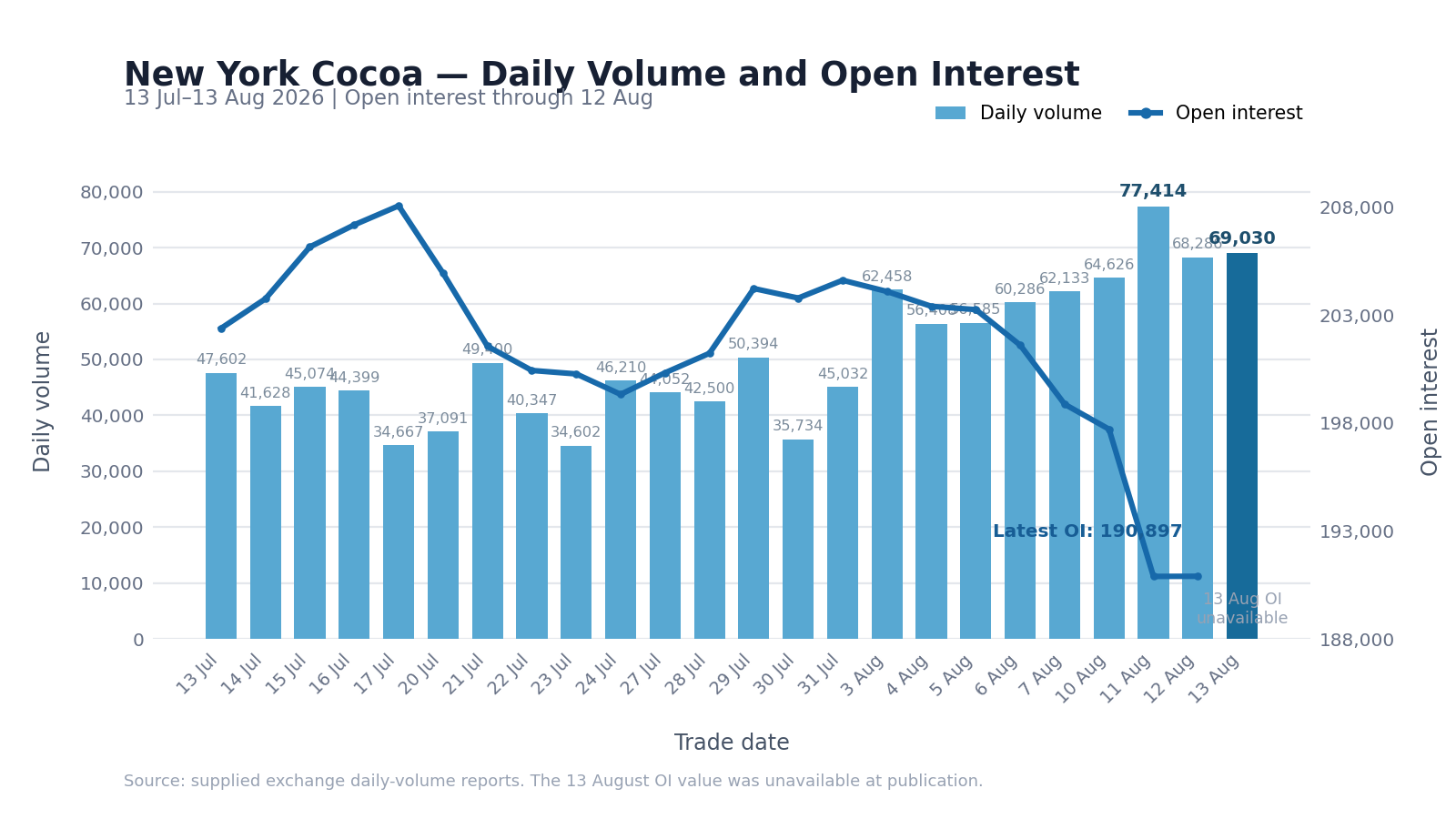
New York cocoa turnover remained exceptionally elevated on 13 August. Total volume increased by 744 contracts, or 1.1%, from 68,286 to 69,030. This was the second-highest reading for the past month, exceeded only by the 77,414 contracts traded on 11 August. Activity stood 19,164 contracts, or 38.4%, above the preceding 23-session average of 49,866, although it remained 8,384 contracts, or 10.8%, below the 11 August peak. Participation was therefore unusually strong even though close-to-close performance was mixed and most of the intraday rally was surrendered.
The latest valid open-interest reading was 190,897 contracts on 12 August, only six contracts above the 190,891 recorded on 11 August. This negligible increase technically ended seven consecutive daily declines, but it does not provide convincing evidence of renewed position building. Open interest remained 13,709 contracts, or 6.7%, below its 31 July level and 17,158 contracts, or 8.2%, beneath the displayed-period peak reached on 17 July.
London cocoa
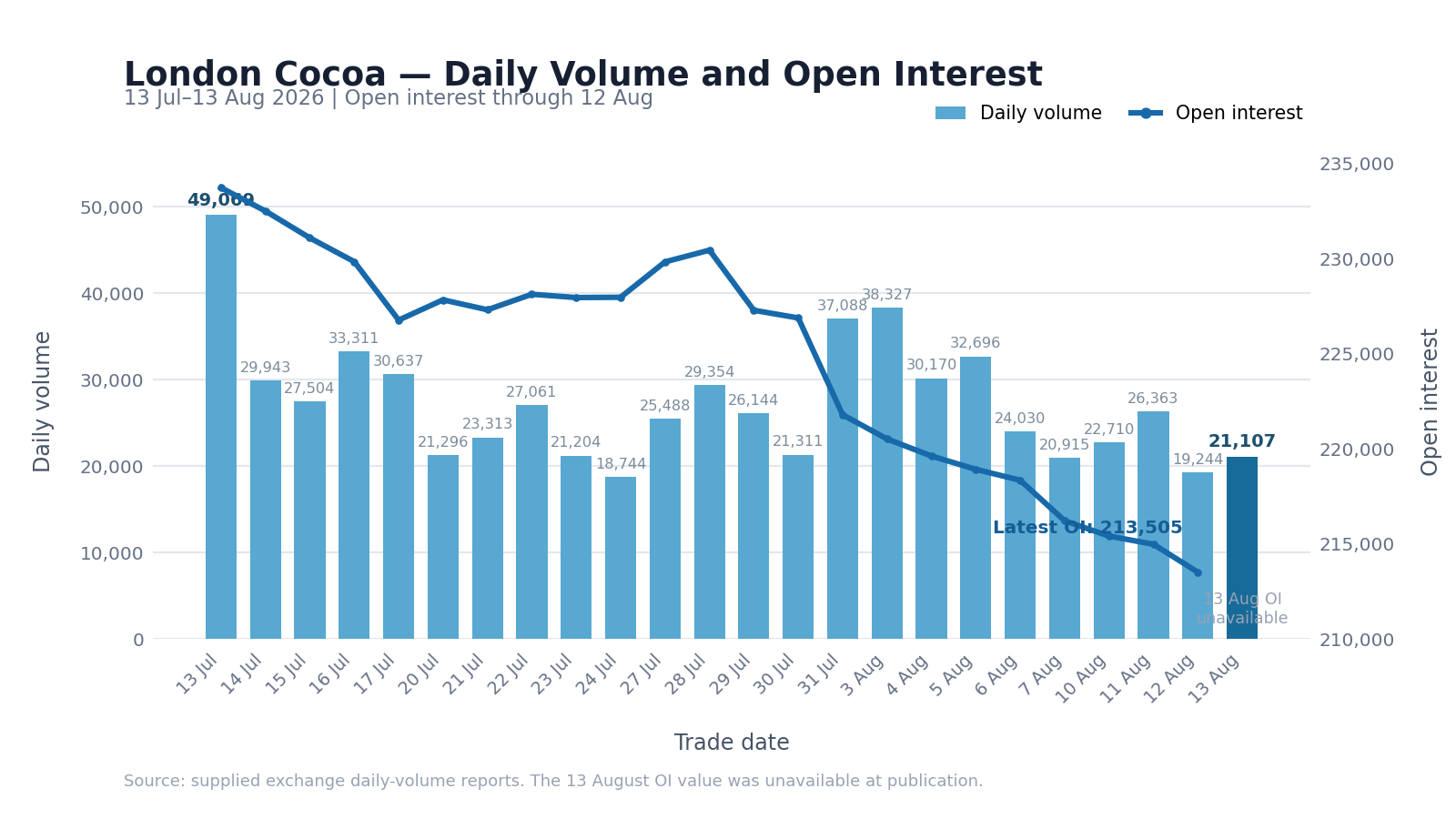
London cocoa activity recovered only modestly on 13 August. Volume increased by 1,863 contracts, or 9.7%, from the unusually weak 19,244 recorded on 12 August to 21,107. Turnover nevertheless remained 5,256 contracts, or 19.9%, below 11 August and 6,542 contracts, or 23.7%, below the preceding 23-session average of 27,649. It was the fourth-lowest volume in the displayed 24-session period, confirming that participation remained subdued despite the day-on-day improvement.
The latest valid open-interest reading was 213,505 contracts on 12 August, down 1,471 contracts, or 0.68%, from the previous session. This represented an eleventh consecutive decline and the lowest valid reading in the displayed period. Open interest has contracted by 16,950 contracts, or 7.36%, since its 28 July local peak and by 20,235 contracts, or 8.66%, from the 13 July period high.
Exchange Trading Volume
| Market | 12 Aug 2026 | 13 Aug 2026 | Change | Change % |
|---|---|---|---|---|
| US | 3,335,795 | 3,335,656 | −139 | −0.004% |
| UK | 1,145,938 | 1,145,938 | 0 | 0.00% |
The measure is not a complete regional stock-to-grind ratio, as it includes only exchange-certified cocoa held at U.S. and EU delivery ports and excludes commercial inventories outside the ICE warehouse system. North America NCA grindings cover processors across North America, while ICE U.S. certified stocks are stored at U.S. delivery ports. ECA reports bean usage in European countries and London-certified cocoa is held in European and UK delivery locations.
Readers can explore detailed cocoa market datasets, futures statistics, and historical indicators in the CocoaIntel Data Hub:
 Cocoa Intel
Friday Outlook Dec Contract
US cocoa enters Friday compressed between two important moving averages on the daily chart. The 21-day SMA continues to provide strong support around $5,650 per tonne, while the 9-day SMA is acting as resistance near $5,800. This consolidation suggests that momentum is building but has not yet produced a confirmed direction. A decisive break outside this range, supported by substantial volume and preferably confirmed by a daily close, could generate a strong move in either direction. A break below $5,650 would weaken the technical structure and expose the next major support zone around $5,300. Conversely, acceptance above $5,800 would shift the short-term outlook decisively higher. My bias is moderately bullish: the December contract could break above $5,800, initially challenge the $6,000 area and, with sustained follow-through, retest the July high near $6,500. The $6,500 level should be viewed as a subsequent upside objective rather than necessarily a one-session target for Friday.
If you notice any discrepancies in these figures or have extra information, please email hello@cocoaintel.com or leave a comment – corrections and additional insights are always welcome.