
Cocoa Holds in Consolidation as the Market Awaits Its Next Big Move (14 August 2026)


On 14 August, December cocoa opened relatively firm but initially moved lower, with selling pressure pushing the price from around 5,700 toward 5,620, where buyers stepped in and established the session low. From there, the market gradually recovered, breaking back above 5,700–5,725 and then accelerating higher into the morning, reaching approximately 5,780. After a brief pullback toward 5,700, buying returned and price broke higher again, eventually testing the 5,800–5,850 area around midday. This was the strongest part of the session, supported by rising volume and a generally positive short-term trend.
Ivory Coast Cocoa Grindings Surge 53.3% in July
Ivory Coast’s cocoa grindings rose 53.3% year on year to 60,263 metric tons in July, according to data from exporters’ association GEPEX released on Friday. The latest figures bring total grindings since the start of the 2025/26 season on October 1 to 553,731 tons, an increase of 7.5% from the same period of the previous season. GEPEX data covers six of the country’s largest grinding companies, including Barry Callebaut, Olam International and Cargill. Ivory Coast has total cocoa grinding capacity of around 750,000 tons, making it the world’s largest cocoa producer and putting it alongside the Netherlands among the world’s leading cocoa processors.
Weather
For the next seven days, the overall pattern remains humid and rainfall-supportive across West and Central African cocoa areas, with frequent showers or thunderstorms and limited periods of sustained sunshine. In Côte d’Ivoire and Ghana, the outlook points to generally cloudy conditions with recurring rainfall, while Ghana has also seen recent forecasts for thunderstorms and rain across parts of the country. In Nigeria, the southern cocoa belt should also remain wet, with forecasting thunderstorms and moderate rainfall across parts of the country through Tuesday and continued rainfall activity in the south. In Cameroon, the cocoa-growing regions should likewise remain under a moist tropical pattern. Overall, the next week looks favorable for soil moisture and pod development but less favorable for extended sunshine and drying, so the key issue for cocoa will be whether rainfall is intermittent enough to allow periods of sunlight rather than remaining persistently wet.
Futures performance
New York cocoa
| Contract | 13 Aug | 14 Aug | Change | Change % |
|---|---|---|---|---|
| Sep-26 | $5,657 | $5,740 | +$83 | +1.47% |
| Dec-26 | $5,710 | $5,786 | +$76 | +1.33% |
| Mar-27 | $5,793 | $5,859 | +$66 | +1.14% |
| May-27 | $5,800 | $5,870 | +$70 | +1.21% |
| Jul-27 | $5,771 | $5,883 | +$112 | +1.94% |
New York cocoa rallied on 14 August, with every contract closing higher than the previous session. The largest move came in July-27, which gained $112/tonne, or 1.94%. September-26 also advanced strongly by $83/tonne. The strength was therefore not confined to the front of the curve and extended through the later maturities.
Liquidity remained concentrated in the front of the curve. September, December and March generated 44,141 contracts, or 89.4% of total volume. December-26 was the single most active maturity with 21,610 contracts, representing 43.7% of total volume. Total volume was 49,398 contracts. Spread volume was 33,182 contracts, equivalent to 67.2% of total activity, while EFP volume was 3,793.
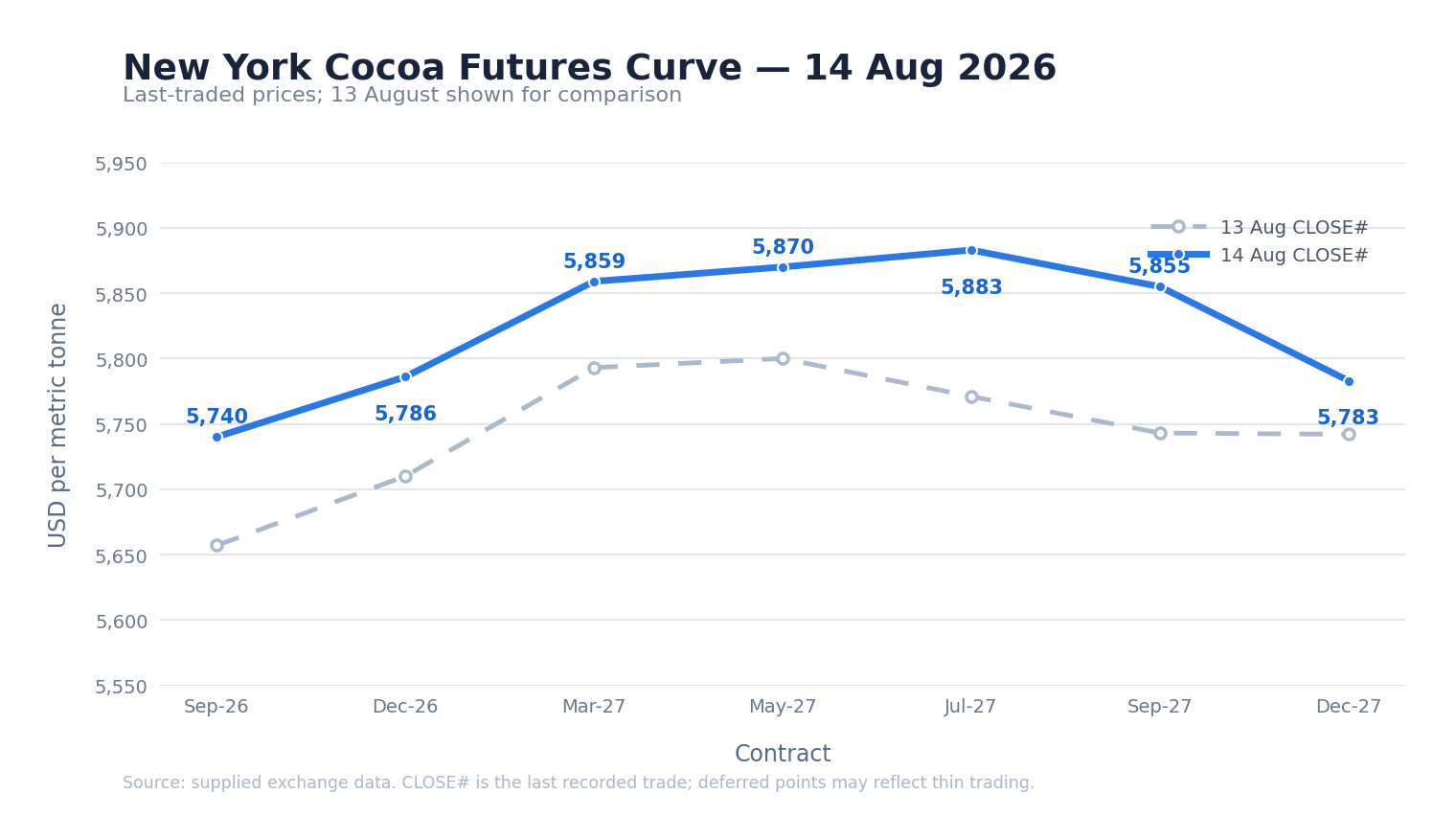
The curve also became more constructive. Using close prices, the September-to-December spread narrowed from $53 to $46, while December-to-March narrowed from $83 to $73. The most notable adjustment was farther out: the May-to-July relationship moved from $29 backwardation on 13 August to $13 contango on 14 August. The September-to-July curve spread therefore increased from $114 to $143/tonne, showing a meaningful steepening of the overall curve.
London cocoa
| Contract | 13 Aug | 14 Aug | Change | Change % |
|---|---|---|---|---|
| Sep-26 | £4,120 | £4,133 | +£13 | +0.32% |
| Dec-26 | £4,163 | £4,176 | +£13 | +0.31% |
| Mar-27 | £4,269 | £4,290 | +£21 | +0.49% |
| May-27 | £4,284 | £4,295 | +£11 | +0.26% |
| Jul-27 | £4,278 | £4,302 | +£24 | +0.56% |
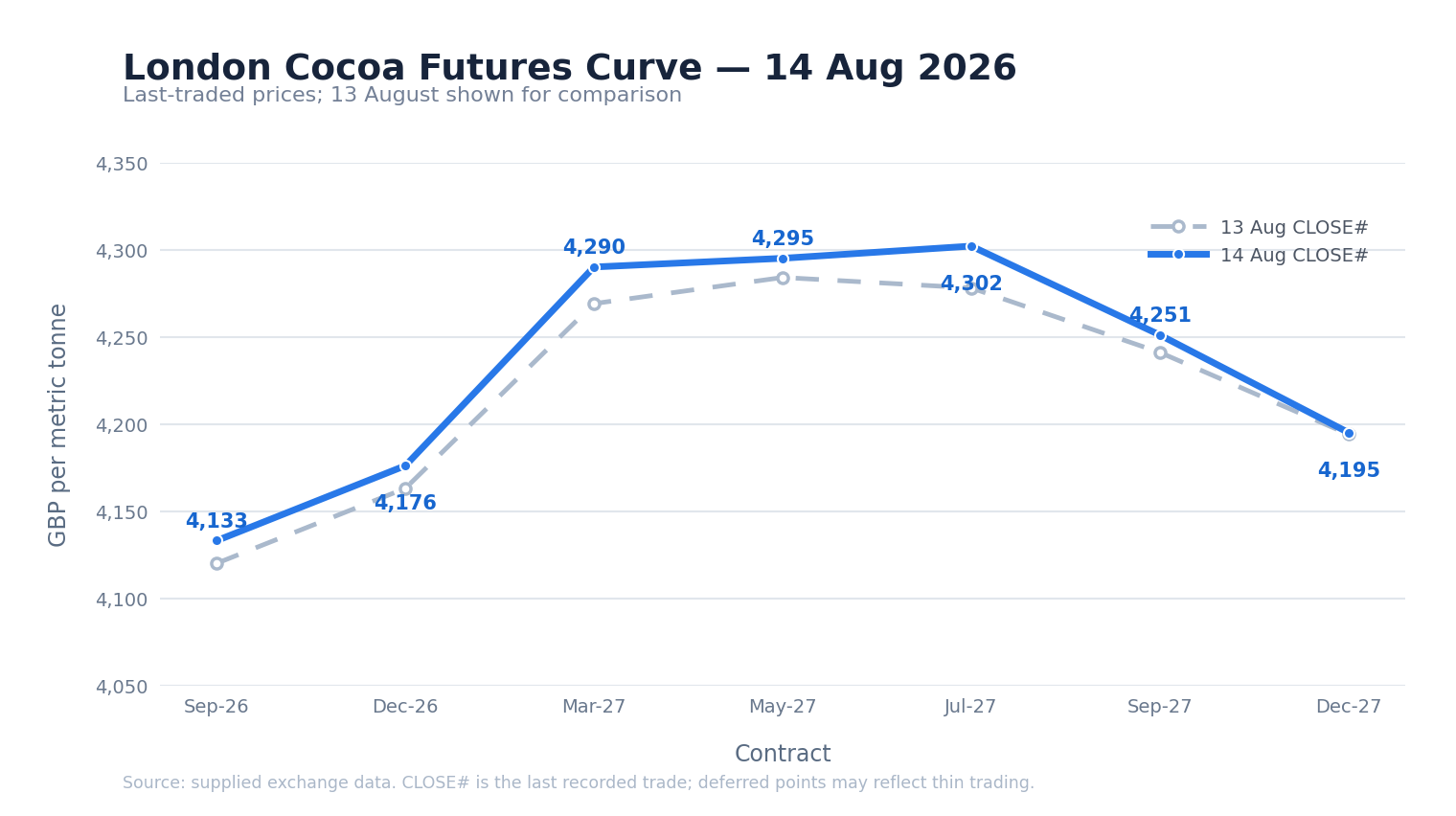
London cocoa also closed higher across the curve, although the percentage gains were considerably smaller than in New York. July-27 was the strongest major maturity, rising £24/tonne, while March-27 gained £21. September and December each increased £13.
Volume was concentrated even more heavily in the front three maturities. September, December and March accounted for 14,218 contracts, or 82.5% of total volume. December-26 was the dominant contract with 7,172 contracts, equal to 41.6% of total volume. Total volume was 17,229 contracts.
Spread activity was particularly significant, with 12,876 spread contracts, or 74.7% of total volume. EFP volume was 566 contracts.
The London curve became modestly steeper. September-to-December remained at £43 contango, while December-to-March widened from £106 to £114. March-to-May narrowed from £15 to £5. The May-to-July structure was the most interesting change, moving from £6 backwardation to £7 contango. Overall, the September-to-July curve spread increased from £158 to £169/tonne.
US–UK Spread
(Dec Contract)
$5,786 − (£4,176 x 1.353$/£) =$135ton (up from $94 ton)
Volume and Open Interest
New York cocoa
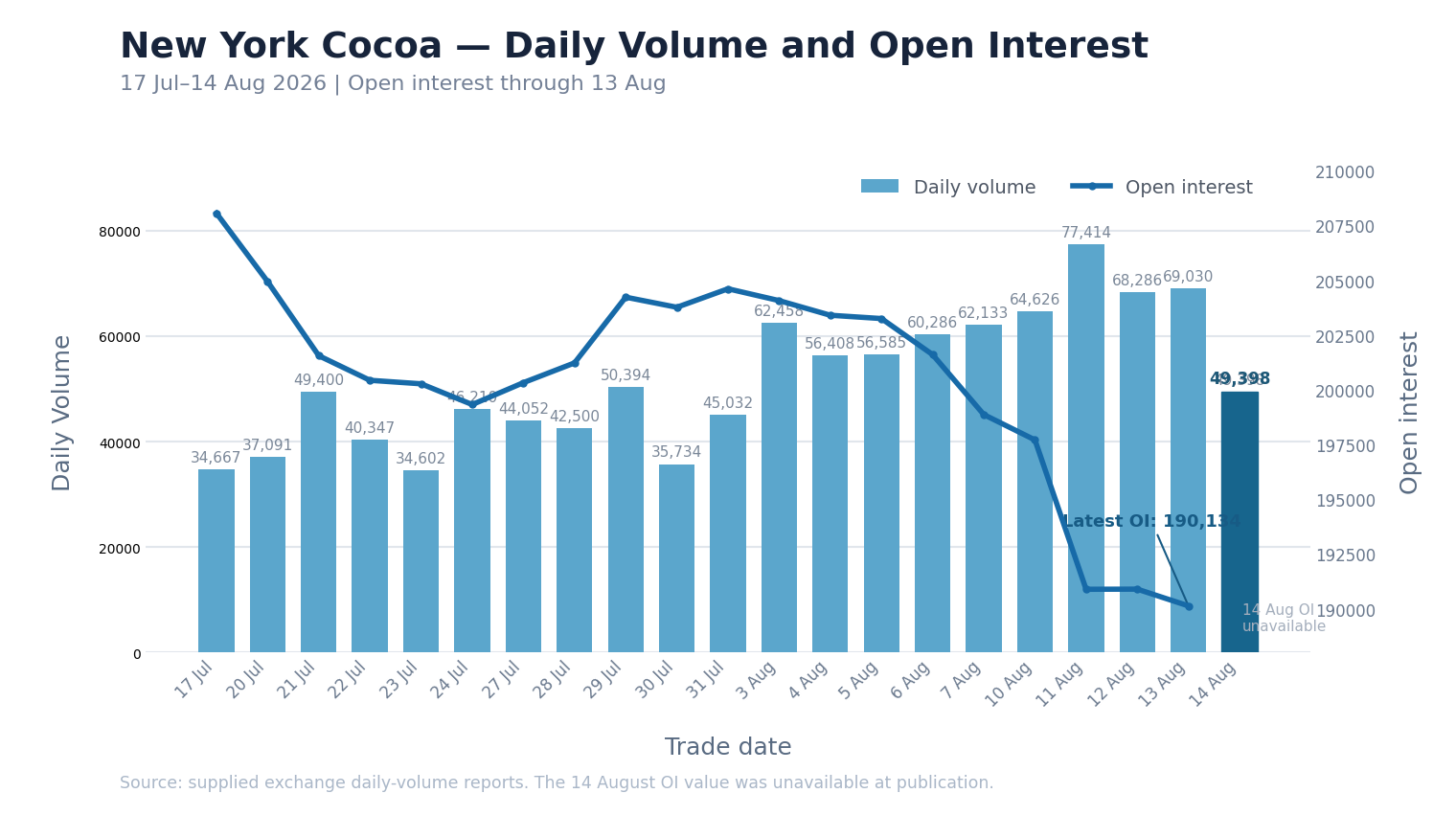
New York cocoa volume fell sharply on 14 August to 49,398 contracts, down 19,632 contracts (-28.4%) from 69,030 on 13 August. Activity was 4.8% below the past month average of 51,863 contracts, confirming a noticeable slowdown in participation. Volume was also 36.2% below the recent peak of 77,414 contracts recorded on 11 August. Despite the lower turnover, activity remained substantial.
The latest available open interest was 190,134 contracts on 13 August, down 763 contracts (-0.4%) from 190,897 on 12 August, extending the broader decline from 208,055 contracts on 17 July. Over the past month, New York cocoa open interest has declined steadily while trading volume has remained elevated, particularly over the past 10 sessions.
London Cocoa
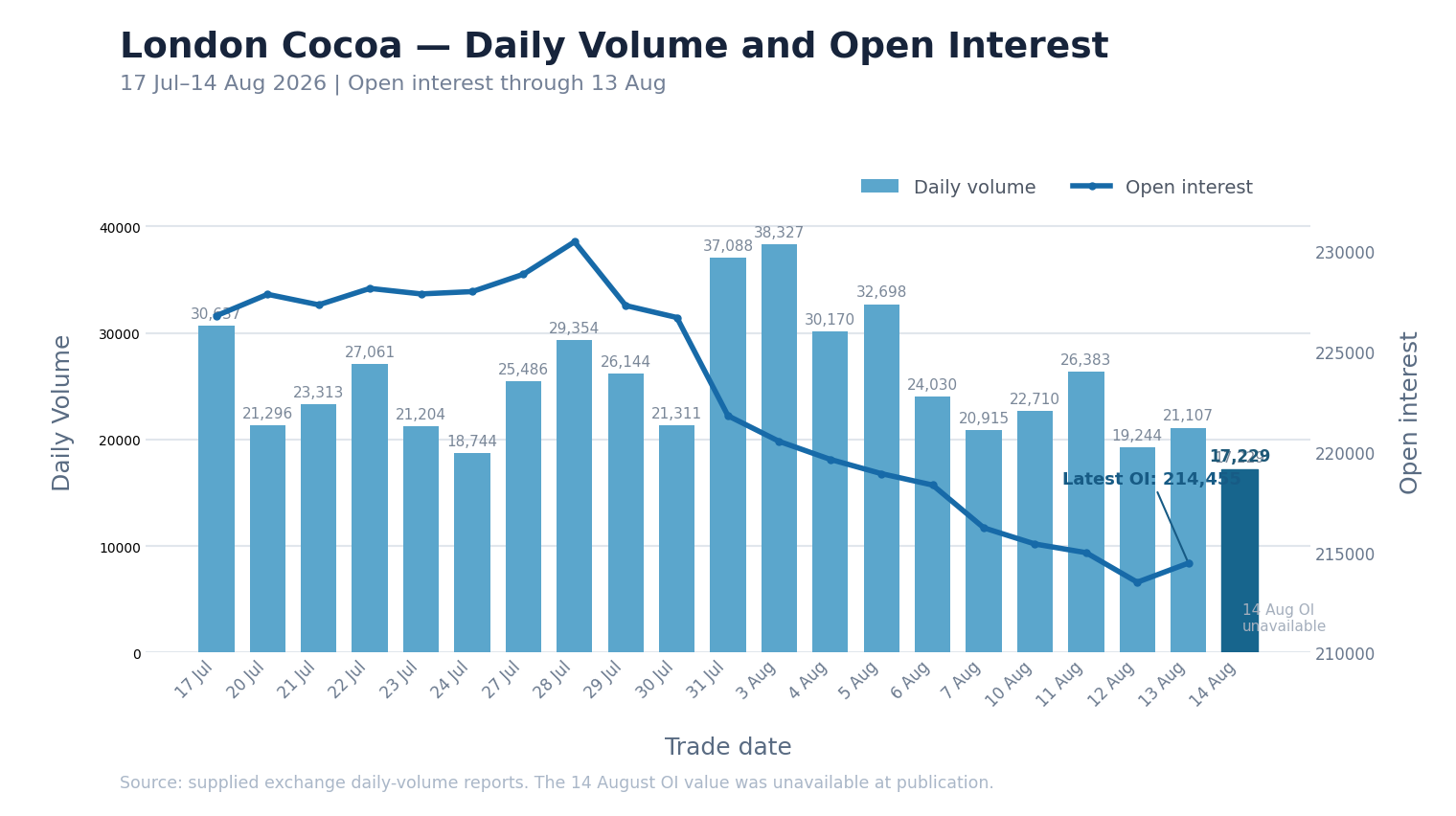
London cocoa volume decreased to 17,229 contracts on 14 August, down 3,878 contracts (-18.4%) from 21,107 on 13 August. It was also 33.4% below the 17 Jul–13 Aug average of 25,861 contracts and far below the period peak of 38,327 contracts on 3 August.
The latest available London open interest was 214,455 contracts on 13 August, an increase of 950 contracts (+0.4%) from 213,505 on 12 August. However, OI remained materially below its period peak of 230,455 contracts on 28 July, down 16,000 contracts (-6.9%).
COT Analysis
New York Cocoa
New York cocoa had open interest of 258,272 contracts as of 11 August, with open interest falling by 18,752 contracts (-6.8%) from the previous reporting week.
Non-commercial traders held 23,377 long versus 38,983 short, giving them a net short position of 15,606 contracts. Compared with the previous week, non-commercial longs fell by 2,578 contracts while shorts declined by only 293. As a result, their net position became 2,285 contracts more bearish.
Commercial traders held 123,020 long versus 109,763 short, giving them a net long position of 13,257 contracts. Their long position declined by 5,461 contracts and their short position declined by 7,309 contracts. Because shorts were reduced more aggressively than longs, the commercial net position increased by 1,848 contracts, indicating a modest shift toward a more bullish commercial balance.
London Cocoa
London cocoa open interest stood at 300,582 contracts. Producers/Merchants/Processors/Users held 125,555 long versus 151,066 short, giving them a net short position of 25,511 contracts. This is consistent with commercial participants maintaining a significant short hedge against physical exposure.
Swap Dealers were positioned differently, with 50,699 long versus 19,621 short, producing a net long position of 31,078 contracts. Their spreading position was also large at 25,333 contracts.
Managed Money held 5,552 long versus 11,330 short, resulting in a net short position of 5,778 contracts. Speculative positioning remained modestly bearish, despite cocoa prices trading in a consolidation phase. Managed Money spreading positions were also substantial at 39,130 contracts.
Exchange Trading Volume
| MARKET | 13 AUG 2026 | 14 AUG 2026 | CHANGE | CHANGE % |
|---|---|---|---|---|
| US | 3,335,656 | 3,332,604 | −3,052 | −0.09% |
| UK | 1,145,938 | 1,145,938 | 0 | 0.00% |
The measure is not a complete regional stock-to-grind ratio, as it includes only exchange-certified cocoa held at U.S. and EU delivery ports and excludes commercial inventories outside the ICE warehouse system. North America NCA grindings cover processors across North America, while ICE U.S. certified stocks are stored at U.S. delivery ports. ECA reports bean usage in European countries and London-certified cocoa is held in European and UK delivery locations.
Readers can explore detailed cocoa market datasets, futures statistics, and historical indicators in the CocoaIntel Data Hub:
 Cocoa Intel
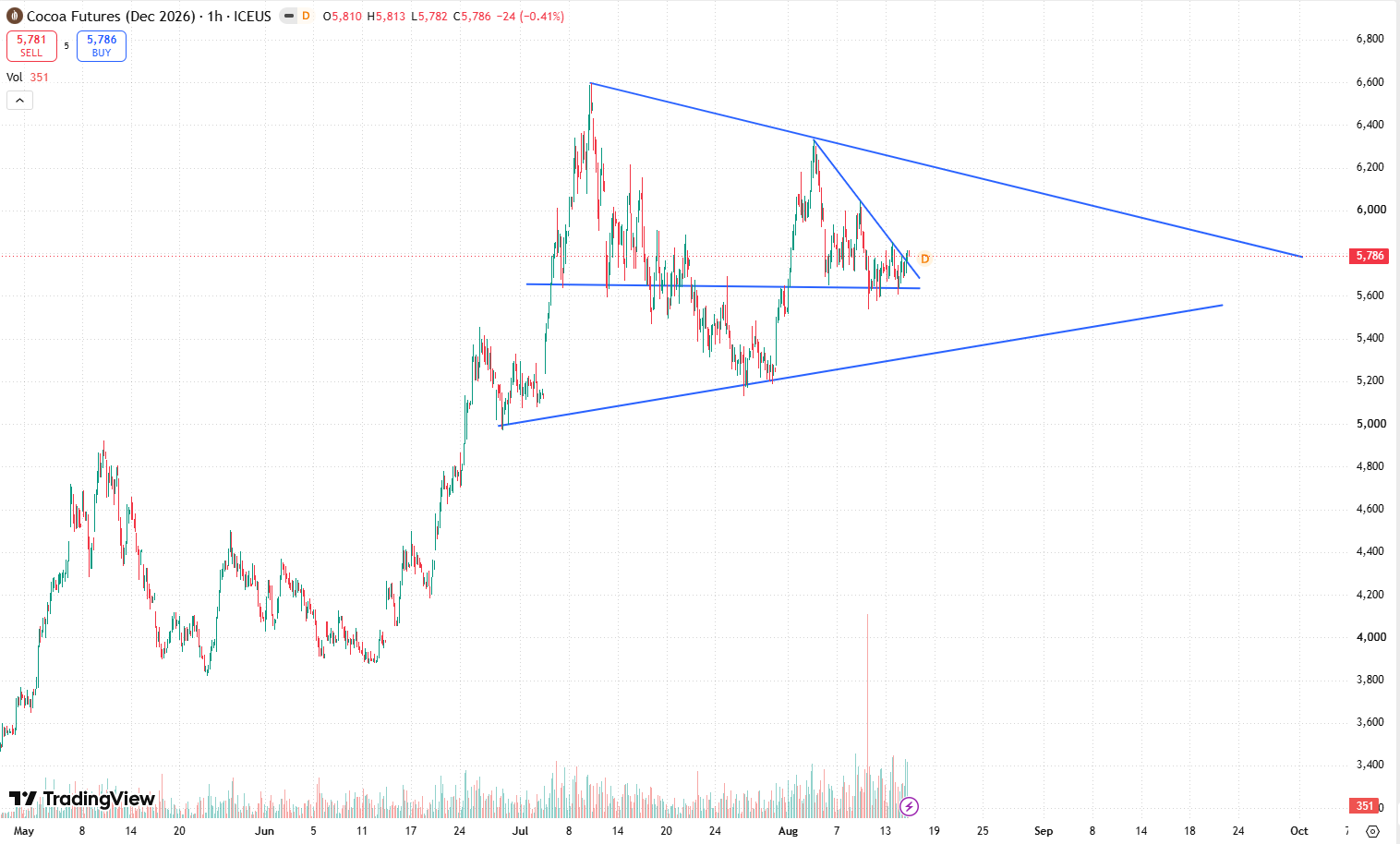
Monday Outlook Dec Contract
On the daily chart, cocoa is still trading between the 9-day SMA and 21-day SMA, with the 9-day SMA acting as resistance and the 21-day SMA as support. It is important to note that price has now broken above the falling trendline that has been forming since the beginning of August. A confirmation of the breakout could open the way toward the next major resistance around 6,200. On the downside, 5,600 remains a strong support level; if this level is decisively broken, the next significant downside target would be around 5,300. As long as price remains above 5,750, the bias remains constructive and the market could attempt to retest higher resistance levels.
If you notice any discrepancies in these figures or have extra information, please email hello@cocoaintel.com or leave a comment – corrections and additional insights are always welcome.