
Cocoa Market Faces Selling Pressure and Supply Uncertainty (28 September 2026)


New York December cocoa surrendered an early rally on Monday, 28 September, as repeated attempts to hold above $5,700 met selling. Prices reached $5,741/t, up 2.46% from Friday’s last-traded close, before retreating. A second recovery towards $5,700–$5,720 also faded, with the contract subsequently testing $5,574. The last-traded close was $5,607/t, just $4 (+0.07%) above Friday’s $5,603. That left December only $33 above its low, in the bottom 20% of its $167 daily range. The official settlement fell $30 (−0.53%) to $5,589/t. Despite the marginal gain in the last-traded close, the weak finish showed that buyers failed to sustain the recovery, leaving resistance above $5,700 and immediate support around $5,574–$5,600.
Côte d’Ivoire’s dry weather threatens January–February production
Persistent rainfall deficits are increasing concern over the later part of Côte d’Ivoire’s main crop. Farmers told Reuters on 28 September that flowers and young pods were drying out in several producing regions, while growers around Daloa, Bongouanou and Yamoussoukro reported fewer young pods than at the same time last year. Divo received no rain during the latest week, against a five-year average of 22.5 mm. Daloa recorded just 4.8 mm, or 25 mm below its five-year average. Rainfall was also below average around Soubré, Agboville and Abengourou.
The crop-stage distinction remains crucial. Growers still expected substantial harvesting from October through December because many large pods were approaching maturity. Their concern centred on the younger pod population needed to sustain production in January and February. Some doubted that a return to heavy rain would fully restore that later harvest. The update strengthens the case for monitoring early-2027 supply risk, while providing no quantified national production loss. It also leaves room for nearby arrivals to increase as mature pods are harvested.
Côte d’Ivoire’s cumulative port arrivals reach 36,500 tonnes
Exporter estimates reported by Reuters on 28 September put cocoa arrivals at Abidjan and San Pedro at a cumulative 36,500 tonnes through 27 September, measured from the start of the 2026/27 marketing season on 1 September. The early opening of the campaign prevents a meaningful comparison with the previous season’s cumulative total, which began on a different date.
The estimate indicates that beans continue to reach the ports, but does not establish how much producer withholding, collection difficulties or other factors may be affecting deliveries. Arrival estimates measure marketed flows rather than total crop production; they cannot independently determine the scale of the strike’s impact or the eventual size of the main crop.
Ghana’s first cocoa-note offer raises questions over purchasing liquidity
JoyNews reporting on 28 September identified a further uncertainty in Ghana’s domestic cocoa financing programme. Its review of Cocoa Capital’s 25 September issuance announcement found that proceeds from the first 270-day commercial-paper offer could finance cocoa purchases and repay a bridge facility linked to legacy debt. The documents reviewed did not specify how much would be allocated to each purpose.
Bookbuilding was scheduled to begin on 28 September, close on 30 September and settle on 1 October. The GH¢16.3 billion programme ceiling consequently cannot be treated as cash already available for new bean purchases. The immediate test is the amount actually raised and the allocation of proceeds. Refinancing could ease COCOBOD’s financial pressures, but its effect on purchasing capacity will depend on how much liquidity reaches the buying system and when. The reporting does not establish a failed placement or quantify a purchasing shortfall.
Ghana’s new producer price faces demands for greater transparency
Ghana’s opposition NPP challenged the GH¢2,650-per-bag producer price in a statement dated 27 September and reported by local media on 28 September. It questioned the calculation behind the government’s assertion that farmers would receive 71.18% of realised gross export value and called for a review. The official price itself was announced on 25 September; the subsequent challenge is the latest development.
The disagreement increases pressure for disclosure of the pricing assumptions as the new purchasing season begins. It does not establish that the official price has changed again or that cocoa deliveries have stopped. For physical trade, payment reliability and buyers’ access to working capital remain the practical issues to monitor alongside the pricing dispute.
Brazil’s agroforestry expansion remains a longer-term supply theme
A Reuters feature published on 28 September examined efforts to expand cocoa agroforestry on former cattle pasture in the Amazon. It described an existing programme that had helped 650 farmers convert 4,000 hectares, alongside financing and environmental challenges as larger plantation investors enter the sector. The market relevance is longer-term supply diversification and the ability to expand traceable production. The feature provided no new 2026/27 crop estimate or quantified increase in near-term export availability.
Ecuador’s wetter conditions contrast with uneven West African rainfall
Reuters cited dealers reporting recent rainfall well above average in Ecuador, while showers in Côte d’Ivoire and Ghana remained uneven and further rain was needed. This highlights contrasting risks across major origins: insufficient moisture could constrain West African crop development, while Ecuador’s wetter conditions could replenish soil moisture but complicate harvesting and drying if excessive rainfall persists.
Futures Performance
New York cocoa
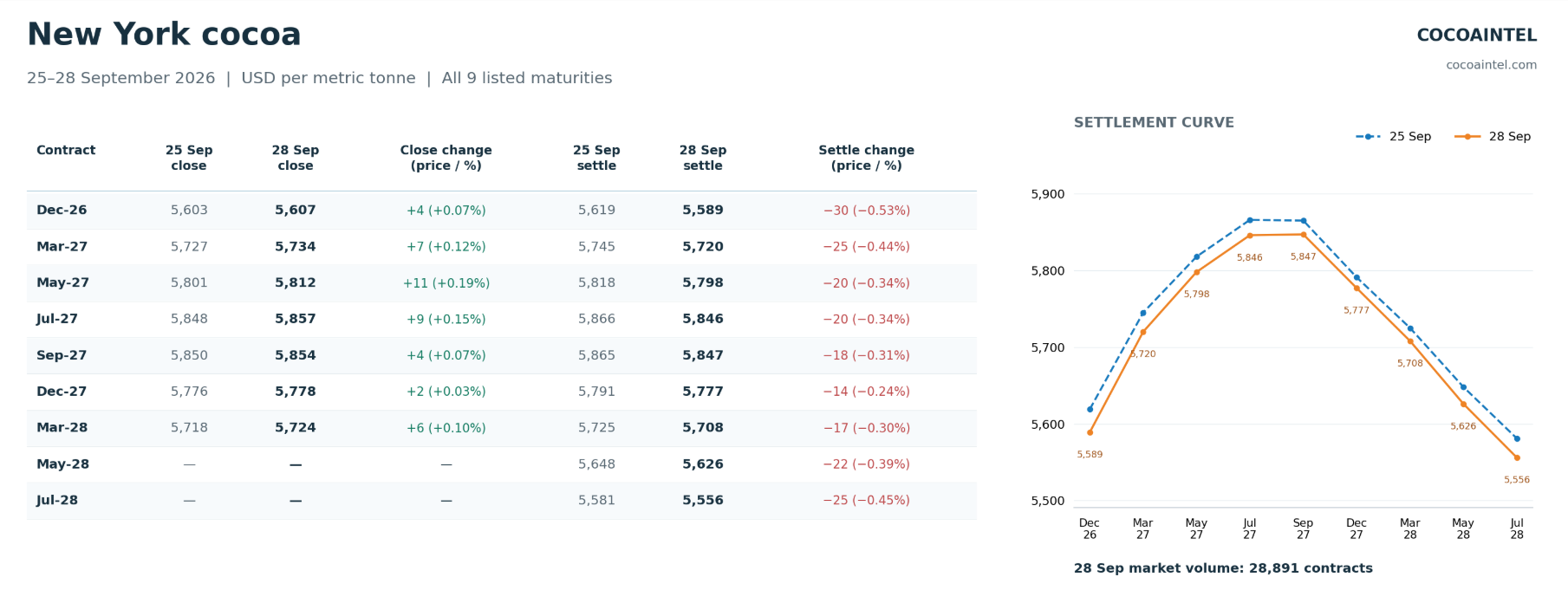
New York’s settlement curve shifted lower across all nine listed maturities, despite marginal gains in the seven available last-traded closes. December settled at $5,589/t, down $30 (−0.53%). Nearby cocoa underperformed deferred contracts: Dec/Mar contango widened from $126 to $131/t and Dec/Jul from $247 to $257/t, reversing most of Friday’s tightening. The recovery therefore lost some of its support from the front of the curve.
The curve retained its mid-2027 peak, with July at $5,846 and September at $5,847, before declining to $5,556 for July 2028. December’s larger discount to those middle maturities provides little evidence of increased urgency to secure nearby exchange delivery. A stronger recovery would require nearby contracts to regain ground against deferred months alongside rising outright prices.
London cocoa
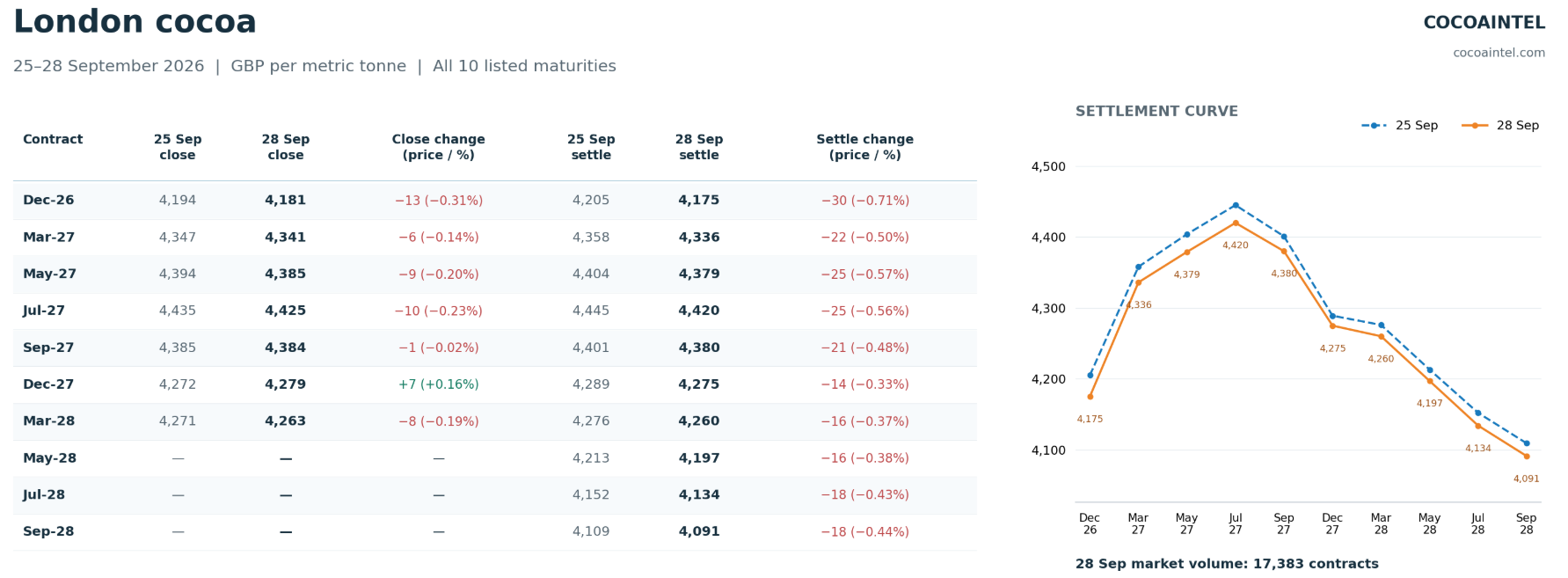
London weakened across six of the seven reported last-traded closes and all ten listed settlements. December’s last trade fell £13 (−0.31%) to £4,181/t, while its settlement declined £30 (−0.71%) to £4,175. December 2027 was the exception among last-traded closes, gaining £7 despite settling £14 lower. Dec/Mar contango widened from £153 to £161/t and Dec/Jul from £240 to £245/t, confirming that nearby pricing also weakened relative to deferred delivery in London.
The settlement curve continued to peak in July 2027 at £4,420 before declining to £4,091 by September 2028. Widening nearby discounts leave the recovery dependent on renewed buying in the front months; the curve currently offers limited support for an immediate tightening narrative. No volume was reported in May, July or September 2028, so those distant settlement points reflect exchange valuations without confirming trades at those prices.
Monday’s combined price and spread signals leave the recovery fragile. Both markets settled lower, nearby discounts widened, and December last trades finished close to their session lows. London’s December settlement decline of 0.71% also exceeded New York’s 0.53%. A more constructive signal would require rising settlements alongside renewed narrowing of Dec/Mar and Dec/Jul contango. For now, the curves provide little evidence of growing urgency to secure prompt exchange delivery; physical differentials and delivery activity would be needed to establish whether this reflects broader availability.
NY–London Dec-26 Spread
| Contract | NY close 25 Sep | London close 25 Sep | Spread 25 Sep | NY close 28 Sep | London close 28 Sep | Spread 28 Sep | Change |
|---|---|---|---|---|---|---|---|
| Dec-26 | $5,603 | £4,194 | +$48.05 | $5,607 | £4,181 | +$65.25 | +$17.20 |
| Mar-27 | $5,727 | £4,347 | −$30.60 | $5,734 | £4,341 | −$19.82 | +$10.78 |
| May-27 | $5,801 | £4,394 | −$18.85 | $5,812 | £4,385 | −$0.14 | +$18.71 |
| Jul-27 | $5,848 | £4,435 | −$26.16 | $5,857 | £4,425 | −$8.16 | +$18.00 |
| Sep-27 | $5,850 | £4,385 | +$42.07 | $5,854 | £4,384 | +$43.18 | +$1.12 |
| Dec-27 | $5,776 | £4,272 | +$117.74 | $5,778 | £4,279 | +$106.36 | −$11.38 |
| Mar-28 | $5,718 | £4,271 | +$61.06 | $5,724 | £4,263 | +$73.56 | +$12.50 |
$5,607 − (£4,181 × 1.3254) = +$65.25/t.
New York’s December premium widened to approximately $65/t from $48/t, an increase of $17/t. Holding GBP/USD at Friday’s rate, the futures-price changes alone would have widened the premium by $21.22/t: New York gained $4 while London declined £13. Sterling’s appreciation increased London’s dollar-equivalent value, offsetting $4.01/t of that widening. The improvement therefore reflects relative strength in New York, with currency movements moderating the change.
New York strengthened relative to London across six of the seven comparable maturities. Discounts narrowed in March and July 2027, while May moved effectively to parity. December 2027 was the exception, with its premium narrowing to $106/t. These are indicative comparisons using reported last trades, which are not necessarily simultaneous. Maturities without reported closes in both markets are excluded.
Volume and Open Interest
New York cocoa
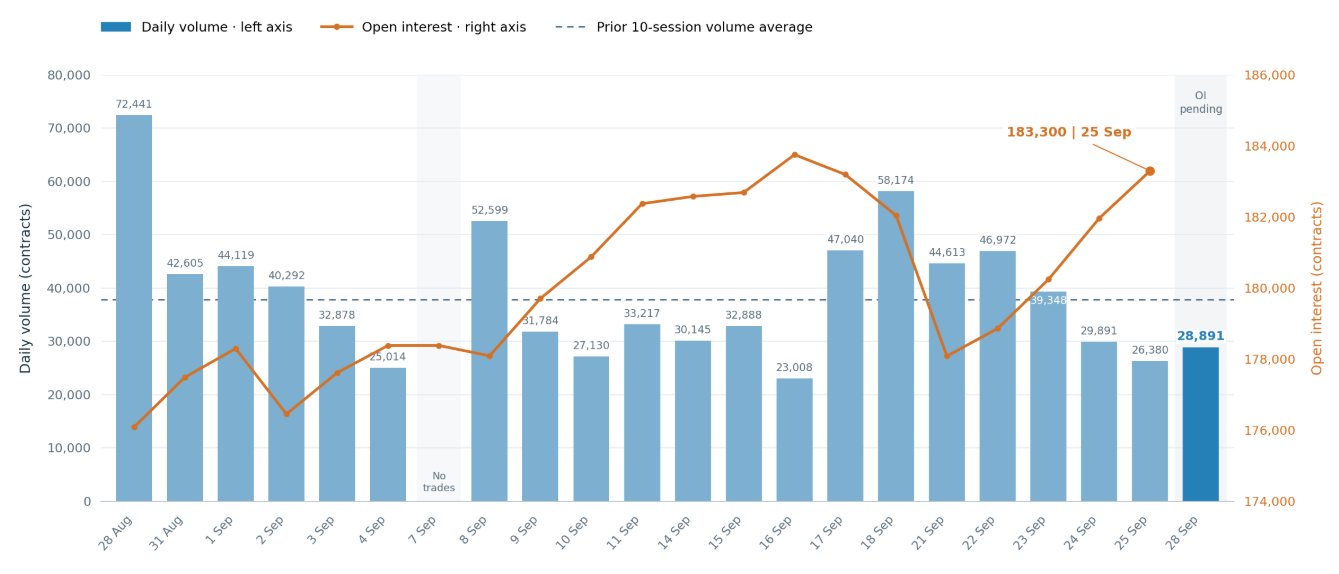
New York turnover increased 9.5% to 28,891 contracts on Monday, ending three consecutive declines, but remained 23.7% below the previous 10-session average of 37,846. Participation therefore remained subdued.
Friday’s newly available open interest rose 1,332 contracts (+0.73%) to 183,300, its fourth consecutive increase. Outstanding positions have recovered 5,215 contracts (+2.93%) since 21 September. Last week’s price recovery therefore coincided with net position creation, providing firmer participation evidence than turnover alone suggested.
London cocoa
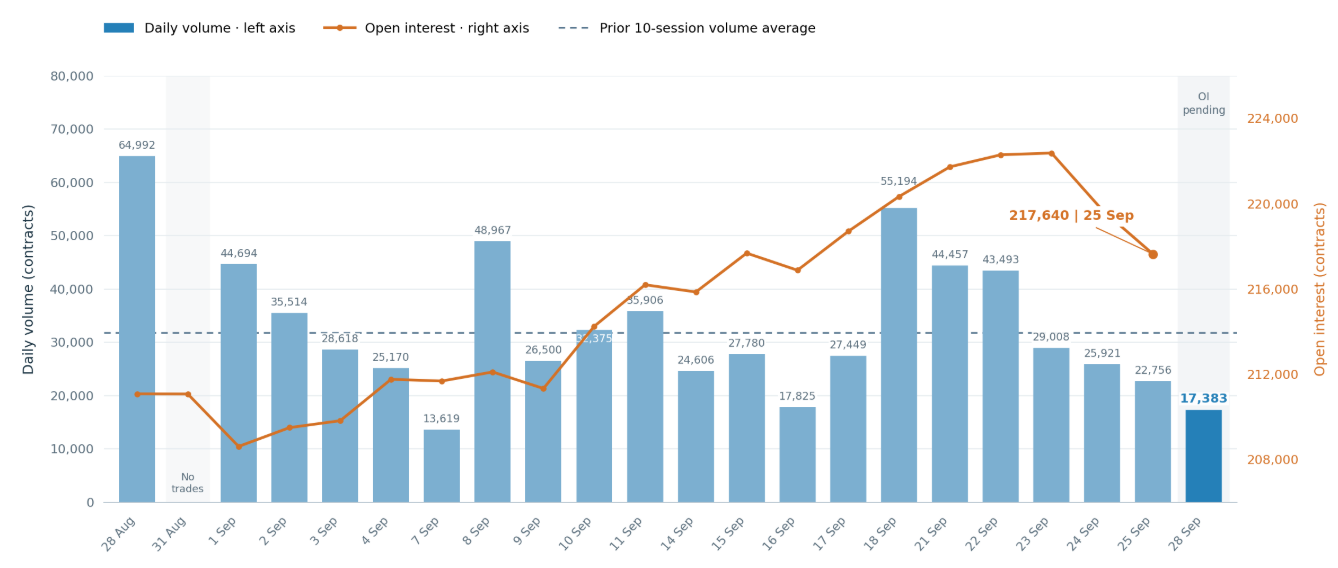
London turnover fell 23.6% to 17,383 contracts on Monday, its sixth consecutive decline and the lowest trading-day total since 7 September. Activity was 45.4% below the previous 10-session average of 31,849.
The latest open interest fell 2,068 contracts (−0.94%) to 217,640 on Friday, extending the decline from 222,384 on 23 September. That two-session reduction of 4,744 contracts (−2.13%) shows declining outstanding exposure, contrasting with New York’s rebuilding positions.
ICE Cocoa Stocks
| Market | Stock measure | Previous update | Latest update | Change | Change % |
|---|---|---|---|---|---|
| US | Total stocks in ICE-licensed warehouses | 3,432,756 bags | 3,452,949 bags | +20,193 bags | +0.59% |
| US | Certified stocks, included in warehouse total | 738,381 bags | 738,381 bags | 0 | 0.00% |
| London / Europe | Valid-warrant stocks | 1,182,656 bags | 1,182,656 bags | 0 t | 0.00% |
US warehouse stocks increased by 20,193 bags on Monday. However, certified stocks remained unchanged at 738,381 bags, equivalent to 21.4% of the warehouse total.
London valid-warrant stocks unchanged at 1,182,656 bags. The previously reported 120-tonne increase had already occurred in the preceding update and should not be counted again.
Tuesday Trading Setup - Dec Contract
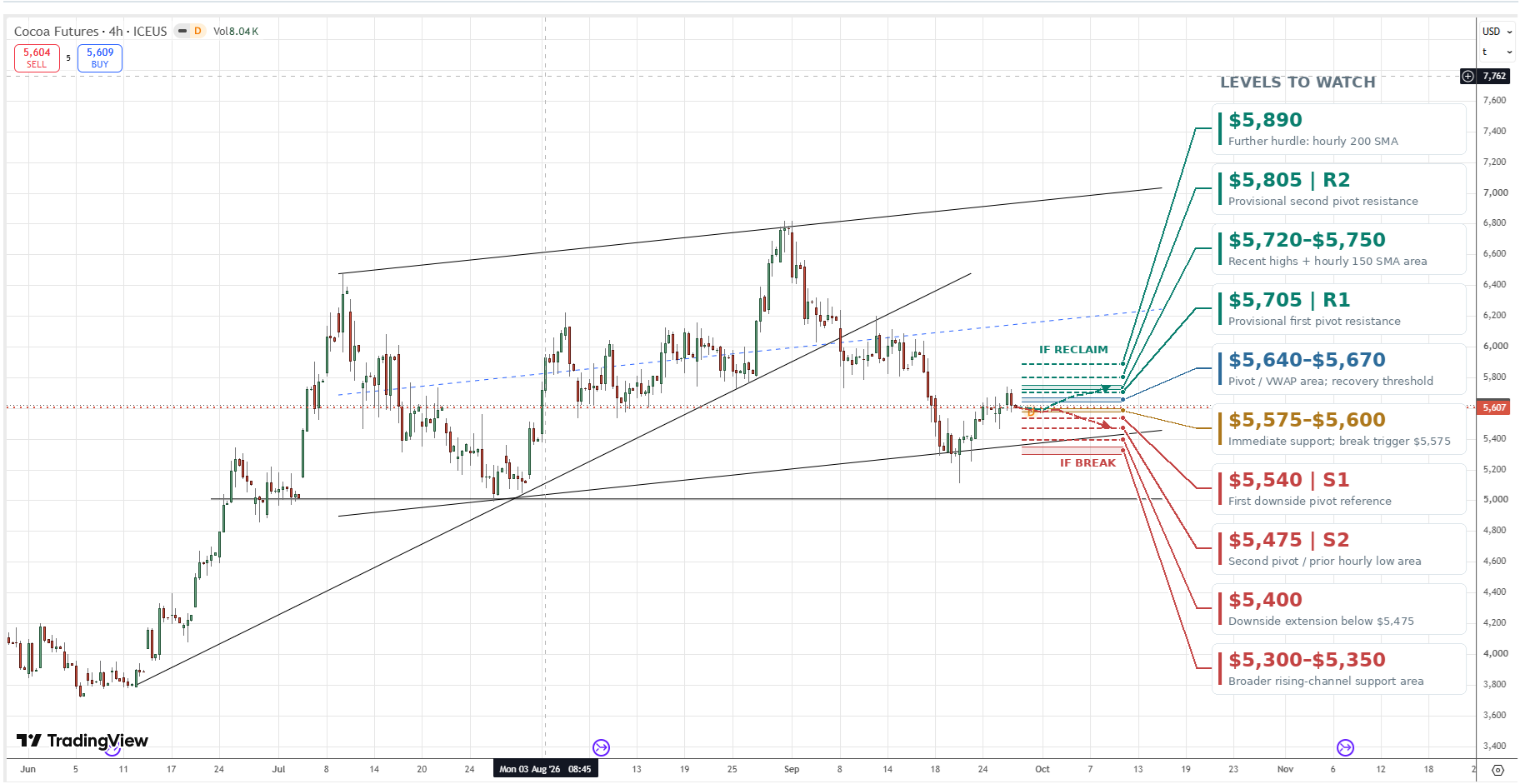
Tuesday’s base case for December cocoa is consolidation with a mild downside bias below $5,640–$5,670, where the estimated central pivot and Monday’s VWAP form the first recovery hurdle. Fading hourly MACD, declining stochastic and weaker OBV favour an initial test of $5,575–$5,600. An hourly close below this support, followed by a failed reclaim, would expose approximately $5,540 (S1), then $5,475 (S2), close to the previous hourly swing-low area. Sustained trading below $5,475 would materially weaken the rebound and reopen $5,400, with broader channel support around $5,300–$5,350 becoming a downside extension rather than the immediate target.
The bullish alternative requires support to hold and price to reclaim $5,670 with stronger volume and improving OBV. That would favour $5,705 (R1), followed by $5,720–$5,750, where recent highs meet the declining hourly 150-period average. Sustained acceptance above $5,750 would shift the immediate bias upward toward $5,805 (R2), with the hourly 200-period average near $5,890 a further hurdle. Recovering daily stochastic and a narrowing negative daily MACD histogram keep this upside scenario viable, but the late five-minute volatility compression provides no directional confirmation. The decisive signal for Tuesday is whether the next range expansion holds above $5,670 or below $5,575.
If you notice any discrepancies in these figures or have extra information, please email hello@cocoaintel.com or leave a comment – corrections and additional insights are always welcome.