
Cocoa Prices Reverse Sharply as Stronger Ghana Output Triggers Selling (5 August 2026)


New York cocoa experienced a sharp intraday reversal on 5 August. September 2026 initially traded higher and reached a session peak of $6,222 per tonne, 2.18% above the previous day’s close of $6,089. The advance failed to hold, however, and selling pressure intensified through the late morning as the contract broke below the $6,000 level and its short-term moving averages. Prices subsequently fell to a low of $5,803, 4.70% below the previous close and 6.73% below the intraday high. A rebound toward $5,900 recovered approximately 1.7% from the low but lacked follow-through, and prices weakened again into the final part of the session. The last recorded trade was $5,848, representing a daily decline of $241, or 3.96%, and leaving the contract only 0.78% above the session low. The hourly chart confirms that the decline represented a correction from the recent rally above $6,200: momentum indicators turned lower, the MACD moved into a bearish configuration, and the stochastic oscillator approached oversold territory. The session was characterised by an early failed rally, a decisive breakdown during the middle of the day and a weak finish near the lower end of the range.
Broader reductions outside West Africa
The tightening outlook was not limited to Côte d’Ivoire and Ghana. Production expectations for Ecuador, Peru and Southeast Asia were also revised lower, with the three origins collectively expected to produce approximately 100,000 tonnes less cocoa than previously forecast.
These reductions were significant because production growth outside West Africa had previously been expected to offset at least part of the weakness in the traditional producing countries. A weaker outlook across several regions therefore reduced the market’s margin for error and increased the importance of favourable weather and crop development during the coming season.
StoneX cuts projected global surplus
The broader production downgrades contributed to StoneX reducing its projected 2026/27 global cocoa surplus to only 25,000 tonnes, compared with an earlier estimate of 149,000 tonnes.
A surplus of this size would leave the global balance close to equilibrium and provide only a limited buffer against additional production losses, stronger-than-expected demand or logistical disruptions. This supported the initial move higher and helped the September 2026 contract reach an intraday high of $6,222 per tonne.
Ghana’s current-crop update changes sentiment
The tone of the market changed later in the session after Ghana’s cocoa regulator reported that approximately 750,000 tonnes had been harvested during the current 2025/26 season. This represented an increase of 25.6% from the 597,000 tonnes collected during the previous season.
Although the market remained concerned about Ghana’s prospects for 2026/27, the stronger current-season figure suggested that nearby cocoa availability was more comfortable than previously assumed. The announcement therefore challenged the immediate bullish narrative, even though it did not remove the risks surrounding next season’s crop.
Futures performance
New York cocoa
New York cocoa reversed the previous session’s advance in a decisive and broad-based sell-off. September 2026 recorded a last trade of $5,848 per tonne, falling $241, or 3.96%, from 4 August. March 2027 registered the largest decline among the five nearest contracts, losing $254, or 4.03%.
The decline more than erased the gains recorded on 4 August. All five nearby contracts finished between $55 and $71 per tonne below their respective 3 August levels.
| CONTRACT | 4 AUG | 5 AUG | CHANGE | CHANGE % |
|---|---|---|---|---|
| Sep-26 | $6,089 | $5,848 | -$241 | -3.96% |
| Dec-26 | $6,218 | $5,969 | -$249 | -4.00% |
| Mar-27 | $6,309 | $6,055 | -$254 | -4.03% |
| May-27 | $6,314 | $6,067 | -$247 | -3.91% |
| Jul-27 | $6,287 | $6,045 | -$242 | -3.85% |
The last recorded trades were concentrated near the bottom of the daily ranges. The five nearest contracts finished within approximately 11%–12% of their respective ranges. They were only $45–$47 above their reported lows, while remaining between $330 and $374 below their session highs.
This represents a clear rejection of the upper end of the intraday ranges. Each of the five contracts traded above its 4 August closing level during the session, but those gains were fully reversed before the final recorded trades.
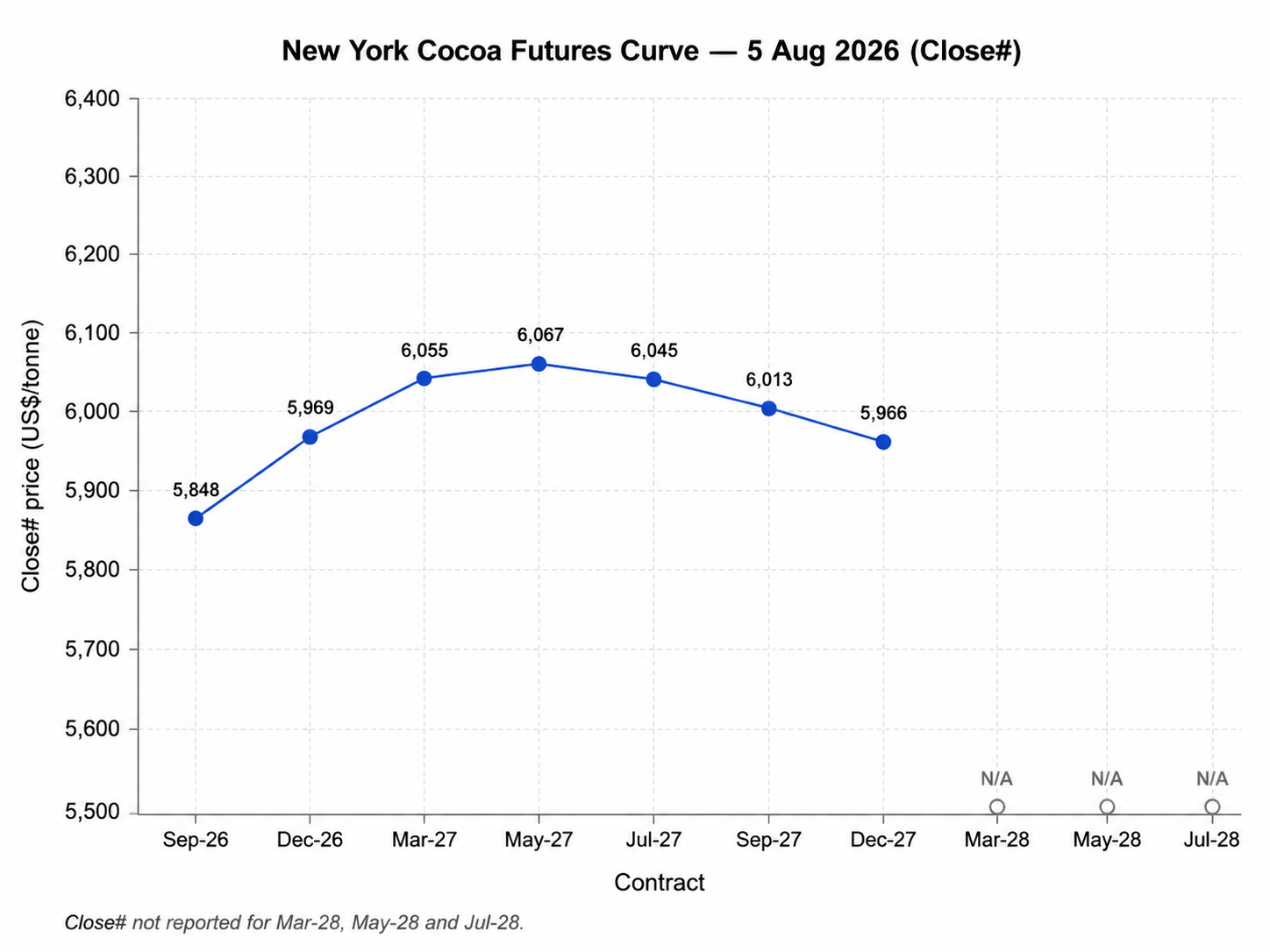
May 2027 remained the highest-priced nearby contract at $6,067 per tonne. The curve continued to rise from $5,848 in September to $5,969 in December, $6,055 in March and $6,067 in May. It then moved into backwardation, declining to $6,045 in July, $6,013 in September and $5,966 in December 2027.
The September-to-May premium narrowed slightly from $225 to $219 per tonne. The September-to-December contango also contracted from $129 to $121 per tonne.
Despite the severe outright decline, the curve therefore continued to show contango at the front, rather than the nearby inversion normally associated with an acute shortage of immediately deliverable cocoa. The principal risk premium remained concentrated in the March–May 2027 period.
London cocoa
London cocoa also declined, although its losses were substantially smaller than those recorded in New York. September 2026 registered a last trade of £4,352 per tonne, falling £18, or 0.41%, from 4 August.
March 2027 recorded the largest percentage decline among the five nearest contracts, losing £40, or 0.89%. July declined by £39, or 0.87%.
| CONTRACT | 4 AUG | 5 AUG | CHANGE | CHANGE % |
|---|---|---|---|---|
| Sep-26 | £4,370 | £4,352 | -£18 | -0.41% |
| Dec-26 | £4,414 | £4,383 | -£31 | -0.70% |
| Mar-27 | £4,518 | £4,478 | -£40 | -0.89% |
| May-27 | £4,511 | £4,477 | -£34 | -0.75% |
| Jul-27 | £4,503 | £4,464 | -£39 | -0.87% |
As in New York, the final recorded trades were positioned in the lower part of the daily ranges. The five nearest London contracts finished within approximately 18%–23% of their respective ranges. They were only £53–£66 above their session lows and between £218 and £234 below their reported highs.
All five contracts traded considerably above their previous closing levels during the session, with the reported highs standing approximately £191–£200 above the 4 August closes. The subsequent reversal and low positioning of the final trades indicate that the intraday rally encountered substantial selling pressure.
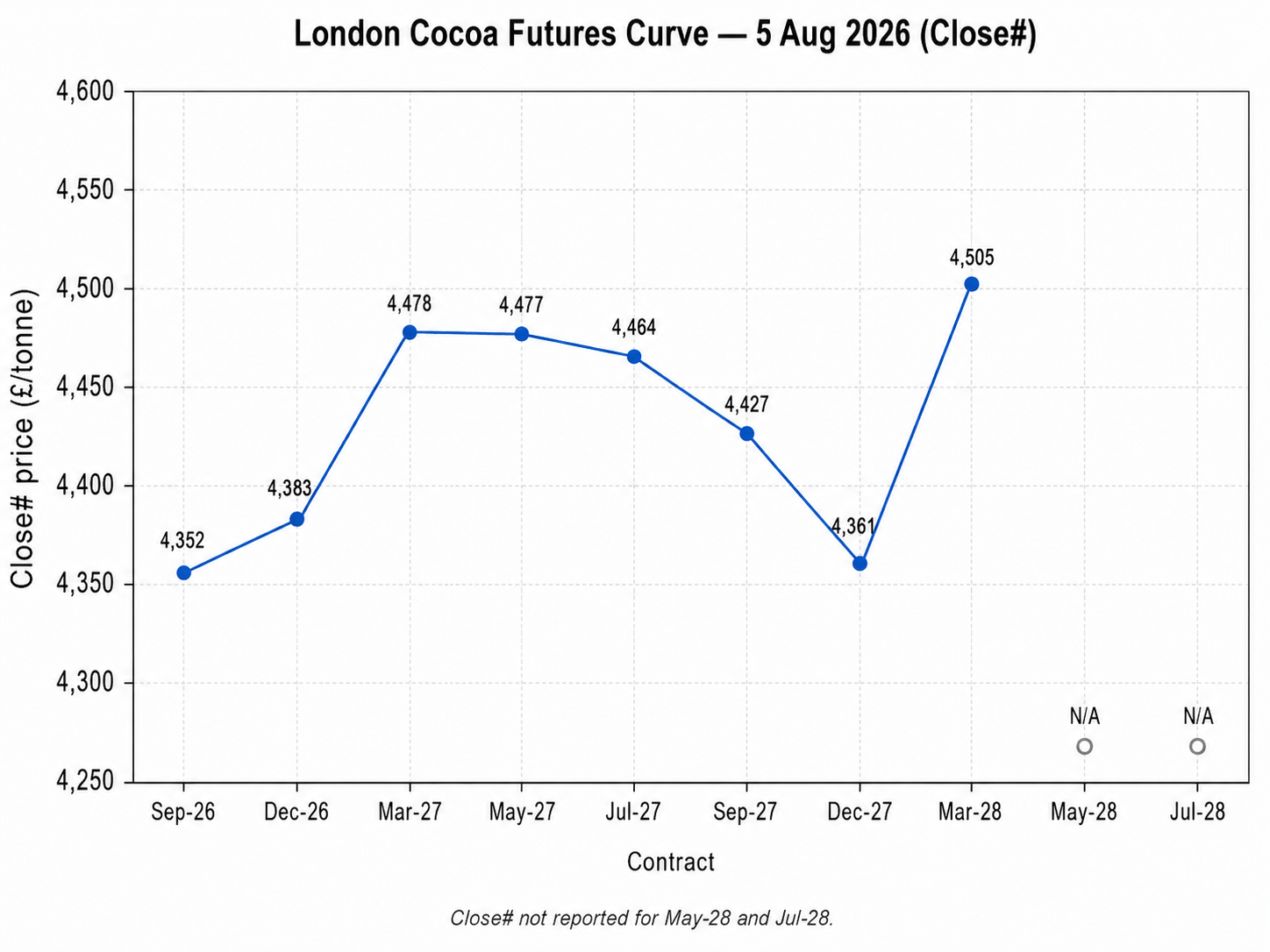
The front of the curve remained in contango through March 2027. September closed at £4,352, December at £4,383 and March at £4,478. March and May were almost flat, with May only £1 below March, after which the structure moved progressively into backwardation: £4,464 in July, £4,427 in September and £4,361 in December 2027.
The May-over-September premium narrowed from £141 to £125 per tonne. The September-to-December contango also contracted from £44 to £31 per tonne. This represented a moderate flattening of the front and middle sections of the curve, as May weakened more than September.
A secondary deferred increase was visible between December 2027 and March 2028, where the last recorded price rose from £4,361 to £4,505 per tonne. This deferred section should be interpreted more cautiously because liquidity was considerably lower and no Close# value was reported for May or July 2028.
Overall, New York materially underperformed London. The September contract declined by 3.96% in New York compared with only 0.41% in London. Nevertheless, both markets displayed bearish intraday characteristics: broad reversals from their session highs and final recorded trades positioned close to the daily lows.
US–UK Spread
(Sep Contract)
$5,848 − (£4,352 x 1.346$/£) =$-9ton (down from $211 ton )
Volume and Open Interest
New York cocoa
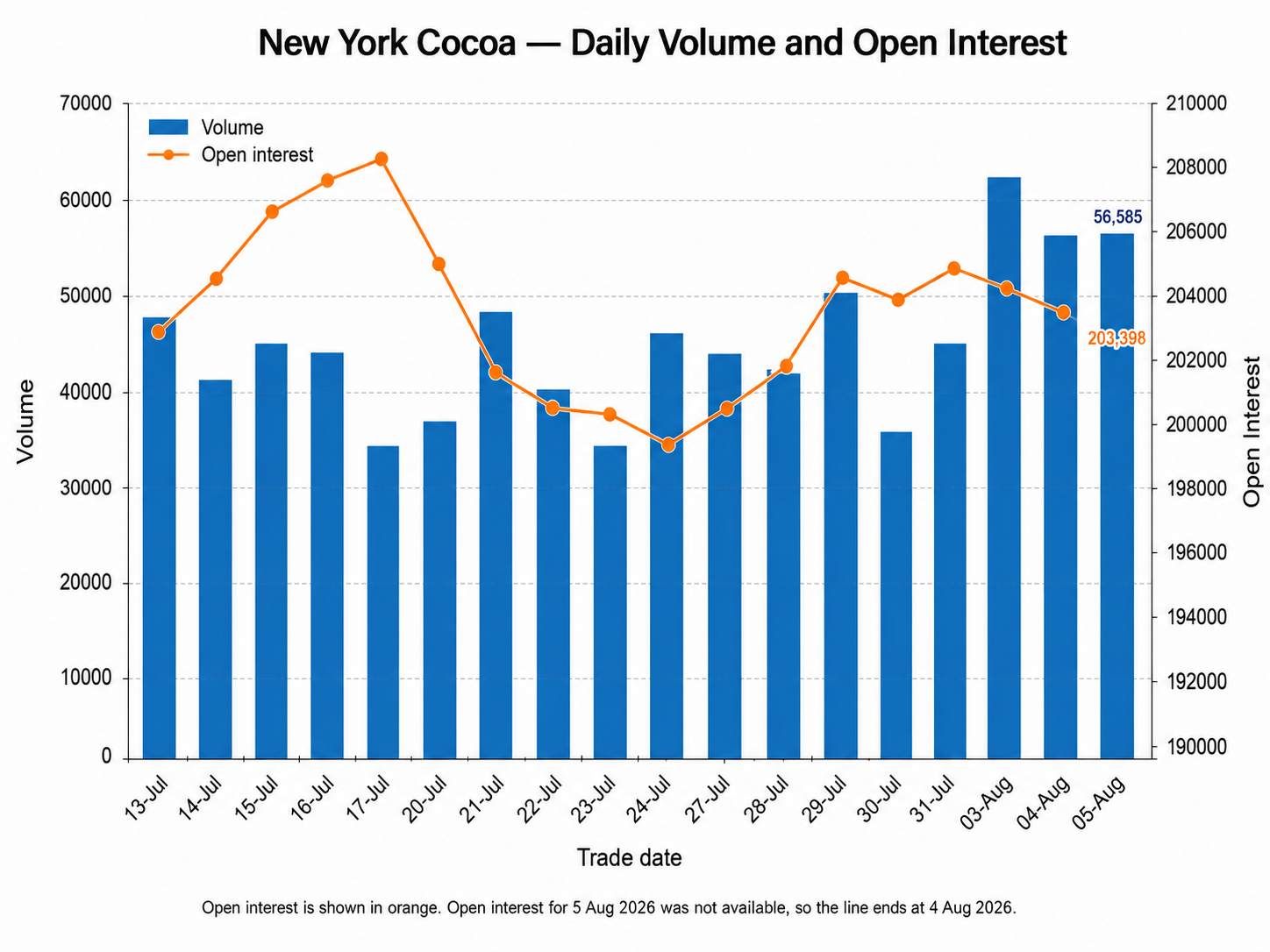
New York cocoa volume remained very strong on 5 August, and was broadly unchanged from the previous session. Daily volume reached 56,585 contracts, up 177 contracts, or 0.3%, from 56,408 on 4 August.
Even though volume did not exceed the exceptional 62,458 contracts recorded on 3 August, turnover still remained elevated. Volume was approximately 27.0% above the average of the preceding 15 sessions, indicating that market participation stayed strong and that activity remained well above recent norms.
This suggests that the sharp move seen on 5 August did not occur on thin or illiquid trade. Instead, it reflected another session of substantial market engagement, with heavy participation continuing after the very active trading seen earlier in the week.
Open interest for 5 August was not yet available in the exchange data. The latest available observation was 203,398 contracts on 4 August, compared with 204,066 contracts on 3 August. That represents a modest decline of 668 contracts.
Looking at the broader pattern, open interest had recovered from the late-July low of 199,322 contracts recorded on 24 July and reached 204,606 contracts on 31 July, but it then eased back to 204,066 on 3 August and 203,398 on 4 August. In other words, total open interest remained above the late-July lows, but it was still below the mid-July peak of 208,055 contracts recorded on 17 July.
This may indicate that the recent heavy activity in New York was supported primarily by strong trading participation and rapid position adjustment, rather than by a clear fresh build in outright market exposure. However, until the 5 August open-interest figure becomes available, it is not yet possible to determine how much of the session reflected new short positioning, long liquidation, or continued two-way trade.
London cocoa
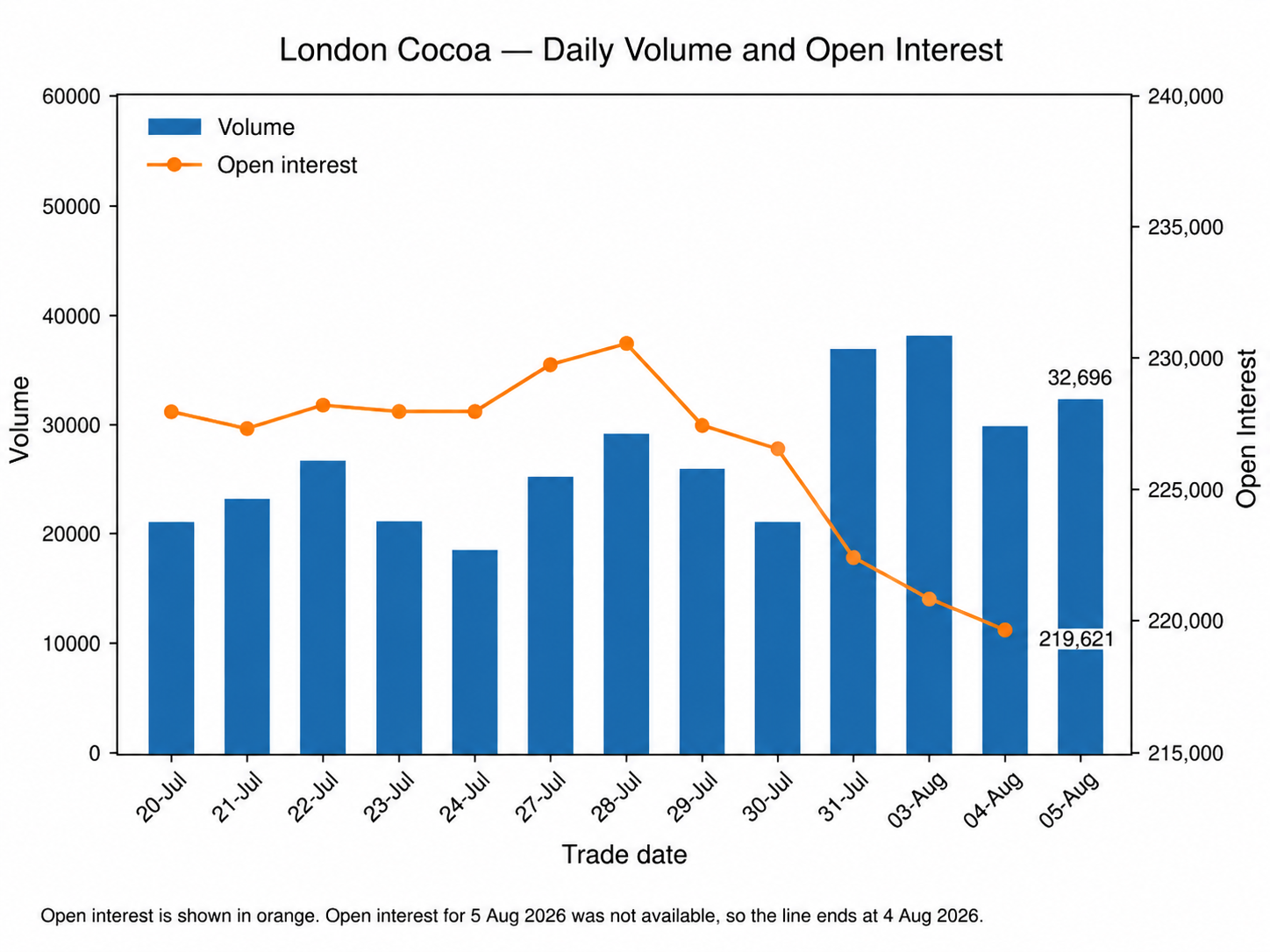
London cocoa volume strengthened again on 5 August after easing in the previous session. Daily volume reached 32,696 contracts, up 2,526 contracts, or 8.4%, from 30,170 on 4 August.
Although this remained below the 38,327 contracts recorded on 3 August, turnover was still firm by recent standards. Volume stood approximately 18.9% above the average of the preceding 10 sessions, indicating that participation remained solid and that trading activity was still above normal recent levels.
This suggests that the move in London on 5 August was not simply a quiet follow-through session. Rather, it took place with reasonably strong market involvement, even if turnover remained lower than in New York and below the early-August peak.
Open interest for 5 August was not yet available in the exchange data. The latest available observation was 219,621 contracts on 4 August, compared with 220,518 contracts on 3 August. That represents a decline of 897 contracts.
Looking at the broader pattern, London open interest has been trending lower since the late-July peak of 230,455 contracts recorded on 28 July. It fell to 227,292 on 29 July, 226,686 on 30 July, 221,793 on 31 July, 220,518 on 3 August, and then 219,621 on 4 August. That places the latest reading at the lowest level in the sample provided.
This may indicate that recent London price action has been accompanied more by position reduction and adjustment than by a fresh expansion in overall market exposure. In other words, recent trading may have reflected a mixture of long liquidation, short-covering, and cautious repositioning rather than aggressive new directional participation. However, as with New York, the final interpretation for 5 August will depend on the open-interest figure once it becomes available.
Exchange Trading Volume
| EXCHANGE | 4 AUG 2026 | 5 AUG 2026 | CHANGE | % CHANGE |
|---|---|---|---|---|
| ICE U.S. Cocoa | 3,338,898 | 3,384,956 | +46,058 | +1.38% |
| ICE Europe Cocoa | 1,149,219 | 1,149,063 | −156 | −0.01% |
| Combined | 4,488,117 | 4,534,019 | +45,902 | +1.02% |
Readers can explore detailed cocoa market datasets, futures statistics, and historical indicators in the CocoaIntel Data Hub:
 Cocoa Intel
Tomorrow's Outlook
Based on the hourly and daily charts, the next session has a mildly bearish but two-sided setup. September cocoa closed at $5,848 near the session low after failing above $6,200, while the hourly MACD turned negative, OBV weakened and price fell below its short-term moving averages; this leaves an initial risk of another test of $5,800, followed by $5,750 if support fails. However, the hourly RSI near 34 and stochastic near 20 indicate that the market is approaching oversold conditions, so an early corrective rebound toward $5,900–$5,950 is also plausible. A sustained recovery above $6,000 would be required to restore the short-term bullish structure; otherwise, rallies are likely to attract selling. Continuing concerns over the 2026/27 crop may limit deeper losses, making volatile consolidation with a downside bias more likely than another uninterrupted collapse.
If you notice any discrepancies in these figures or have extra information, please email hello@cocoaintel.com or leave a comment – corrections and additional insights are always welcome.