
Cocoa Rebounds on Weather Concerns Despite Bearish Ghana Crop Upgrade (23 September 2026)


December New York cocoa delivered a strong intraday reversal on Wednesday. The contract opened at $5,395/t, initially extended the recent sell-off to a session low of $5,252, then reversed sharply as buying emerged around the $5,300 support area. Momentum accelerated through the morning, carrying prices to $5,576/t, before the market consolidated near the highs and closed at $5,519/t, up $100/t or 1.85% from the previous $5,419 close. The session covered a wide $324/t range, but importantly December finished in the upper 20% of that range and recovered $267 from the low. The structure therefore reads as early selling followed by a sustained recovery, with the late-session consolidation suggesting buyers retained control rather than immediately giving back the rebound.
Ghana crop reaches 771,000 tonnes, but financing remains the immediate constraint
Ghana’s reported 2025/26 cocoa production reached approximately 771,000 tonnes, around 121,000 tonnes, or 18.6%, above COCOBOD’s initial 650,000-tonne forecast. The result points to a meaningful recovery in Ghanaian output after the severe production losses of recent seasons, but it is an update on the 2025/26 crop rather than an upgrade to the 2026/27 production outlook.
The stronger crop is arriving against a difficult financing backdrop. COCOBOD is seeking to raise GH¢16.3 billion, approximately $1.4 billion, through a domestic debt programme structured via Cocoa Capital PLC. The first tranche is expected to comprise GH¢4 billion of commercial paper and a GH¢2.3 billion bond. Short-term paper would finance seasonal cocoa purchases, while longer-dated bonds would refinance existing obligations, with repayment supported by assigned cocoa export receivables from selected forward sales.
Financing remains critical because Ghana’s traditional syndicated-loan model collapsed during the 2023/24 season, while the alternative pre-financing arrangement with international trading houses also failed to provide sufficient liquidity last season. Licensed buyers have said COCOBOD still owes them around GH¢4 billion for cocoa purchased during the previous crop, and Ghana has yet to announce the opening date of the new season. The key distinction is therefore between physical crop availability and the liquidity required to purchase and move those beans through the internal marketing system.
Côte d’Ivoire moves more than 50,000 tonnes through its national traceability system
Côte d’Ivoire’s new traceability infrastructure is beginning to handle meaningful physical volumes. According to the Conseil du Café-Cacao, 50,085 tonnes of cocoa were purchased and registered through the Système National de Traçabilité between September 7 and September 20, involving 770 cooperatives and licensed buyers purchasing from 70,525 producers.
The same update showed that 1,032 validated consignment documents covered expected deliveries of 40,947 tonnes, while 21,467 tonnes had physically reached exporters at the ports of Abidjan and San Pedro by September 20. Activity is expected to accelerate as additional exporters resume purchasing following the availability of seasonal bank financing.
These figures represent different stages of the supply chain and should not be added together. SNT purchases measure cocoa registered upstream, consignment documents cover expected deliveries, and port receipts measure cocoa physically received by exporters. Nevertheless, the volumes show that Côte d’Ivoire’s traceability system is moving beyond administrative preparation into meaningful operational use at the start of the 2026/27 campaign.
Côte d’Ivoire rainfall concerns shift attention from volume to bean quality
Weather remains an important near-term risk for the Ivorian crop. Reuters reported earlier this week that rainfall had been below average across most major cocoa-producing regions, with farmers warning that insufficient moisture was affecting the development of smaller pods and could shorten the main crop if dryness persists into October. Cloudy conditions were also making it more difficult to dry harvested beans properly, creating a separate quality risk.
That concern was reinforced on September 23 by Ousmane Attai Ouedraogo, who shared a field update describing several days without rainfall in some cocoa-producing areas following more favourable conditions in previous weeks. Farmers cited in the update were increasingly concerned that continued dryness could affect pod development and ultimately bean quality. The observations should be treated as local field intelligence rather than a nationwide meteorological assessment, but they are consistent with the broader conditions reported earlier in the week.
The quality dimension is particularly relevant because the Conseil du Café-Cacao has already established specifications for the 2026/27 campaign. The August 31 circular sets a maximum 8% moisture content, bean count of no more than 105 beans per 100 g, and limits including 4% mouldy beans, 8% slaty beans, 6% defective beans, 2% broken beans, 1% foreign matter and 1.5% waste.
This means the weather story is not only about headline tonnage. Insufficient rainfall can reduce pod filling and bean size, while poor post-harvest drying conditions can raise moisture and mould risk. A crop can therefore remain reasonably resilient in volume terms while producing a smaller proportion of beans that comfortably meet export specifications. The next several weeks will be important for both crop size and commercially usable quality.
Côte d’Ivoire creates specialised Coffee and Cocoa Institute
The Ivorian government announced on September 23 the creation of a new Coffee and Cocoa Institute, following approval by the Council of Ministers. Government spokesperson Amadou Coulibaly said the institute is intended to create an advanced research environment incorporating modern technologies, specialised scientific expertise and cooperation with national universities, regional centres of excellence and international research organisations.
Ousmane Attai Ouedraogo also highlighted the announcement, describing the institute’s mission as being to “spearhead scientific initiatives regarding coffee and cocoa” in response to competitiveness challenges.
For the cocoa market, this is a longer-term structural development rather than an immediate supply catalyst. Its significance will depend on whether research translates into more productive and resilient planting material, improved disease management, better climate adaptation and stronger agronomic practices. These issues are increasingly important as Côte d’Ivoire seeks to sustain output while facing ageing orchards, disease pressure and tighter constraints on further acreage expansion.
Cameroon strengthens its position in processed cocoa exports
Cameroon moved from seventh to sixth place among global cocoa-paste exporters in 2025, according to the country’s Competitiveness Committee, while retaining ninth place for cocoa butter. Cocoa-paste exports increased to 73,261 tonnes from 61,527 tonnes in 2024, a rise of 19.1%, while export value increased 24.4% to CFA261.34 billion.
Cocoa butter followed a different pattern: export volumes declined 13.4% to 21,494 tonnes, while the value of those shipments increased 16.5%. The divergence shows how elevated processed-cocoa prices continued to support export earnings even where physical volumes weakened. Cameroon’s improvement in cocoa-paste exports is notable because it reflects the country’s continuing expansion of domestic processing and value addition.
Ecuador export volumes decline as the price correction hits revenues
Ecuador exported 263,137 tonnes of cocoa and cocoa products between January and July 2026, down 8.3% from 287,010 tonnes during the same period last year. Export earnings fell much more sharply, to approximately $1.196 billion from $2.636 billion, reflecting both lower physical shipments and the substantial correction in international cocoa prices from the exceptional levels reached during 2024 and 2025.
ANECACAO attributed part of the decline to the crop’s natural production cycle after several high-yielding seasons, while producers also cited adverse weather. Excess moisture reportedly damaged pods in March, followed by hotter and drier conditions between April and August that affected plant development and yields. Concerns are now also emerging over the potential impact of heavier rainfall associated with El Niño.
For the global balance, the physical decline is more relevant than the collapse in export revenue. An 8.3% reduction in reported export tonnage is meaningful, but far smaller than the 55% fall in dollar receipts might initially suggest. Ecuador nevertheless remains an important variable in the medium-term supply outlook because of its growing role as a major source of cocoa outside West Africa.
El Niño intensifies, raising regional cocoa weather risks
Climate risk is moving back into focus as the 2026 El Niño continues to strengthen. IRI reported that the weekly Niño 3.4 index had reached around +3.0°C in September, while all 22 models in its latest ensemble continued to project a very strong event through late 2026 and into early 2027. NOAA’s outlook also points to an unusually intense event, reinforcing confidence that the Pacific warming episode will remain a major weather variable through the coming crop cycle.
The implications for cocoa remain highly regional. Indonesia is one of the clearer areas to monitor, with seasonal forecasts favouring below-normal rainfall across parts of Southeast Asia and the Maritime Continent. West Africa also warrants attention after below-average rainfall was reported across several major Ivorian cocoa regions, although the relationship between El Niño and rainfall in Côte d’Ivoire and Ghana is not direct enough to treat the event as an automatic drought signal. Ecuador faces a different risk, with producers concerned about potentially excessive rainfall, while local forecasts will also be more informative than the global ENSO signal for Brazil.
For the 2026/27 cocoa balance, the key question is therefore not simply whether El Niño remains exceptionally strong, but how that global climate signal translates into rainfall, temperature and crop-development conditions across individual origins. Persistent dryness in West Africa or Southeast Asia, excessive rainfall in parts of Latin America, or sustained heat stress would each affect supply through different channels.
Futures Performance
New York cocoa
| Contract | 22 Sep Close | 23 Sep Close | Change | Change % |
|---|---|---|---|---|
| Dec-26 | $5,419 | $5,519 | +$100 | +1.85% |
| Mar-27 | $5,546 | $5,652 | +$106 | +1.91% |
| May-27 | $5,617 | $5,724 | +$107 | +1.90% |
| Jul-27 | $5,650 | $5,763 | +$113 | +2.00% |
| Sep-27 | $5,634 | $5,750 | +$116 | +2.06% |
| Dec-27 | $5,573 | $5,678 | +$105 | +1.88% |
| Mar-28 | $5,559 | $5,626 | +$67 | +1.21% |
New York extended Tuesday’s recovery, with December gaining 1.85% to $5,519/t and July–September 2027 leading the advance. December recovered from $5,252 to finish in the upper fifth of its daily range, demonstrating renewed support after the early weakness. Total futures volume declined 16.2% to 39,348 contracts, with December and March contributing 75.3%. The price action supports continuation, but participation has not strengthened alongside prices.
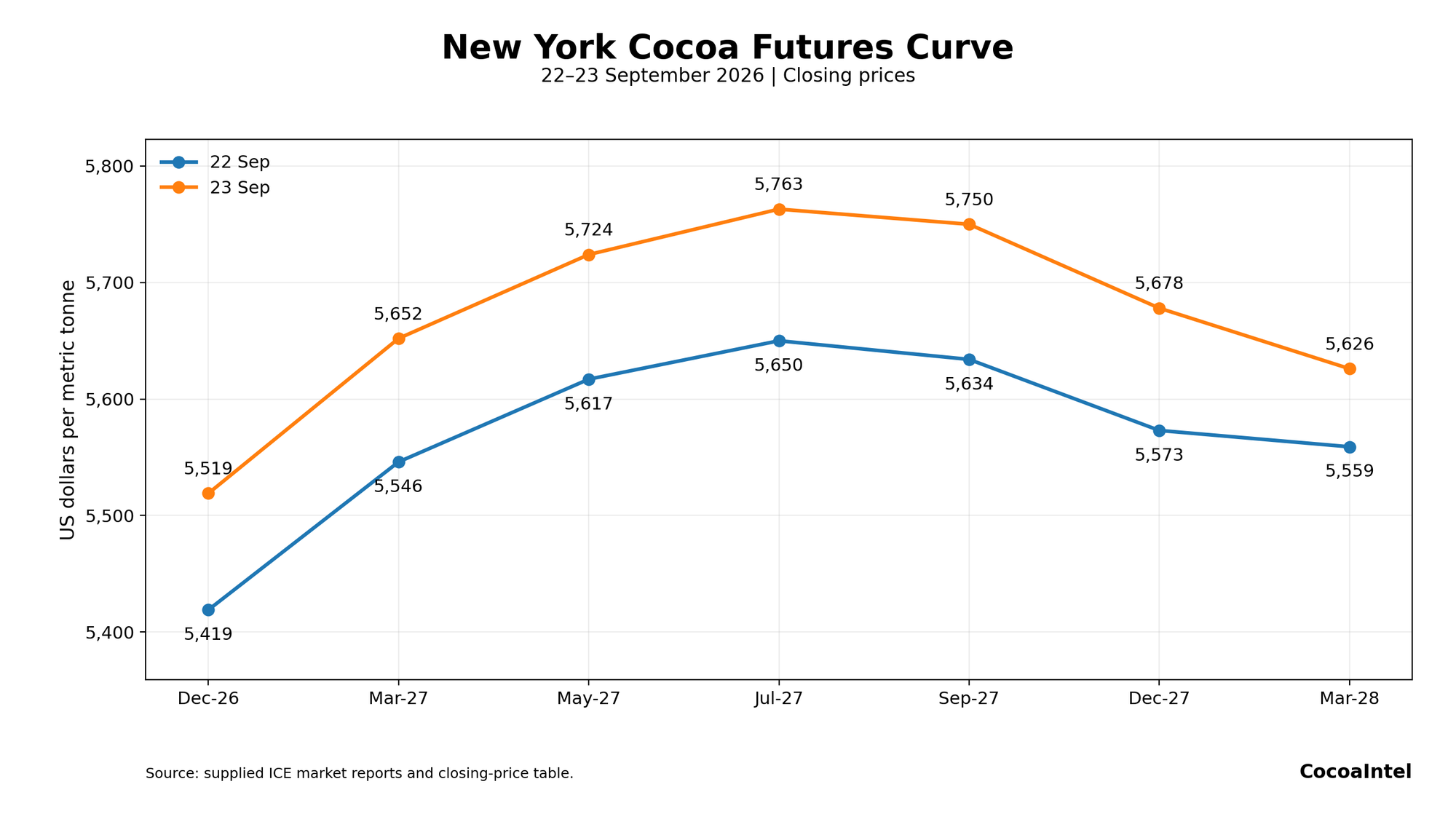
The curve rose across all seven maturities, but nearby spreads weakened despite the outright rally. December/March contango widened from $127 to $133/t, while May/July widened from $33 to $39/t. July remained the curve’s peak at $5,763/t, although its premium over September narrowed from $16 to $13/t. September/December backwardation strengthened from $61 to $72/t, leaving the firmer spread signal further along the curve. This is a broad price recovery, not a nearby supply squeeze: December still needs to outperform March to provide stronger confirmation of tightening prompt availability.
London cocoa
| Contract | 22 Sep Close | 23 Sep Close | Change | Change % |
|---|---|---|---|---|
| Dec-26 | £4,006 | £4,139 | +£133 | +3.32% |
| Mar-27 | £4,169 | £4,303 | +£134 | +3.21% |
| May-27 | £4,213 | £4,348 | +£135 | +3.20% |
| Jul-27 | £4,249 | £4,385 | +£136 | +3.20% |
| Sep-27 | £4,217 | £4,339 | +£122 | +2.89% |
| Dec-27 | £4,129 | £4,238 | +£109 | +2.64% |
| Mar-28 | £4,118 | £4,215 | +£97 | +2.36% |
London rallied sharply across the curve, with December gaining 3.32% to £4,139/t and the strongest absolute move in July at +£136/t. Gains gradually moderated further out, showing that the recovery remained concentrated toward the front and middle of the curve. The first four maturities also finished within £10 of their session highs, indicating that buyers maintained control into the close.
Volume fell to 29,008 contracts, down 33.3% from 43,493 on 22 September. The price recovery was therefore strong, but achieved on materially lighter turnover, which provides less confirmation than the magnitude of the outright move alone would suggest.
Futures Curve
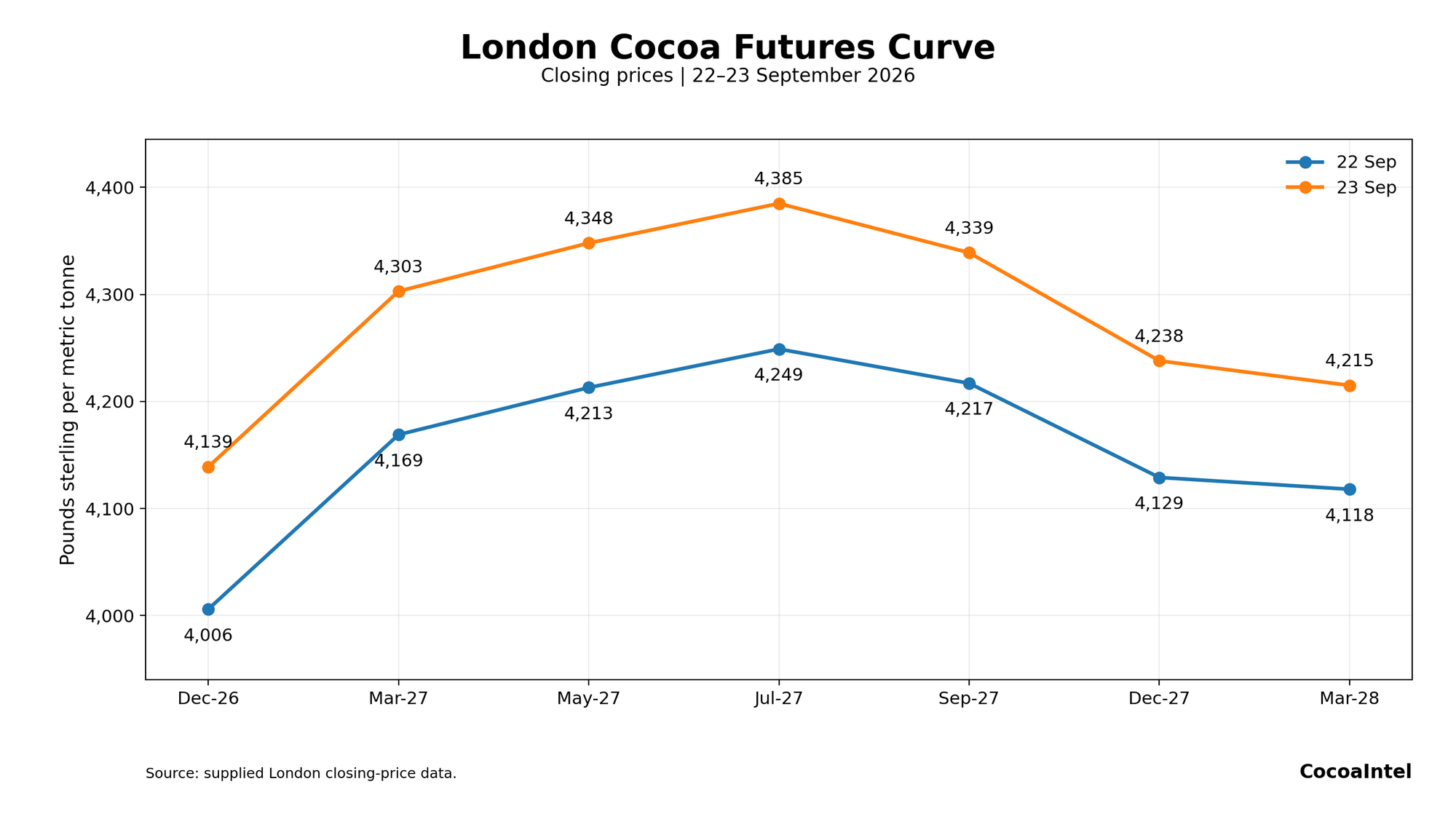
The curve gives a more nuanced signal than the flat-price rally. December/March contango widened slightly from £163 to £164/t, while March/May and May/July also widened by £1/t. Nearby December therefore did not strengthen relative to the next contracts despite the 3.3% rally.
Further along the curve, however, structure firmed. July/September backwardation widened from £32 to £46/t, while September/December increased from £88 to £101/t. Dec-26/Dec-27 contango also narrowed from £123 to £99/t. The market perspective is therefore strong outright recovery with improving mid-curve relative strength, but no evidence yet of an immediate nearby squeeze.
NY–London Dec-26 Spread
| Contract | New York | London | London in USD | NY–London Spread |
|---|---|---|---|---|
| Dec-26 | $5,519 | £4,139 | $5,479 | +$40/t |
| Mar-27 | $5,652 | £4,303 | $5,696 | −$44/t |
| May-27 | $5,724 | £4,348 | $5,756 | −$32/t |
| Jul-27 | $5,763 | £4,385 | $5,805 | −$42/t |
| Sep-27 | $5,750 | £4,339 | $5,744 | +$6/t |
| Dec-27 | $5,678 | £4,238 | $5,610 | +$68/t |
| Mar-28 | $5,626 | £4,215 | $5,580 | +$46/t |
For Dec-26: $5,519 − (£4,139 × 1.3238) = +$39.79/t, rounded to +$40/t.
Volume and Open Interest
New York cocoa
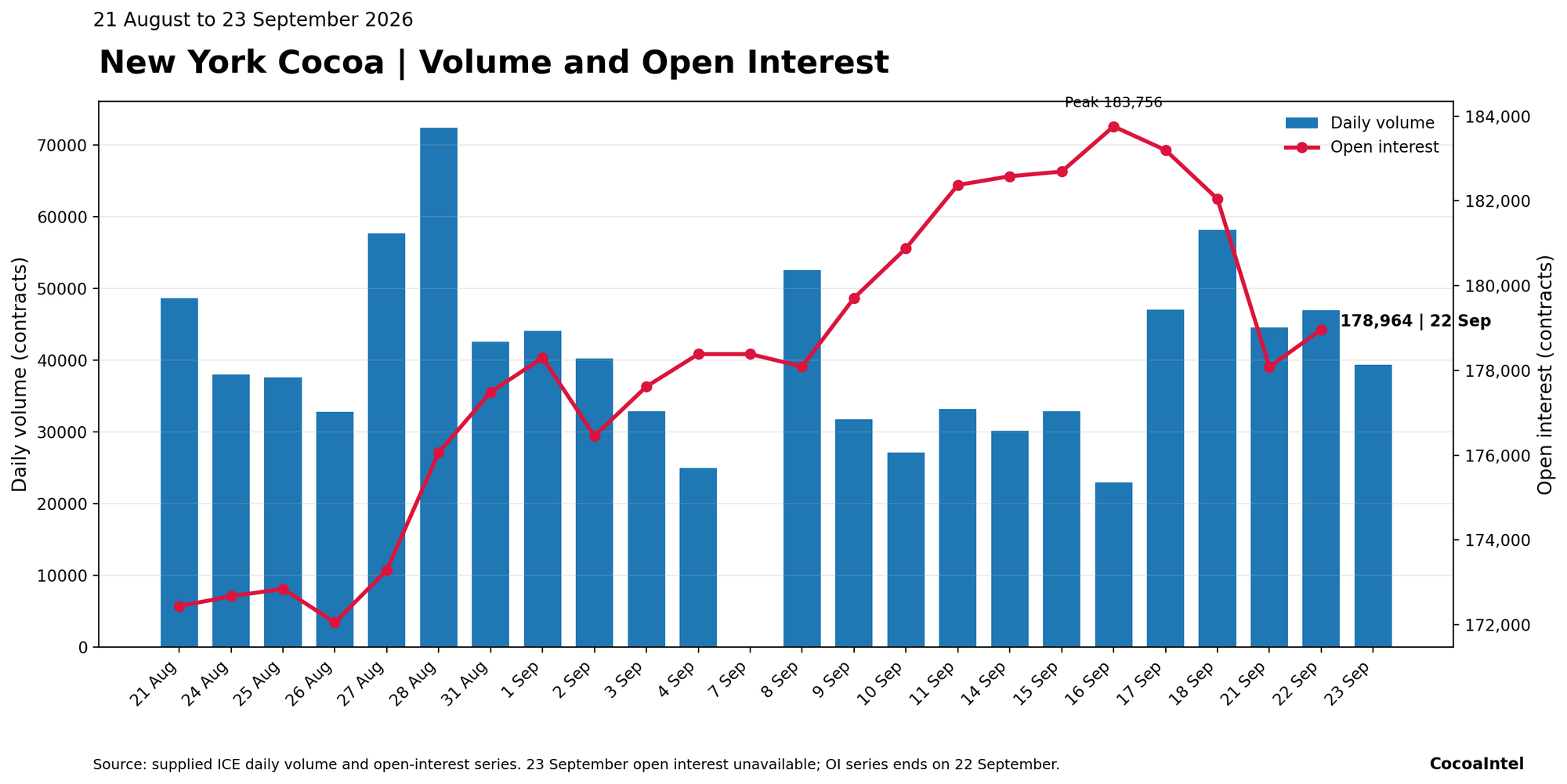
New York volume fell to 39,348 contracts on 23 September, down 16.2% from 46,972 a day earlier, but remained about 5% above the previous 10-session average. The second day of the rebound therefore came with lighter participation than Tuesday, although activity was still respectable rather than unusually thin.
The more constructive signal is the latest available open-interest reading. OI rose by 879 contracts to 178,964 on 22 September, reversing part of the sharp contraction seen into 21 September. That suggests Tuesday’s price recovery was accompanied by at least some fresh positioning rather than being driven entirely by short-covering. However, OI remains 4,792 contracts, or 2.6%, below the 16 September peak of 183,756.
London cocoa
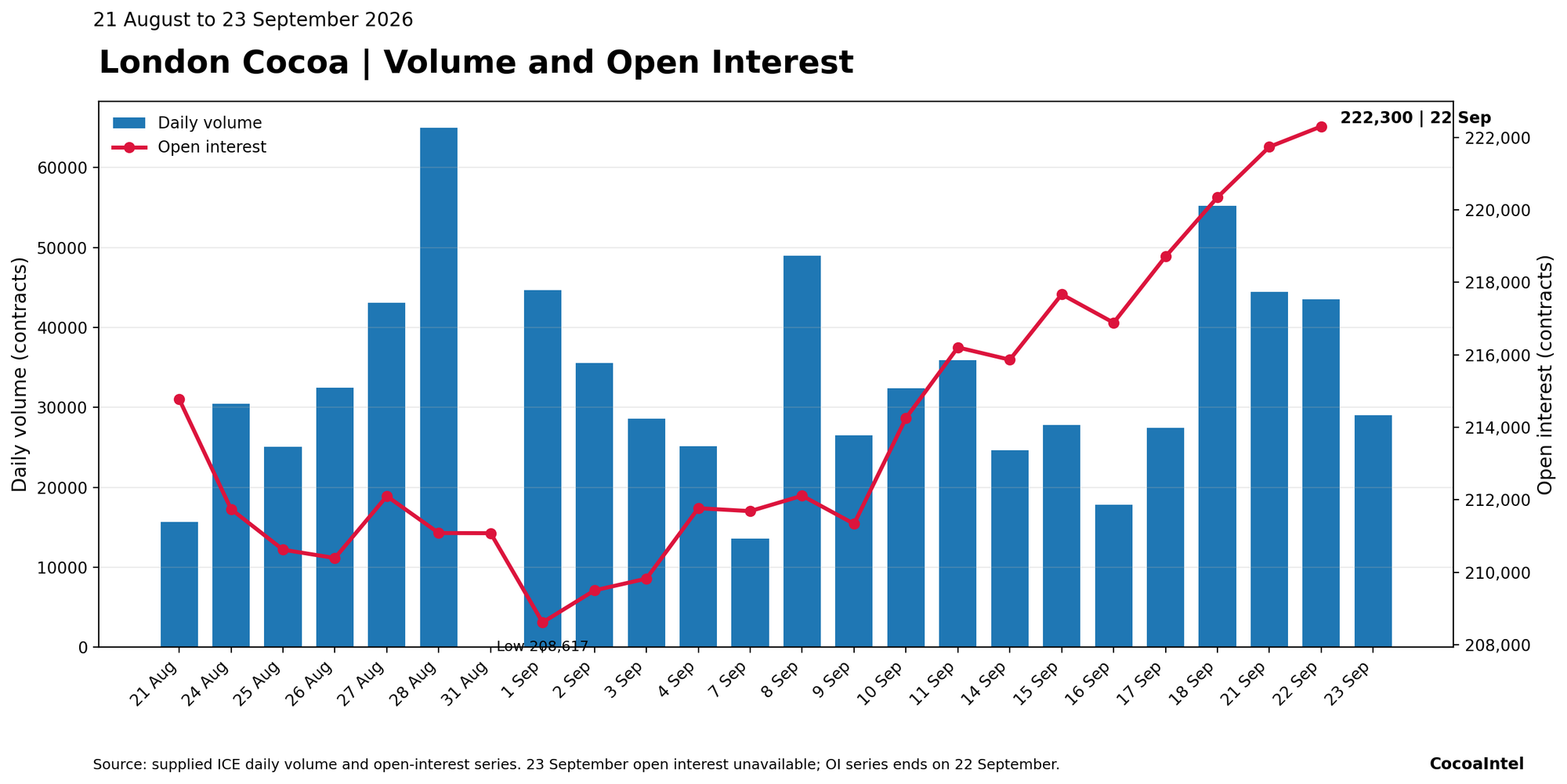
London volume declined to 29,008 contracts on 23 September, down 33.3% from the previous session and around 13.6% below the prior 10-session average. Price strength therefore continued on noticeably lighter turnover, which provides less confirmation than the New York move from a volume perspective.
London open interest increased by 564 contracts to 222,300 on 22 September, the highest reading in the supplied period and 6.6% above 1 September. The increase indicates continued position-building, but does not independently establish bullish accumulation. With 23 September OI unavailable, Wednesday’s strong price finish cannot yet be classified as fresh-position-led rather than predominantly short-covering.
ICE Cocoa Stocks
| Market | Previous update | Latest update | Change | Change % |
|---|---|---|---|---|
| US | 3,435,088 bags | 3,437,710 bags | +2,622 | +0.08% |
| UK / London | 1,165,156 bags | 1,180,781 bags | +15,625 | +1.34% |
US stocks held in ICE-licensed warehouses increased by 2,622 bags to 3,437,710 on 23 September. Certified stock moved in the opposite direction, falling by 9,130 bags, or 1.22%, to 738,381. The headline warehouse build therefore did not translate into an expansion of the certified pool.
London’s latest available report, dated 22 September, showed valid-warrant tonnage increasing by 1,000 tonnes to 75,570 tonnes, equivalent to approximately 1,180,781 bags of 64 kg. The inventory signal is mixed: London valid stocks increased, while US certified stocks contracted. These are different reporting dates and inventory measures, and neither the certification decline nor the increase in valid warrants should automatically be interpreted as physical warehouse flows.
Thursday Trading Setup - Dec Contract
Thursday’s bias favours bullish continuation, potentially after an initial pullback as intraday momentum resets. The defence of $5,300/t, where ascending-channel support overlaps the daily 90-period SMA, provides the foundation. Improving hourly RSI and MACD, alongside a daily stochastic turn from oversold, support another test of $5,560–5,600. However, daily MACD remains negative and volume confirmation is incomplete: this is still a recovery, not a confirmed trend reversal.
Sustained hourly acceptance above $5,600 would open $5,780–6,100 the previous consolidation and broader recovery objective. Thursday’s primary expectation is a test of $5,600, with extension towards $5,750 if participation strengthens; $6,000 requires a more substantial breakout. Holding $5,400–5,450 on any pullback would preserve the continuation setup. Losing that zone would expose $5,300 again, while sustained trading below $5,300 would invalidate the immediate bullish case and reopen $5,100–5,000.
If you notice any discrepancies in these figures or have extra information, please email hello@cocoaintel.com or leave a comment – corrections and additional insights are always welcome.