
Cocoa Sell-Off Deepens as New York Tests $5,300 Support (18 September 2026)


Cocoa extended its sell-off on Friday, 18 September, with both markets finishing near their session lows. New York December opened higher at $5,666 but reversed sharply, breaking below $5,500 and testing the $5,300 support area. The contract touched $5,290 before last trading at $5,330, down $290 or 5.16%. London December fell £281, or 6.61%, to £3,968, after reaching a low of £3,911. Higher turnover accompanied the declines in both markets, while both contracts finished in the bottom fifth of their daily ranges, leaving little evidence of a sustained recovery before the weekend.
Côte d’Ivoire’s regulator defended traceability as the strike’s impact remained unclear.
The Conseil du Café-Cacao said in a statement issued on 18 September that its mandatory traceability system was functioning normally. The statement followed SYNAP-CI’s announcement of an indefinite strike beginning on 16 September, including calls to withhold cocoa from Abidjan and San Pedro. The regulator’s assessment concerns the traceability system and does not independently establish whether physical deliveries have been affected.
Ghana’s cocoa financing faced investor resistance ahead of a possible funding offer.
JoyNews Research reported on 16 September, citing sector sources, that domestic institutional investors were seeking higher interest rates and risk premiums before committing funds for 2026/27 cocoa purchases. This compounded the purchasing constraints already flagged by licensed buyers over approximately GH¢4 billion in outstanding COCOBOD payments.
An 18 September JoyNews update indicated that COCOBOD could launch a financing offer during the week beginning 21 September, although it did not establish that funding had been secured. The immediate market concern is whether cash reaches buyers in time to purchase and move beans. Prolonged financing delays could restrict near-term deliveries even where cocoa is available, while successful fundraising would ease that risk.
Uganda’s cocoa exports contributed to higher July export earnings.
Uganda’s finance ministry identified cocoa beans among the commodities supporting a 10.1% year-on-year increase in total export earnings to $1.403 billion in July. The ministry report was published on 18 September and covered by Reuters on 21 September. However, it did not separately quantify cocoa export earnings or shipment volumes, leaving the contributions of prices and physical deliveries unclear.
Mars outlined efforts to improve cocoa productivity in Brazil and Indonesia.
Mars’s 2025 Cocoa for Generations progress report, documented two improved cocoa clones in Indonesia and 37 high-productivity, disease-resistant clones registered in Brazil. The company also highlighted disease-detection and bean-assessment tools, alongside efforts to diversify sourcing. These initiatives could improve yields and supply resilience over time.
Indonesia outlined plans to attract investment into Papua’s chocolate industry.
In comments made on 17 September, Transmigration Minister Muhammad Iftitah Sulaiman Suryanagara said the government intended to involve investors in developing chocolate production in Papua. The proposal could increase local processing and demand for Papuan cocoa while retaining more value at origin.
Nestlé faced uncertainty over its Russian operations.
Nestlé confirmed on 18 September that a presidential decree issued the previous day had placed its Russian business under temporary external administration. The company said it was assessing its options, protecting its rights and working to maintain business continuity. The development introduces operational uncertainty, but the statement announced no factory shutdown or quantified change in cocoa purchasing.
Weather
Weather risks remain concentrated in Côte d’Ivoire, Sulawesi and parts of Brazil, where rainfall deficits warrant continued monitoring. Ghana retains a stronger moisture position, Ecuador faces a fresh heavy-rainfall warning, and conditions across Peru remain mixed. The assessment covers 12–18 September, the preceding 30 days and the outlook for the week beginning 21 September.
Côte d’Ivoire
Monitored interior areas received only 5–11 mm during the latest week. Over 30 days, sizeable central and southern areas recorded approximately 25–50% of normal rainfall, while western soil-moisture indicators remained weak. Further below-normal rainfall would limit replenishment and increase concern for developing pods. Forecast temperatures near or slightly below normal offer some relief from evaporative pressure.
Ghana
Monitored areas received 25–35 mm, with a stronger monthly rainfall balance and generally wetter soil-moisture indicators than a year earlier. Recent temperatures were around 1°C above normal, adding to water demand. The outlook favours drier conditions across the southern belt, but existing moisture reserves provide a relative buffer. Coastal and inland conditions remain uneven.
Nigeria and Cameroon
Weekly rainfall averaged approximately 45 mm in the monitored areas, although monthly deficits persisted locally. Soil-moisture models disagree, particularly over Nigeria, so recent rain cannot be assumed to have eliminated underlying dryness. Further rainfall should support replenishment, but heavier showers could restrict field access and bean drying, especially in southern Nigeria and western Cameroon.
Ecuador
INAMHI’s 19 September warning identifies increasing rainfall across the northern and central coastal cocoa belt, including Esmeraldas, Manabí, Santo Domingo, Los Ríos and northern Guayas. The most active periods are expected on 21 September and the night of 22–23 September. Antecedent moisture conditions remain variable, and monitored coastal river gauges were normal on 19 September. Additional rain could replenish drier plots while increasing localized waterlogging, transport and drying risks.
Brazil
Southern Bahia enters the forecast period with accumulated drought in several cocoa municipalities. CEMADEN’s August assessment classified Ilhéus as moderately dry and several neighbouring producing municipalities as severely dry. Pará’s indicators were more mixed. Forecasts favour limited rainfall and daytime maximum temperatures broadly 2–4°C above normal across central Transamazonian Pará and inland southern Bahia, although coastal showers remain possible. Further warmth and insufficient replenishment could increase stress where reserves are depleted.
Indonesia
Sulawesi’s estimated rainfall reached 7.5 mm during the latest week, compared with 45.5 mm in the corresponding 2025 period. The 30-day total was approximately 90% lower year-on-year, while mean daily maximum temperatures were about 1.9°C higher. Rainfall nevertheless increased slightly from the preceding week, indicating persistent dryness with limited improvement. Showers forecast in Central, West and South Sulawesi during 21–24 September could provide local relief, but a broader moisture recovery remains uncertain.
Peru
Rainfall increased in the San Martín monitoring area but declined in Huánuco and Ucayali during the latest week. Their monthly totals remained above the corresponding 2025 periods, despite localized deficits relative to normal. The outlook brings renewed foothill rainfall, including 25–50 mm patches around Tarapoto–Tocache–Tingo María, alongside daytime maximum temperatures commonly 2–4°C above normal. Rain should improve moisture locally, while warmer conditions make its distribution increasingly important.
Futures performance
New York cocoa
| Contract | 17 Sep close | 18 Sep close | Change | Change % |
|---|---|---|---|---|
| Dec-26 | $5,620 | $5,330 | −$290 | −5.16% |
| Mar-27 | $5,731 | $5,445 | −$286 | −4.99% |
| May-27 | $5,792 | $5,504 | −$288 | −4.97% |
| Jul-27 | $5,800 | $5,529 | −$271 | −4.67% |
| Sep-27 | $5,768 | $5,519 | −$249 | −4.32% |
| Dec-27 | $5,612 | $5,439 | −$173 | −3.08% |
| Mar-28 | $5,711 | $5,425 | −$286 | −5.01% |
New York cocoa extended its decline across all seven comparable maturities on 18 September. Dec-26 fell $290, or 5.16%, to $5,330, bringing its combined loss over Thursday and Friday to $621, or 10.44%. Declines ranged from 3.08% in Dec-27 to 5.16% in Dec-26. The nearby contract therefore recorded the largest percentage loss, while Dec-27 showed the greatest relative resilience on this last-trade basis.
Six of the seven contracts traded above Thursday’s last-traded close during the session, but those gains did not hold. Dec-26 ranged between $5,290 and $5,684, trading below both $5,500 and $5,300 before finishing just $40 above its low. Its $394 range was narrower than Thursday’s $532, but the close was weaker within that range: approximately 10% above the low, compared with 21% on Thursday. Dec-26 through Dec-27 all finished within the bottom 11% of their ranges; Mar-28 ended approximately one-third of the way up its range. The session therefore showed continued selling pressure and little recovery by the final trades.
New York cocoa futures curve
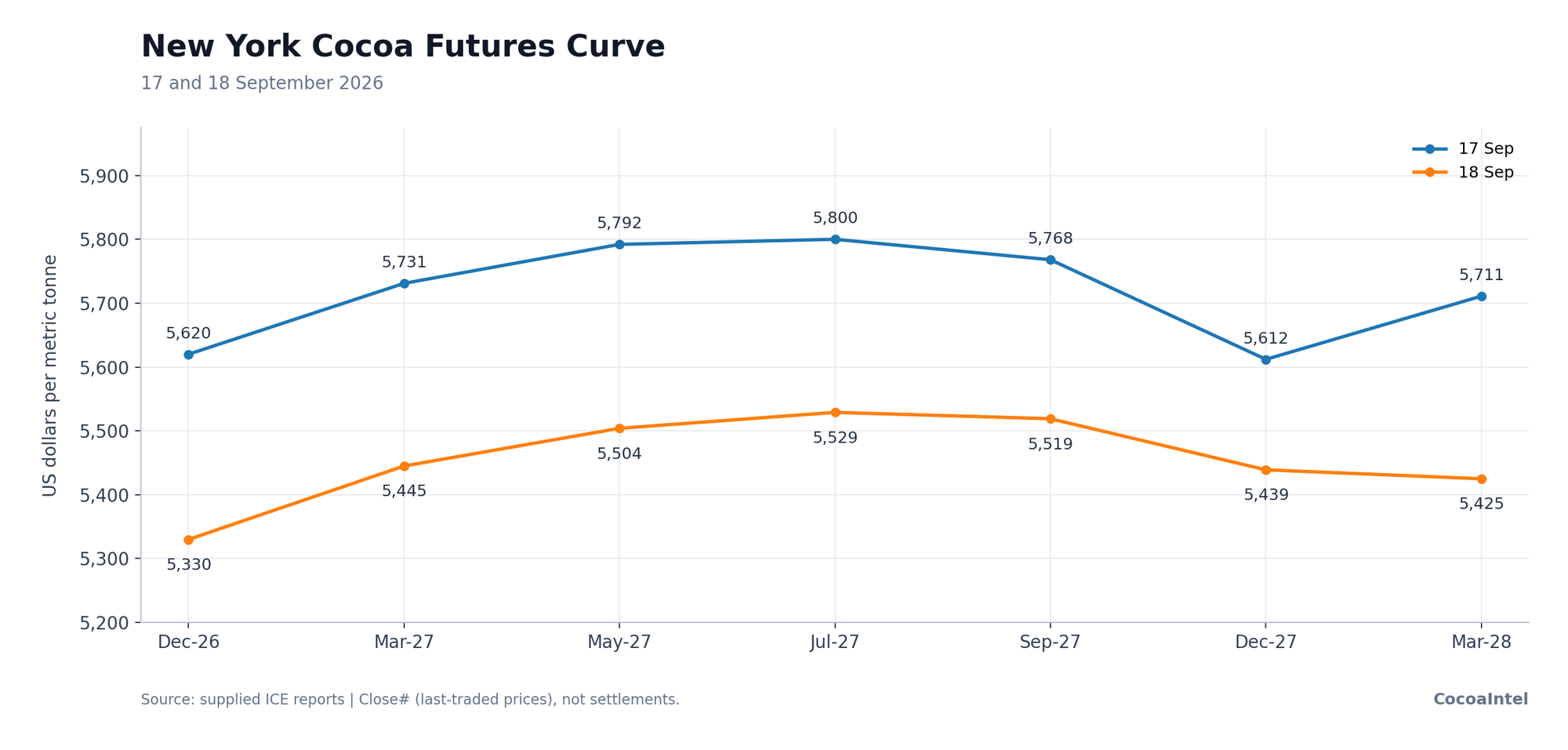
The New York curve shifted lower while retaining its peak in Jul-27, now at $5,529, only $10 above Sep-27. Dec-26/Mar-27 contango widened slightly from $111 to $115, while May-27/Jul-27 contango increased from $8 to $25. Beyond July, backwardation narrowed from $32 to $10 against Sep-27 and from $156 to $80 between Sep-27 and Dec-27. Dec-26/Dec-27 moved from $8 backwardation to $109 contango, reflecting the larger decline in nearby December relative to December 2027.
The Dec-27/Mar-28 relationship requires the same caution as in the previous report. Last trades moved from $99 contango to $14 backwardation, but official settlements showed backwardation on both days, narrowing from $93 to $55. The apparent reversal in the last-trade curve should therefore not be presented as a confirmed structural change. Last trades in different maturities need not occur at the same time, particularly in less active contracts.
London cocoa
| Contract | 17 Sep close | 18 Sep close | Change | Change % |
|---|---|---|---|---|
| Dec-26 | £4,249 | £3,968 | −£281 | −6.61% |
| Mar-27 | £4,418 | £4,125 | −£293 | −6.63% |
| May-27 | £4,458 | £4,159 | −£299 | −6.71% |
| Jul-27 | £4,471 | £4,187 | −£284 | −6.35% |
| Sep-27 | £4,417 | £4,157 | −£260 | −5.89% |
| Dec-27 | £4,284 | £4,078 | −£206 | −4.81% |
| Mar-28 | £4,255 | £4,087 | −£168 | −3.95% |
London cocoa also fell across all seven comparable maturities, with losses accelerating from Thursday on this closing-price basis. Dec-26 dropped £281, or 6.61%, to £3,968, taking its two-session decline to £410, or 9.37%. May-27 recorded the largest percentage fall at 6.71%, while losses moderated farther out to 4.81% in Dec-27 and 3.95% in Mar-28. The sell-off was broad, but deferred contracts again held up better than the front and middle of the curve.
Unlike New York, every comparable London contract remained below Thursday’s last-traded close throughout its reported daily range. Dec-26 traded between £3,911 and £4,225 before finishing at £3,968, £57 above its low and approximately 18% of the way up its range. Its £314 range was 46.7% wider than Thursday’s £214. Dec-26 through Sep-27 finished within the bottom 19% of their ranges, while Dec-27 and Mar-28 ended around 24% and 32%, respectively. The combination of wider ranges and low closing positions indicates sustained pressure, with no recovery to the previous day’s closing levels.
London cocoa futures curve
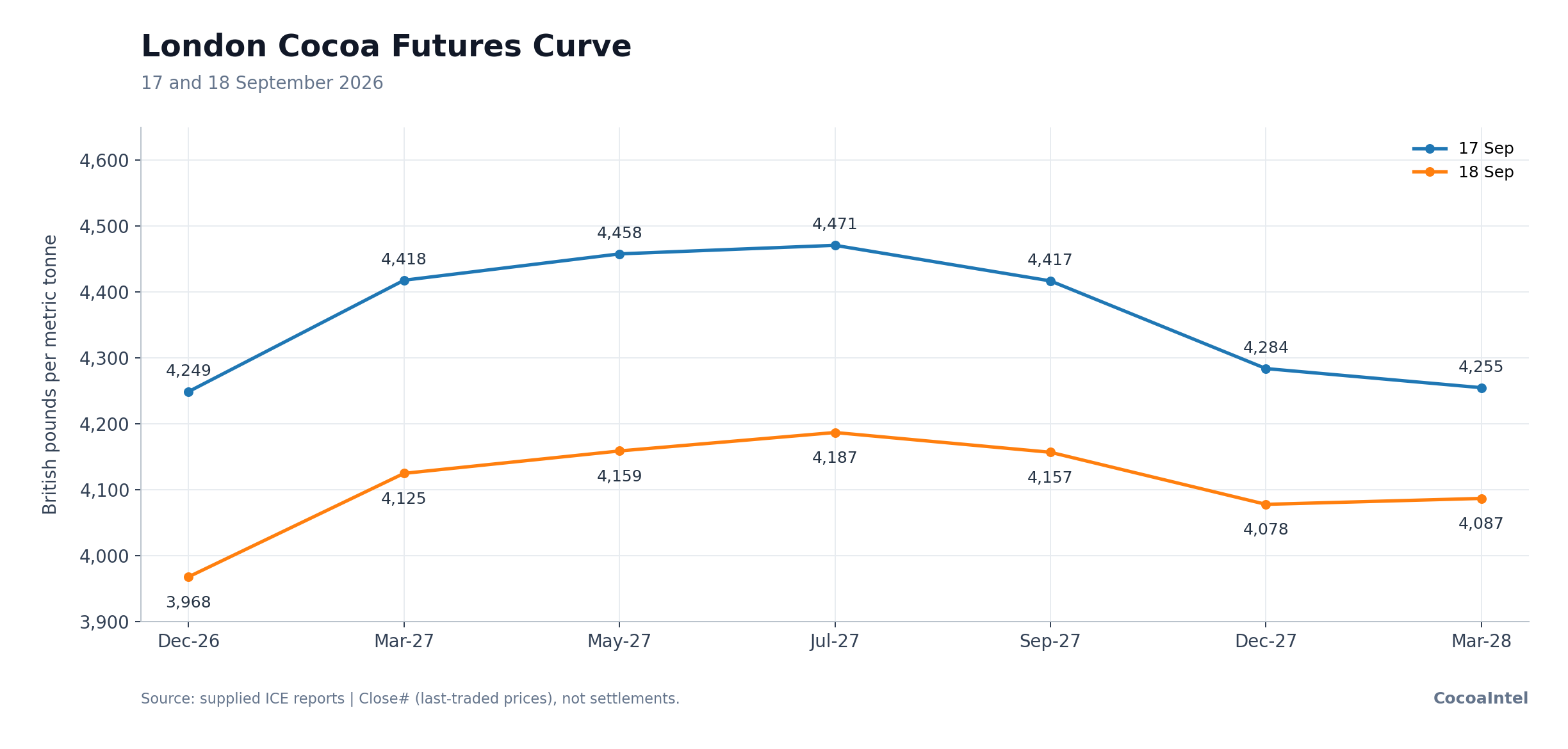
The London curve shifted sharply lower, retaining its highest closing price in Jul-27 at £4,187. Dec-26/Mar-27 contango narrowed from £169 to £157, and Mar-27/May-27 contango contracted from £40 to £34. May-27/Jul-27 contango widened from £13 to £28. Although nearby contango narrowed, the substantial December discount to March remained intact.
Farther out, Jul-27/Sep-27 backwardation narrowed from £54 to £30, while Sep-27/Dec-27 backwardation contracted from £133 to £79. Dec-27/Mar-28 changed from £29 backwardation to £9 contango; official settlements also confirmed that change in direction. Dec-26/Dec-27 contango widened from £35 to £110, showing that nearby December weakened more than December 2027 despite the narrowing in the December–March spread.
NY–London Dec-26 Spread
$5,330 − (£3,968 × 1.3395 $/£) = +$14.86/t
New York December moved to approximately $15/t above London, compared with a $52/t discount on 17 September, using each day’s exchange rate. The spread shifted approximately $67/t in New York’s favour, restoring a small premium as London weakened more sharply.
Volume and Open Interest
New York Cocoa
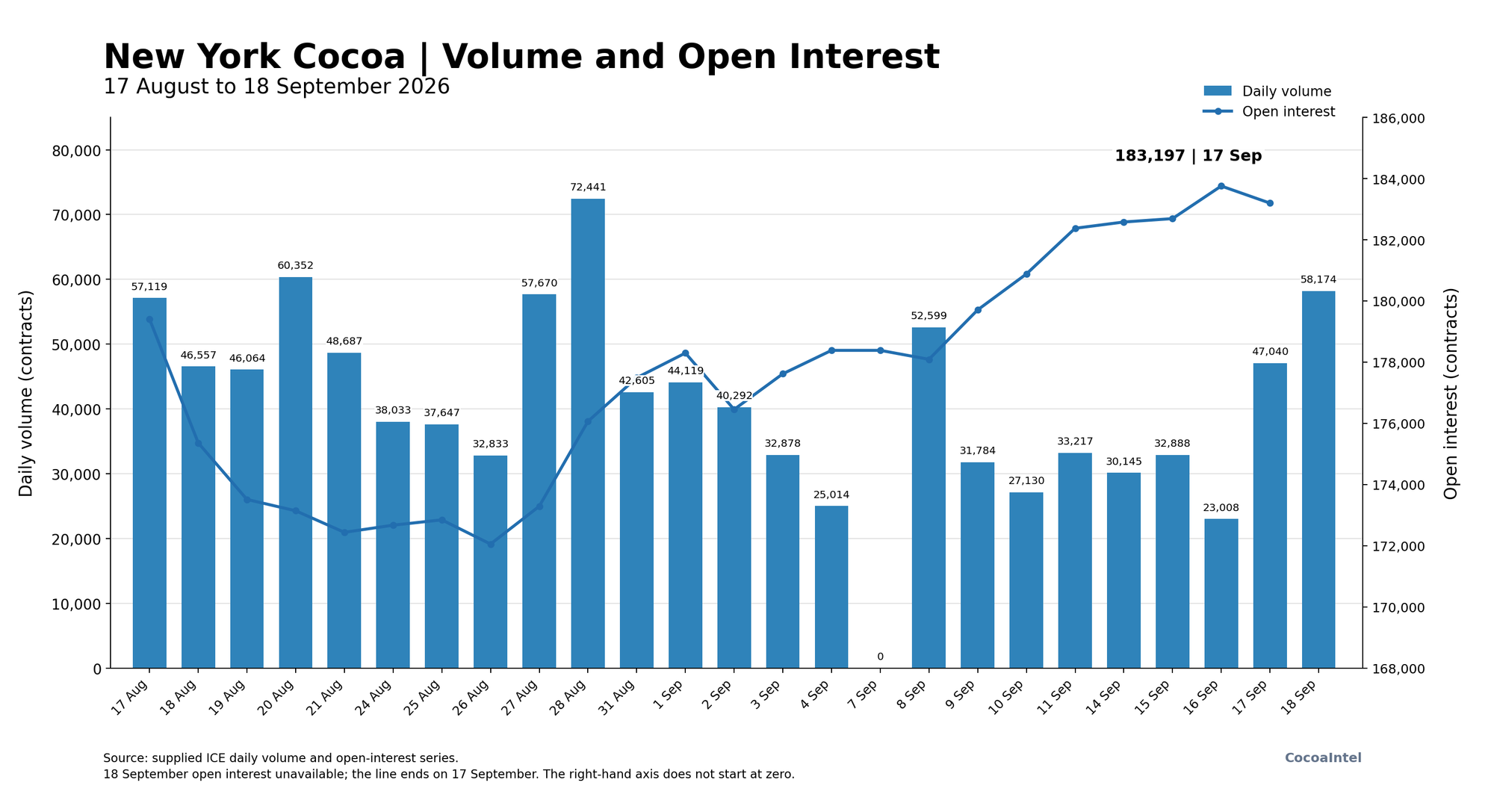
New York cocoa volume rose to 58,174 contracts on 18 September, up 23.7% from 47,040 on Thursday. Turnover was 44.0% above the recent 20-session average of 40,410 contracts and the highest since 28 August, although still 19.7% below that session’s peak of 72,441. Friday’s further price decline therefore attracted above-average participation for a second consecutive session, extending the contrast with Wednesday’s low-volume rebound.
The latest available open interest is 183,197 contracts for 17 September, down 559 contracts, or 0.30%, from Wednesday’s series high of 183,756. OI nevertheless remained 11,142 contracts, or 6.5%, above its 26 August low. Thursday’s falling prices thus coincided with a modest net reduction in outstanding positions, consistent with some position unwinding. The small decline in aggregate OI does not establish that long liquidation was the dominant driver or exclude new positions being opened during the session.
Friday’s heavier turnover shows increased participation in the continued sell-off, but its positioning remains unresolved because 18 September OI is unavailable. A further decline in OI would indicate additional net position closures; an increase would show that outstanding exposure expanded during the fall. Thursday’s OI contraction should not be carried forward as evidence of Friday’s trading behaviour.
London Cocoa
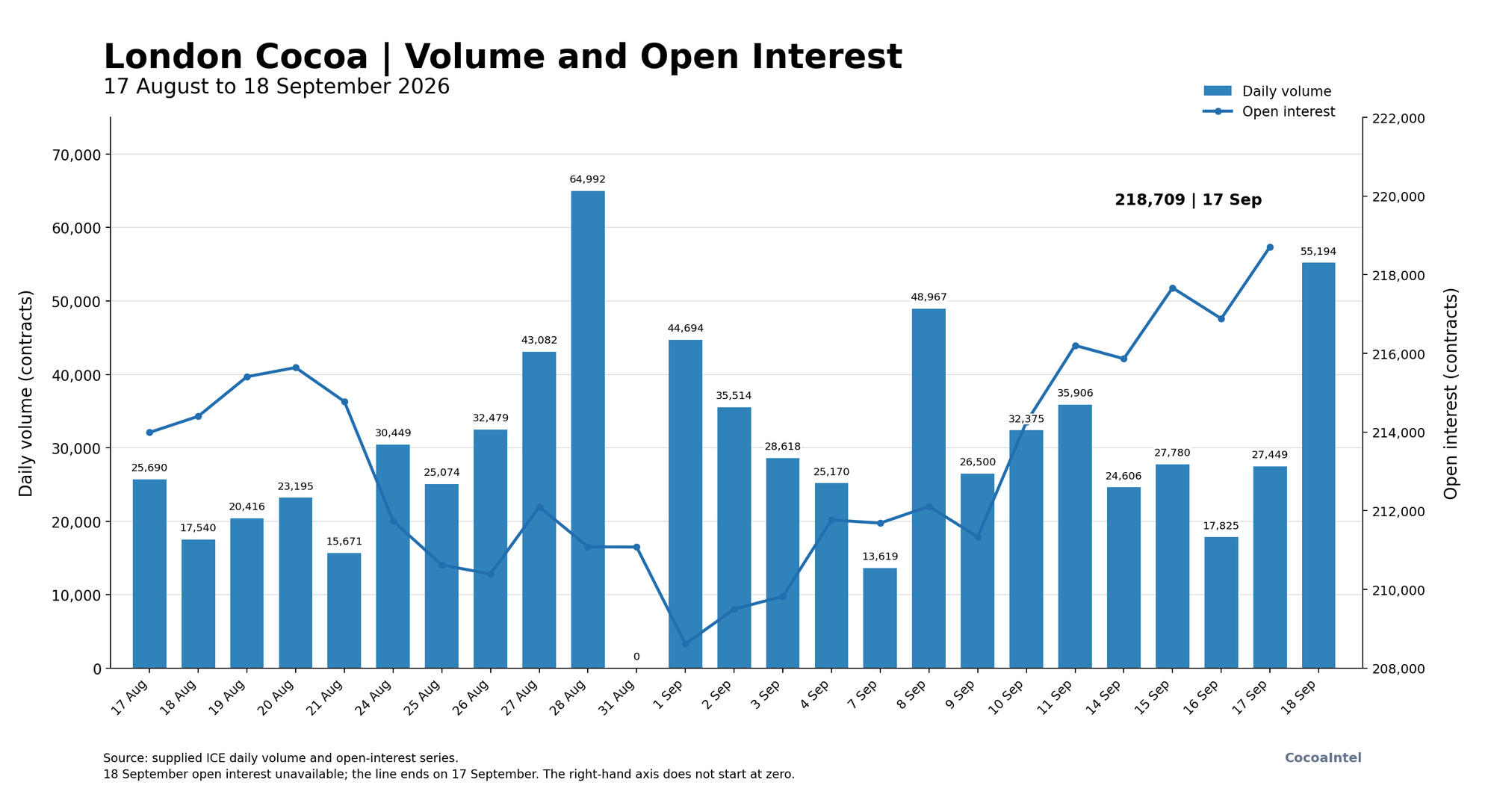
London cocoa volume more than doubled to 55,194 contracts on 18 September, up 101.1% from 27,449 on Thursday. Turnover was 68.3% above the recent 20-session average of 32,798 contracts and the highest since 28 August. It was the second-highest reading in the displayed period, remaining 15.1% below the peak of 64,992. Friday’s decline consequently drew substantially stronger participation than Thursday’s, when volume had remained below its recent average.
The latest available open interest rose to 218,709 contracts on 17 September, up 1,825 contracts, or 0.84%, from the previous session and the highest level in the series. OI stood 10,092 contracts, or 4.8%, above its 1 September low. Thursday’s falling prices therefore coincided with net position creation, contrasting with New York’s modest contraction. This supports the interpretation that new positions were being established during the decline, but aggregate OI cannot identify which side initiated them or prove that speculative short selling drove the move.
Friday’s much heavier turnover adds evidence that participation in the sell-off broadened. However, the increase in OI belongs to Thursday; Friday’s positioning cannot be classified until the next reading is available. The data currently show a decline accompanied by expanding exposure on Thursday, followed by a further fall on much higher volume on Friday.
COT Analysis
Funds were positioned bearishly before cocoa broke support, with New York showing a further reduction in bullish exposure. However, these reports cover 15 September and do not capture the sell-off on 17–18 September.
| Managed-money positioning | New York | London |
|---|---|---|
| Long positions | 18,956 | 7,001 |
| Short positions | 31,401 | 10,482 |
| Net position | −12,445 | −3,481 |
| Weekly net change | −910 | Not supplied |
| Net position / combined open interest | −5.12% | −1.19% |
Futures and options combined, across contract months. Negative net positions indicate net shorts.
New York. Managed money’s net short widened from 11,535 to 12,445 contracts, an increase of 7.9%. Reported longs fell by 1,432 contracts, or 7.0%, while shorts also declined, by 522 contracts, or 1.6%. The bearish shift therefore came from a larger contraction in long exposure. This suggests weakening bullish commitment ahead of the breakdown; the reported figures do not show an increase in directional shorts during that week.
Spreading increased by 1,610 to 39,726 contracts. Because offsetting positions are classified separately, and options are converted into futures equivalents using their deltas, changes in these columns cannot be translated directly into contracts bought or sold. Describing the entire reduction in reported longs as outright futures liquidation would overstate the evidence.
London. Managed money held a 3,481-contract net short, equivalent to 1.19% of combined open interest. Its bearish imbalance was smaller than New York’s relative to market size. The supplied London report contains no weekly comparison, so it cannot establish whether funds were increasing or reducing bearish exposure.
Producer/merchant/processor/user positions were also net short: 21,397 contracts in New York and 19,137 in London. These businesses use derivatives to hedge physical-market exposure, so their shorts should not automatically be interpreted as predictions of lower prices.
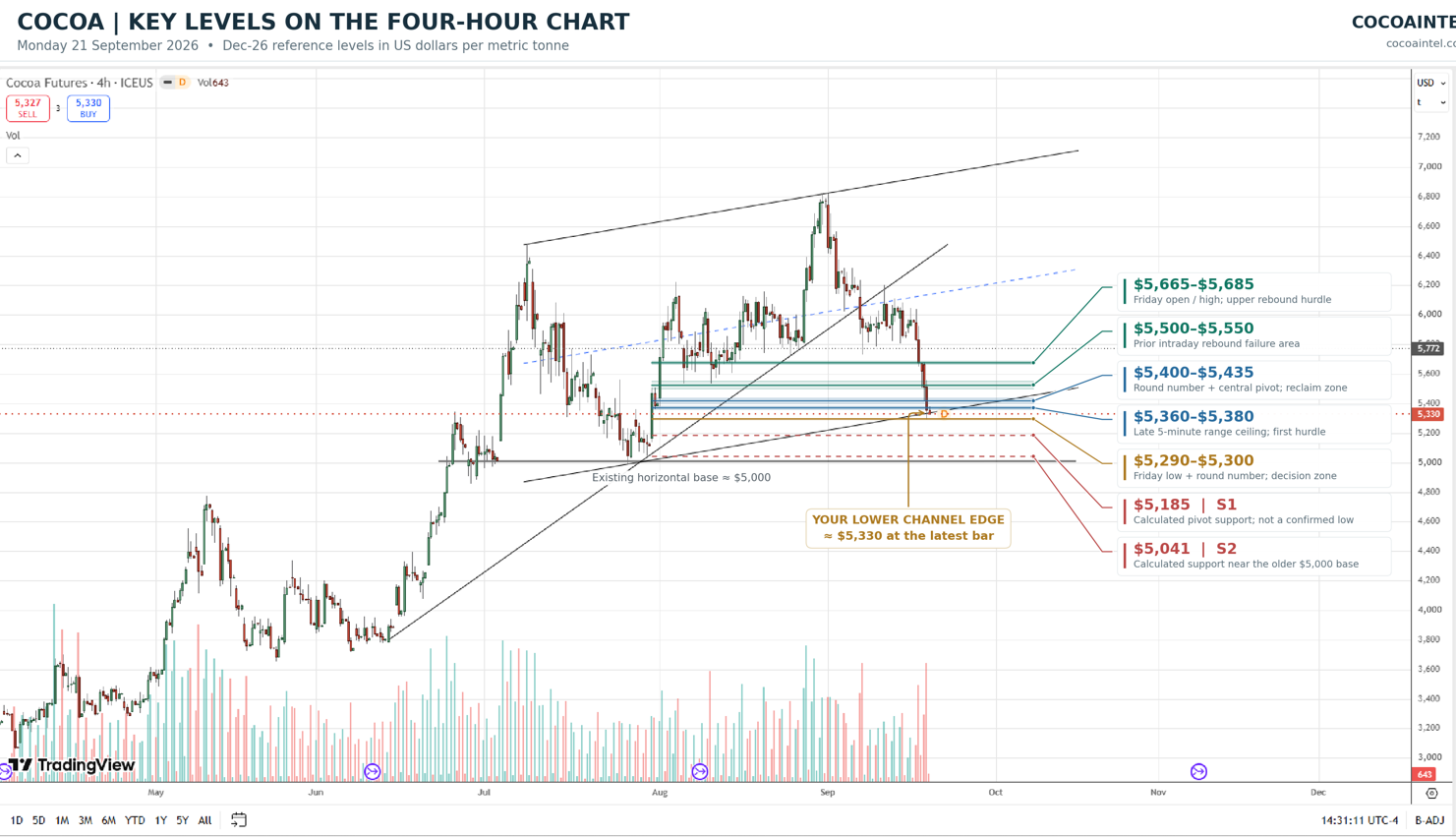
For future price action, COT provides bearish context rather than a timing signal. The breakdown occurred with funds already leaning short and New York’s bullish exposure weakening. Further reductions in long exposure or fresh short selling could extend the decline. On the December chart, an hourly break below $5,290–$5,300, followed by a failed recovery, would strengthen that continuation scenario. The COT figures themselves cannot confirm those later flows.
Conversely, holding support and reclaiming $5,400–$5,435 could encourage existing shorts to cover, helping a rebound toward $5,500–$5,550. A recovery would still need higher lows and sustained buying. These snapshots are insufficient to establish that shorts are exceptionally crowded, so the net-short balance alone is not a reliable bottom signal.
ICE Cocoa Stocks
| Market | 17 Sep update | 18 Sep update | Change | Change % |
|---|---|---|---|---|
| US | 3,429,167 | 3,434,532 | +5,365 | +0.16% |
| UK / London | 1,478,594 | 1,161,250 | −317,344 | −21.46% |
London’s reported valid stocks fell by 317,344 bag equivalents, or 21.46%, to 1,161,250, with the warrant breakdown indicating an expiry-related reclassification. Across all three delivery-unit categories, reductions in initially valid warrants were exactly matched by increases in expired warrants. This means less cocoa was classified as valid for exchange delivery, but does not establish that an equivalent quantity physically left warehouses. The decline should therefore be treated as a change in delivery eligibility, rather than evidence of stronger consumption or a sudden tightening in physical supply.
Monday Trading Setup Dec Contract
December cocoa enters Monday with a bearish bias after falling 5.16% to $5,330 on Friday. The decline reached the previously identified $5,300 channel-support area, with a session low of $5,290. December-contract volume rose 18.0% to 24,966 contracts.
The daily chart places price near its rising 90-period moving average, reinforcing the importance of the $5,300 area. The hourly structure remains weak: price is below its falling 9- and 21-period averages, RSI and stochastic are depressed, MACD is negative and OBV is near recent lows. Hourly volatility has increased, while the late five-minute consolidation showed contracting ranges. A corrective bounce remains possible, but oversold readings alone cannot establish a bottom.
The immediate decision area is $5,290–$5,300. An hourly close below $5,290, followed by a failed recovery above $5,300, would strengthen the continuation case and bring calculated pivot support near $5,185, then $5,041, into focus. These are conditional reference levels, rather than confirmed buying zones. Rebounds that stall below $5,400–$5,435 would leave the sequence of lower highs intact.
For a recovery to develop, price first needs to hold $5,290–$5,300 and clear $5,360–$5,380, around the top of the late intraday consolidation. An hourly reclaim of $5,400–$5,435, followed by a higher low, would improve the case for a rebound toward $5,500–$5,550, where Friday’s earlier recovery failed. Sustained trading above $5,550 would weaken the immediate bearish case and bring $5,665–$5,685, covering Friday’s opening and high area, back into view.
If you notice any discrepancies in these figures or have extra information, please email hello@cocoaintel.com or leave a comment – corrections and additional insights are always welcome.