
El Niño Watch: Cocoa’s Next Big Headache May Already Be Forming
Rising El Niño probabilities could threaten West African cocoa production just as the market enters the 2026/27 season with thin inventories and fragile crop conditions.

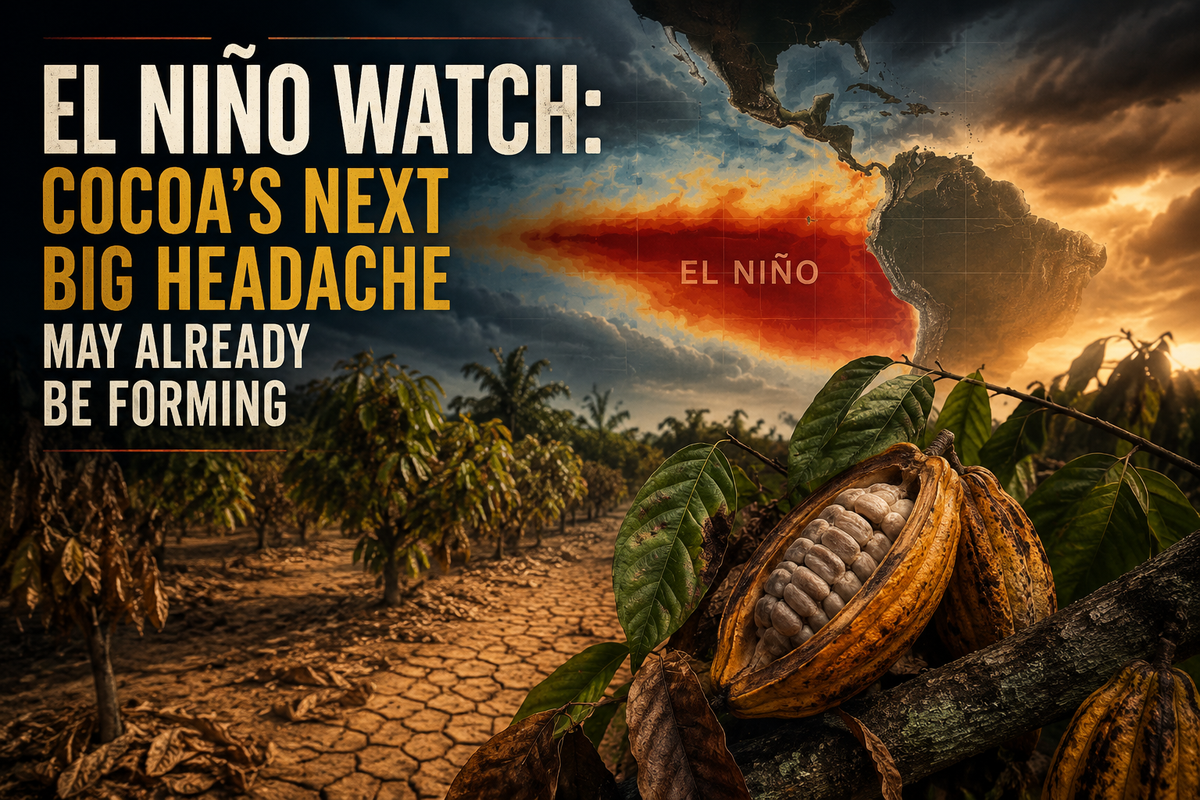
The cocoa market has moved from panic to relative calm with remarkable speed. After futures surged to nearly $12,000 per tonne in late 2024, a level that few market participants considered plausible, prices retraced sharply as improving West African harvest prospects and a severe contraction in demand shifted sentiment from acute shortage to tentative surplus. The most extreme fears have faded, and the industry is no longer operating under the same sense of immediate crisis. Yet the underlying vulnerabilities that produced the historic rally remain largely unresolved. With the probability of El Niño rising materially for the second half of 2026, it is increasingly clear that the market may be more fragile than current prices suggest.
The 2023/24 season marked one of the most severe supply disruptions in the history of the cocoa market. Global production fell far short of consumption, creating a deficit estimated at approximately 490,000 tonnes. Stocks-to-grindings ratios declined to their lowest levels in more than four decades, while certified inventories in Europe and North America were drawn down aggressively. The resulting price spike forced a rapid adjustment across the chocolate supply chain. Manufacturers reformulated products, reduced cocoa content where possible, introduced smaller package sizes, and raised consumer prices. Industrial demand contracted significantly. European grindings declined sharply, and Asian grindings experienced an even more pronounced drop as processors and manufacturers responded to unprecedented raw material costs.
The subsequent correction in prices was therefore not solely a story of improving supply. It was also a story of demand destruction. The market rebalanced because consumption adjusted downward as much as because production began to recover. This distinction is important. Demand destruction can stabilize the balance sheet temporarily, but it does not address the structural constraints that continue to limit the cocoa sector’s capacity to produce consistently.
Production has indeed improved. Current forecasts suggest that global cocoa output in the 2025/26 season will recover meaningfully from the lows of the previous year, and the International Cocoa Organization has shifted its outlook from a substantial deficit to a modest surplus. However, the size of that surplus remains highly uncertain and has already been revised several times. StoneX recently reduced its estimate for the 2026/27 surplus by nearly half, citing weather risks and weak farm-level investment. What appears on paper to be a return to balance is, in reality, a narrow and potentially unstable cushion.
The reason this matters is that the structural problems facing the cocoa sector have not been resolved. Côte d’Ivoire and Ghana continue to account for roughly 60% of global cocoa production, and both countries enter the upcoming crop cycle with substantial agronomic and financial challenges. Cocoa swollen shoot virus remains a major issue in Ghana. Black pod disease continues to pressure yields across the region. Much of the tree stock is old and less productive. Replanting programs remain underfunded, and fertilizer application rates are widely reported to be inadequate.
These problems have been exacerbated by the sharp decline in prices from the 2024 highs. Although international prices reached unprecedented levels, many farmers did not receive a proportionate improvement in long-term profitability. Subsequent cuts in farmgate prices have reduced incentives to invest in pruning, fertilizer, pest management, and rehabilitation. In Côte d’Ivoire, surveys suggest that a large majority of farmers have not purchased sufficient fertilizer for the coming season. This is a particularly concerning signal because nutrient deficits often translate into lower yields even when weather conditions are favorable.
In other words, the market may be in surplus, but it is a surplus resting on a biologically weakened and financially constrained production base.
This is the context in which El Niño is re-emerging as a significant market risk.
Both the National Oceanic and Atmospheric Administration and the World Meteorological Organization indicate that the probability of El Niño development has increased materially. ENSO-neutral conditions still prevail, but ocean temperatures and atmospheric indicators are increasingly consistent with a transition toward El Niño during the second half of 2026. NOAA currently assigns a 61% probability that El Niño develops during the May–July period and a greater than 90% probability that it is established by October–December. Importantly, the agency also assigns a meaningful probability that the event becomes very strong by late 2026.
For cocoa, the timing is particularly concerning. The period during which El Niño is most likely to become established overlaps with the onset of the West African main crop. Historically, El Niño has often been associated with below-normal rainfall and elevated temperatures across parts of the cocoa belt, although the magnitude and geographic distribution of impacts vary from event to event. The key risk is not simply reduced precipitation, but the interaction between weather stress and already weakened orchards.
Cocoa trees are highly sensitive to moisture deficits during flowering and pod development. When rainfall is insufficient or temperatures become excessively high, trees may abort flowers and cherelles, reduce pod retention, and produce smaller beans. Agronomic studies indicate that even moderate reductions in rainfall can lead to substantial declines in dry bean yields. Under current conditions, where disease pressure is elevated and fertilizer application is limited, the crop’s resilience to such stress is significantly diminished.
The risk is not confined to West Africa. Indonesia often experiences drier conditions during El Niño years, increasing pest pressure and reducing yields. Ecuador can experience excessive rainfall that complicates drying and raises disease incidence. Brazil may also experience altered rainfall patterns. These producing countries provide valuable diversification, but they do not have the scale necessary to offset a major shortfall in Côte d’Ivoire or Ghana.
The market is beginning to recognize this vulnerability. Cocoa futures have recovered substantially from their February 2026 lows, and weather risk is increasingly part of the narrative. The most important point is not that a supply crisis is inevitable. It is that the margin for error is extremely small. A projected surplus of roughly 150,000 tonnes in a market consuming nearly five million tonnes per year provides only a modest buffer. A single season of weather-induced disruption could erase that cushion quickly.
Because inventories remain tight, the market is unlikely to wait for definitive evidence of crop damage before repricing. As seen during the 2023–2025 rally, futures can respond aggressively to changes in expected supply long before official crop estimates are revised. If El Niño is formally declared and rainfall anomalies begin to appear across the West African cocoa belt, a weather premium could return rapidly to both New York and London cocoa futures.
Several indicators will be particularly important over the coming months. NOAA and WMO ENSO updates will provide the clearest signal regarding the evolution of Pacific conditions. Rainfall and soil moisture data across Côte d’Ivoire and Ghana will offer early evidence of crop stress. Mid-crop arrivals, flowering reports, and disease observations will help determine whether weather risks are translating into fundamental deterioration. Developments in Ghana’s financing program for cocoa purchases will also be relevant, as liquidity constraints could affect the government’s ability to support farmers and maintain procurement.
It is essential to emphasize that El Niño does not guarantee another cocoa shortage. Climate outcomes remain uncertain, and some events have produced only modest effects on West African weather. A weak or short-lived El Niño could have limited market consequences. Likewise, continued demand weakness could partially offset supply losses.
However, the balance of risks is clearly asymmetric. If El Niño remains benign, the market may continue to trade within a broad but manageable range. If the event strengthens and contributes to meaningful dryness during the main crop, the current surplus could disappear quickly and price volatility could intensify once again.
The cocoa market has moved beyond the extremes of 2024, but the structural conditions that created those extremes: aging orchards, disease, inadequate farm investment, concentrated supply, and extraordinary sensitivity to weather, remain firmly in place.
El Niño does not need to be catastrophic to alter the outlook materially.
In a market with thin inventories, fragile tree health, and limited capacity to absorb another shock, it simply needs to arrive at the wrong time.