
New York Cocoa Rebounds 2.1% as Buyers Defend $5,300, While Indonesia Adds Fresh Supply Risk (22 September 2026)

New York December 2026 cocoa staged a sharp intraday recovery on Tuesday after initially extending the recent sell-off. Dec-26 fell to an intraday low of $5,111, briefly breaking below the lower boundary of the broader rising channel, before strong buying interest drove the contract to a high of $5,520. The move represented an 8.0% low-to-high rebound and, more importantly, returned price back inside the channel, turning the earlier downside break into a potential failed breakdown. The contract subsequently eased from the session high but still closed at $5,419, up 2.11% from Monday's $5,307 close and 6.0% above the intraday low. The rejection of sub-$5,300 prices and recovery back above channel support mark a meaningful change in short-term momentum, although the broader September structure remains damaged and still requires further confirmation before a sustained trend reversal can be established.
Indonesia: drought risk begins to translate into lower reported production
The Indonesian Cocoa Farmers Association, APKAI, said cocoa output during the August-September peak-harvest period was down by as much as 15% compared with June as prolonged drought reduced water availability across producing areas.
The comparison is against June rather than the same period last year, so it should not be interpreted as a 15% year-on-year crop decline. Nevertheless, it provides an important first indication that the severe dryness observed across Indonesia is affecting actual cocoa output rather than remaining only a forward weather risk.
The country's rainy season is now expected to begin around November, later than previously anticipated across much of Indonesia. APKAI expects production conditions to improve once rainfall returns but warned that the disruption could also affect the timing of the 2027 harvest.
For the global balance, Indonesia remains a secondary producer compared with West Africa and Ecuador, but the development is notable because it represents a progression from adverse weather indicators to reported crop impact. Further evidence of delayed flowering, pod development or reduced yields would increase the relevance of Indonesia to the 2026/27 supply outlook.
Ecuador: cocoa export volumes fall 8.3% through July
Ecuador exported 263,137 tonnes of cocoa and cocoa products between January and July 2026, down 8.3% from 287,010 tonnes during the same period last year.
Export revenues declined much more sharply, falling to approximately $1.196 billion from $2.636 billion a year earlier, but the physical volume decline is the more relevant figure for the global cocoa balance. The collapse in export value largely reflects the substantial correction in international cocoa prices from the exceptional levels recorded in 2024 and 2025.
The weaker shipment data are significant because Ecuador has become one of the most important sources of incremental cocoa supply outside West Africa. Continued growth in Ecuadorian production has helped diversify the global supply base and partially offset structural problems in Côte d'Ivoire and Ghana. An 8.3% decline in exports therefore warrants monitoring if the trend persists through the second half of the year.
Weather remains part of the underlying risk profile.
Guinea tightens controls on cocoa movements involving Ivorian-origin product
Guinea's National Quality Control Office has warned cocoa and coffee operators in N'Zérékoré against mixing different grades of product and moving commodities without prior quality inspection as the new marketing campaign approaches.
Officials said transfers between trucks should take place under the supervision of quality-control inspectors so that quantities, product quality and the merchandise being moved can be verified. Authorities specifically referred to cocoa and other products arriving from neighbouring Côte d'Ivoire.
The report does not establish that the cocoa concerned was illegally exported, nor does it provide reliable information on the scale of the flows. It should therefore not be interpreted as evidence of widespread smuggling. The development is nevertheless relevant to the broader issue of cross-border cocoa movements in West Africa.
Futures Performance
New York cocoa
| Contract | 21 Sep close | 22 Sep close | Change | Change % |
|---|---|---|---|---|
| Dec-26 | $5,307 | $5,419 | +$112 | +2.11% |
| Mar-27 | $5,427 | $5,546 | +$119 | +2.19% |
| May-27 | $5,490 | $5,617 | +$127 | +2.31% |
| Jul-27 | $5,537 | $5,650 | +$113 | +2.04% |
| Sep-27 | $5,539 | $5,634 | +$95 | +1.72% |
| Dec-27 | $5,509 | $5,573 | +$64 | +1.16% |
| Mar-28 | $5,451 | $5,559 | +$108 | +1.98% |
New York cocoa recovered across the curve on 22 September, with the strongest gains concentrated in the front and middle maturities. Dec-26 rose 2.11% to $5,419, while Mar-27 gained 2.19% and May-27 2.31%. Jul-27 advanced 2.04%, while gains were generally more moderate further out the curve.
Trading activity was also substantial. Total New York futures volume reached 46,972 contracts, with Dec-26 and Mar-27 accounting for roughly 72% of outright volume. The concentration of activity in the most liquid contracts makes the recovery more significant than a move driven primarily by thin deferred trading.
From a market perspective, the session marked a clear improvement in outright price performance after the recent sell-off. The rebound was broad rather than isolated to one maturity, and participation remained strong enough to suggest genuine two-way interest at lower prices. Whether that improvement represents the beginning of a more durable shift, however, depends on what the futures curve and open-interest data show.
New York cocoa futures curve
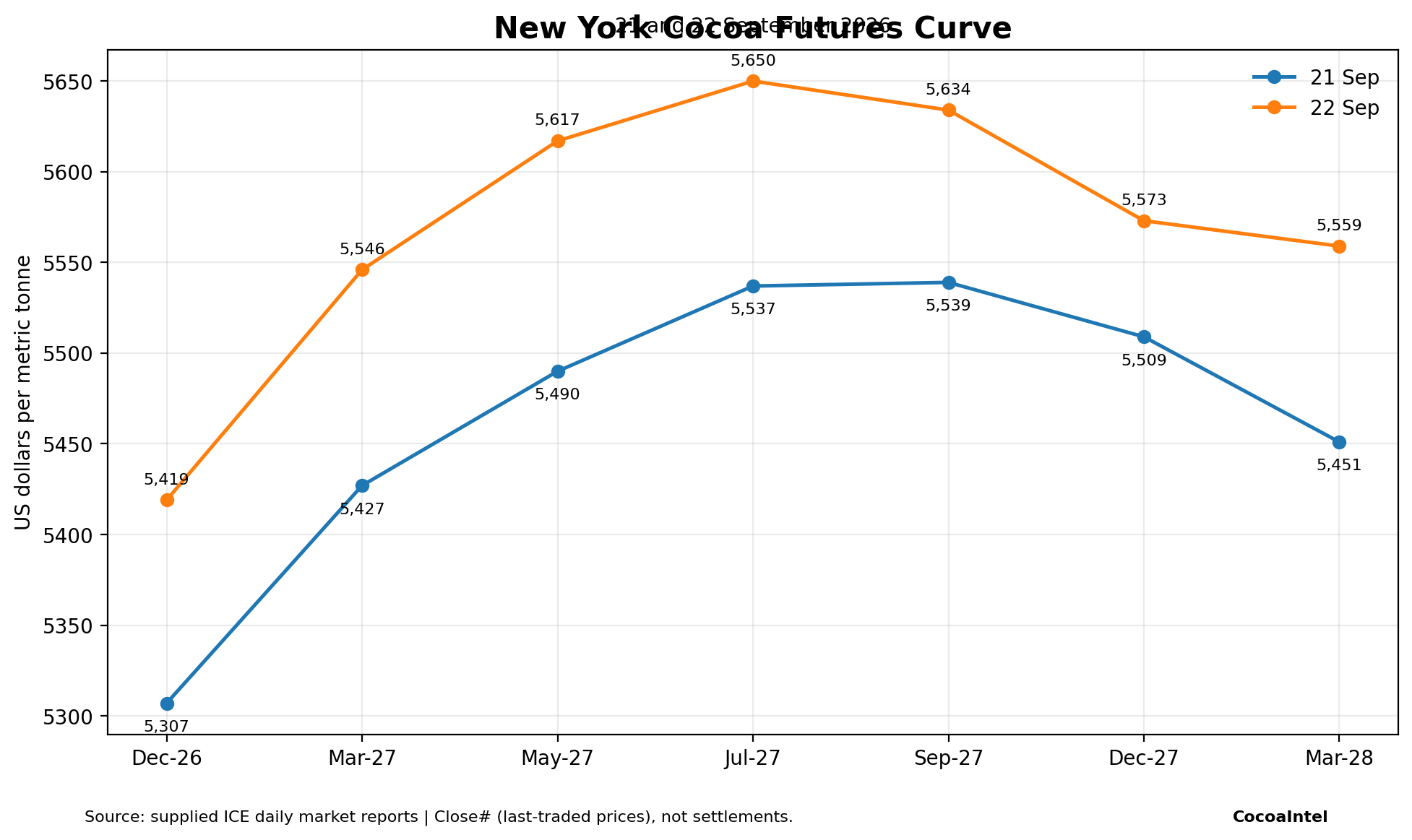
The New York curve moved higher across all comparable maturities, but the shape of the curve remained more cautious than the outright price action. Dec-26/Mar-27 contango widened from $120 to $127, while Mar-27/May-27 contango increased from $63 to $71. This indicates that nearby December did not strengthen relative to the next two contracts despite the sharp rebound in flat price.
Further along the curve, the structure became firmer. May-27/Jul-27 contango narrowed from $47 to $33, while Jul-27/Sep-27 shifted from $2 contango to $16 backwardation. Sep-27/Dec-27 backwardation also widened from $30 to $61. At the broader level, Dec-26/Dec-27 contango narrowed from $202 to $154, showing that the front of the curve recovered relative to the same point one year forward.
The market implication is mixed. The rally was strong, but the widening of Dec-26/Mar-27 contango argues against interpreting it as evidence of an immediate nearby supply squeeze. The more constructive signal sits in the middle of the curve, where relative firmness increased around mid-2027. That suggests the market is assigning greater value to future supply risk, but not yet signalling acute tightness in immediately available cocoa.
London cocoa
| Contract | 18 Sep close | 21 Sep close | Change | Change % |
|---|---|---|---|---|
| Dec-26 | £3,968 | £3,961 | −£7 | −0.18% |
| Mar-27 | £4,125 | £4,131 | +£6 | +0.15% |
| May-27 | £4,159 | £4,182 | +£23 | +0.55% |
| Jul-27 | £4,187 | £4,216 | +£29 | +0.69% |
| Sep-27 | £4,157 | £4,194 | +£37 | +0.89% |
| Dec-27 | £4,078 | £4,112 | +£34 | +0.83% |
| Mar-28 | £4,087 | £4,106 | +£19 | +0.46% |
London cocoa also recovered across the curve, although the move was more moderate than in New York. Dec-26 rose 1.14% to £4,006, Mar-27 gained 0.92%, and May-27 advanced 0.74%. Jul-27 remained the highest-priced comparable maturity at £4,249, while percentage gains generally diminished toward the deferred end.
Total London futures volume reached 43,493 contracts, with Dec-26 and Mar-27 representing around 59% of outright activity. Participation therefore remained concentrated in the liquid nearby contracts, confirming that the rebound was not confined to less active maturities.
The weaker percentage response relative to New York is important. London confirmed that the recovery was visible across both exchanges, but New York showed the stronger repricing on the day. The next question is whether that divergence is also visible in the shape of the two futures curves.
London cocoa futures curve
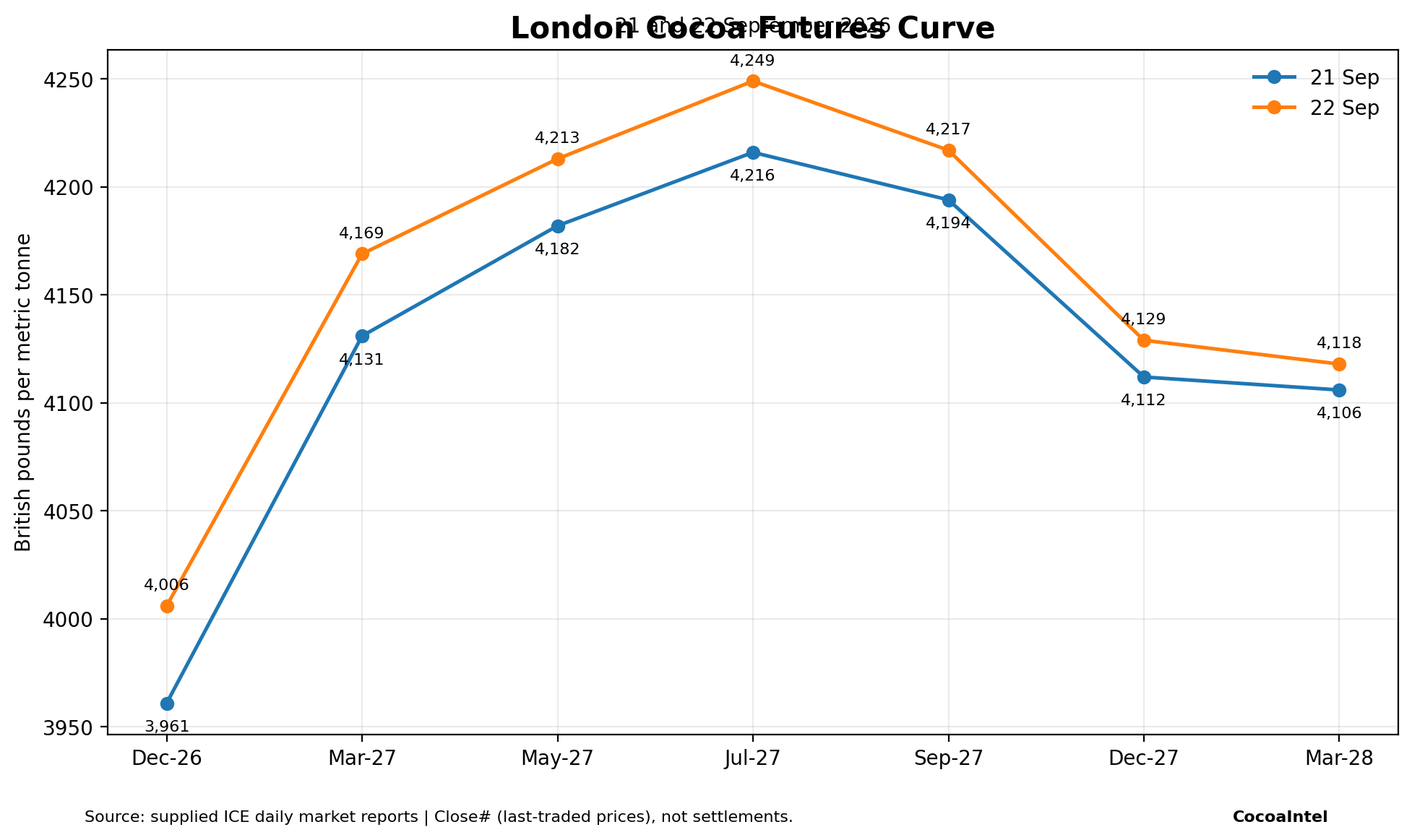
The London curve also strengthened, although its structural changes were more measured. Dec-26/Mar-27 contango narrowed from £170 to £163, while Mar-27/May-27 contango contracted from £51 to £44. This represents modest front-end tightening, in contrast with New York, where the nearest spread widened.
The middle of the curve remained relatively firm. May-27/Jul-27 contango widened slightly from £34 to £36, while Jul-27/Sep-27 backwardation increased from £22 to £32 and Sep-27/Dec-27 backwardation widened from £82 to £88. Dec-26/Dec-27 contango also narrowed from £151 to £123.
From a market perspective, London gives a somewhat firmer nearby signal than New York because front-end contango narrowed rather than widened. Even so, the scale of the move remains too small to indicate meaningful physical scarcity. The curve still points to relatively comfortable nearby availability, while the stronger backwardation further out suggests greater concern around the 2027 supply window than around immediate delivery.
NY–London Dec-26 Spread
$5,419 − (£4,006 × 1.3343 $/£) = +$73.8/t
| Contract | New York | London | London in USD | NY–London spread |
|---|---|---|---|---|
| Dec-26 | $5,419 | £4,006 | $5,345 | +$74/t |
| Mar-27 | $5,546 | £4,169 | $5,563 | −$17/t |
| May-27 | $5,617 | £4,213 | $5,621 | −$4/t |
| Jul-27 | $5,650 | £4,249 | $5,669 | −$19/t |
| Sep-27 | $5,634 | £4,217 | $5,627 | +$7/t |
| Dec-27 | $5,573 | £4,129 | $5,509 | +$64/t |
| Mar-28 | $5,559 | £4,118 | $5,495 | +$64/t |
Volume and Open Interest
New York cocoa
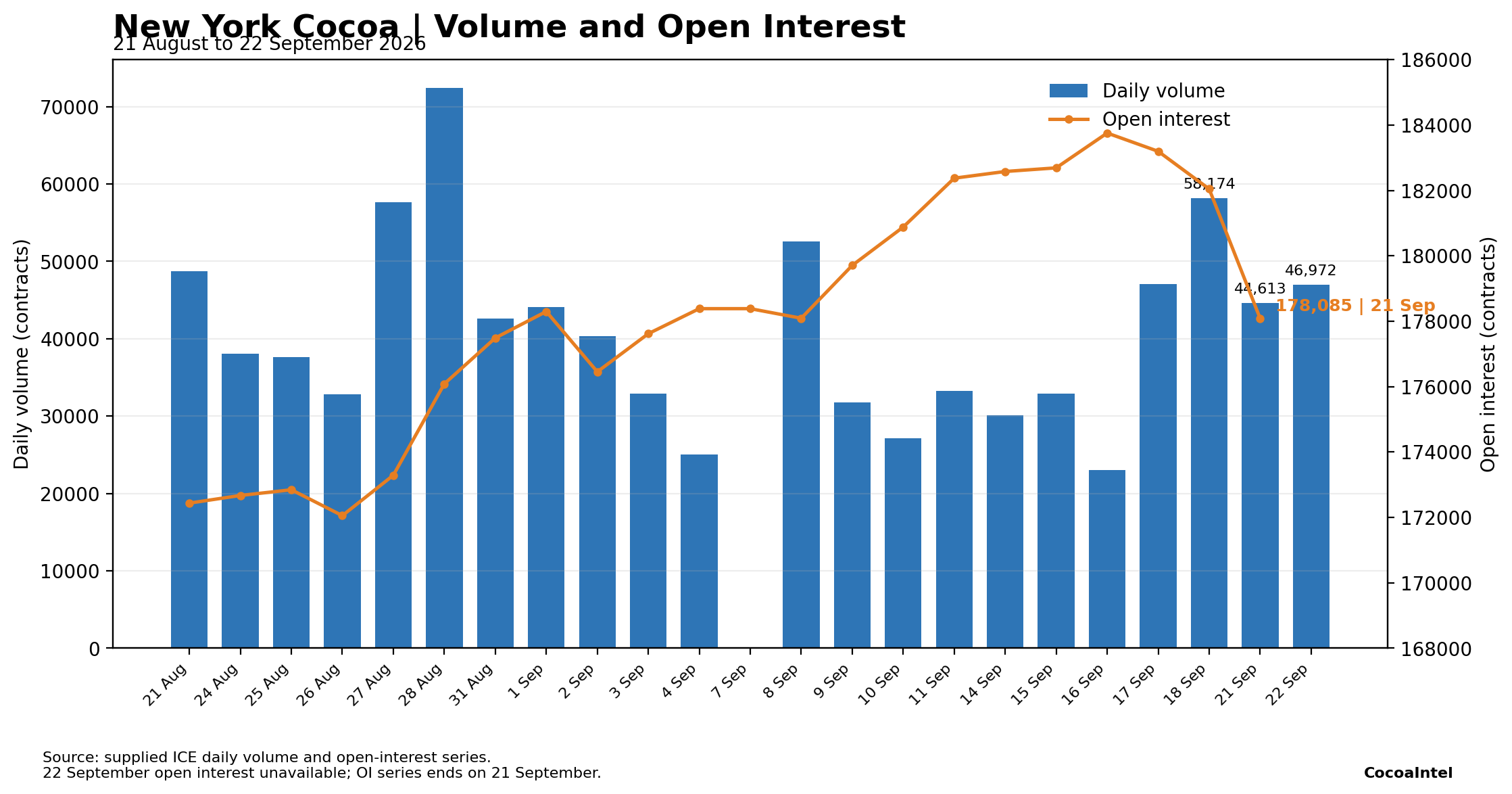
New York cocoa volume rose to 46,972 contracts on 22 September, up 5.3% from Monday and around 23% above the previous 10-session average. That makes Tuesday's rebound more credible than a low-liquidity bounce: the recovery occurred with meaningful participation, particularly in the nearby contracts.
The more important signal comes from open interest. The latest available reading, for 21 September, fell to 178,085 contracts, down 3,960 contracts in one session and 5,671 contracts, or 3.1%, from the 16 September peak of 183,756. With prices falling sharply over the same period, the combination of lower prices and lower OI is consistent with substantial long liquidation and position reduction, rather than a sell-off driven entirely by aggressive new short creation.
The fall in open interest ahead of Tuesday's rebound indicates that part of the recent decline was driven by position liquidation. With some of that pressure already removed, the strong recovery from the lows on above-average volume is a constructive sign of possible seller exhaustion. The key question is now whether fresh capital is entering the market. If the next OI update shows rising open interest alongside higher prices, the case for a more durable bullish reversal would strengthen materially; continued OI contraction would instead suggest that short covering remains an important driver.
London cocoa
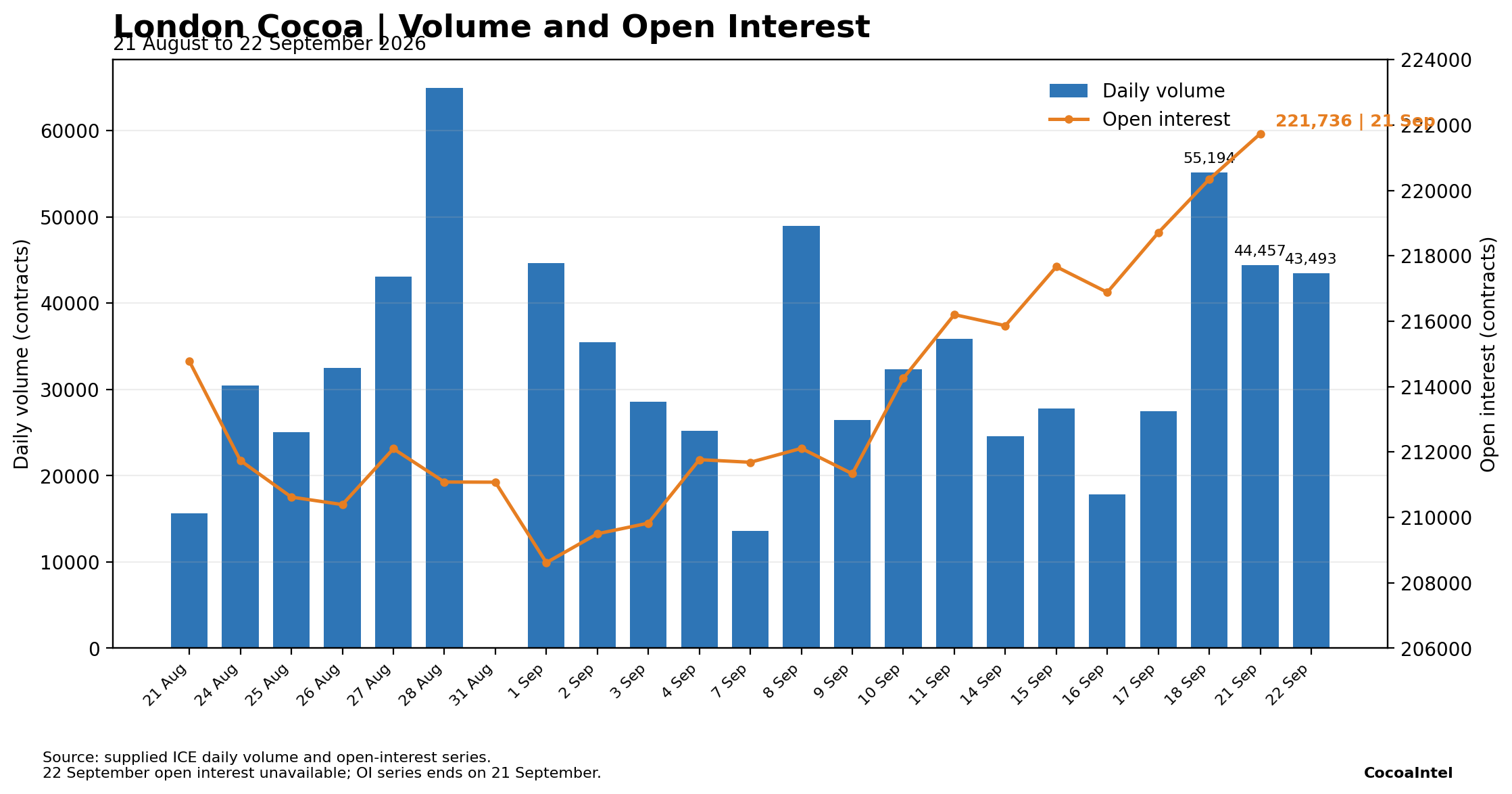
London volume reached 43,493 contracts on 22 September, only 2.2% below Monday but roughly 28% above the previous 10-session average. Participation therefore remained elevated even though London's price rebound was smaller than New York's.
The open-interest structure is strikingly different. London OI rose to 221,736 contracts on 21 September, the highest level in the supplied series and 4,852 contracts, or 2.2%, above 16 September. Unlike New York, where OI contracted during the sell-off, London continued to add outstanding positions as prices weakened.
That pattern is more consistent with new positioning being established into weakness, potentially including fresh shorts or producer/merchant hedging, rather than simple liquidation. The contrast with New York is important: New York experienced more substantial position liquidation, while London continued to build outstanding exposure
ICE Cocoa Stocks
| Market | Previous update | Latest update | Change | Change % |
|---|---|---|---|---|
| US | 3,431,944 bags | 3,435,088 bags | +3,144 | +0.09% |
| UK / London | 1,161,250 bags* | 1,165,156 bags** | +3,906 | +0.34% |
United States
Certified stock stood at 747,511 bags, equivalent to roughly 21.8% of total cocoa held in ICE-licensed U.S. warehouses. Ecuadorian cocoa continued to dominate the certified pool, with standard Ecuador Group B accounting for 486,807 bags, or about 65% of certified stocks, followed by Colombia at 91,562 bags and Peru at 74,403 bags. There were no bags pending grading, while 425,902 bags had passed grading to date.
London
The increase is modest, but importantly it means that London deliverable availability has not tightened alongside the price recovery. Valid stocks remain broadly stable to slightly higher, reinforcing the message already visible in the futures curve: nearby physical availability is still relatively comfortable.
Trading Setup Dec Contract
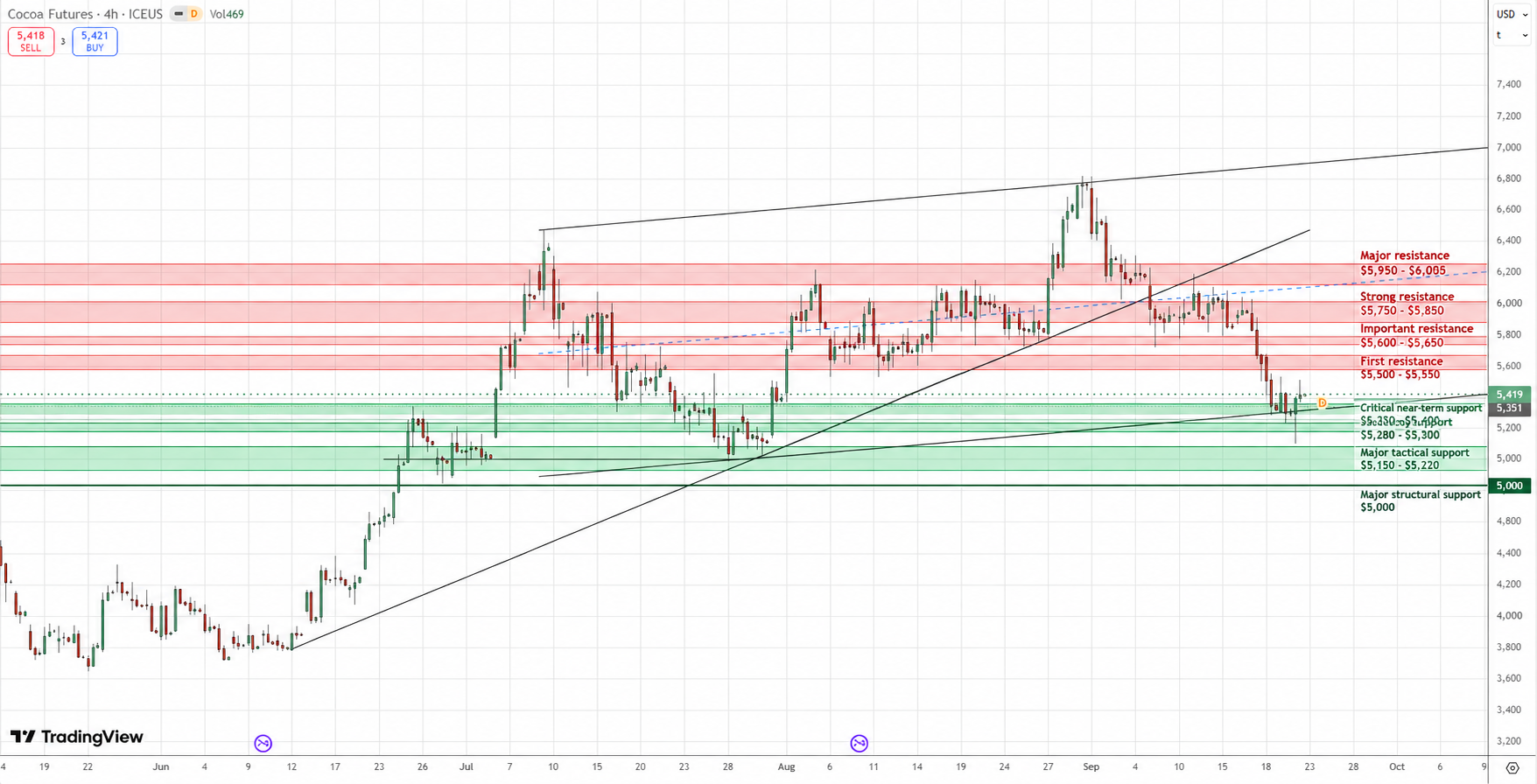
The short-term technical bias has shifted from aggressively bearish to cautiously bullish following a failed breakdown below the broader rising channel. The recovery back above channel support, combined with oversold daily momentum and improving intraday indicators, creates scope for further upside on Wednesday. However, the broader daily structure remains damaged, with MACD still negative and price below several key moving averages. A break above $5,500-$5,550 would strengthen the reversal signal and expose $5,600-$5,650, followed by heavier resistance around $5,750-$5,850 and $5,950-$6,050. Crucially, as long as the $5,300 area remains intact, the recent move below the channel can continue to be treated as a failed breakdown rather than confirmation of a new bearish leg. Sustained defence of this level would increase the probability that a broader trend reversal is developing. If buyers subsequently reclaim the major resistance zones above $6,000, the structure of the broader rising channel would reopen a medium-term path toward its upper boundary, currently approaching the $7,000 area. Conversely, a sustained break below $5,300 would materially weaken the reversal thesis, bringing $5,200 back into focus and ultimately exposing the major structural support around $5,000.
If you notice any discrepancies in these figures or have extra information, please email hello@cocoaintel.com or leave a comment – corrections and additional insights are always welcome.