Cocoa Rebounds Above $5,600 as London Leads the Recovery (8 October 2026)


Cocoa futures recovered on Thursday, 8 October, following two consecutive declining sessions. New York December closed at $5,617/t, up $90 (+1.63%), after trading between $5,431 and $5,723. The contract breached $5,500 during the session but finished $186 above its low, in the upper half of its $292 range. The stronger finish showed improved buying support, although the rebound recovered only 38.3% of Wednesday’s closing loss.
London December posted a firmer recovery, closing at £4,222/t, up £78 (+1.88%), within a £4,056–£4,270 range. It finished just £48 below its high and recovered 73.6% of Wednesday’s decline. Official settlements also increased, with New York December rising $83 (+1.49%) to $5,665/t and London December gaining £59 (+1.41%) to £4,233/t. Both markets made lower session lows but finished higher, cushioning the preceding sell-off while remaining below Tuesday’s closing levels.
Explore CocoaIntel’s new cocoa market-data section, covering weather, COT positioning, grindings, Ivorian arrivals, certified ICE stocks, futures curves, US–London spreads and seasonality.
Open Cocoa → Market Data, then select the dashboard you want to explore.
NOAA raises the probability of an exceptionally strong El Niño
NOAA’s Climate Prediction Center maintained its El Niño Advisory on Thursday and increased the probability of an exceptionally strong event during October–December to 83%, from 75% in September. The comparison refers to a three-month Relative Oceanic Niño Index reaching at least +2.5°C. The agency expects El Niño to strengthen through year-end, with strong-to-very strong conditions likely to persist through January–March 2027.
The assessment strengthens the forward weather-risk signal facing cocoa producers. NOAA reported enhanced rainfall activity across the central and eastern Pacific and suppressed activity over Indonesia. For cocoa, the production implications will depend on regional rainfall, soil moisture and crop development: the advisory does not itself provide a quantified harvest-loss forecast.
Indonesia’s new forecast keeps dry conditions in focus
Indonesia’s meteorological agency, BMKG, warned on 8 October that dry conditions would remain widespread despite opportunities for local rainfall. Its assessment for 11–20 October places approximately 66% of the country in the low-rainfall category of 0–50 mm over ten days, including Sulawesi and Maluku. The agency identified El Niño and a positive Indian Ocean Dipole as factors restricting rainfall formation.
For 9–11 October, moderate rain remains possible in Central Sulawesi, while strong-wind warnings cover Central, South and Southeast Sulawesi. Local showers could provide some relief, but sustained dryness would leave cocoa-growing areas exposed to continuing water stress. The bulletin provides a weather forecast rather than evidence of a measured cocoa-production loss.
StoneX sees inventory protection now, but a much thinner next-season surplus
StoneX’s Edition 37 cocoa outlook describes a market with a stronger inventory buffer following the 2025/26 production recovery, while retaining concerns about the durability of that improvement. Its charts show an estimated global surplus of 422,000 tonnes for 2025/26 and 25,000 tonnes for 2026/27. Côte d’Ivoire’s production is forecast at 1.775 million tonnes for 2026/27, compared with the preceding season’s 2 million-tonne baseline—a decline of approximately 11.3%.
The brokerage’s fourth-quarter assessment remains moderately bearish because accumulated supplies and restrained demand for cocoa products could absorb a slower start to West African deliveries. However, weaker early pod development, low producer remuneration and possible bean retention could interrupt the flow into the physical market. StoneX envisages slower early-quarter deliveries followed by a gradual acceleration from late October into November, leaving room for temporary tightness even with substantial existing inventories.
Its demand assessment also distinguishes improving grindings from recovering chocolate consumption. Some processing growth may reflect the rebuilding of cocoa-product inventories depleted during the shortage. Powder demand has performed better than butter and liquor, but stronger powder production also generates butter that must find buyers. If chocolate demand remains weak, that imbalance can pressure product stocks and processing margins.
The resulting framework is one of near-term inventory protection alongside greater exposure to the next crop. Existing stocks may restrain sustained rallies, while weather, delivery timing and speculative position adjustments preserve the possibility of sharp price swings.
Illegal gold mining draws labour away from Ivorian cocoa farms
A Deutsche Welle field report published on 8 October highlighted competition for agricultural labour around Ayamé in southeastern Côte d’Ivoire. Cocoa grower Alexis Amadi said four of his five workers had left, attracted by the prospect of higher earnings elsewhere. Local accounts described workers moving into illegal gold mining and farms struggling to maintain plantations and harvest beans.
These interviews identify a production constraint alongside the weather risks: favourable growing conditions cannot fully translate into marketed cocoa if maintenance and harvesting lack labour. The evidence is local and supplies no national tonnage estimate, but it reinforces the importance of producer income and farm profitability when assessing the resilience of Ivorian supply.
Moronou’s traceability rollout reveals a gap between registration and active reporting
AIP reported on Thursday that more than 53,000 coffee-and-cocoa producers had been registered and their plantations geolocated in Moronou, with at least 43,000 producer cards distributed. The figures were announced at the regional campaign launch on 7 October. However, only 15 cooperatives had begun operating through the national traceability system within the Bongouanou delegation.
CCC official Josiane Assandé said the transactions recorded so far did not yet reflect the region’s full potential. This distinction matters when interpreting early purchasing data: farmer registration and card distribution do not automatically produce complete transaction coverage. Limited recorded activity may reflect uneven system participation as well as the pace of physical cocoa sales.
Ivorian processors seek improvements in industrial competitiveness
Côte d’Ivoire’s Commerce Ministry reported on 8 October that Minister Kalil Konaté had met a GEPEX delegation led by Lionel Soulard on 6 October. Discussions covered capacity utilisation, energy, financing, quality and international regulations. GEPEX proposed a national competitiveness committee bringing together government bodies, the CCC and industrial operators.
The ministry cited installed grinding capacity of 1.155 million tonnes. That measures industrial capability rather than realised bean consumption. The purchasing implications will depend on utilisation, processing economics and reliable access to beans and energy; the meeting did not announce an immediate increase in grindings.
Manufacturers continue exploring formulations with less cocoa
In an interview published by Food Business News on 8 October, Voyage Foods chief executive Adam Maxwell reported growing manufacturer interest in combining conventional chocolate compounds with the company’s cocoa-free NextCoa ingredient. He said the alternative remained commercially attractive despite cocoa prices retreating from their earlier extremes.
The comments add a supplier’s perspective on reformulation following the high-price period. Blended coatings could reduce cocoa usage per unit of finished product where manufacturers adopt them, although the interview supplied no verified measure of cocoa displacement. This remains a structural demand development rather than a quantified change in current bean consumption.
Futures Performance
New York cocoa
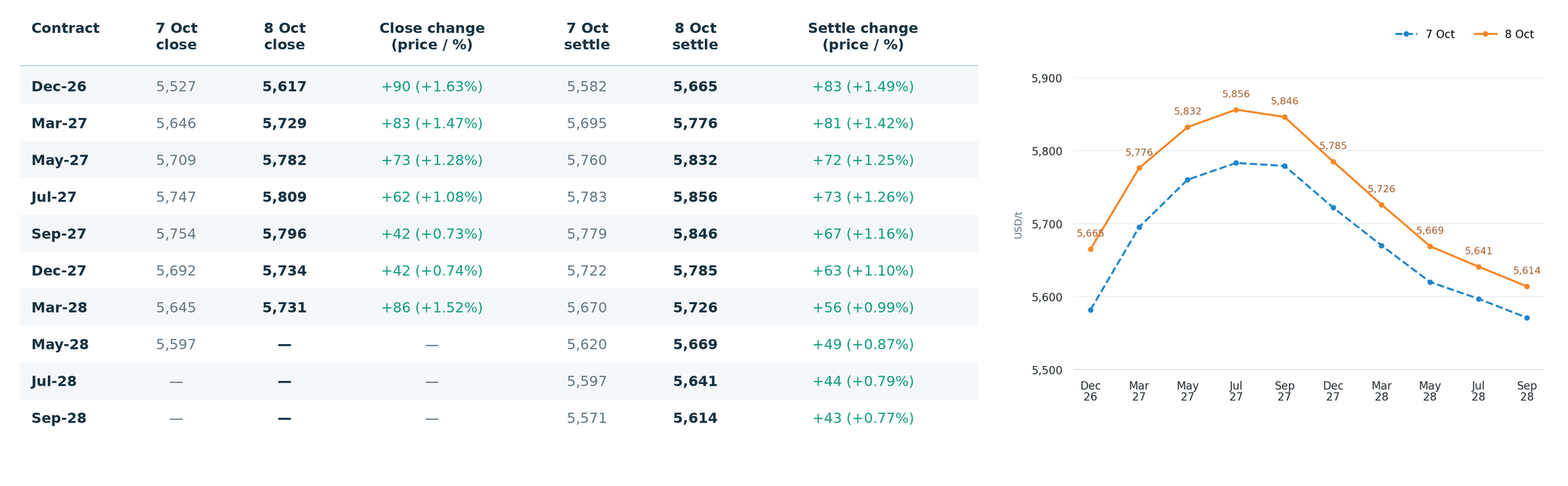
New York recovered across all seven comparable last-traded closes on Thursday, 8 October. December closed at $5,617/t, up $90 (+1.63%), after trading between $5,431 and $5,723. Although the contract made a lower low than Wednesday, it finished $186 above that low, in the upper half of its $292 range. Buying support improved substantially from Wednesday’s near-low finish, but the rebound recovered only 38.3% of the preceding session’s $235 closing loss.
All ten official settlements increased, with December settling at $5,665/t, up $83 (+1.49%). December strengthened modestly against the main deferred deliveries: Dec/Mar contango narrowed from $113 to $111/t, Dec/Jul from $201 to $191/t and Dec/Sep from $197 to $181/t. July 2027 remained the curve’s peak at $5,856/t. The recovery therefore combined broad upward repricing with some nearby spread tightening, while retaining a substantial premium for mid-2027 delivery.
London cocoa
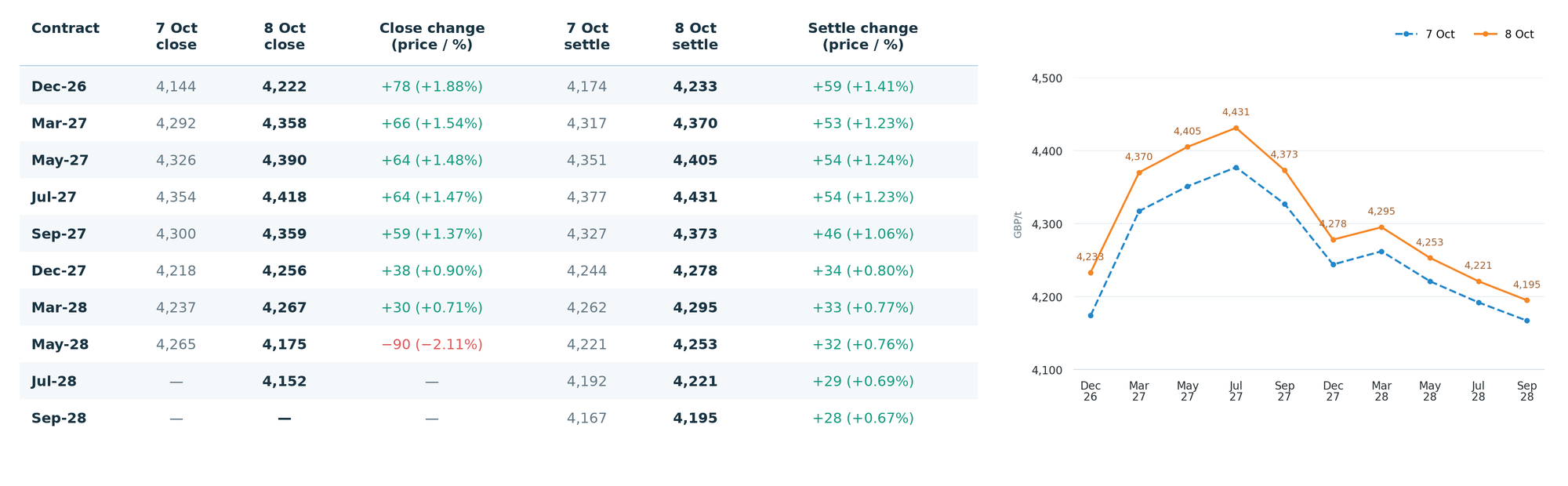
London advanced across the seven comparable last-traded closes from December 2026 through March 2028. December closed at £4,222/t, up £78 (+1.88%), after trading between £4,056 and £4,270. The contract also made a lower low, but finished just £48 below its high, within the upper 22.4% of its £214 range. It recovered 73.6% of Wednesday’s £106 closing loss, giving London a stronger retracement of the preceding decline than New York.
All ten settlements rose, with December settling at £4,233/t, up £59 (+1.41%). Dec/Mar contango narrowed from £143 to £137/t, Dec/Jul from £203 to £198/t and Dec/Sep from £153 to £140/t. July 2027 retained the curve’s peak at £4,431/t. Nearby cocoa consequently gained slightly against the deferred curve during the rebound. May 2028’s last-traded close fell 2.11% despite its higher settlement, but turnover of only 18 contracts limits the significance of that exception.
NY–London Dec-26 Spread
| Contract | NY close 8 Oct | London close 8 Oct | Spread ($/t) |
|---|---|---|---|
| Dec-26 | $5,617 | £4,222 | +$32.14 |
| Mar-27 | $5,729 | £4,358 | −$35.76 |
| May-27 | $5,782 | £4,390 | −$25.09 |
| Jul-27 | $5,809 | £4,418 | −$35.13 |
| Sep-27 | $5,796 | £4,359 | +$29.91 |
| Dec-27 | $5,734 | £4,256 | +$104.16 |
| Mar-28 | $5,731 | £4,267 | +$86.61 |
$5,617 − (£4,222 × 1.3228) = +$32.14/t.
New York December’s premium over London narrowed to $32.14/t on Thursday, 8 October, from $51.53/t on Wednesday, a reduction of $19.39/t. New York gained $90 while London rose £78. At Wednesday’s exchange rate, those futures-price moves reduced the premium by $13.06/t. Sterling’s appreciation added another $6.33/t to London’s dollar-equivalent value, further compressing the spread.
New York weakened relative to London across six of the seven comparable maturities. March, May and July 2027 remained at deeper discounts, while September and December 2027 retained smaller premiums. March 2028 was the exception: its premium widened by $39.96/t to $86.61/t, although volumes of just 62 lots in New York and 326 in London limit the weight of that signal.
GBP/USD: 1.3228 for 8 October; Wednesday’s published 1.3213 is retained for comparison. Spreads use last-traded closes, with FX and futures prices observed at different times. May–September 2028 lack matching current closes.
Volume and Open Interest
New York cocoa
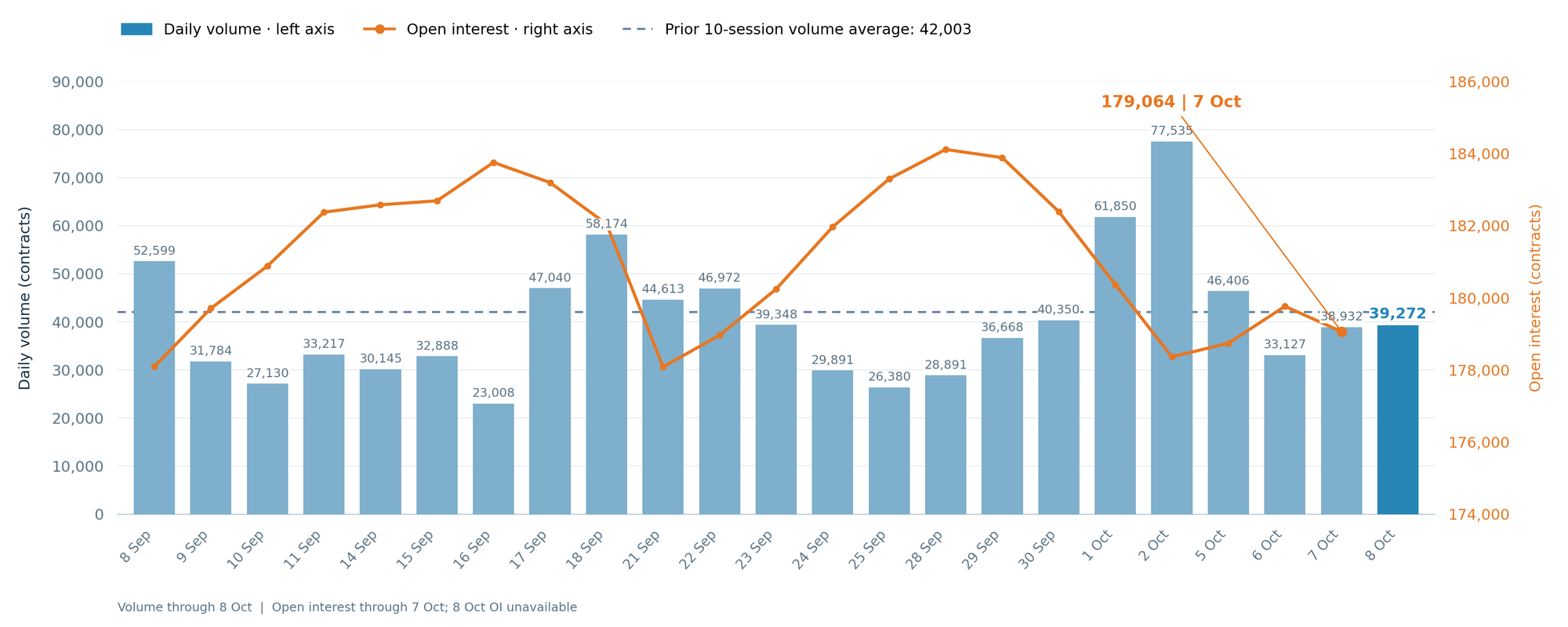
New York turnover increased to 39,272 contracts on Thursday, 8 October, up 0.9% from Wednesday’s 38,932, although still 6.5% below the preceding 10-session average of 42,003. December’s 1.63% recovery therefore attracted broadly unchanged participation compared with Wednesday’s sharp decline, providing limited volume confirmation of renewed buying interest. Activity remained below its recent average, leaving the rebound less convincing than an advance accompanied by a substantial expansion in turnover.
Open interest fell 701 contracts (−0.39%) to 179,064 on 7 October, interrupting the preceding two-session increase. Wednesday’s 4.08% price decline coincided with a net reduction in outstanding positions, consistent with some position unwinding. The contraction reversed only part of Tuesday’s 1,024-contract increase, leaving exposure slightly above Monday’s level. Aggregate OI cannot identify which participants reduced their positions. Thursday’s rebound on almost unchanged volume suggests initial stabilisation; further gains accompanied by stronger turnover and rising OI would strengthen the recovery assessment, while renewed weakness would challenge it.
London cocoa
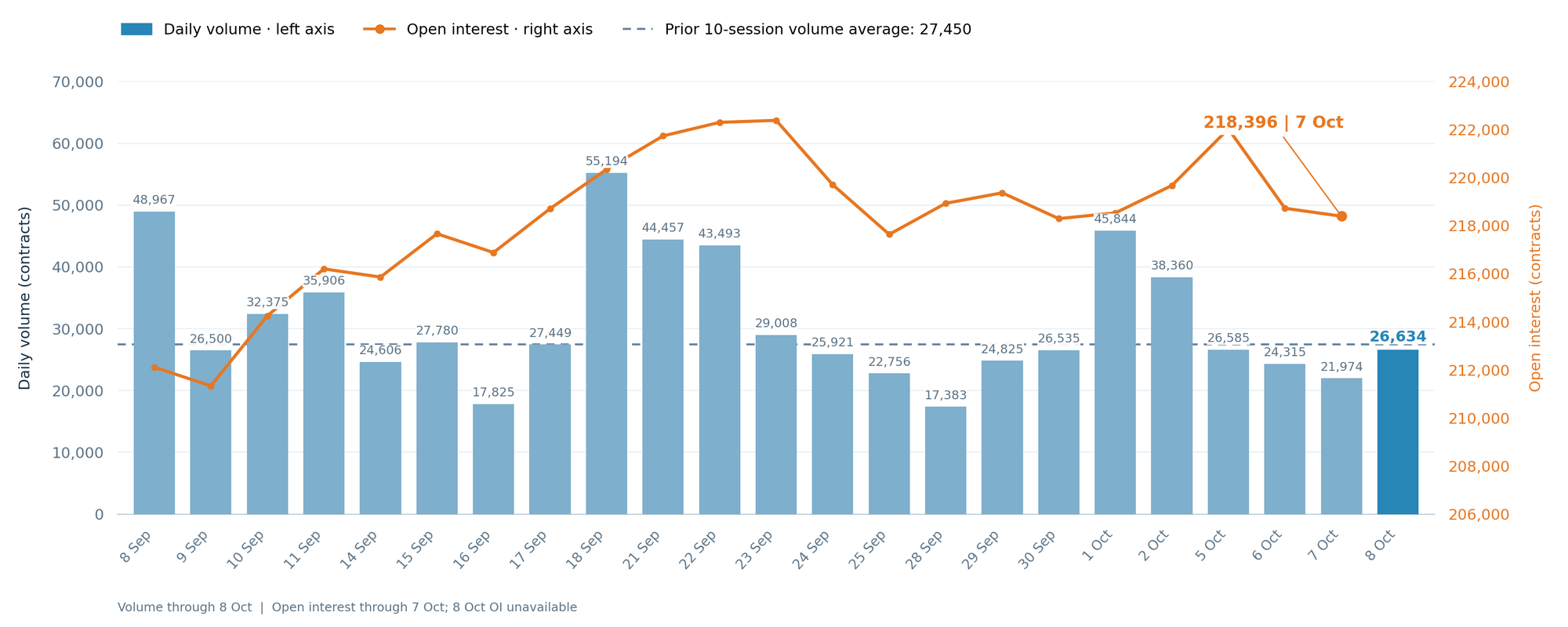
London turnover increased to 26,634 contracts on Thursday, up 21.2% from Wednesday’s 21,974 and just 3.0% below the preceding 10-session average of 27,450. December’s 1.88% recovery consequently occurred with a meaningful increase in participation, providing stronger volume confirmation than New York’s rebound. Activity returned close to its recent average after Wednesday’s decline on lighter turnover, making the recovery more convincing in terms of trading participation.
Open interest fell 330 contracts (−0.15%) to 218,396 on 7 October, its second consecutive decrease. Wednesday’s 2.49% price decline therefore coincided with continued position unwinding, although the contraction was substantially smaller than Tuesday’s 3,303-contract reduction. The two-session fall totalled 3,633 contracts (−1.64%), showing that outstanding exposure continued to adjust while the pace of contraction slowed. Thursday’s higher-volume rebound strengthens the stabilisation signal but does not establish that selling has been exhausted. Further gains accompanied by rising OI would support renewed position building; renewed weakness alongside declining OI would be consistent with further unwinding.
ICE Cocoa Stocks
| Market | Stock measure | Previous update | Latest update | Change | Change % |
|---|---|---|---|---|---|
| US | Total stocks in ICE-licensed warehouses | 3,549,555 bags | 3,559,258 bags | +9,703 bags | +0.27% |
| US | Certified stocks, included in warehouse total | 439,117 bags | 451,142 bags | +12,025 bags | +2.74% |
| London / Europe | Valid-warrant stocks, 64-kg bag equivalents | 1,197,344 | 1,193,438 | −3,906 | −0.33% |
U.S. warehouse holdings increased by 9,703 bags on 8 October, while certified stocks rose by 12,025 bags to represent 12.7% of total holdings. Both the broader warehouse inventory buffer and the pool eligible for futures delivery expanded. The continued rebuilding provides additional protection against interruptions in origin supply, although certified stocks remain a subset of warehouse holdings and should not be added to the total.
London valid-warrant stocks declined by 250 tonnes to 76,380 tonnes on 7 October, reversing slightly more than the preceding update’s 210-tonne increase. Deliverable warrant coverage therefore eased while U.S. certified availability improved. The London decline concerns valid-warrant tonnage and does not by itself establish physical warehouse withdrawals.
Friday Trading Setup — ICE Futures U.S. Cocoa December 2026
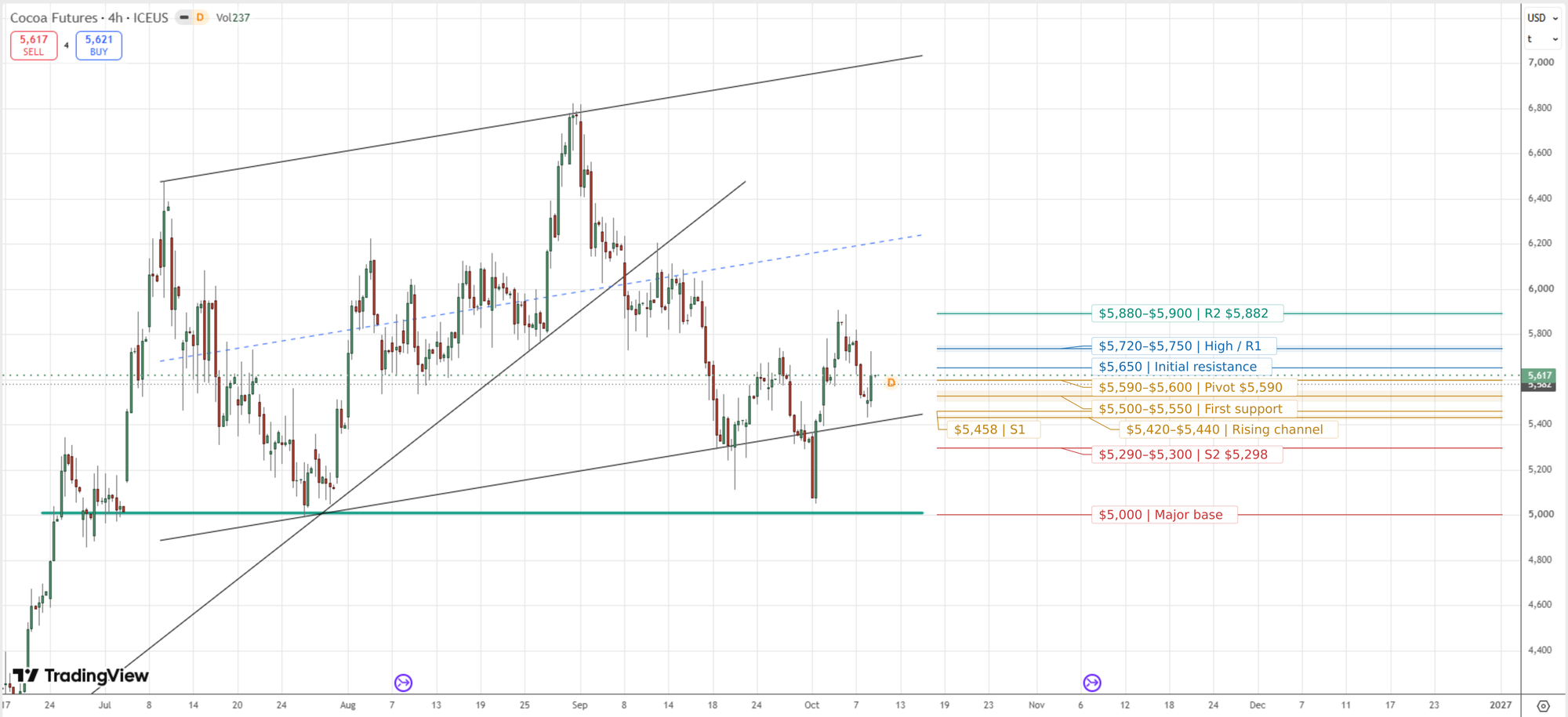
December cocoa enters Friday with an improved short-term tone after Thursday’s 1.63% rebound to $5,617/t, following a test of $5,431. Holding $5,590–$5,600, around the calculated pivot at $5,590, would support further recovery towards $5,650, then $5,720–$5,750, which brackets Thursday’s $5,723 high and calculated R1 at $5,750. A sustained break above that area would improve recovery prospects towards $5,880–$5,900, around R2 at $5,882. Hourly momentum has improved, although the rebound remains below the earlier week’s highs.
Failure to hold the pivot area would bring the $5,500–$5,550 consolidation zone back into focus, followed by calculated S1 at $5,458. Below that, the rising channel boundary around $5,420–$5,440, close to Thursday’s $5,431 low, remains the key structural support. A sustained break below this area, followed by a failed reclaim, would strengthen the downside case towards $5,290–$5,300, around S2 at $5,298. Thursday’s firmer finish offers initial stabilisation, but the limited increase in volume leaves the recovery needing further confirmation.