
Ivory Coast Opens 2026/27 Cocoa Main Crop With Farmgate Price Expected at 1,200 CFA/kg (28 August 2026)


New York cocoa futures surged on Friday, extending Thursday’s rebound into a sustained rally. The active Dec-26 contract gained $403, or 6.47%, to finish at $6,636 per tonne after trading between $6,211 and $6,687. Prices moved higher in successive waves throughout the session, with brief pullbacks repeatedly attracting buying, and finished just $51 below the daily high. Strength was broad across the curve, with the five principal maturities advancing between 4.86% and 6.62%, confirming that the rally was not confined to a single contract.
Ivory Coast’s 2026/27 main-crop marketing season opens on September 1 under the country’s revised cocoa calendar, with the guaranteed producer price remaining the main unresolved issue.
Reuters reported on August 28, citing four industry and two government sources, that the government is expected to maintain the farmgate price at 1,200 CFA francs per kilogram.
Maintaining 1,200 CFA/kg would not represent another price cut. It would leave the guaranteed price unchanged from the reduction introduced in March, but 57% below the record 2,800 CFA/kg paid at the beginning of the 2025/26 season.
The Coffee and Cocoa Council reportedly proposed a range of 1,200–1,500 CFA/kg, based on the average prices achieved through forward sales between March and June. Government sources said the regulator had sold more than 1.1 million tonnes while international prices were considerably lower. The subsequent recovery in London cocoa therefore does not automatically translate into a higher producer price for beans already sold forward.
Meanwhile, exporter estimates showed that cumulative cocoa arrivals at the ports of Abidjan and San Pedro reached approximately 2.0 million tonnes by August 30, up 19.6% from the same period last season.
The latest weekly flow was considerably weaker. Around 1,000 tonnes arrived in Abidjan and 1,500 tonnes in San Pedro between August 24 and 30, taking the weekly total to just 2,500 tonnes, compared with 9,000 tonnes during the equivalent week last season—a decline of roughly 72%.
The regulator has also approved 107 exporters and cooperatives for the 2026/27 season, down marginally from 109 last season. Major international companies—including Olam, CEMOI, Barry Callebaut, Touton, Sucden, Nestlé and Cargill—remain authorised. The reduction of two licences does not, by itself, indicate a meaningful change in export capacity.
The more important risk concerns the timing of the incoming crop. Industry and Coffee and Cocoa Council sources told Reuters that the main crop could be delayed by eight to ten weeks. Weekly arrivals are expected to remain below 15,000 tonnes during September and 25,000 tonnes during October before accelerating from late October or early November.
This could concentrate a large share of deliveries into November and December, potentially straining storage and loading capacity at Abidjan and San Pedro. Exporters may simultaneously try to accelerate shipments before the EU Deforestation Regulation begins applying to large and medium-sized operators on December 30, 2026.
A farmgate price of 1,200 CFA/kg would create an additional commercial risk. Ghana’s recently quoted producer price was equivalent to approximately 2,000 CFA/kg. Such a wide regional differential creates a strong economic incentive for unofficial cross-border flows into Ghana, Liberia and Guinea, although it does not prove that additional smuggling will occur.
Futures performance
New York cocoa
| Contract | 27 Aug | 28 Aug | Change | Change % |
|---|---|---|---|---|
| Sep-26 | $6,190 | $6,491 | +$301 | +4.86% |
| Dec-26 | $6,233 | $6,636 | +$403 | +6.47% |
| Mar-27 | $6,354 | $6,768 | +$414 | +6.52% |
| May-27 | $6,390 | $6,813 | +$423 | +6.62% |
| Jul-27 | $6,387 | $6,802 | +$415 | +6.50% |
New York cocoa advanced across all five principal maturities. May-27 posted the largest rise, gaining $423, or 6.62%, to $6,813. Sep-26 increased $301, or 4.86%, to $6,491, but traded only three lots, so its movement is not representative of broader activity.
The active Dec-26 through Jul-27 contracts traded through ranges of $451 to $486 per tonne, narrower than the $571 to $604 ranges on 27 August. Mar-27 recorded the widest range at $486, while Jul-27 had the narrowest at $451.
These active maturities finished 89.3% to 96.9% above their daily lows, compared with 72.7% to 75.9% on 27 August. This indicates that most of the advance was retained into the final trade.
Total volume rose 25.6% to 72,441 contracts. Spread volume increased 56.4% to 47,715, raising its share of turnover from 52.9% to 65.9%. Implied outright volume declined 9.0% to 24,726 contracts. EFP activity fell from 1,247 to 618 contracts, EFS activity declined from 1,140 to 130, and 53 contracts of block volume were reported after none on 27 August.
New York futures curve
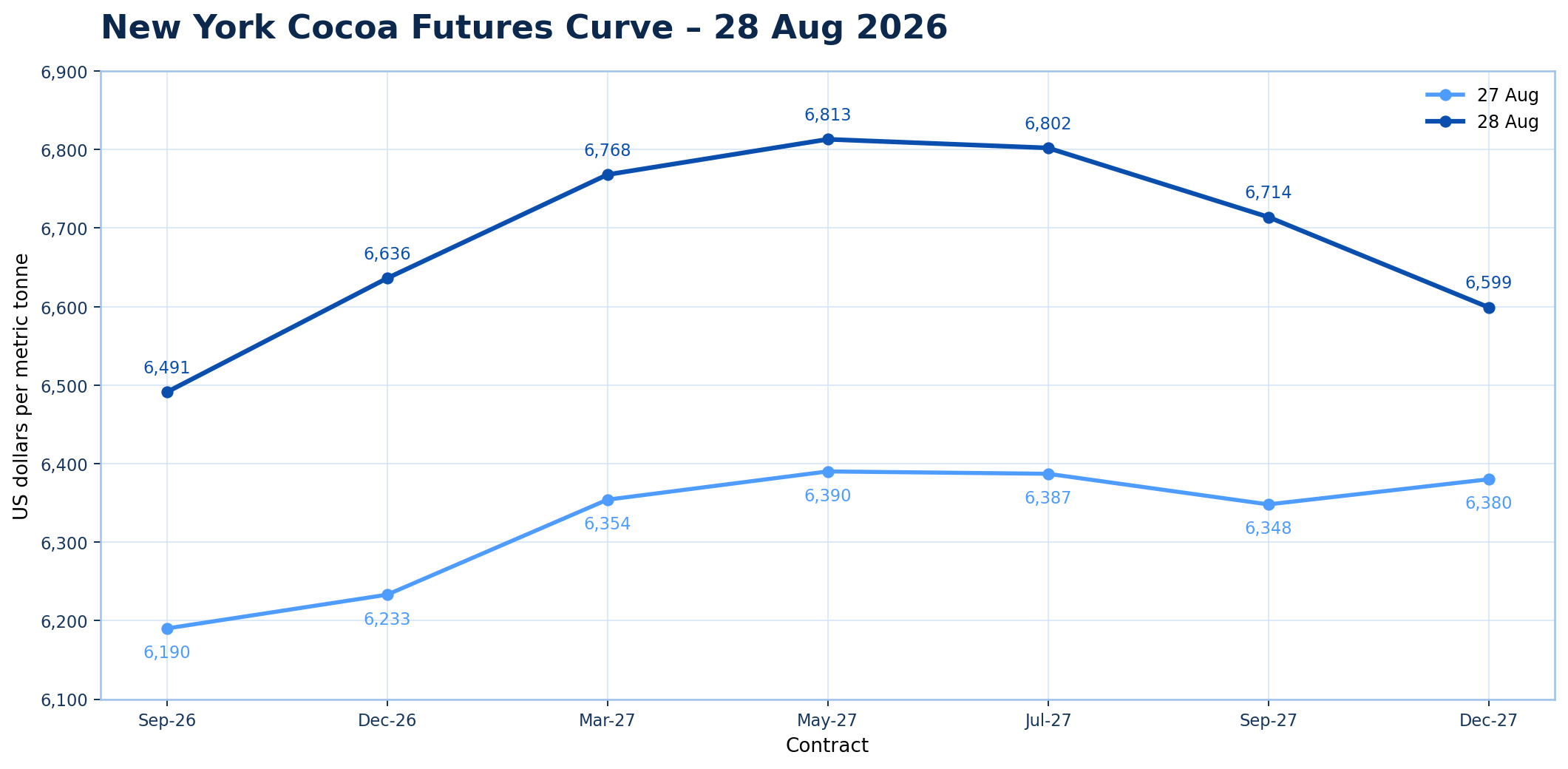
The current curve peaked at May-27 at $6,813. It rose $322 between Sep-26 and May-27, compared with $200 previously, before falling $214 toward Dec-27. The rally was strongest through the actively traded middle maturities and weaker at the far end.
London cocoa
| Contract | 27 Aug | 28 Aug | Change | Change % |
|---|---|---|---|---|
| Sep-26 | £4,375 | £4,753 | +£378 | +8.64% |
| Dec-26 | £4,464 | £4,845 | +£381 | +8.53% |
| Mar-27 | £4,588 | £4,969 | +£381 | +8.30% |
| May-27 | £4,603 | £4,964 | +£361 | +7.84% |
| Jul-27 | £4,587 | £4,939 | +£352 | +7.67% |
London cocoa also advanced sharply across all five principal maturities. Dec-26 and Mar-27 recorded the largest cash gains, each rising £381, to £4,845 and £4,969 respectively. Sep-26 posted the strongest percentage increase, advancing £378, or 8.64%, to £4,753.
The first five contracts traded through ranges of £343 to £375 per tonne. Sep-26 recorded the widest range at £375, while Jul-27 had the narrowest at £343.
These maturities finished 90.9% to 92.4% above their daily lows, compared with 74.2% to 80.3% on 27 August. The consistently strong positioning shows that most of the day’s rally was retained into the final trade.
Total volume increased 50.9% to 64,992 contracts. Spread volume rose 58.2% to 44,430, lifting its share of turnover from 65.2% to 68.4%. Implied outright volume increased 37.1% to 20,562 contracts. EFP activity declined from 190 to 168 contracts, while EFS activity rose from zero to 3,620. No block volume was reported. Total open interest declined by 1,018 contracts to 211,083.
London futures curve
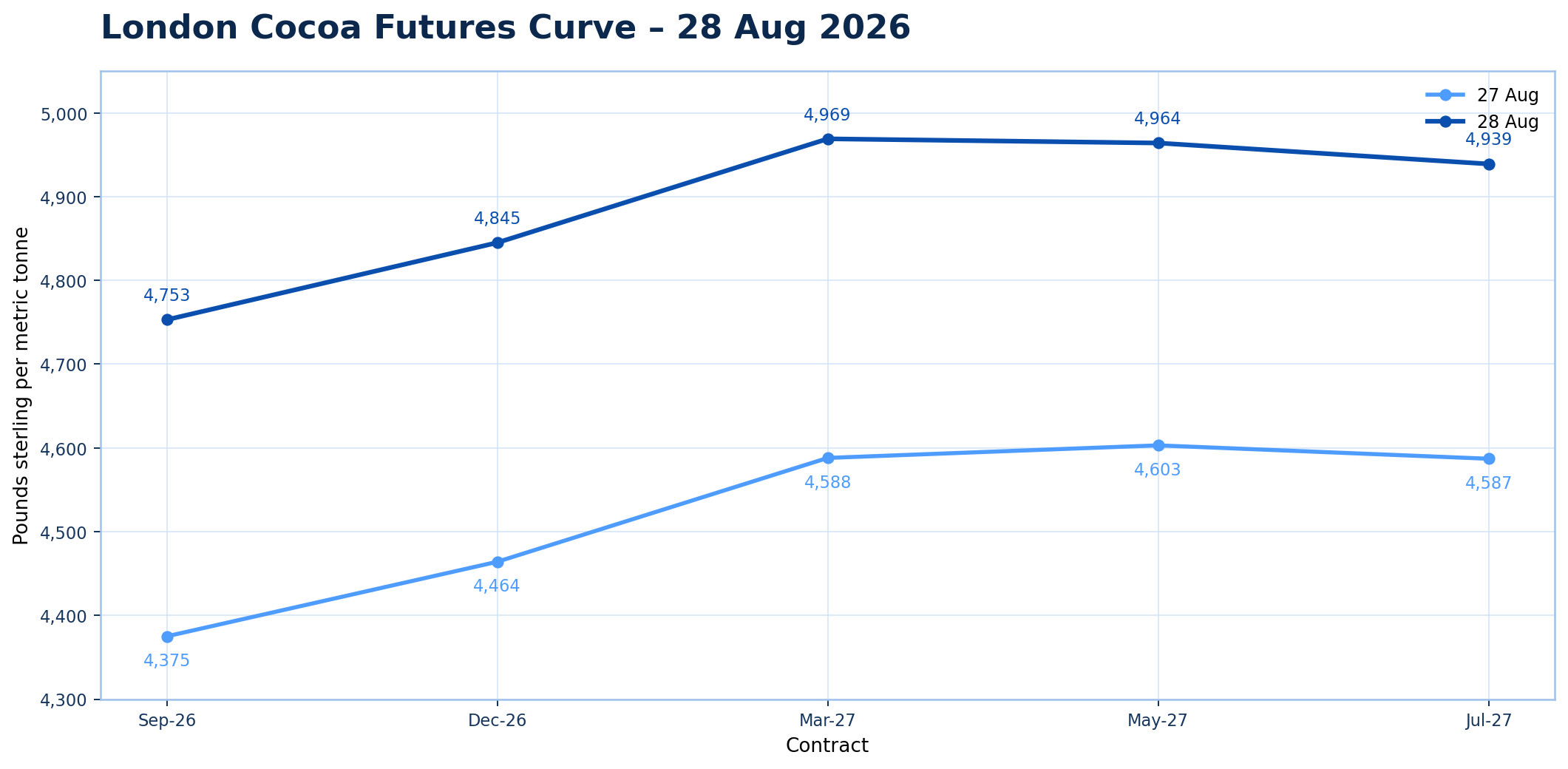
The curve peaked at Mar-27 at £4,969, only £5 above May-27. The Mar/May structure moved from a £15 contango to a £5 backwardation, while the May/Jul backwardation widened from £16 to £25.
US–UK Spread
(Dec Contract)
$6,636 − (£4,845 x 1.360$/£) =$47ton (down from $164 ton)
Volume and Open Interest
New York cocoa
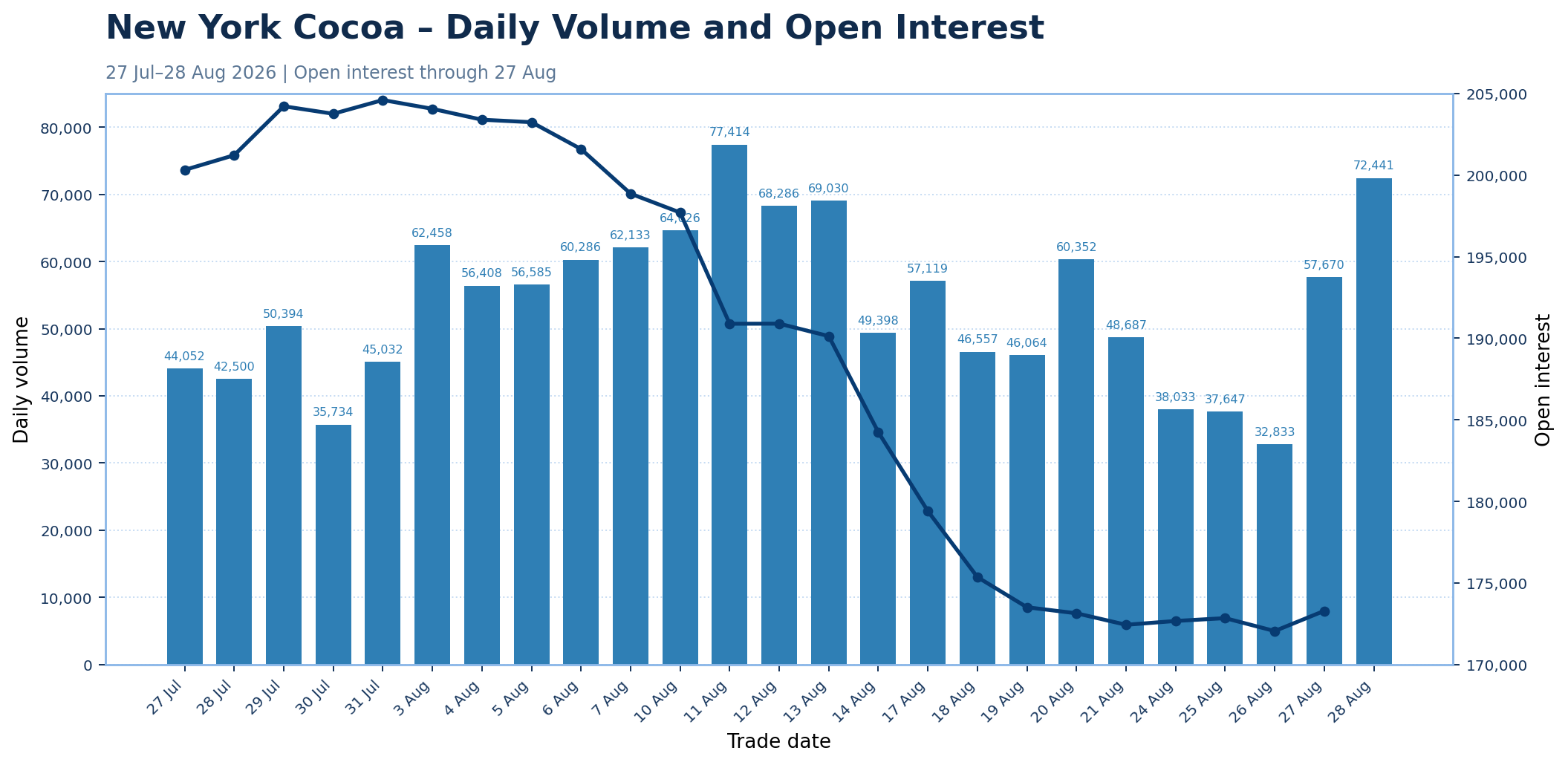
New York cocoa volume rose to 72,441 contracts on 28 August, up 14,771 contracts, or 25.6%, from 57,670 on 27 August. Turnover stood 32.1% above the preceding 20-session average of 54,831 contracts and only 6.4% below the displayed-period peak of 77,414 recorded on 11 August. It was the second-highest daily volume in the 25-session window.
The latest available open interest, for 27 August, increased to 173,290 contracts from 172,055 on 26 August, a rise of 1,235 contracts, or 0.7%. It remained 31,316 contracts, or 15.3%, below the period peak of 204,606 on 31 July and 27,031 contracts, or 13.5%, below its 27 July level. No valid figure was reported for 28 August.
The two-day rebound in turnover marks a sharp recovery in trading participation. Open interest recovered only modestly from the period low.
London cocoa
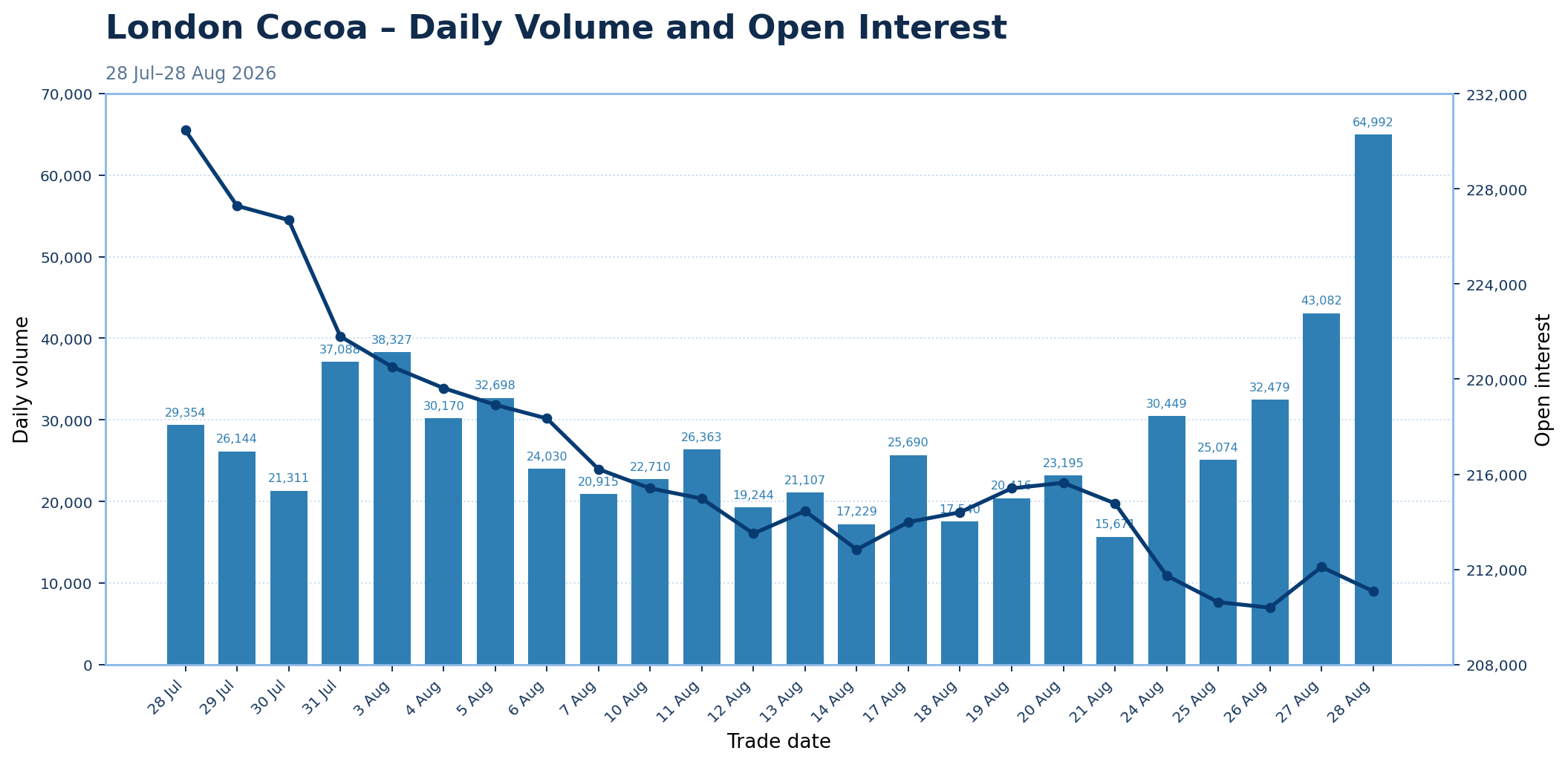
London cocoa volume surged to 64,992 contracts on 28 August, up 21,910 contracts, or 50.9%, from 43,082 on 27 August. Turnover was 148.3% above the preceding 20-session average of 26,174 contracts and reached the highest level of the displayed period. It was more than four times the period low of 15,671 contracts recorded on 21 August.
Open interest declined to 211,083 contracts from 212,101, a decrease of 1,018 contracts, or 0.5%. It remained only 690 contracts, or 0.3%, above the period low of 210,393 recorded on 26 August and stood 19,372 contracts, or 8.4%, below the period high of 230,455 on 28 July.
The sharp acceleration in turnover confirms much stronger trading participation, but open interest remained near its period low. Alongside the strong price advance, the decline in open interest is consistent with substantial position-closing or short-covering rather than broad net position-building, although aggregate open interest cannot identify trader direction conclusively.
COT Analysis
New York cocoa
As of 25 August, New York cocoa non-commercial traders held 22,115 long contracts and 40,501 shorts, leaving them net short by 18,386 contracts. This compared with a net short of 17,088 one week earlier, meaning the position became 1,298 contracts, or 7.6%, more net short. Shorts increased by 1,492 contracts, while longs rose by only 194. The resulting net short was equivalent to 8.1% of open interest.
Commercial traders held a net long position of 14,064 contracts, an increase of 316 during the week. Nonreportable traders also expanded their net long position, increasing it by 983 contracts to 4,321. Commercial positioning primarily reflects industry hedging rather than a straightforward directional market view.
Combined futures-and-options open interest declined by 1,925 contracts, or 0.8%, to 228,066. The reduction was largely associated with a 4,783-contract decline in non-commercial spread positions, which fell to 76,088 contracts but still represented 33.4% of open interest. Because outright long and short holdings increased, the decline in open interest appears more closely related to spread unwinding than to a broad withdrawal from directional exposure.
London cocoa
London cocoa open interest stood at 297,686 contracts on 25 August. Producers, merchants, processors and users held 120,755 longs against 146,961 shorts, leaving the category net short by 26,206 contracts, or 8.8% of open interest. Swap dealers held the largest net-long exposure, with 51,439 longs and 18,055 shorts producing a net long of 33,384 contracts, equivalent to 11.2% of open interest. These positions principally reflect commercial hedging and market intermediation rather than sentiment.
Managed money held 5,747 long contracts and 12,848 shorts, producing a net short position of 7,101 contracts, or 2.4% of open interest. Managed-money shorts were approximately 2.24 times the size of longs, indicating a bearish directional bias, although the outright position was relatively modest compared with total market open interest. Other reportable traders were almost directionally neutral, with a net short of only 345 contracts, while nonreportable traders were net long by 268.
Spread positioning was particularly important in London. Swap dealers held 24,963 spread contracts, managed money held 40,330 and other reportables held 48,538. Together, these positions totalled 113,831 contracts, or 38.2% of open interest. This substantial spread exposure indicates that relative-value and inter-month strategies were more prominent than the directional net figures alone suggest.
Exchange Trading Volume
| MARKET | 27 AUG 2026 | 28 AUG 2026 | CHANGE | CHANGE % |
|---|---|---|---|---|
| US | 3,383,008 | 3,390,667 | +7,659 | +0.23% |
| UK | 1,129,688 | 1,126,406 | −3,282 | −0.29% |
The measure is not a complete regional stock-to-grind ratio, as it includes only exchange-certified cocoa held at U.S. and EU delivery ports and excludes commercial inventories outside the ICE warehouse system. North America NCA grindings cover processors across North America, while ICE U.S. certified stocks are stored at U.S. delivery ports. ECA reports bean usage in European countries and London-certified cocoa is held in European and UK delivery locations.
Readers can explore detailed cocoa market datasets, futures statistics, and historical indicators in the CocoaIntel Data Hub:
 Cocoa Intel
Monday Outlook Dec Contract
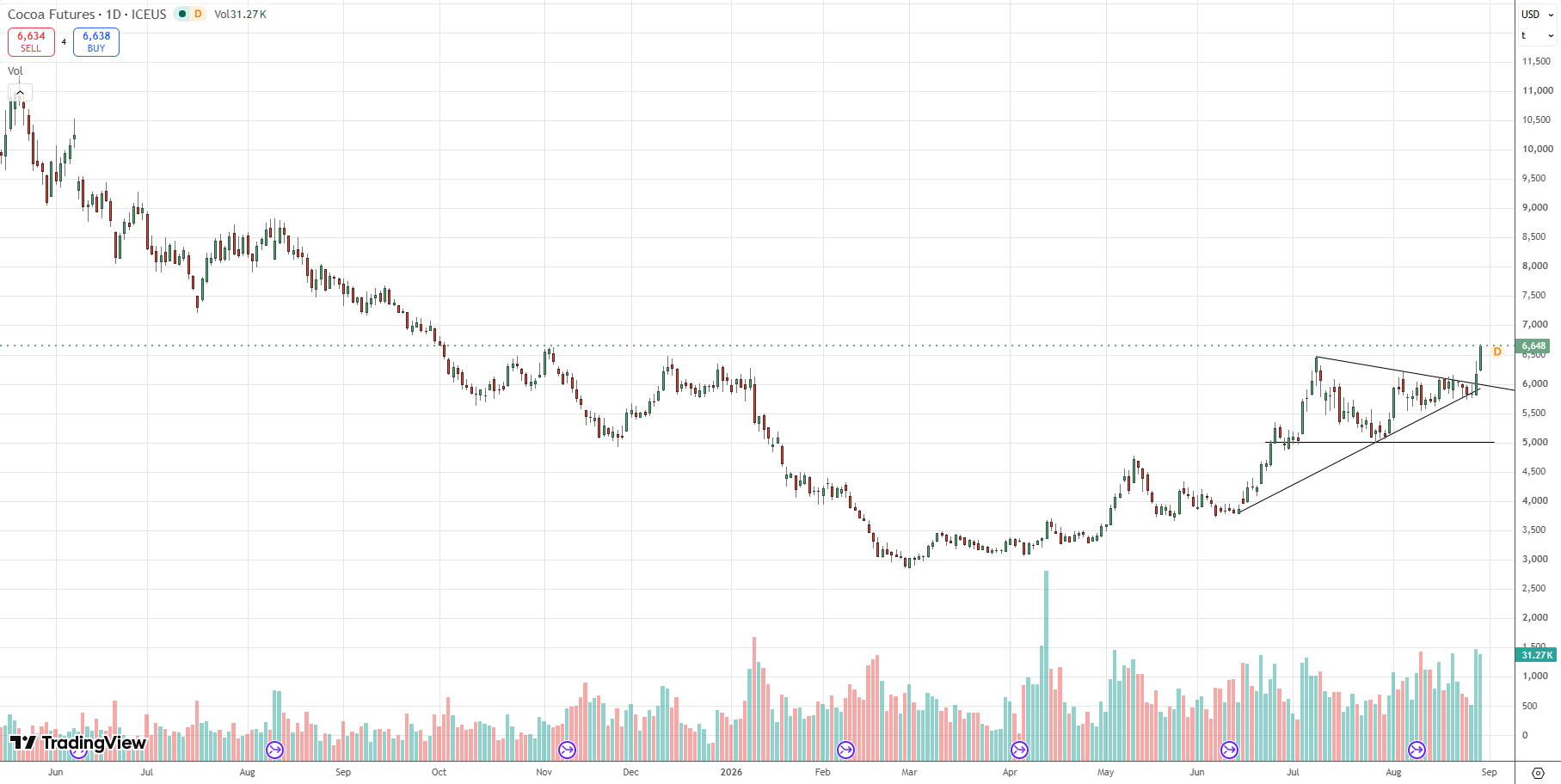
Following Friday’s 7.69% rise to 6,648, the most likely scenario for Monday is bullish consolidation rather than an immediate reversal. The breakout above the previous triangle was supported by strong volume and rising OBV, but the daily and hourly indicators are now overbought, making some profit-taking likely. I would assign approximately a 45% probability to consolidation between 6,450 and 6,750, a 40% probability to continued short covering, and only a 15% probability to a failed breakout. The Côte d’Ivoire farmgate-price report may support an initial rise because it was published after Friday’s market close, but the expected 1,200 CFA/kg price has not yet been officially confirmed and is unchanged from the mid-crop price. It could become bullish through farmer withholding, smuggling and reduced farm maintenance, although the lower procurement price also makes it easier for exporters to fulfil the more than 1.1 million tonnes already sold forward. The stronger immediate bullish factor remains the reported eight-to-ten-week delay to the Ivorian main crop and the expectation of very low September and October arrivals. Monday’s session may be particularly volatile because London cocoa is closed for the UK bank holiday and New York opens late at 7:30 a.m. ET, leaving New York alone to absorb the weekend news. The most likely sequence is therefore an early test of 6,687–6,700, followed by a pullback or sideways consolidation. Holding above 6,700 for 30–60 minutes would target approximately 6,850 and then 7,000–7,100, while a break below 6,450 would expose 6,300 and possibly 6,210. Overall, consolidation above 6,450 would remain constructive and should not be interpreted as a bearish reversal.
If you notice any discrepancies in these figures or have extra information, please email hello@cocoaintel.com or leave a comment – corrections and additional insights are always welcome.