Cocoa Falls Towards $5,500 Amid Reports of Returning Ivorian Rain (7 October 2026)


New York December cocoa fell sharply on Wednesday, 7 October, closing at $5,527/t, down $235 (−4.08%) from Tuesday’s $5,762. The contract traded between $5,515 and $5,820, a $305 range, and finished just $12 above its low, within the bottom 4% of the range. The official settlement declined $118 (−2.07%) to $5,582/t. The weak last-traded finish extended Tuesday’s retreat and brought the immediate $5,500 support area into focus, while the rising channel boundary around $5,400–$5,420 remained below the market.
Explore CocoaIntel’s new cocoa market-data section, covering weather, COT positioning, grindings, Ivorian arrivals, certified ICE stocks, futures curves, US–London spreads and seasonality.
Open Cocoa → Market Data, then select the dashboard you want to explore.
Reported rainfall recovery offers relief in western Côte d’Ivoire
Producer accounts shared by Ousmane Attai Ouedraogo on 7 October suggest that rainfall has improved in several important cocoa-growing areas. He reported “regular and sometimes heavy rainfall” in Soubré, Duékoué, Toulepleu, Guiglo and Bloléquin. This marks a potentially significant change after the dry conditions described in Monday’s farmer interviews, particularly around Soubré.
Sustained, well-distributed rainfall could ease water stress, support surviving young pods and improve bean filling. Its duration and geographical coverage will determine how much production benefits. Earlier damage to flowers and young pods remains relevant to the later main crop, while persistent heavy rain could increase pod-disease pressure and complicate harvesting and drying. Ouedraogo’s account provides an encouraging field update; it remains based on producer testimony rather than measured rainfall totals.
Côte d’Ivoire permits temporary clearance of untraced cocoa stocks
A Conseil du Café-Cacao notice dated 25 September authorised an exceptional procedure for moving untraced cocoa stocks from the 2025/26 season to exporters’ factories. The operation began on 28 September and runs until mid-October. Only stocks inventoried during the season’s final week are eligible. Regional delegations must verify their physical existence before consignment documents are issued, with documented volumes limited to confirmed inventory. These documents will not carry the designation of traced cocoa.
The procedure could improve near-term bean availability for processing by facilitating the movement of carryover stocks as the new season begins. These beans represent existing inventory rather than additional new-crop production. The notice provides no aggregate tonnage or confirmed transfer volumes, leaving the scale of the potential supply impact unquantified.
Ecuador’s exporters and analysts outline a conditional supply outlook
ANECACAO executive director Merlyn Casanova told Expana on 7 October that Ecuador could export 626,000 tonnes of cocoa in 2026/27, before allowing for potential El Niño losses, provided growing conditions remain supportive. The association is encouraging growers to clear drainage channels, strengthen plant nutrition, prune excessive shade and control weeds as farms prepare for heavier rainfall.
Expana cocoa analyst Andrew Moriarty outlined potential production losses of 40,000–50,000 tonnes if excessive rainfall persists into early 2027. This adds a separate conditional assessment to the larger warning covered yesterday. Casanova maintained that rainfall intensity, duration and distribution would determine the eventual damage. The October–April growing window is particularly important: effective drainage and disease control will influence whether Ecuador can sustain its expanding contribution to international supply.
Upcoming grindings will test the strength of processing demand
Third-quarter cocoa-grindings figures are scheduled for 15 October in Asia and North America, while the European Cocoa Association still lists that date as tentative. The releases will measure July–September industrial bean usage and provide a clearer demand assessment after the recent focus on crop risks.
The regional backdrop is uneven. European second-quarter grindings fell 4.6% year-on-year to 316,366 tonnes, while North America reported 7.65% growth to 109,659 tonnes. Asia’s reported increase was 25.07%, to 224,646 tonnes. These are historical benchmarks for the forthcoming release, rather than third-quarter forecasts.
CocoaIntel’s qualitative expectation is for continued regional divergence, with Europe more vulnerable to weak processing demand and Asia and North America needing to confirm that their second-quarter recovery continued. Another European contraction would reinforce concern over demand recovery. Broader processing growth would strengthen industrial bean demand as buyers assess emerging supply risks.
Abengourou cooperatives report competition from higher-priced unofficial purchases
AIP reported on 7 October that cooperatives in Indénié-Djuablin were concerned about cocoa moving towards Ghana as buyers outside official channels offered higher purchasing prices. Speaking at the regional campaign launch on 6 October, cooperative representative Ehora Yao Léonard said those buyers were offering 1,500–1,600 FCFA/kg, against the official 1,200 FCFA/kg. He described cooperative warehouses as almost empty and called for stronger border surveillance and an improved official price.
The reported offers represent premiums of approximately 25–33%, creating a strong incentive for farmers to sell outside organised channels. This adds a new cooperative account to the previously reported border seizures. Such diversion could weaken recorded Ivorian purchases and arrivals while changing where beans enter export statistics, making traceability and purchasing incentives important when interpreting national flows.
Barry Callebaut outlines expansion of Ivorian chocolate manufacturing
Barry Callebaut intends to triple its chocolate-production line capacity in Côte d’Ivoire, according to government and AIP reporting published on 7 October following chief executive Hein Schumacher’s meeting with Commerce Minister Kalil Konaté the previous day. Schumacher described a ten-year growth programme anchored in Côte d’Ivoire, including a broader product offering for local and regional customers.
The proposal extends the country’s industrial ambitions further along the cocoa value chain, towards chocolate manufacturing and regional consumer markets. Its commercial impact will depend on investment execution, customer demand and reliable access to beans, energy and logistics. The announced tripling concerns the chocolate line; it should be kept separate from SACO’s existing bean-grinding capacity.
Nestlé expands marketing support for cocoa beverages
Nestlé announced a multiyear NBA partnership on 7 October covering Milo, Nescau and Nesquik across 21 markets and four continents. Beginning in January 2027, the agreement combines youth basketball programmes with retail promotions, branded packaging and fan events.
Reuters reported that the initiative targets younger, increasingly health-conscious consumers. Nestlé’s cocoa and malt beverages head, Ali Abbas, described the objectives as “youth, culture, penetration and relevance with future generations.” The campaign shows how manufacturers are investing in consumer engagement to support cocoa-beverage sales, with the eventual purchasing benefit depending on the additional product volumes generated.
Futures Performance
New York cocoa
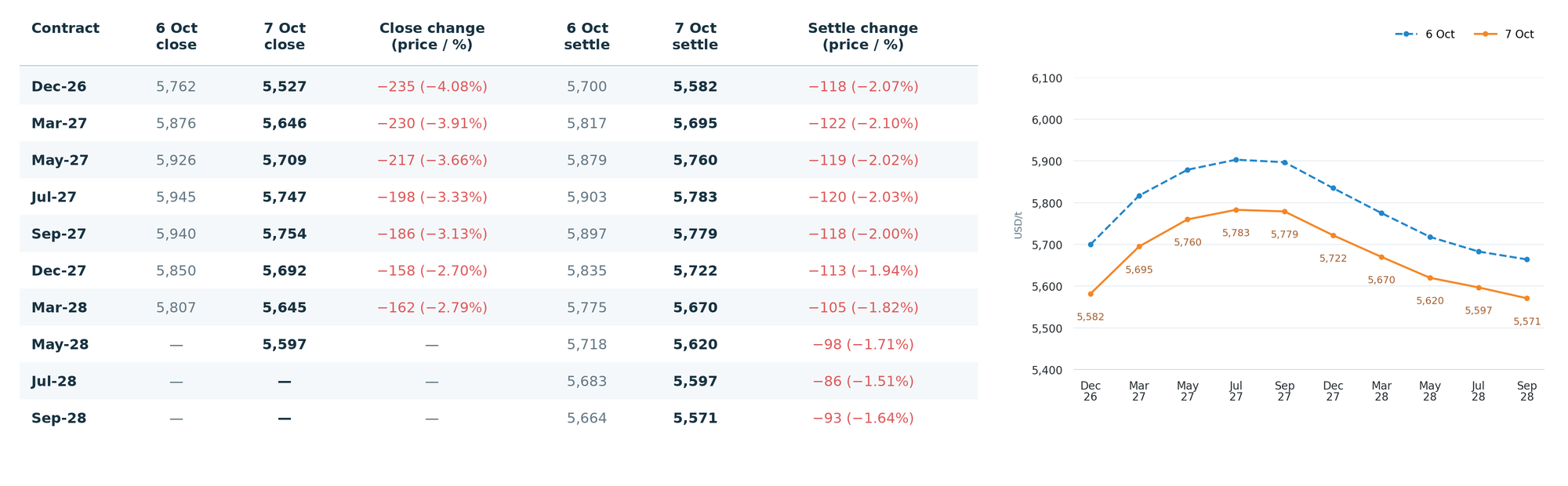
New York declined across all seven comparable last-traded closes on Wednesday, 7 October. December closed at $5,527/t, down $235 (−4.08%), underperforming the principal 2027 contracts. Its $305 daily range extended from $5,515 to $5,820, with the close just $12 above the low and within the bottom 4% of the range. The weak finish showed limited buying support as the latest recovery continued to unwind.
The settlement curve fell across all ten maturities, with December settling at $5,582, down $118 (−2.07%). Dec/Mar contango narrowed slightly from $117 to $113/t and Dec/Jul from $203 to $201/t, while Dec/Sep remained unchanged at $197/t. July 2027 retained the curve’s peak at $5,783. The largely unchanged spreads indicate broad downward repricing, with only modest relative resilience in December on settlement. Mid-2027 deliveries continued to command a substantial premium over nearby cocoa.
London cocoa
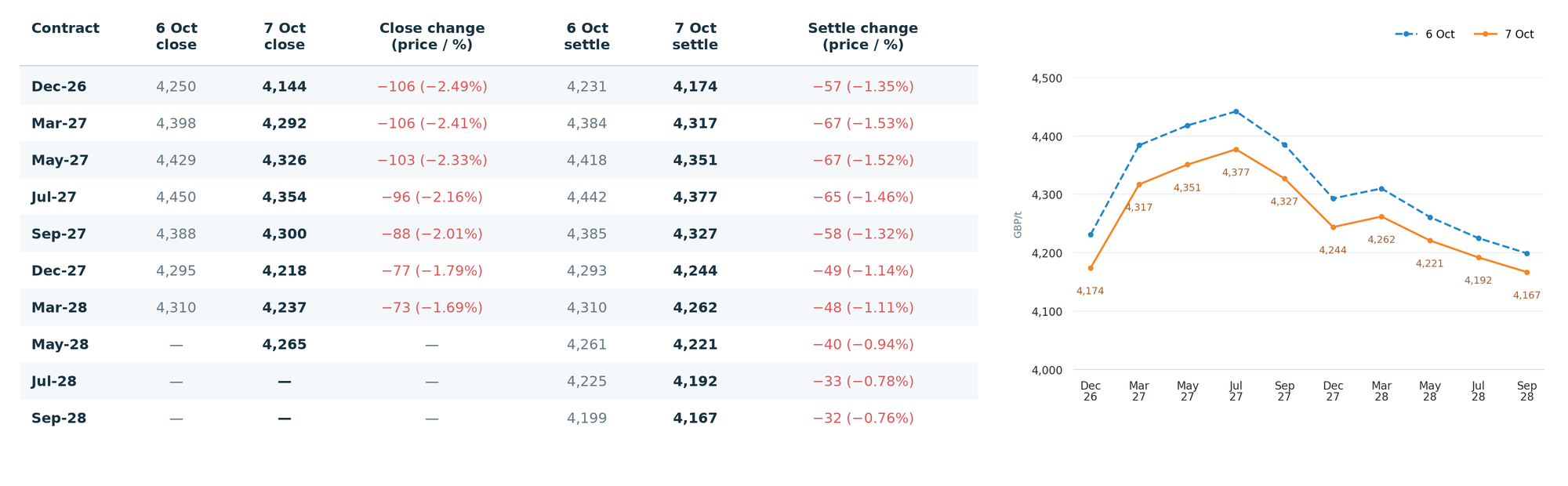
London also declined across all seven comparable last-traded closes. December closed at £4,144/t, down £106 (−2.49%), with percentage losses generally smaller further along the curve. The contract finished just £3 above its £4,141 low, within the bottom 2% of its £204 daily range. Nearby cocoa remained under pressure, and the closing position offered little evidence of a sustained recovery from the lows.
All ten official settlements moved lower, with December settling at £4,174, down £57 (−1.35%). Dec/Mar contango narrowed from £153 to £143/t and Dec/Jul from £211 to £203/t, as December held up better than the main deferred contracts on settlement. July 2027 remained the curve’s peak at £4,377. London therefore showed more noticeable nearby spread compression than New York, although this remained relative resilience within a falling market. Sparse trading in the 2028 maturities limits the weight of their individual last-price signals.
NY–London Dec-26 Spread
| Contract | NY close 7 Oct | London close 7 Oct | Spread 7 Oct ($/t) |
|---|---|---|---|
| Dec-26 | $5,527 | £4,144 | +$51.53 |
| Mar-27 | $5,646 | £4,292 | −$25.02 |
| May-27 | $5,709 | £4,326 | −$6.94 |
| Jul-27 | $5,747 | £4,354 | −$5.94 |
| Sep-27 | $5,754 | £4,300 | +$72.41 |
| Dec-27 | $5,692 | £4,218 | +$118.76 |
| Mar-28 | $5,645 | £4,237 | +$46.65 |
| May-28 | $5,597 | £4,265 | −$38.34 |
New York December’s premium narrowed to $51.53/t on Wednesday, 7 October, from $119.70/t on Tuesday, a reduction of $68.17/t. New York fell $235 while London declined £106. At Tuesday’s exchange rate, those futures-price changes would have reduced the premium by $94.27/t. Sterling’s depreciation lowered London’s dollar-equivalent value, offsetting $26.11/t of that deterioration. The narrower premium therefore reflects New York’s sharper decline, partly cushioned by currency movements.
New York weakened relative to London across all seven comparable maturities. March, May and July 2027 moved from premiums into discounts, while September 2027, December 2027 and March 2028 retained smaller premiums. May 2028 also traded at a discount, although no comparable Tuesday close was available. The broad compression reversed Tuesday’s relative improvement, showing that New York lost more ground across the curve during Wednesday’s sell-off.
GBP/USD: 1.3213 for 7 October; the preceding report’s 6 October rate of 1.3276 and historical spreads are preserved. Last-traded closes and FX are not necessarily simultaneous.
Volume and Open Interest
New York cocoa
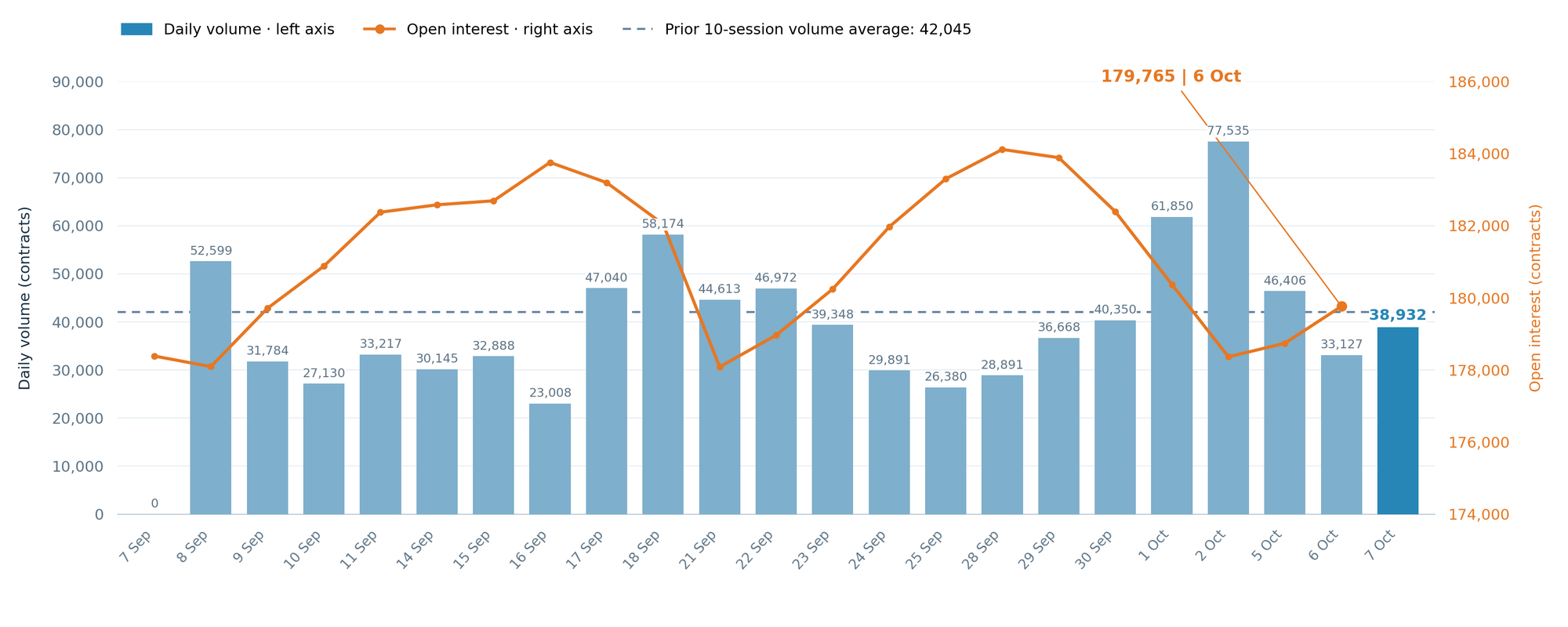
New York turnover increased to 38,932 contracts on Wednesday, 7 October, up 17.5% from Tuesday’s 33,127, although still 7.4% below the preceding 10-session average of 42,045. December’s 4.08% decline therefore attracted greater participation than Tuesday’s pullback, strengthening the evidence of selling pressure. Activity nevertheless remained below its recent average, rather than matching the intensity of the preceding week’s sharp moves.
Open interest rose 1,024 contracts (+0.57%) to 179,765 on 6 October, its second consecutive increase. Tuesday’s 1.54% price decline coincided with net creation of outstanding positions, making the move more consistent with expanding exposure than a decline driven solely by position unwinding. Aggregate OI cannot identify which participants initiated that exposure. Wednesday’s deeper decline and higher volume leave the continuation risk elevated; further weakness accompanied by rising OI would strengthen that assessment, while price stabilisation would challenge it.
London cocoa
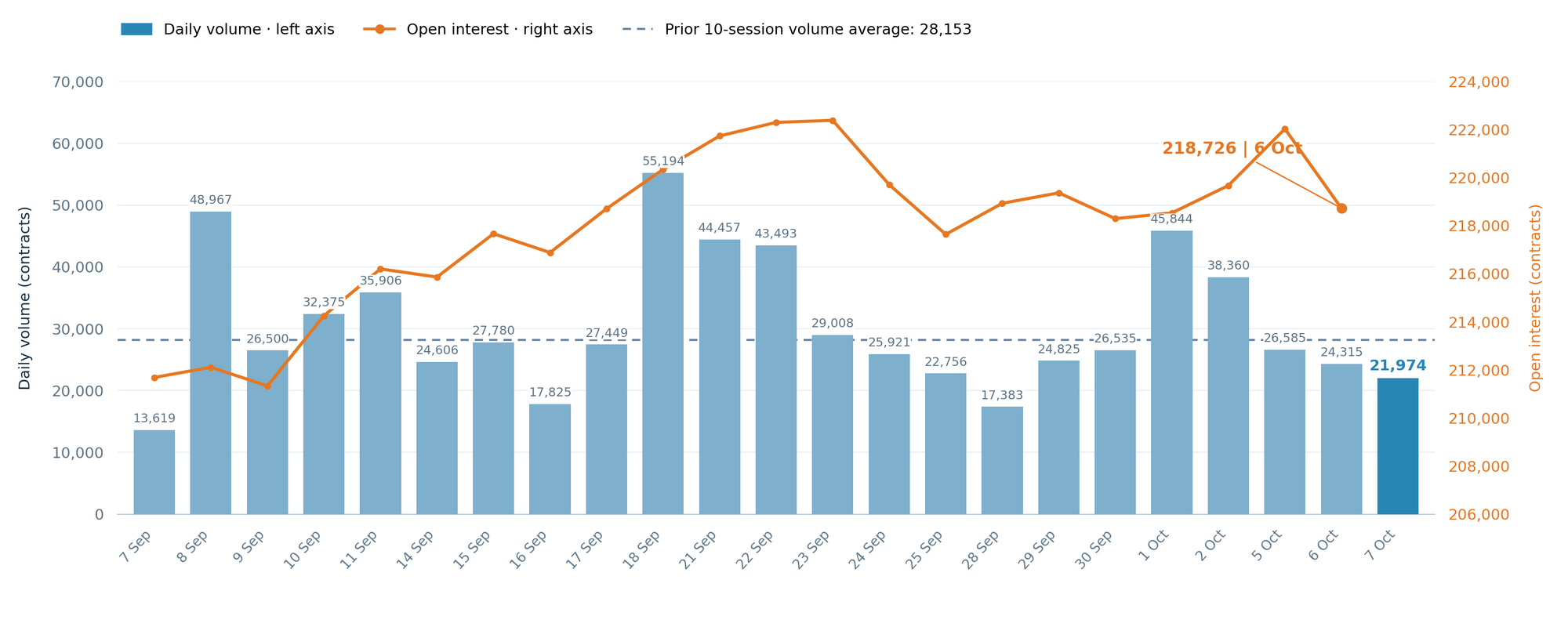
London turnover fell to 21,974 contracts on Wednesday, down 9.6% from Tuesday’s 24,315 and 21.9% below the preceding 10-session average of 28,153. December’s 2.49% decline consequently occurred with lighter participation, providing weaker volume confirmation than New York’s sell-off. Lower activity did not prevent further price deterioration, but it provides less evidence of an expanding wave of selling.
Open interest fell 3,303 contracts (−1.49%) to 218,726 on 6 October, reversing the preceding three-session increase almost entirely. Tuesday’s 2.61% decline therefore coincided with a meaningful contraction in outstanding exposure, consistent with position unwinding rather than net expansion. This reduced recently accumulated exposure but does not establish that selling has been exhausted. Renewed weakness accompanied by rising OI would indicate fresh position creation; stabilisation alongside further OI contraction would be consistent with the adjustment easing.
ICE Cocoa Stocks
| Market | Stock measure | Previous update | Latest update | Change | Change % |
|---|---|---|---|---|---|
| US | Total stocks in ICE-licensed warehouses | 3,538,981 bags | 3,549,555 bags | +10,574 bags | +0.30% |
| US | Certified stocks, included in warehouse total | 423,725 bags | 439,117 bags | +15,392 bags | +3.63% |
| London / Europe | Valid-warrant stocks, 64-kg bag equivalents | 1,194,063 | 1,197,344 | +3,281 | +0.27% |
U.S. warehouse holdings increased by 10,574 bags on 7 October, while certified stocks rose more sharply, gaining 15,392 bags to represent 12.4% of total holdings. The certification increase matched the additional bags recorded as having passed grading.
London valid-warrant stocks increased by 210 tonnes to 76,630 tonnes on 6 October, compared with 5 October. Antwerp accounted for 190 tonnes of the increase and Hamburg for 20 tonnes. Deliverable warrant coverage improved, although accompanying changes in expired and suspended warrant categories mean the increase cannot automatically be interpreted as new physical warehouse arrivals.
Thursday Trading Setup — ICE Futures U.S. Cocoa December 2026
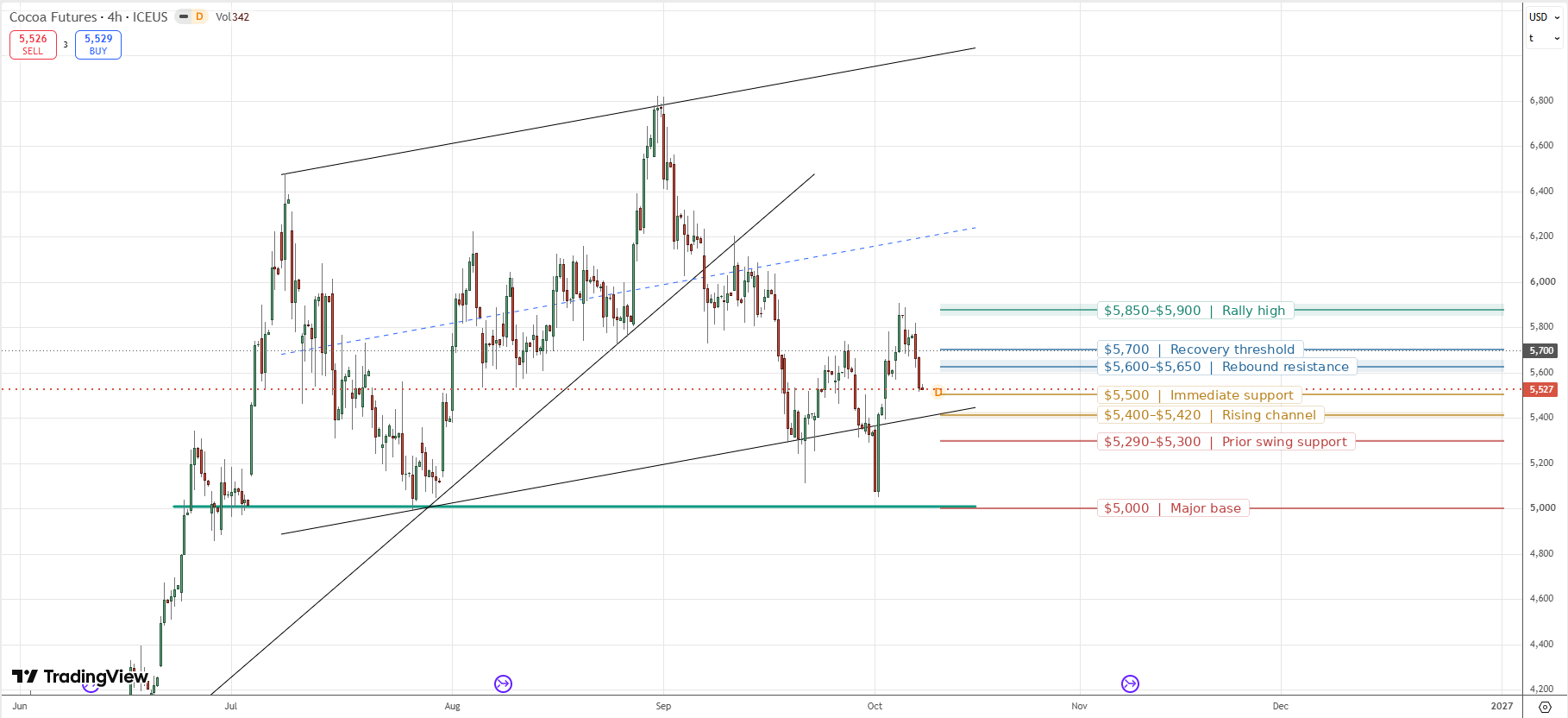
December cocoa enters Thursday with a bearish near-term bias after Wednesday’s 4.08% decline to $5,527/t, with the close just $12 above the session low. Below $5,600–$5,650, which brackets the calculated pivot at $5,621, rebounds remain vulnerable to selling. A sustained break below $5,515–$5,500, followed by a failed reclaim, would expose the rising channel boundary around $5,400–$5,420, closely aligned with calculated S1 at $5,421. Losing that area would strengthen the continuation case towards $5,316, calculated S2, then $5,290–$5,300. Conversely, holding support and reclaiming $5,650 would improve recovery prospects towards $5,725–$5,730, around R1 at $5,726. The broader channel remains intact, but buyers need to recover lost ground to ease the immediate pressure.