Cocoa Extends Recovery Amid Growing Ivorian Crop Concerns (2 October 2026)


New York December cocoa extended Thursday’s recovery on Friday, 2 October, although late selling reduced the advance. After opening at $5,490/t and pulling back to $5,395, prices recovered through $5,500 and $5,600 before accelerating above $5,700. The contract reached $5,781, up 6.11% from Thursday’s last-traded close, but failed to sustain those gains and retreated towards $5,600 before stabilising. The last-traded close was $5,609/t, up $161 (+2.96%), leaving December $172 below its high and slightly above the midpoint of its $386 daily range. The official settlement rose $289 (+5.37%) to $5,670/t. Friday therefore preserved a meaningful recovery, while the retreat from the highs showed renewed selling above $5,700. London December closed at £4,244/t, up £212 (+5.26%), recording the stronger gain on a last-traded-close basis.
Côte d’Ivoire’s main cocoa crop expected to fall around 17%
Exporters surveyed by Reuters expect Côte d’Ivoire’s 2026/27 main crop to reach approximately 1.25 million tonnes, compared with 1.5 million last season, a reduction of around 250,000 tonnes, or 17%. Published on 2 October, the survey linked the weaker outlook to persistent dryness since July and reduced fertiliser and pesticide use as farmers faced higher input costs. The harvesting calendars differ: this season’s main crop runs from September to February, compared with October to March previously.
Farmers reported that insufficient moisture had impaired flowering and pod development. Survey respondents said that even renewed rainfall would be unlikely to lift the main harvest above 1.4 million tonnes, while a pod counter working for a French company expected the mid-crop to benefit most from rain arriving now. Continued dryness in October would place the later main-crop harvest under further pressure.
One Abidjan-based exporter projected October port arrivals of just 20,000–25,000 tonnes per week, against an average of approximately 71,300 tonnes last October. That projection points to substantially weaker replenishment during a normally important delivery period. Existing inventories provide a buffer, but the pace of October arrivals will help establish how quickly the developing crop can replace cocoa already moving through the supply chain.
Ghana discusses cocoa financing with Stanbic Bank
COCOBOD said on 2 October that its management had met a Stanbic Bank Ghana delegation to discuss financing across the cocoa value chain. The discussions covered cocoa purchasing, farm rehabilitation, plantation development and processing, with particular attention to domestic financing instruments. Stanbic’s delegation included Anne Aliker, its executive responsible for corporate and investment banking across African regions.
The purchasing component is particularly relevant as Ghana mobilises funding for the new season. Working capital could support timely farmer payments and the movement of beans through the buying system, while rehabilitation and plantation investment address future productive capacity. Processing finance could support domestic bean demand and greater value retention at origin. The practical test is whether the discussions lead to committed facilities and disbursements that reach the purchasing system when needed.
Dominican Republic reports approximately 110,000 tonnes of cocoa production
Agriculture Minister Francisco Oliverio Espaillat Bencosme reported on 1 October that Dominican cocoa production reached approximately 110,000 tonnes during the latest completed cocoa year. Exports exceeded 103,000 tonnes and generated US$515 million, which the minister described as the country’s second-highest cocoa export earnings. The reported production outcome follows the earlier forecast above 100,000 tonnes and strengthens the evidence of expanding supply outside West Africa.
Espaillat also announced support for the Dominican Cocoa Revitalisation Project, PRACAO. Its first phase is scheduled to begin in 2027, with US$100 million planned over six years, within a broader three-stage programme envisaging US$500 million over 20 years. Priorities include replacing ageing plantations, researching more productive cocoa varieties with greater tolerance to moniliasis, and improving drying, post-harvest handling and processing. These investments aim to strengthen productivity and export quality while addressing the sector’s ageing farms and workforce.
Weather
Côte d’Ivoire and Ghana — southern rainfall deficits persist
NOAA’s seven-day rainfall estimates for 26 September–2 October show many southern areas of Côte d’Ivoire and Ghana receiving less than 25 mm, with substantially wetter conditions farther north. The 30-day anomaly map for 3 September–2 October retains deficits across much of the southern belt, despite surpluses in northern districts. Rainfall outside the main producing areas therefore gives an incomplete picture of conditions facing cocoa farms.
The outlook through 7 October maintains this contrast: wetter conditions are favoured in northwestern Côte d’Ivoire and northern Ghana, while rainfall along the southern coasts is expected to remain below average. For cocoa, the important test is whether showers spread into producing districts and recur sufficiently to replenish moisture. Continued uneven rainfall would leave flowering and young-pod development exposed, particularly where reserves have already been depleted. More regular rain could support subsequent crop development, while dry intervals help harvesting and bean drying.
Nigeria and Cameroon — wetter conditions, with coastal exceptions
The latest rainfall maps show greater moisture replenishment across much of southern Nigeria and western Cameroon than in the southern Ivorian–Ghanaian belt. However, parts of coastal Nigeria retain deficits over both seven and 30 days. NOAA’s outlook through 7 October favours further rainfall across Nigeria and Cameroon, with a drier signal along Nigeria’s southern coast. In wetter districts, repeated showers could slow collection and drying and increase fungal-disease pressure; coastal farms with accumulated deficits still need more consistent rainfall.
Brazil — patchy showers against depleted moisture reserves
NOAA’s modelled soil-moisture anomalies dated 2 October indicate deficits across parts of Pará and Bahia. INMET’s 3–5 October outlook offers showers and thunderstorms in central and southern Pará, shifting towards the southwest on Monday, while coastal Bahia receives mainly isolated showers. Rainfall relief is therefore likely to vary considerably between farms.
For 5–11 October, CPC/GFS guidance retains limited rainfall over much of central Pará and the Bahia cocoa belt, alongside above-normal daytime temperatures. The combination would increase evaporative demand where soil reserves remain low. The key improvement would be repeated, well-distributed rain rather than a single storm; isolated showers may briefly improve surface conditions without restoring deeper moisture.
Indonesia — broad rainfall relief remains uncertain
BMKG’s 2–8 October bulletin continues to identify a predominantly dry atmospheric background associated with El Niño and a positive Indian Ocean Dipole. Its forecast places about 79.7% of Indonesia in the low-rainfall category of 0–50 mm during the first ten days of October; this is national area coverage, rather than a Sulawesi rainfall estimate.
Sulawesi’s main cocoa provinces are absent from the bulletin’s moderate- and heavy-rain warning lists for 5–8 October. NOAA’s 2 October modelled moisture map also shows deficits across much of the island. Isolated showers could provide local relief, but sustained replenishment remains the requirement for easing pressure on flowering, pod retention and filling.
Ecuador — coastal rain warning extends into Monday
INAMHI’s warning issued on 1 October remains valid until 10:00 local time on 5 October. It covers moderate and occasionally heavy rain, thunderstorms and gusts across Esmeraldas, Santo Domingo, Los Ríos, Guayas and parts of Manabí and El Oro. The strongest activity was forecast between the night of 2 October and early 4 October.
For coastal cocoa, the immediate risks are ponding on low-lying farms, difficult access roads and interruptions to drying where heavy showers occur. Rain can also replenish drier soils, making local drainage and antecedent conditions important. The warning’s expiry on Monday morning should be respected when assessing the rest of the week.
Peru — renewed rainfall opportunities alongside warmth
CPC/GFS guidance for 5–11 October shows rainfall opportunities along the eastern Andean foothills through San Martín and Huánuco, extending into parts of Ucayali, with greater amounts near the foothills than across some adjacent lowlands. Above-normal daytime temperatures accompany the rain outlook. Showers could improve moisture availability, while warmer conditions increase water demand between events; farm-level relief will depend on rainfall frequency and coverage.
Futures Performance
New York cocoa
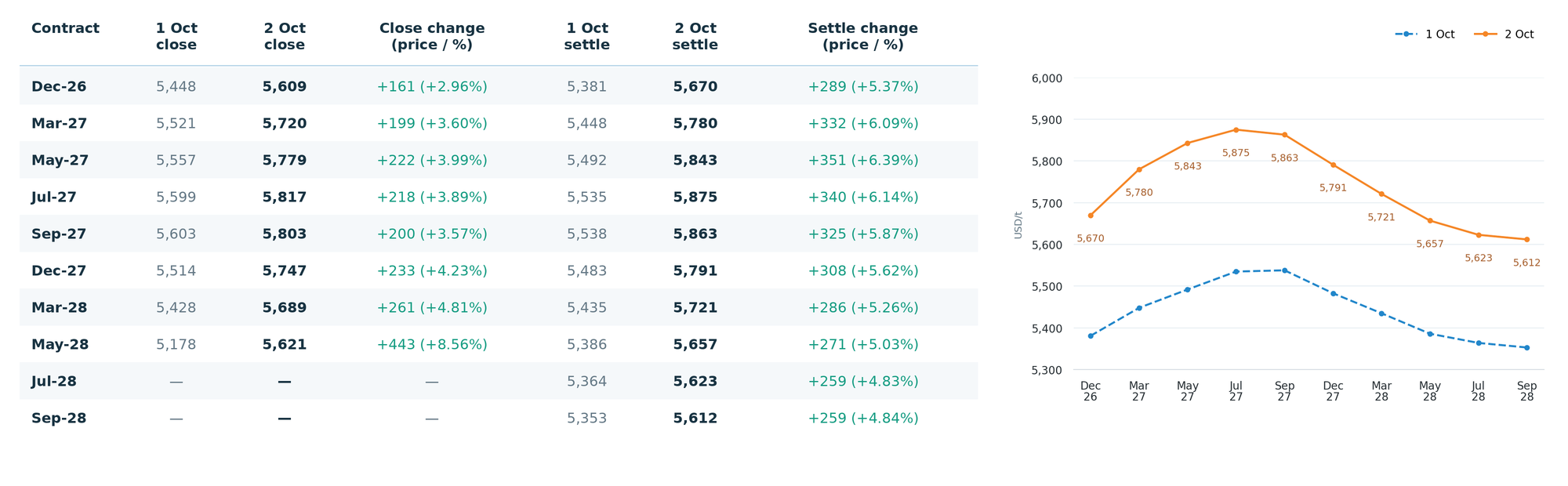
New York advanced across all eight available last-traded closes on Friday, 2 October. December closed at $5,609/t, up $161 (+2.96%), while March and May 2027 gained 3.60% and 3.99%, respectively. December traded between $5,395 and $5,781, finishing $172 below its high and 55% of the way up its daily range. The session extended Thursday’s recovery, although buyers did not sustain the strongest prices. May 2028’s 8.56% closing gain warrants caution: only eight contracts traded, and Thursday’s last trade was substantially below its settlement.
The settlement curve rose across all ten maturities, with December settling at $5,670, up $289 (+5.37%). Mid-2027 contracts strengthened more than December: Dec/Mar contango widened from $67 to $110/t and Dec/Jul from $154 to $205/t, reversing part of Thursday’s tightening. July replaced September as the curve’s peak at $5,875, while Jul/Sep moved from $3 contango to $12 backwardation. The broad recovery therefore came with stronger pricing for mid-2027 delivery, rather than improved nearby relative performance. Further outright gains accompanied by narrowing December discounts would make the recovery more convincing at the front of the curve.
London cocoa
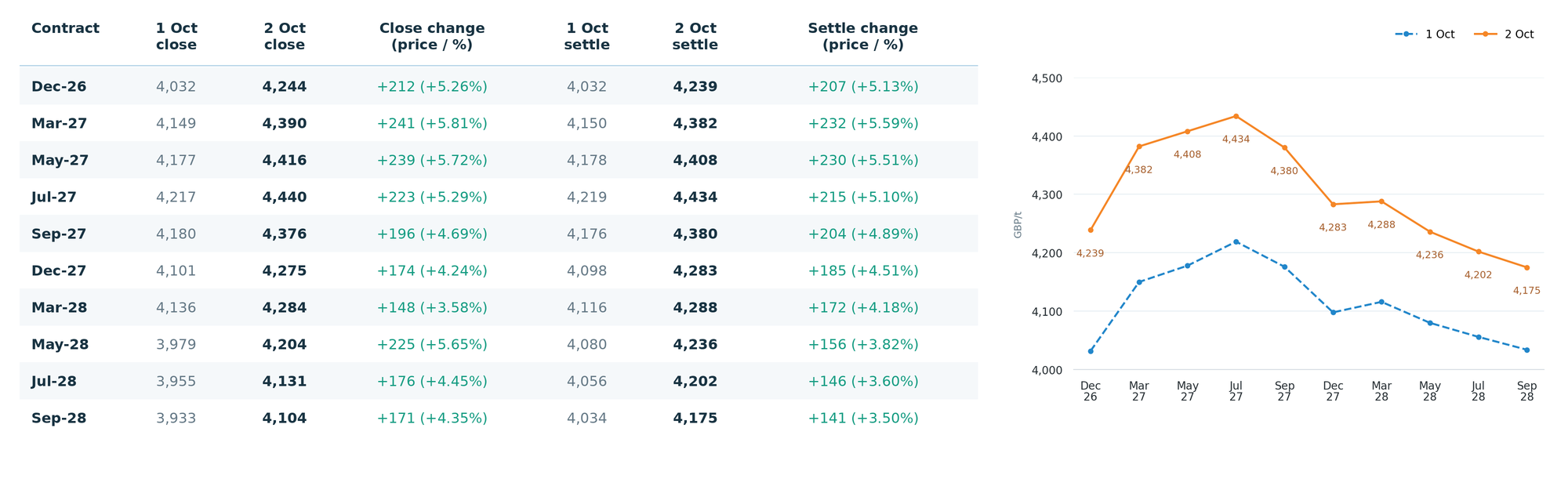
London advanced across all ten last-traded closes. December closed at £4,244/t, up £212 (+5.26%), with March and May 2027 gaining 5.81% and 5.72%, respectively. December’s £4,032–£4,296 range ended with the close just £52 below its high, around 80% of the way up the range. That was a firmer finish than New York’s, with London retaining more of its advance into the last reported trade.
All ten settlements also rose, with December settling at £4,239, up £207 (+5.13%). Dec/Mar contango widened from £118 to £143/t and Dec/Jul from £187 to £195/t, as March and July gained more in absolute terms than December. July remained the curve’s peak at £4,434, while Jul/Sep backwardation widened from £43 to £54/t. The curve continued to price mid-2027 delivery above December, with a steeper decline after July. The recovery was broad, but distant closing prices carry less weight: May–September 2028 accounted for only 56 contracts combined.
NY–London Dec-26 Spread
| Contract | NY close 2 Oct | London close 2 Oct | Spread 2 Oct ($/t) |
|---|---|---|---|
| Dec-26 | $5,609 | £4,244 | −$11.33 |
| Mar-27 | $5,720 | £4,390 | −$93.68 |
| May-27 | $5,779 | £4,416 | −$69.11 |
| Jul-27 | $5,817 | £4,440 | −$62.89 |
| Sep-27 | $5,803 | £4,376 | +$7.86 |
| Dec-27 | $5,747 | £4,275 | +$85.62 |
| Mar-28 | $5,689 | £4,284 | +$15.70 |
| May-28 | $5,621 | £4,204 | +$53.64 |
$5,609 − (£4,244 × 1.3243) = −$11.33/t.
New York December moved from a $124.95/t premium on Thursday to an $11.33/t discount on Friday, a deterioration of $136.28/t. At Thursday’s exchange rate, futures-price changes alone would have reduced the spread by $118.88/t: New York gained $161, while London’s £212 increase equated to $279.88. Sterling’s appreciation increased London’s dollar-equivalent price by a further $17.40/t. London’s stronger recovery therefore reversed most of Thursday’s improvement in New York’s relative position, bringing December back close to parity.
Volume and Open Interest
New York cocoa
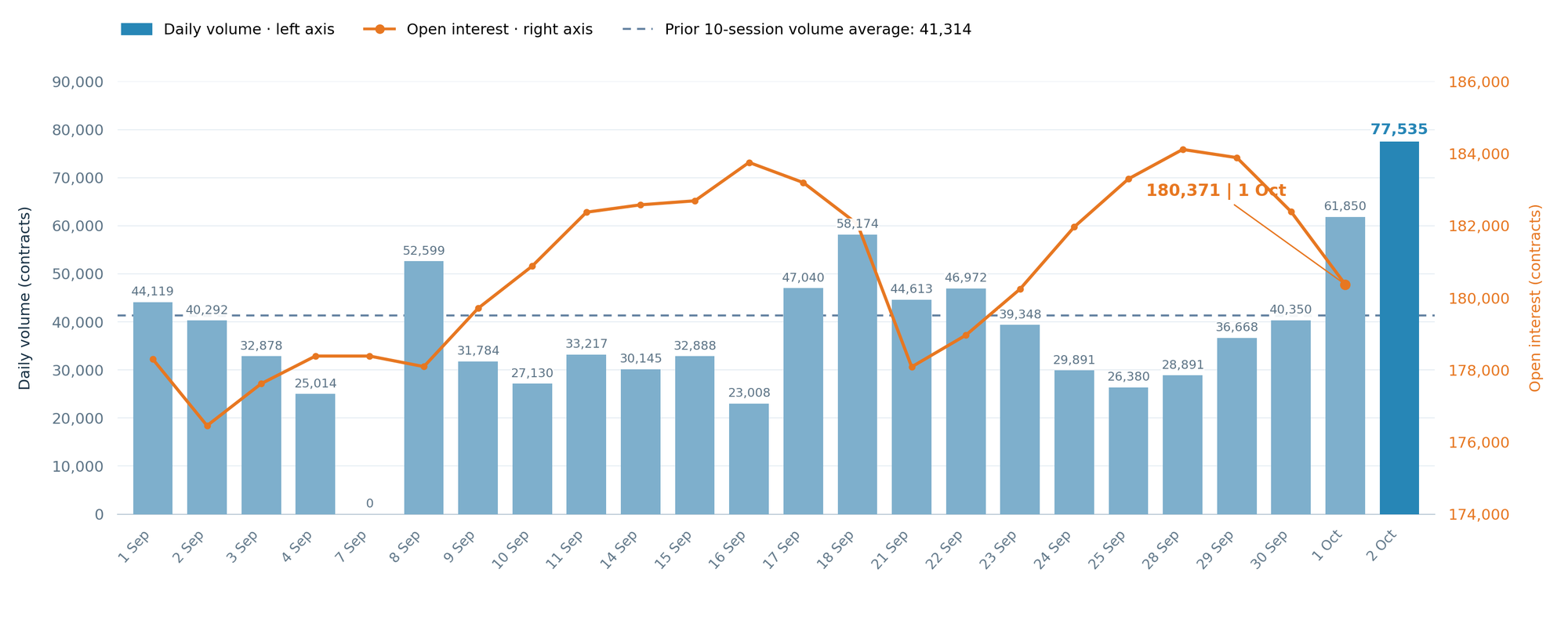
New York turnover rose to 77,535 contracts on Friday, 2 October, up 25.4% from Thursday’s 61,850 and 87.7% above the preceding 10-session average of 41,314. December’s 2.96% closing gain and the broad rise across maturities therefore attracted substantially stronger participation. This gives the recovery firmer volume confirmation, although December’s finish $172 below its daily high shows that buyers did not sustain the strongest prices.
Open interest fell 2,019 contracts (−1.11%) to 180,371 on 1 October, its third consecutive decline and a cumulative reduction of 3,745 contracts since Monday. Thursday’s December rebound therefore occurred while outstanding positions contracted, rather than alongside net position creation. That is consistent with position unwinding during the recovery, although aggregate OI cannot establish how much involved short covering. Renewed OI growth alongside higher prices would strengthen the case that additional positions are helping sustain the recovery; continued contraction would leave that confirmation weaker.
London cocoa
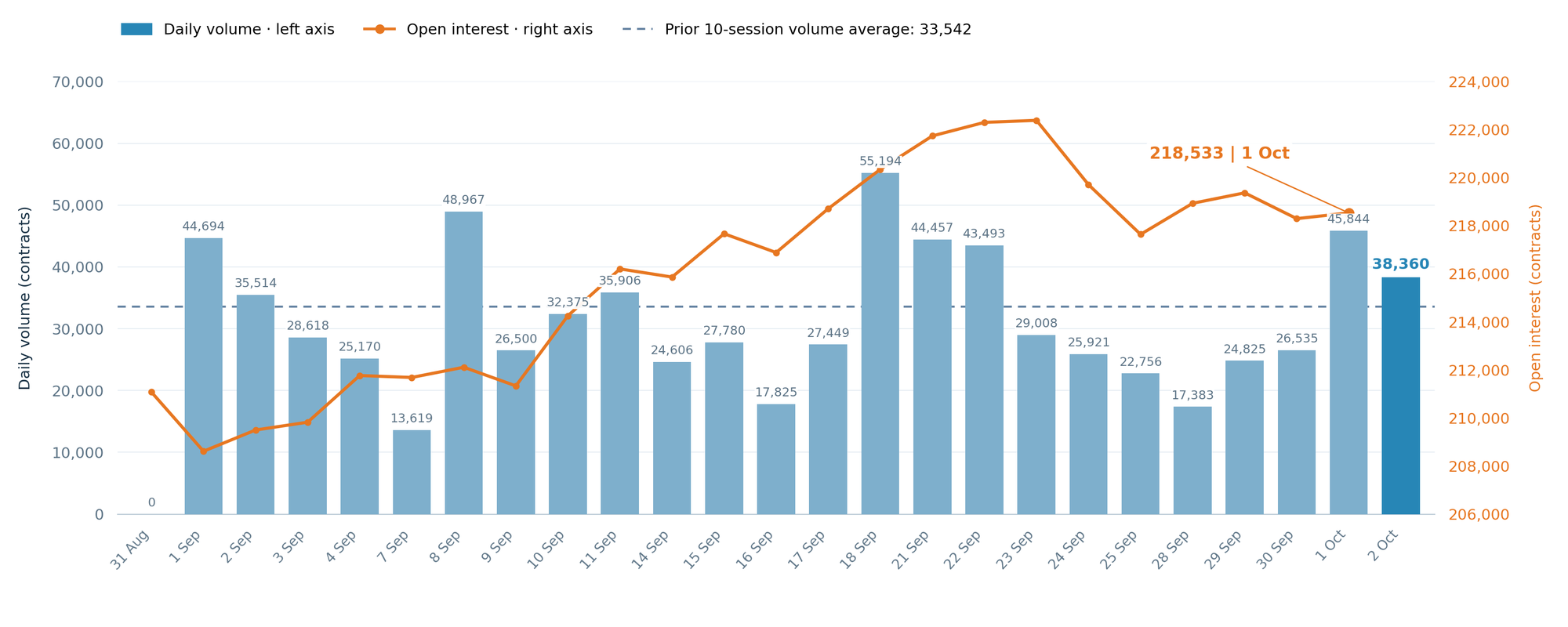
London turnover fell to 38,360 contracts on Friday, down 16.3% from Thursday’s 45,844, but remained 14.4% above the preceding 10-session average of 33,542. December’s 5.26% closing gain and advances across all ten maturities therefore occurred with above-average participation, despite activity easing from Thursday’s exceptionally busy session. London’s stronger price gain came with a smaller increase over normal turnover than New York’s.
Open interest increased 238 contracts (+0.11%) to 218,533 on 1 October, recovering only part of Wednesday’s 1,073-contract decline. Thursday’s 0.35% December gain coincided with modest net position creation, offering a different positioning signal from New York’s contraction. However, most deferred contracts closed lower that day, and the OI increase was small, so it does not establish broad bullish accumulation. Sustained price strength accompanied by further OI expansion would give the recovery stronger positioning confirmation.
COT Analysis
Positions as of 29 September 2026, on a futures-and-options-combined basis. Weekly changes are measured against 22 September. Long and short columns exclude the matched positions reported separately as spreading.
| Indicator | New York | Weekly change | London | Weekly change |
|---|---|---|---|---|
| Managed-money longs | 14,890 | +1,047 | 6,799 | +113 |
| Managed-money shorts | 34,208 | +943 | 13,835 | +706 |
| Managed-money net position | −19,318 | +104 | −7,036 | −593 |
| Managed-money spreading | 41,654 | +5,833 | 36,984 | +1,468 |
| Combined open interest | 238,851 | +5,576 | 290,225 | −2,074 |
New York cocoa
Managed money remained net short 19,318 contracts, only 104 fewer than the previous week. Reported longs increased by 1,047 to 14,890, while shorts rose by 943 to 34,208. Bullish exposure recovered after the preceding week’s sharp reduction, but additional shorts almost entirely offset that improvement. The directional balance therefore remained bearish, with little evidence of a broad shift toward bullish positioning.
Spreading increased by 5,833 contracts to 41,654, while combined OI rose 2.4%. Much of the expansion in reported fund exposure was consequently offsetting rather than directional. The remaining short exposure creates potential buying pressure if prices sustain their recovery and funds reduce bearish positions. Renewed weakness would instead leave those shorts aligned with the price trend, while the enlarged long position remains vulnerable to unwinding.
London cocoa
London’s managed-money net short widened 593 contracts to 7,036, a 9.2% increase. Reported shorts rose by 706 to 13,835, substantially exceeding the 113-contract increase in longs to 6,799. The bearish adjustment therefore came from higher reported short exposure rather than falling longs. It occurred while combined OI declined 0.7%, showing that funds increased their directional short balance within a modestly smaller overall market.
The net short represented 2.4% of combined OI, compared with 8.1% in New York, leaving London’s proportional directional imbalance smaller. Friday’s stronger London recovery puts pressure on bearish exposure if higher prices hold. However, both snapshots stop on Tuesday, before the 1–2 October recovery, so they cannot establish whether Friday’s buying reflected short covering or fresh long accumulation.
ICE Cocoa Stocks
| Market | Stock measure | Previous update | Latest update | Change | Change % |
|---|---|---|---|---|---|
| US | Total stocks in ICE-licensed warehouses | 3,485,609 bags | 3,500,581 bags | +14,972 bags | +0.43% |
| US | Certified stocks, included in warehouse total | 423,725 bags | 423,725 bags | 0 | 0.00% |
| London / Europe | Valid-warrant stocks, 64-kg bag equivalents | 1,185,313 | 1,185,313 | 0 | 0.00% |
U.S. warehouse holdings increased by 14,972 bags on Friday, 2 October, taking the total to 3,500,581 bags. Stocks rose by 67,825 bags (+1.98%) over the week. Certified stocks remained unchanged at 423,725 bags, representing 12.1% of total holdings. Meanwhile, 47,280 bags were awaiting grading, compared with none on Thursday; passed grading remained at 1,740 bags. The new grading queue provides a potential route to replenishing certified stocks, subject to successful grading.
London valid-warrant stocks were unchanged at 75,860 tonnes in the report dated 1 October, equivalent to approximately 1,185,313 bag equivalents. Both port totals and the perpetual-valid, initially valid, expired and non-tenderable warrant categories matched the 30 September report.
The supplied historical series puts U.S. warehouse holdings 79.3% above 2 October 2025 and London’s valid-warrant stocks 122.6% above 1 October 2025. These larger inventories provide a greater buffer against weaker origin supply. A sustained drawdown would be a clearer indication that crop concerns were translating into tighter exchange inventories.
Monday Trading Setup — ICE Futures U.S. Cocoa December 2026
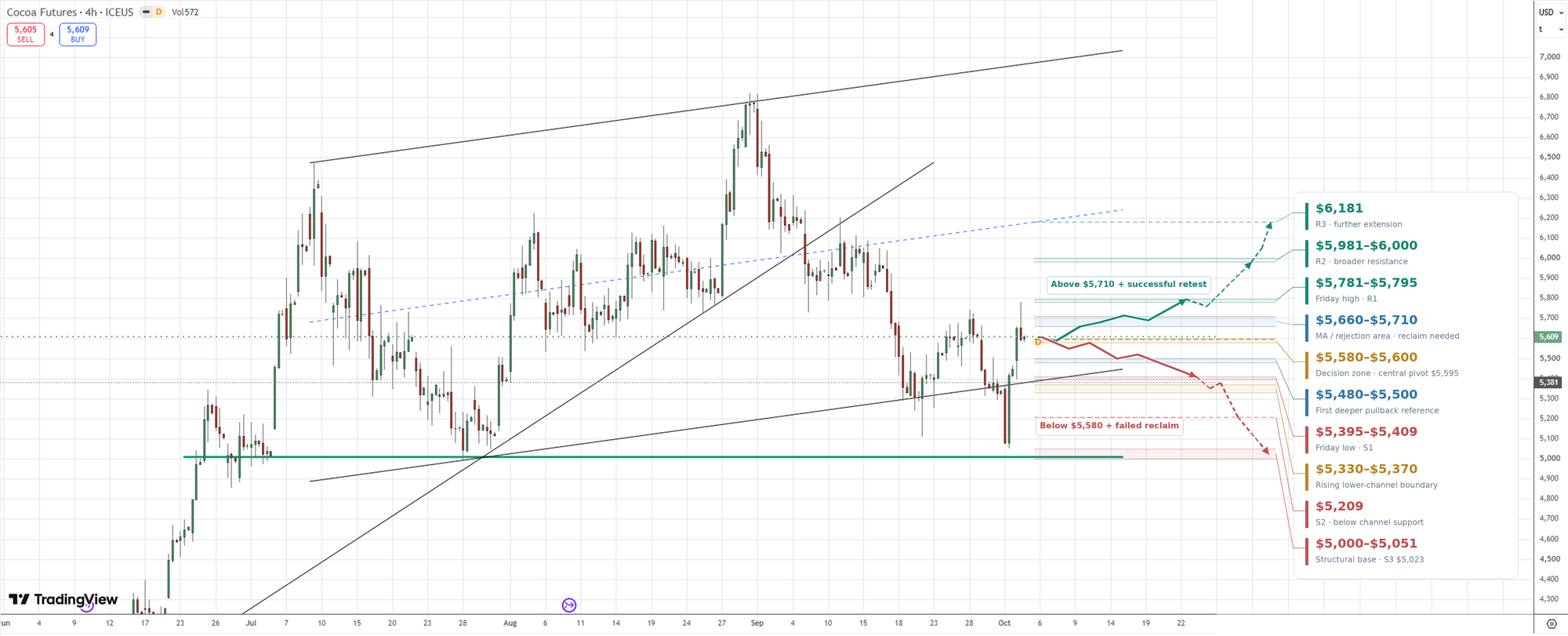
Monday’s setup favours consolidation followed by another recovery attempt while $5,580–$5,600 holds, encompassing the $5,595 central pivot and Friday’s late trading floor. Price has reclaimed the rising lower-channel boundary and recovered above the hourly 21- and 90-period averages and the daily 9- and 90-period averages. Hourly RSI is above 50, MACD is positive and OBV has improved, but the shrinking MACD histogram, rolling stochastic and five-minute range compression show that momentum eased into the close. The first confirmation is an hourly reclaim of $5,660–$5,710, covering the recent rejection area, hourly 200-period average and falling daily 21-period average. A successful retest would favour another approach to $5,781–$5,795, combining Friday’s high with R1. Acceptance above $5,795 would open $5,981–$6,000, where R2 meets broader resistance; this is a conditional extension rather than the initial Monday objective.
An hourly close below $5,580, followed by a failed reclaim of $5,595–$5,600, would favour a deeper pullback towards $5,480–$5,500, then $5,395–$5,409, combining Friday’s low with S1. Holding that lower zone and forming a higher low would preserve the recovery from Thursday’s trough. Failure would bring the rising channel boundary around $5,330–$5,370 back into play; renewed acceptance below it would expose $5,209, then the $5,000–$5,051 structural base, which includes S3 at $5,023. Daily MACD remains negative and hourly ATR is elevated despite late five-minute compression, so the rebound still needs confirmation through sustained closes and retests above resistance.