Cocoa Extends Recovery as Ivorian Crop Risks Persist (5 October 2026)


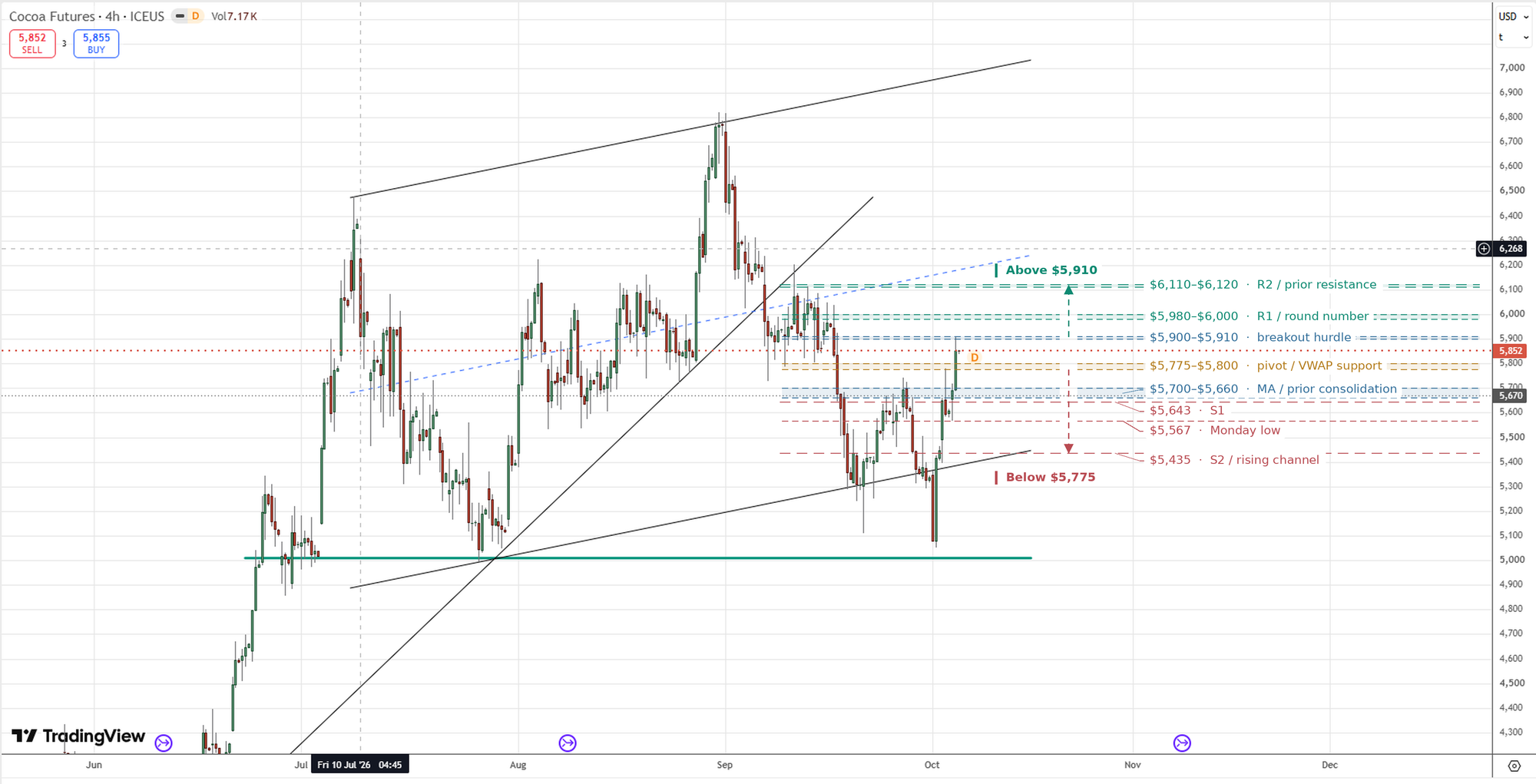
New York December cocoa extended its recovery on Monday, 5 October, closing at $5,852/t, up $243 (+4.33%) from Friday. An early retreat to $5,567 was followed by consolidation around $5,600–$5,650 before buying strengthened, carrying prices through $5,700 and $5,800. A brief pullback was absorbed, allowing another advance to the session high of $5,908, approximately 5.33% above Friday’s close. Prices subsequently eased into quieter consolidation near $5,850, retaining most of the rally. December finished just $56 below its high, in the upper 16% of the $341 daily range, showing that buyers sustained the recovery through the close. The official settlement rose $197 (+3.47%) to $5,867/t, while London December’s last-traded close increased £120 (+2.83%) to £4,364/t.
Côte d’Ivoire’s dry spell raises the risk of an early end to the main crop
Fresh farmer interviews reported by Reuters on 5 October reinforced concern that Côte d’Ivoire’s September–February main crop could finish early if rainfall remains insufficient. Soubré received no rain during the latest week, against a five-year average of 22 mm, while Daloa recorded 3.4 mm, or 25.7 mm below its average. Growers also described dry conditions around Agboville, Divo and Abengourou, with patchy rainfall around Bongouanou and Yamoussoukro. Farmers warned that rain delayed until mid-October could jeopardise young pods intended for harvesting next year.
The immediate harvest outlook remains different from the later crop risk. Growers expect deliveries to increase from mid-October as larger pods mature, even while the younger pod population remains vulnerable. The market therefore faces the possibility of improving near-term arrivals alongside a weaker January–February harvest. October rainfall matters for sustaining production beyond the initial harvesting surge.
Côte d’Ivoire’s weekly port arrivals rise to 18,000 tonnes
Exporter estimates reported by Reuters on 5 October put arrivals at 18,000 tonnes during the week ending 4 October, bringing the season-to-date total to 54,500 tonnes. Weekly deliveries increased by 2,000 tonnes, or 12.5%, from the previous 16,000-tonne estimate. The increase shows a gradual improvement in marketed flows ahead of the larger harvest farmers expect from mid-October.
The cumulative total runs from 1 September, following this season’s early opening, whereas the previous campaign began on 1 October. That calendar difference prevents a straightforward season-to-date comparison with last year. The coming weekly readings will show whether the anticipated acceleration in harvesting translates into stronger port replenishment.
Ghana’s first cocoa-financing offer reportedly raises GH¢3.39 billion
Joy Business reported on 5 October, citing people familiar with the placement, that Cocoa Capital PLC raised GH¢3.39 billion for COCOBOD in the first tranche of its commercial-paper programme. The offer fell GH¢610 million short of its GH¢4 billion target. Investors reportedly received an 11% interest rate on paper with a 266-day tenor.
This is a substantive follow-up to the previously announced financing programme: Ghana has moved from seeking funds to a reported placement. The programme envisages GH¢14 billion of short-term paper and a separate GH¢2.3 billion of longer-term bonds for legacy debt. For cocoa purchasing, the important step is now the allocation and transfer of proceeds to the buying system. The initial shortfall leaves additional funding to secure, while subsequent offers and refinancing obligations will influence working capital available for farmer payments and bean collection.
Nigeria’s Johnvents prepares an ₦80 billion offer for cocoa purchases
Johnvents Industries plans to raise up to ₦80 billion through commercial paper to finance working capital, particularly bulk cocoa purchases as the main harvest begins. Nairametrics reported on 5 October that transaction adviser CardinalStone Partners had circulated the forthcoming Series 1 Tranche A and B offer under a ₦250 billion programme.
Johnvents’ cocoa-processing facilities in Akure and Ile-Oluji have combined installed capacity of approximately 48,000 tonnes annually. A successful placement would strengthen its ability to procure beans, carry inventory and sustain processing through the harvest. The purchasing effect will depend on the amount subscribed and when the proceeds become available; the offer is still being prepared.
Côte d’Ivoire adds exporters and cooperatives to its approved list
A supplementary Conseil du Café-Cacao decision dated 2 October, shared by Ousmane Attai Ouedraogo on 5 October, added four commercial companies and 13 cooperatives to the approved exporters for 2026/27. Ouedraogo described the additions as “4 commercial companies and 13 cooperatives approved for export for the season” and said they brought the totals to 74 commercial companies and 50 cooperatives.
The additional authorisations broaden the group permitted to export, including cooperatives able to sell directly into international channels. Their commercial impact will depend on purchasing finance, sufficient bean volumes and compliance with traceability requirements. The distinction between legal export access and operational capacity is particularly relevant as the new season gathers pace.
Divo’s traceability update documents first-month purchases and deliveries
AIP reporting published on 5 October provided new regional figures for Côte d’Ivoire’s national traceability system. CCC official Séka Sylvestre said 12,646 producers in the Divo delegation had completed transactions through the system since its 1 September launch. Ninety-six of the region’s 235 recognised cooperatives had used it, purchasing 6,640 tonnes and delivering 4,084 tonnes to ports.
Those figures document operational use across Divo, Lakota, Guitry, Tiassalé and Taabo, while indicating that recorded participation remained uneven. Producer identification, digital transaction records and scanned bag seals form part of the required marketing process, making adoption relevant to farm-level selling and movement through the chain. Purchases and port deliveries represent different stages of that flow and should be monitored separately when assessing the campaign’s progress.
Ivorian authorities intercept more than 42 tonnes headed towards Ghana
Ivorian authorities announced on 5 October that they had seized 492 sacks containing 42.216 tonnes of cocoa during an attempted crossing into Ghana. AIP reported that the interception took place near Ebilassokro on 4 October under Operation Verrou 322. The regional prefect explicitly referred to the cocoa-price differential between the two countries while warning against unauthorised exports.
The seizure adds evidence of attempted cross-border diversion to the pricing discussion already covered in earlier reports. Such movements can change where beans enter official purchasing and export statistics without changing the regional harvest. Enforcement and origin verification therefore matter when interpreting national flows and tracing cocoa through the supply chain.
Colombia’s cocoa-bean export earnings fall sharply in August
DANE’s export bulletin released on 5 October showed Colombian cocoa-bean export receipts of approximately US$3.7 million in August, against US$14.3 million a year earlier, a reported decline of 74.5%. For January–August, receipts fell 63.8% to US$40.4 million from US$111.8 million. The figures are provisional and cover whole or broken cocoa beans, raw or roasted.
The sharper monthly decline highlights pressure on export earnings from this smaller Latin American origin. These are value figures: separating the effect of lower prices from changes in physical shipments requires corresponding tonnage data. They should therefore be read as an export-revenue update rather than a measure of crop losses.
Futures Performance
New York cocoa
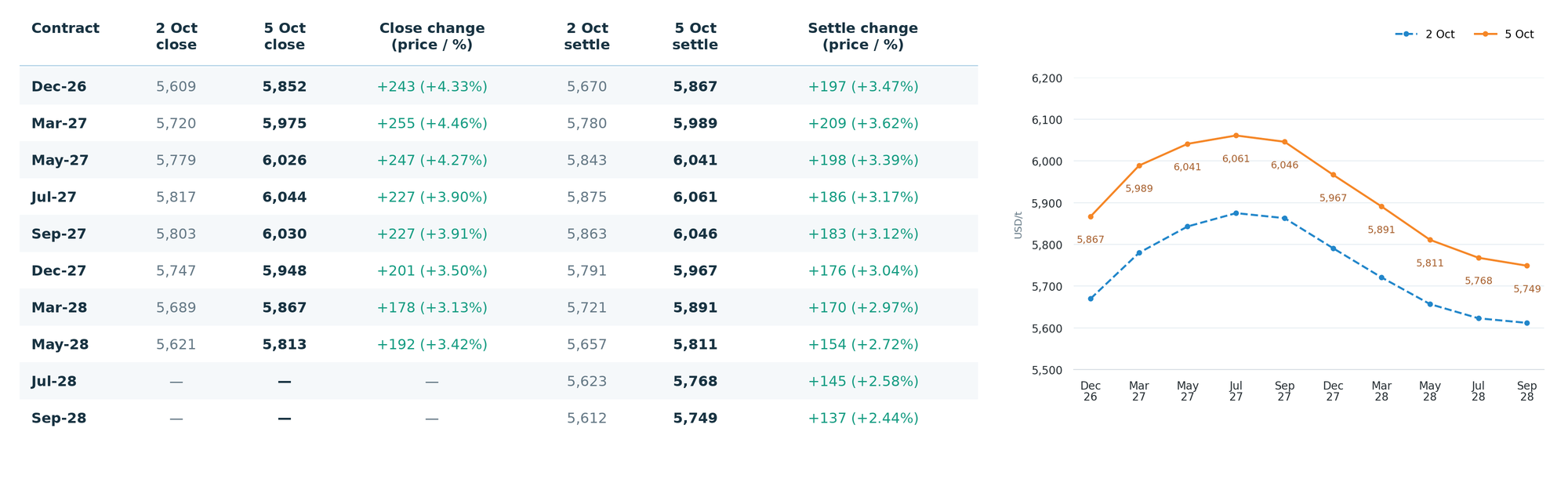
New York advanced across all eight available last-traded closes on Monday, 5 October. December closed at $5,852/t, up $243 (+4.33%), finishing above Friday’s $5,781 high and just $56 below Monday’s $5,908 high. The close in the upper 16% of its $341 range showed that buyers retained substantially more of the advance than on Friday. March 2027 led the principal maturities with a 4.46% closing gain. Far-dated trading remained thin, with only 25 contracts changing hands in May 2028.
The settlement curve rose across all ten maturities, with December settling at $5,867, up $197 (+3.47%), and July 2027 remaining the peak at $6,061. Calendar spreads gave a mixed signal: Dec/Mar contango widened from $110 to $122/t, while Dec/Jul narrowed from $205 to $194 and Dec/Sep from $193 to $179. December therefore strengthened relative to summer and early-autumn delivery, although March outperformed the nearby contract. The recovery gained support from firmer closing prices and partial spread tightening, while the substantial premium for mid-2027 delivery remained intact.
London cocoa
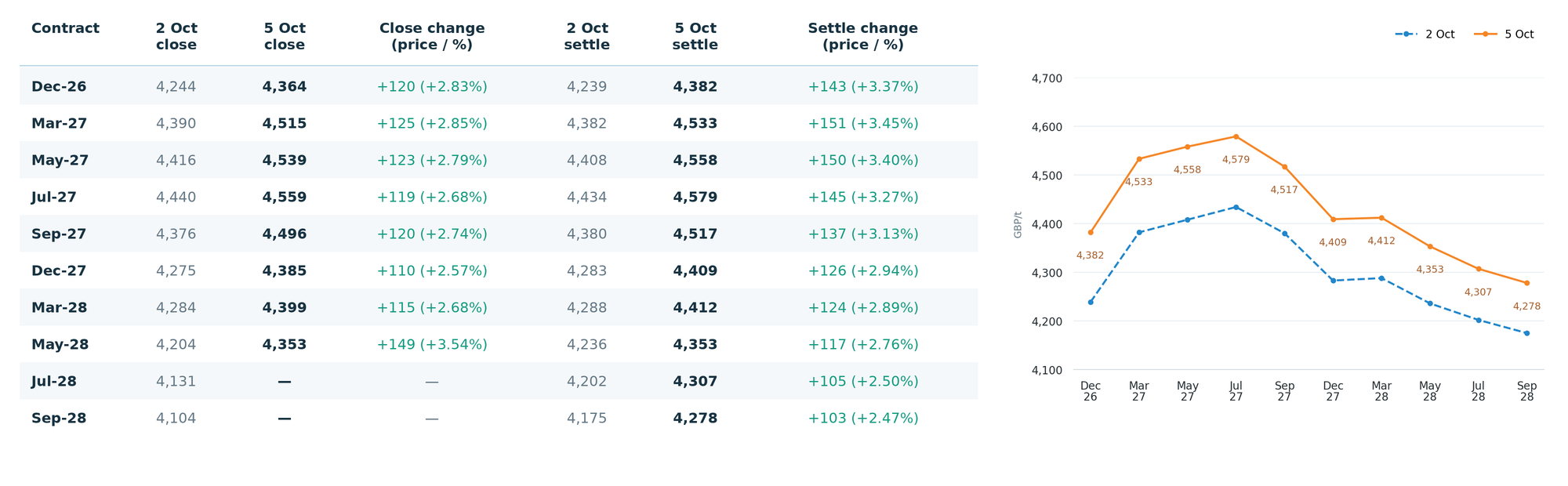
London also rose across all eight available last-traded closes. December closed at £4,364/t, up £120 (+2.83%), above Friday’s £4,296 high. It finished £64 below Monday’s £4,428 high, around the upper quarter of its £253 trading range. Buyers established a higher closing level, although New York retained more of its session’s advance. May 2028 recorded the largest closing gain at 3.54%, but turnover of only 59 contracts limits the significance of that far-dated move.
All ten official settlements increased, with December settling at £4,382, up £143 (+3.37%), and July 2027 retaining the curve’s peak at £4,579. Dec/Mar contango widened from £143 to £151/t and Dec/Jul from £195 to £197, while July’s premium over September increased from £54 to £62. The rally therefore preserved a substantial premium for March–July delivery, with little improvement in December’s position against those contracts. London’s higher outright prices were constructive, but the curve showed more strength around mid-2027 than a broad tightening led by nearby supply.
NY–London Dec-26 Spread
| Contract | NY close 5 Oct | London close 5 Oct | Spread 5 Oct ($/t) |
|---|---|---|---|
| Dec-26 | $5,852 | £4,364 | +$83.66 |
| Mar-27 | $5,975 | £4,515 | +$7.07 |
| May-27 | $6,026 | £4,539 | +$26.35 |
| Jul-27 | $6,044 | £4,559 | +$17.91 |
| Sep-27 | $6,030 | £4,496 | +$87.19 |
| Dec-27 | $5,948 | £4,385 | +$151.91 |
| Mar-28 | $5,867 | £4,399 | +$52.40 |
| May-28 | $5,813 | £4,353 | +$59.20 |
$5,852 − (£4,364 × 1.3218) = +$83.66/t.
New York December moved from an $11.33/t discount on Friday to an $83.66/t premium on Monday, an improvement of $94.99/t. At Friday’s exchange rate, the futures-price changes alone added $84.08/t: New York gained $243, while London’s £120 increase equated to $158.92. Sterling’s decline from 1.3243 to 1.3218 lowered London’s dollar-equivalent value by another $10.91/t, reinforcing New York’s relative gain.
New York strengthened relative to London across all eight comparable maturities. March, May and July 2027 moved from discounts into premiums of $7.07, $26.35 and $17.91/t, respectively. The improvement was concentrated in December 2026 through May 2027, where spreads increased by approximately $95–101/t. May 2028 improved by only $5.56/t, with weaker sterling offsetting a small deterioration on the futures-price component. Its turnover of 25 contracts in New York and 59 in London also warrants less weight than the actively traded maturities.
Volume and Open Interest
New York cocoa
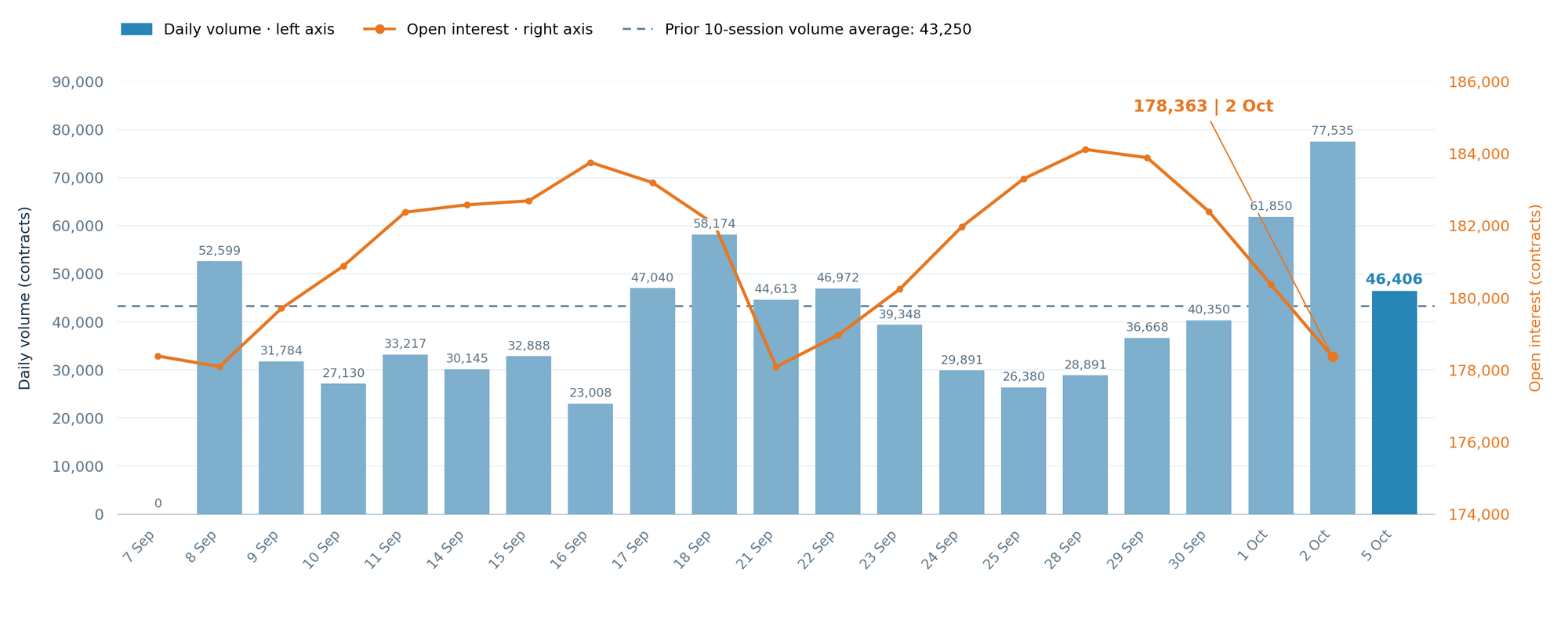
New York turnover fell to 46,406 contracts on Monday, 5 October, down 40.1% from Friday’s 77,535, but 7.3% above the preceding 10-session average of 43,250. December’s 4.33% closing gain therefore came with moderate volume confirmation, as activity eased from Friday’s surge while remaining above its recent benchmark. Further gains accompanied by renewed volume expansion would add conviction to the recovery.
Open interest fell 2,008 contracts (−1.11%) to 178,363 on 2 October, its fourth consecutive decline and 5,753 contracts below 28 September. Friday’s 2.96% December closing gain therefore occurred alongside net position reduction, a combination consistent with position unwinding, including possible short covering. The next reading will test whether Monday’s stronger advance attracted additional outstanding positions. Rebuilding exposure alongside higher prices would strengthen the continuation case; further contraction would leave position unwinding as a plausible contributor to the advance.
London cocoa
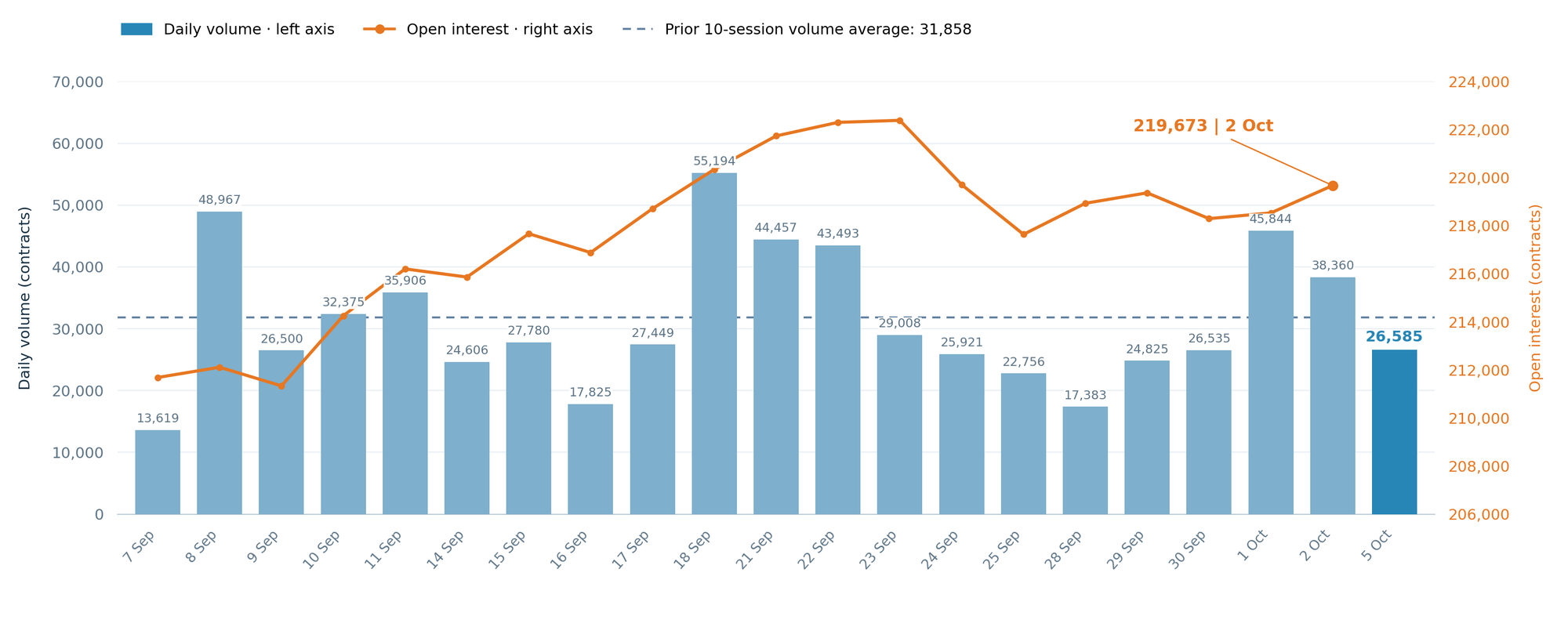
London turnover declined to 26,585 contracts on Monday, down 30.7% from Friday’s 38,360 and 16.6% below the preceding 10-session average of 31,858. December’s 2.83% closing gain consequently had weaker volume confirmation than New York’s advance. The recovery continued, but the below-average turnover indicates that Monday’s higher prices attracted comparatively restrained participation.
Open interest increased 1,140 contracts (+0.52%) to 219,673 on 2 October, its second consecutive rise and 2,033 contracts above 25 September. Friday’s 5.26% December closing gain coincided with net creation of outstanding paired positions, offering firmer evidence of expanding exposure than New York’s contraction. Further price gains accompanied by continued OI growth would strengthen participation behind the recovery, while Monday’s lighter turnover leaves the latest advance less convincingly supported by trading activity.
ICE Cocoa Stocks
| Market | Stock measure | Previous update | Latest update | Change | Change % |
|---|---|---|---|---|---|
| US | Total stocks in ICE-licensed warehouses | 3,500,581 bags | 3,525,434 bags | +24,853 bags | +0.71% |
| US | Certified stocks, included in warehouse total | 423,725 bags | 423,725 bags | 0 | 0.00% |
| London / Europe | Valid-warrant stocks, 64-kg bag equivalents | 1,185,313 | 1,194,219 | +8,906 | +0.75% |
U.S. warehouse holdings increased by 24,853 bags (+0.71%) on Monday, 5 October, to 3,525,434 bags. Certified stocks remained unchanged at 423,725 bags, representing 12.0% of total holdings. Pending grading rose by 8,676 bags to 55,956, while passed grading remained at 1,740. The larger grading queue could expand the certified pool, subject to successful grading. Since 25 September, warehouse holdings have increased by 92,678 bags (+2.70%), strengthening the inventory buffer against weaker origin supply.
London’s latest supplied report, dated 2 October, showed valid-warrant stocks increasing by 570 tonnes (+0.75%) from the 1 October reading to 76,430 tonnes—approximately 1,194,219 bag equivalents. The increase was concentrated in Antwerp. Perpetual-valid warrants rose by 17 standard delivery units and four large delivery units, sized at 10 and 100 tonnes respectively, accounting for the full increase. Expired warrants declined, while the total number of warehouse receipts remained unchanged. These category changes are consistent with existing warrants being revalidated, increasing the stock eligible for exchange delivery.
Tuesday Trading Setup — ICE Futures U.S. Cocoa December 2026
Tuesday’s bias remains constructive while December holds $5,775–$5,800, around the calculated daily pivot of $5,776 and Monday’s hourly VWAP. Price has reclaimed its daily 21-period moving average and stands above the rising hourly 9- and 21-period averages, with positive hourly MACD, firmer OBV and improving daily momentum supporting the recovery. However, elevated hourly oscillators, softening five-minute MACD and contracting intraday ranges make an initial consolidation or controlled pullback plausible. Immediate resistance is $5,900–$5,910. An hourly close above that zone, followed by a successful retest, would strengthen the continuation case towards $5,980–$6,000, encompassing calculated R1 at $5,984 and psychological resistance. Sustained acceptance above $6,000 would bring $6,110–$6,120 into focus, encompassing calculated R2 at $6,117 and earlier September resistance.
A pullback that holds $5,775–$5,800 and establishes a higher low would preserve the recovery. An hourly break below $5,775, followed by a failed reclaim, would favour retracement towards $5,700–$5,660, where the hourly moving averages and previous consolidation provide the next support area, followed by $5,643, calculated S1. Losing that support would expose Monday’s low near $5,567; a break below the low would materially weaken the recovery and reopen $5,435, calculated S2 near the broader rising-channel boundary. The key distinction for Tuesday is whether buyers defend the first pullback or allow the recent breakout to unwind.