Cocoa Pulls Back Despite Persistent Crop Risks (6 October 2026)


New York December cocoa retreated on Tuesday, 6 October, after failing to extend Monday’s rally. The contract opened at $5,790/t and briefly reached $5,889, approximately 0.63% above Monday’s close, before selling pushed prices back through $5,800. Subsequent recoveries faded, and the decline extended to $5,670, down 3.11% from Monday. Late buying lifted prices towards $5,760, leaving the last-traded close at $5,762/t, down $90 (−1.54%).
December finished $92 above its low, in the lower half of its $219 daily range. The range remained entirely inside Monday’s and narrowed by 35.8%, showing a retracement within the preceding session’s advance. The official settlement fell $167 (−2.85%) to $5,700/t, while London December closed £114 lower (−2.61%) at £4,250/t. Buyers cushioned the late decline but could not sustain Monday’s upward momentum.
Ecuador exporter warns of a potential 100,000-tonne cocoa production loss
Ecuador’s cocoa production could fall by 100,000 tonnes because of El Niño-related disruption, exporter and former ANECACAO president Iván Ontaneda said in an interview published by El Comercio on 5 October and reported by Reuters on 6 October. He identified flooding in Guayas, Los Ríos—including Babahoyo and Montalvo—and low-lying areas of Manabí as the main harvest began in September. Excess humidity threatens bean quality through mould and disease, complicating export preparation and contract fulfilment. Ontaneda expects the largest production impact in early 2027.
The warning extends the supply concern beyond West Africa: Ecuador faces excessive moisture while Ivorian growers are struggling with insufficient rainfall. Lower Ecuadorian output or deteriorating export quality could constrain alternative supplies as buyers assess the weaker Ivorian crop outlook. However, the 100,000-tonne figure remains Ontaneda’s estimate. ANECACAO told Reuters that it was too early to forecast the impact, leaving subsequent field assessments and export-quality readings as important tests of the projected loss.
Ouedraogo reports sharp growth in Ivorian cocoa-product exports
Côte d’Ivoire’s cocoa-product exports increased unevenly in September, according to government figures cited by Ousmane Attai Ouedraogo. He reported year-on-year growth of 103.56% in cocoa paste and 25.72% in chocolate and other cocoa-derived products, while cocoa butter declined 0.9%. He also cited a 109.74% increase in cumulative cocoa-powder exports, although the post did not specify the cumulative reporting period. “With the exception of cocoa butter, all major processed cocoa products posted significant growth,” Ouedraogo wrote.
The contrast with subdued new-season bean arrivals puts greater attention on inventories and shipment timing. Processors can export products manufactured from previously acquired beans, allowing strong outward shipments to coexist with slow replenishment at origin. Butter’s weaker performance also suggests that the increase was uneven across the product complex.
Cargill’s quarterly earnings decline includes cocoa valuation losses
Bloomberg reported on 5 October that Cargill’s net income fell to $927 million in the quarter ended 31 August, from $1.94 billion a year earlier—a decline of approximately 52%. Accounts reviewed by Bloomberg identified cocoa mark-to-market losses alongside pressure from higher cattle costs. The previous year’s result also benefited from a tax provision, making the annual comparison unusually demanding. Cargill declined to comment.
The cocoa losses highlight the financial exposure created by sharp price movements across procurement, inventories and product sales. Bloomberg also described a slow recovery in demand in key consuming markets after the earlier period of high prices. Together, these pressures show why stronger bean prices can coexist with difficult processing economics: purchasing costs, finished-product pricing and inventory valuations adjust at different speeds.
Indonesia links agroforestry finance with JB Cocoa purchasing arrangements
Indonesia’s environmental fund, BPDLH, signed a memorandum of understanding with JB Cocoa and Rainforest Alliance in Jakarta on 6 October. The partnership connects revolving finance for social-forestry and agroforestry businesses with commercial purchasing arrangements. BPDLH will provide financing, JB Cocoa will act as a buyer of community production, and Rainforest Alliance will support sustainable farming practices, producer capacity and value-chain development.
The structure addresses two connected obstacles for smaller producers: access to finance and access to dependable buyers. Linking lending with technical support and purchasing channels could improve the commercial viability of participating farms and strengthen organised sourcing.
Côte d’Ivoire’s opposition calls for closer oversight of cocoa marketing
Côte d’Ivoire’s opposition PDCI-RDA proposed stronger cocoa-market oversight at a press conference on 6 October. Spokesperson Bredoumy Soumaïla argued that the purchasing-price gap with Ghana increased the risks of cross-border bean diversion, pressure on domestic processors and lost fiscal receipts. The party called for an Agriculture Ministry monitoring unit tracking prices and stocks daily, closer scrutiny of regulatory budgets, regular audits of sector levies and changes to how earnings are distributed to producers.
The proposals add political pressure to the debate over producer remuneration and the functioning of the marketing system. Better visibility over prices, inventories and marketed flows could help distinguish crop weakness from changes in where beans are sold. These remain opposition proposals; their practical significance will depend on the government’s response.
Malaysia detains a Ugandan cocoa shipment over documentation concerns
Malaysia’s Border Control and Protection Agency detained cocoa beans valued at RM11.8 million at Pasir Gudang Port on 3 October, citing incomplete and suspicious documentation. Bernama first reported the agency’s statement on 5 October, with further coverage appearing on 6 October. The Ugandan consignment was held for investigation after discrepancies were identified during inspection.
The detention interrupts clearance of the affected shipment and illustrates how documentation problems can delay access to purchased beans. For suppliers and processors, consistency between cargo declarations, supporting documents and import requirements remains important to maintaining delivery schedules.
Futures Performance
New York cocoa
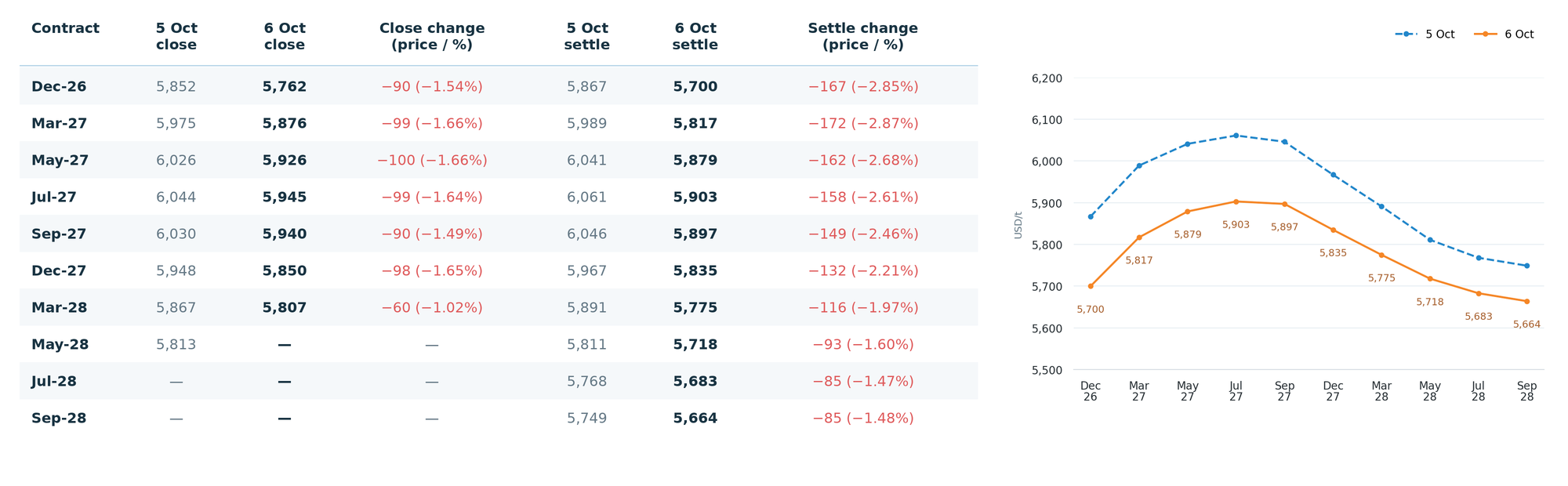
New York declined across all seven available last-traded closes on Tuesday, 6 October. December closed at $5,762/t, down $90 (−1.54%), giving back approximately 37% of Monday’s $243 advance. March and May 2027 each fell 1.66%. December traded between $5,670 and $5,889 and finished in the lower half of its range, showing that Monday’s recovery had lost momentum while retaining part of its gains.
The settlement curve fell across all ten maturities, with December settling at $5,700, down $167 (−2.85%). Calendar-spread performance was mixed: Dec/Mar contango narrowed from $122 to $117/t, but Dec/Jul widened from $194 to $203/t and Dec/Sep from $179 to $197/t. July 2027 remained the curve’s peak at $5,903. December’s modest relative improvement against March did not extend to the summer contracts, leaving the recovery without broad confirmation from nearby pricing.
London cocoa
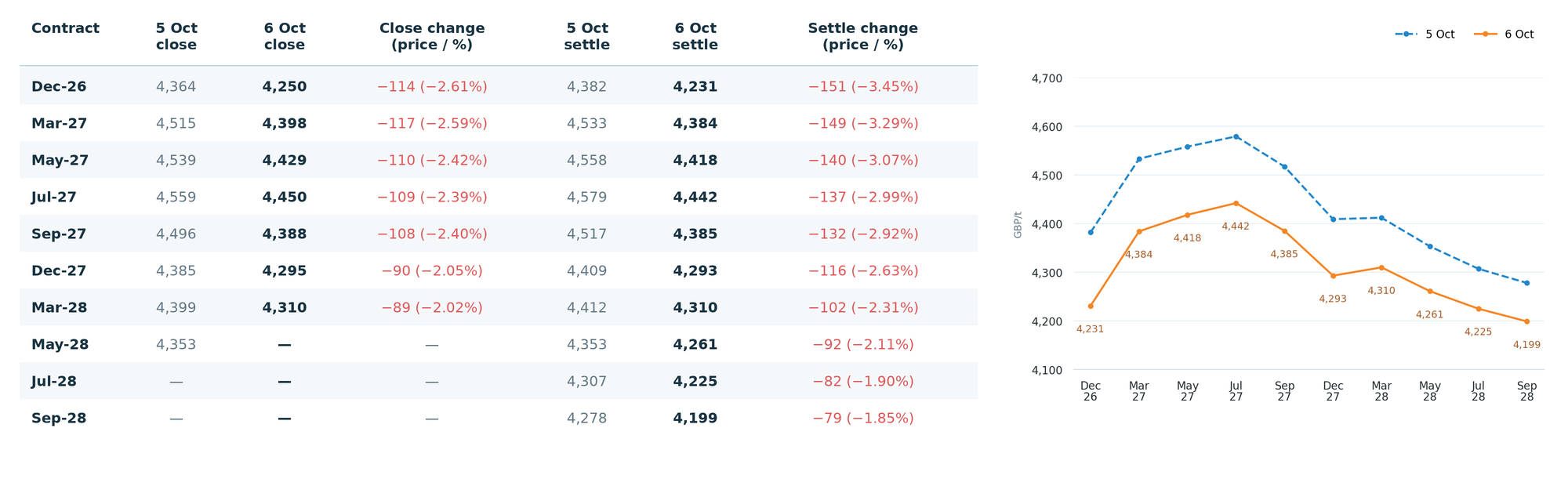
London also declined across all seven available last-traded closes. December closed at £4,250/t, down £114 (−2.61%), a sharper decline than New York’s nearby contract. Its £4,205–£4,393 range ended with the close just £45 above the low, in the bottom quarter of the session’s range. The weaker finish showed greater pressure on nearby London cocoa, while March through September 2027 lost approximately 2.4–2.6%.
All ten settlements moved lower, with December settling at £4,231, down £151 (−3.45%). Dec/Mar contango widened from £151 to £153/t, Dec/Jul from £197 to £211/t and Dec/Sep from £135 to £154/t. July 2027 remained the curve’s peak at £4,442. London’s retracement therefore weakened both outright prices and nearby relative pricing. The smaller declines in May–September 2028 settlements provide limited evidence of deferred buying interest, with only three contracts traded across those maturities.
NY–London Dec-26 Spread
| Contract | NY close 6 Oct | London close 6 Oct | Spread 6 Oct ($/t) |
|---|---|---|---|
| Dec-26 | $5,762 | £4,250 | +$119.70 |
| Mar-27 | $5,876 | £4,398 | +$37.22 |
| May-27 | $5,926 | £4,429 | +$46.06 |
| Jul-27 | $5,945 | £4,450 | +$37.18 |
| Sep-27 | $5,940 | £4,388 | +$114.49 |
| Dec-27 | $5,850 | £4,295 | +$147.96 |
| Mar-28 | $5,807 | £4,310 | +$85.04 |
$5,762 − (£4,250 × 1.3276) = +$119.70/t.
New York December’s premium widened to $119.70/t on Tuesday, 6 October, from $83.66/t on Monday, an increase of $36.04/t. New York fell $90 while London declined £114. At Monday’s exchange rate, those futures-price changes would have widened the premium by $60.69/t. Sterling’s appreciation from 1.3218 to 1.3276 increased London’s dollar-equivalent value, offsetting $24.65/t of that improvement. The wider premium therefore reflects New York’s smaller retracement, with currency movements moderating its relative gain.
New York strengthened relative to London across six of the seven comparable maturities. March, May and July 2027 premiums widened to $37.22, $46.06 and $37.18/t, respectively, while September reached $114.49/t. December 2027 was the exception: its premium narrowed by $3.95 to $147.96/t, as sterling’s appreciation outweighed New York’s relative resilience on the futures-price component. The broad improvement shows firmer relative pricing in New York during Tuesday’s decline, although both markets lost ground outright.
GBP/USD: 1.3276 for 6 October from Investing.com’s historical table; Monday’s published 1.3218 rate retained. Comparisons use last-traded closes, which are not necessarily simultaneous with each other or the FX observation.
Volume and Open Interest
New York cocoa
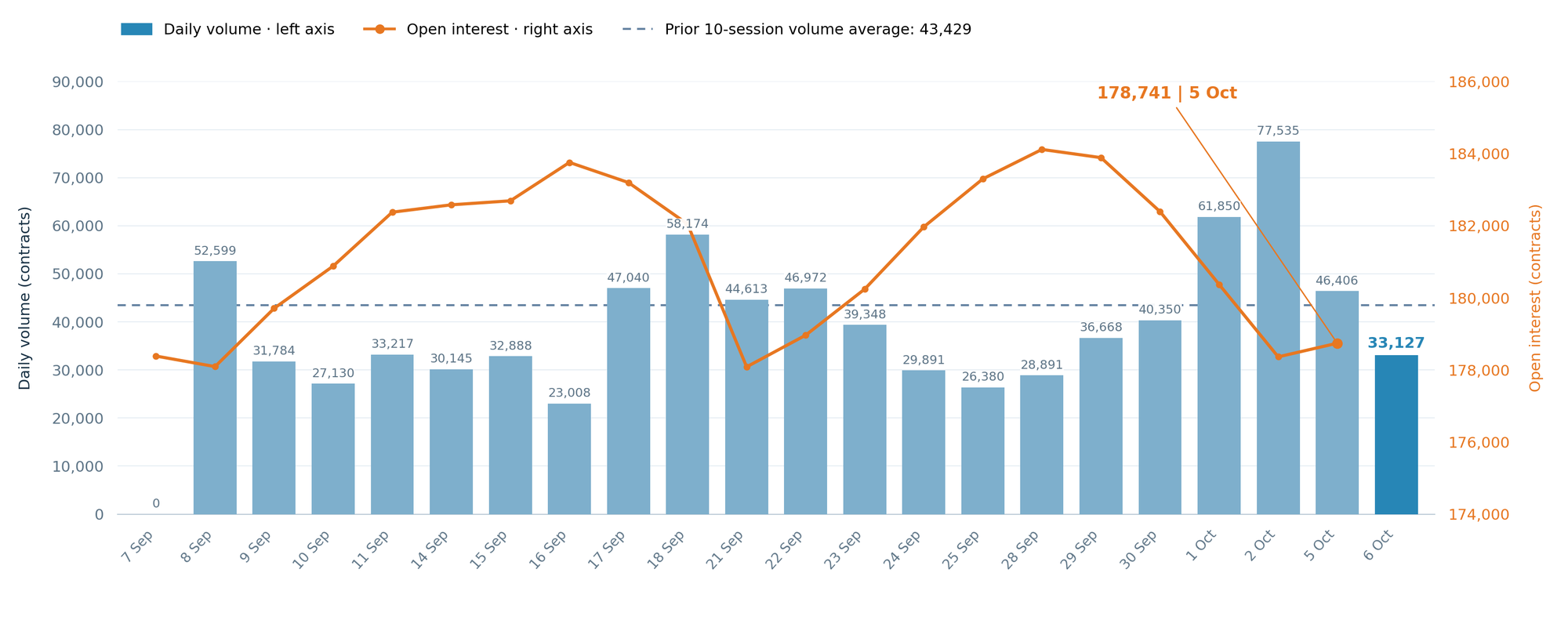
New York turnover fell to 33,127 contracts on Tuesday, 6 October, down 28.6% from Monday’s 46,406 and 23.7% below the preceding 10-session average of 43,429. December’s 1.54% closing decline therefore occurred with substantially lighter participation. The retracement lacked the volume expansion that would provide stronger confirmation of sustained selling pressure, while the price reversal showed that Monday’s recovery had lost momentum.
Open interest increased 378 contracts (+0.21%) to 178,741 on 5 October, ending four consecutive declines. Monday’s 4.33% December gain consequently coincided with modest net creation of outstanding positions, showing that exposure began to rebuild as prices rose. OI nevertheless remained 5,375 contracts below 28 September, so the latest confirmed rebuilding was limited. Higher prices accompanied by further OI growth would strengthen participation behind the recovery; an advance accompanied by renewed OI contraction would leave position unwinding as a plausible contributor.
London cocoa
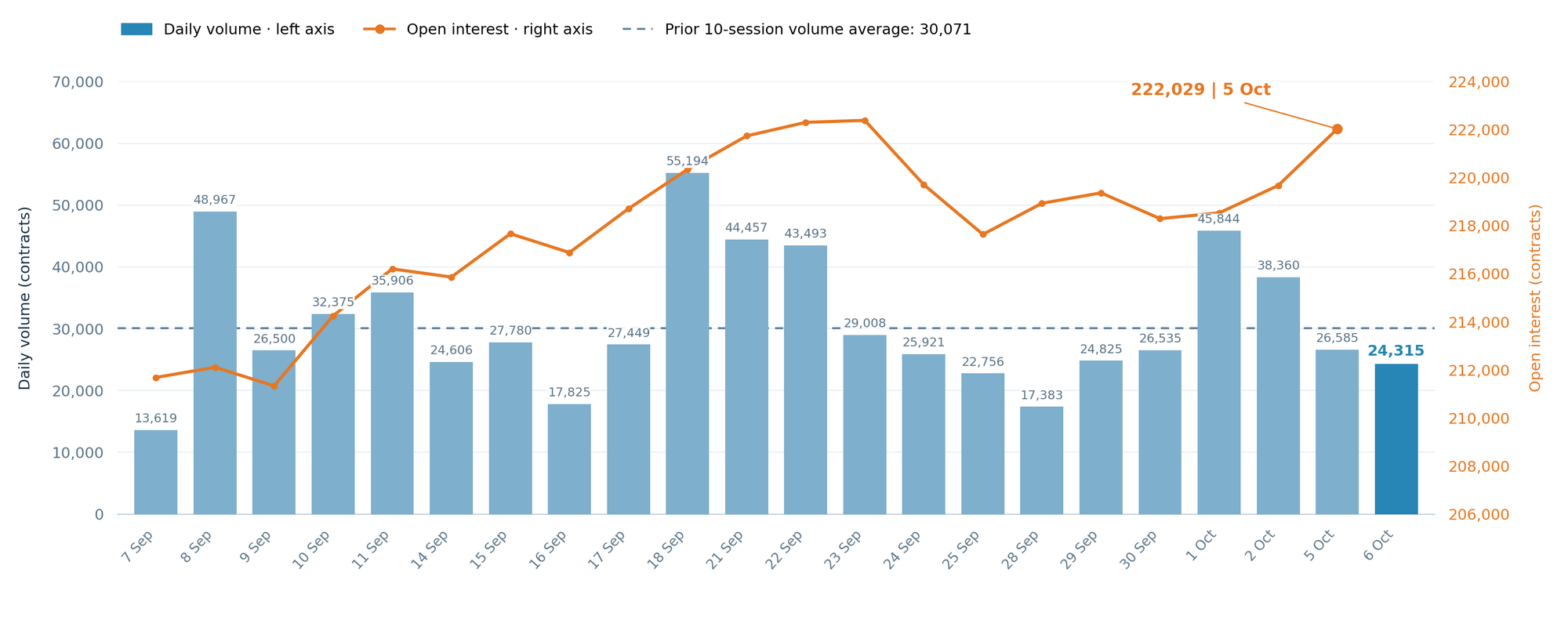
London turnover declined to 24,315 contracts on Tuesday, down 8.5% from Monday’s 26,585 and 19.1% below the preceding 10-session average of 30,071. December’s sharper 2.61% closing decline came with below-average activity, giving the sell-off restrained volume confirmation. London weakened more than New York in price terms, but neither market recorded an expansion in turnover behind Tuesday’s retreat.
Open interest rose 2,356 contracts (+1.07%) to 222,029 on 5 October, its third consecutive increase and a cumulative gain of 3,734 contracts since 30 September. Monday’s 2.83% December advance therefore coincided with a more substantial expansion in outstanding paired positions than in New York. Tuesday’s reversal now tests a recovery that had been attracting fresh exposure. A return to higher closes alongside continued OI growth would support renewed momentum; further weakness would increase the importance of whether that expanded exposure remains in place or begins to unwind.
ICE Cocoa Stocks
| Market | Stock measure | Previous update | Latest update | Change | Change % |
|---|---|---|---|---|---|
| US | Total stocks in ICE-licensed warehouses | 3,525,434 bags | 3,538,981 bags | +13,547 bags | +0.38% |
| US | Certified stocks, included in warehouse total | 423,725 bags | 423,725 bags | 0 | 0.00% |
| London / Europe | Valid-warrant stocks, 64-kg bag equivalents | 1,194,219 | 1,194,063 | −156 | −0.01% |
U.S. warehouse holdings increased by 13,547 bags on Tuesday, 6 October. Certified stocks remained unchanged at 423,725 bags, representing 12.0% of total holdings. Pending grading rose by 10,877 bags (+19.4%) to 66,833, entirely through additional Ecuadorian cocoa, while passed grading remained at 1,740 bags. The growing queue could expand the certified pool following successful grading and certification. Total warehouse holdings have increased by 106,225 bags (+3.09%) since 25 September, strengthening the inventory buffer against weaker origin supply.
London’s latest supplied observation, dated 5 October, showed valid-warrant stocks declining by 10 tonnes from 2 October to 76,420 tonnes—approximately 1,194,063 64-kg bag equivalents. At Antwerp, perpetual-valid standard warrants fell by one while expired warrants increased by one. Other categories and the total receipt count remained unchanged. These changes are consistent with a 10-tonne warrant expiring; they do not indicate a net physical withdrawal from warehouses.
Wednesday Trading Setup — ICE Futures U.S. Cocoa December 2026
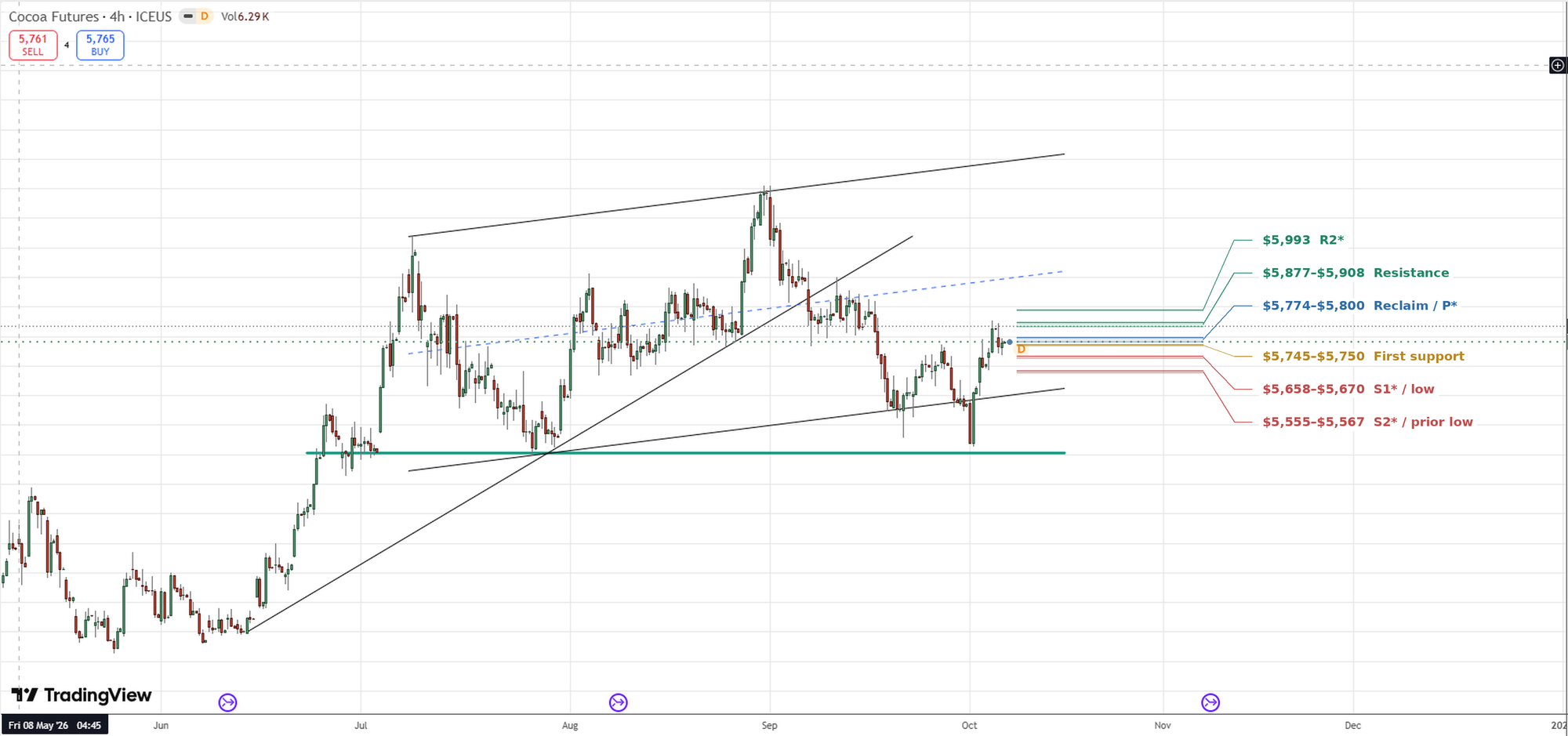
Wednesday’s immediate decision area is $5,745–$5,800, where Tuesday’s late recovery meets the hourly moving averages and the calculated pivot at $5,774. Price recovered above its rising hourly 21-period average, but hourly MACD remains below its signal and OBV below Monday’s peak. Elevated five-minute stochastic readings and contracting ATR make initial consolidation plausible. An hourly close above $5,774, followed by sustained acceptance above $5,800, would strengthen the rebound towards $5,877–$5,908, encompassing calculated R1 and the latest two session highs. Clearing $5,908 would bring $5,993–$6,000 into focus, around R2 and psychological resistance.
Failure to hold $5,745–$5,750, followed by a failed reclaim of the pivot, would shift attention towards $5,658–$5,670, combining calculated S1 with Tuesday’s low. The daily 21-period and hourly 200-period averages provide additional support around that area, making it the more important test of the recovery. An hourly close below $5,658 followed by a failed recovery above $5,670 would favour a deeper retracement towards $5,555–$5,567, encompassing calculated S2 and Monday’s low. Holding the first support zone and reclaiming $5,800 would preserve the recovery; losing it would materially weaken that structure.